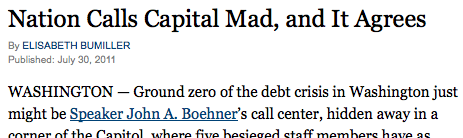
On the radar: “Mad,” “Nutter”

From the New York Times, July 31, 2011

For some reason, adjectives indicating mental instability have always been a key marker of difference between American and British English. We have crazy  and insane; they have mad and daft. Does the New York Times article above indicate a meeting of the minds on mad, or merely that headline writers really like short words? Only time will tell.

Moving on to nouns, I’ve always felt the U.K. nutter is more expressive than our nut, and in recent years have wondered what U.K. visitors to Philadelphia (near which I live) think when they discover that it’s governed by a Mayor Nutter. Predictably, I enjoyed this quote from a recent Reuters article on the Murdoch scandals:

“We used to talk to career criminals all the time. They were our sources,” says another former reporter from the paper who also worked for Murdoch’s daily tabloid, the Sun. “It was a macho thing: ‘My contact is scummier than your contact.’ It was a case of: ‘Mine’s a murderer!’ On the plus side, we always had a resident pet nutter around in case anything went wrong.”

My pulse quickened some months ago when the PBS program “Frontline” posted Wikileaks leaker Bradley Manning’s Facebook status updates, including this from September 4, 2009: “Thinks Cambridge, Massachusetts is full of crazy (but fun) nutters.” But it turns out that Manning’s mother is from Wales and he spent much of his adolescence in that country.

However, I haven’t given up hope on the nutter front and was very pleased to read this yesterday in John Nichols’ blog at The Nation:

But it is becoming all too clear that the “right-wing nutter” fantasy that the debt-ceiling debate could be gamed for political points is crashing into the prospect of a “crunching global recession.”

So far, no sightings of daft.

“Journo”

The OED reports that this diminutive for journalist originated in Australia in the 1960s, migrating to the UK no later than 1984, when this ominously prescient quote appeared in The Listener: “Rupert Murdoch once said, if the journos don’t like it they can always get out; there are plenty more journos on the street.”

The atmosphere was animated and perhaps a little self-satisfied—the New Hampshire primary is tremendous fun, and journos and politicos alike are always tickled to be part of it—but of boisterousness there was none. (Hendrik Hertzberg, The New Yorker, blog, January 8, 2008)/It’s been nearly a year since the release of UFOs: Generals, Pilots and Government Officials Go on the Record, journo Leslie Kean’s attempt to steer The Great Taboo into the arena of mainstream debate. (Sarasota Herald-Tribune, blog, July 29, 2011)

Delicious kerfuffle

Something that originally got me interested in NOOBs was its contrarianness: the way it balanced the conventional notion of Americanisms flooding into British English. Indeed, complaints about creeping Americanisms have been aired in Britain for at least two hundred years. The events of the last week have shown that resentment has not diminished in the slightest.

It started with an article in the BBC’s online magazine by journalist Matthew Engel, which opened this way:

I have had a lengthy career in journalism. I hope that’s because editors have found me reliable. I have worked with many talented colleagues. Sometimes I get invited to parties and meet influential people. Overall, I’ve had a tremendous time.

Lengthy. Reliable. Talented. Influential. Tremendous.

All of these words we use without a second thought were never part of the English language until the establishment of the United States.

This was right in the wheelhouse of University of Pennsylvania linguist Mark Liberman, who summarily demonstrated in a post for Language Log–the invaluable blog he curates–that four of the five words were not Americanisms at all. (The exception is lengthy.) Liberman:

The Oxford English Dictionary cites reliable as in regular British use for more than two centuries before the establishment of the United States. The first citation for talented, in the relevant sense, is from Edward Bulwer-Lytton, a quintessentially and even parodically British writer. The relevant sense of influential was first used by Roger North, who spent all of his 83 years in England, and died more than 40 years before the American revolution. The OED’s first citation for tremendous in the “extraordinarily great” sense is from the English poet Robert Southey.

It gets better. The BBC invited readers to send in their choice for the most objectionable “Americanism,” and in just one day got 1295 responses: so many, and so filled with fury, that the Beeb stopped taking new ones. They then created an article from “50 of your most noted examples,” and even now, two and a half days after the post, it is the most e-mailed story on the BBC site. The top 50 make for diverting reading. One reader nominated eaterie (which I always thought was spelled eatery) and commented, only, “Oh my gaad!” Another noted, “The one that always gets me is the American need to use the word bi-weekly when fortnightly would suffice just fine.” I guess. Ross from London shared, “I hear more and more people pronouncing the letter Z as “zee”. Not happy about it!” Predictably, my favorite comment was: “What kind of word is “gotten”? It makes me shudder.”

This time, it was The Economist’s pseudonymous “Johnson” blogger that had the rejoinder, pointing out that many of these so-called Americanisms, too, were as British as steak and kidney pie: including oftentimes, wait on (to mean “wait for”) and physicality. Johnson wisely noted that a remarkable number of the entries “share one or more of these features”:

1) selective hyper-literalism: refusal to understand idioms as such

2) amnesia, or else the ” recency illusion“: A belief that something quite old is new

3) simple anti-Americanism: the belief that if something is ugly, it must have come from the States

To which I would add the idea that if you don’t like something, it is vile, evil, and/or a mistake.

“Have a look”

The singer Charlotte Church, who commented, "I happened to find myself desperate for a wee with the toilet cubicles all occupied."

British equivalent of the American take a look. There seems to be a British fondness for verbal idioms that start with have a–for example, have a go at it (U.S.: give it a try); Are you having a laugh? (the Ricky Gervais’ character’s catch phrase on the TV show “Extras”); and this headline from NOW Magazine: “Charlotte Church: I was having a wee, not sex in embarrassing snaps.” (To make sense of this quote, insert comma after “sex” and know that “snaps” means “photographs” in British tabloid English.)

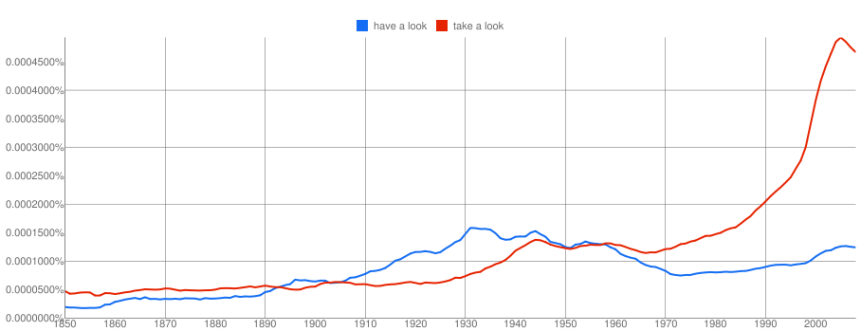
A Google Ngram of American use of have a look (blue line) and take a look (red line) from 1850-2008 shows they were more or less equally popular until about 1960, when have dropped and take took off. Like many Britishisms, the American use of  have a look has steadily and significantly increased in since roughly 1980.

Devotees of Candace Bushnell–a journalist who looks like Suzanne Somers with a polo-club membership–approach her writing the way they might a car wreck or a Peter Greenaway movie: they know it might repel, but they are forced to have a look. (Ginia Bellafante, Time, August 12, 1996)/Complex date calculations aside, we will have a look at a handful of the companies who have withstood the test of time, both at home and abroad. (San Francisco Chronicle, July 18, 2011)

On the radar: “Pants”

The Boston Globe has an amusing piece today about the different American and British meanings for pants: “trousers” here and “underpants” there. No sign yet of the Britishism getting any traction in these parts. If that does ever happen, it will kick the venerable expression “keep your pants on” up a few notches.

American pants and British pants, all in one picture!

“DIY”

Sometimes verb; more often adjective. Acronym for “do-it-yourself.”

Google Ngram shows roughly a doubling of American use since 1990 (with a bump presumably associated with the launch of the DIY Channel on cable television in 1999):


American use of "DIY," 1990-2008

DIY also increased in Britain in this period, from about double U.S. use to triple–demonstrating, I suppose, the transatlantic power of cliched catchphrases.

Owen Wilson, not yet a bankable movie star, and Jackie Chan, not ready for retirement, return for a second round of D.I.Y. stunts and business-casual wisecracks in this sequel to “Shanghai Noon.” (The New Yorker, March 3, 2003)/Indie-minded artists, storytellers and comics creators have banded together to form a pop-up space called “Tr!ckster” that will celebrate the spirit of DIY and creator-owned work. (Los Angeles Times, June 21, 2011)

“Shite”

Excrement; shit.  I have always thought of this word as having a strong Irish association, though the OED is silent on the subject. In the U.S., it is used exclusively metaphorically, that is, to mean that something is worthless, offensive or contemptible. One definition on Urban Dictionary recognizes shite‘s slightly euphemistic quality, calling it “the best way to say ‘shit’ without getting told off, as you can simply say that you were trying out being Irish for the day. ”

And [former New York Times Editor Howell] Raines all but comes out and writes that his predecessor, Joseph Lelyveld, produced shite. (Jack Shafer, Slate, March 24, 2004)/“We’re getting hammered by everything right now,” says Bert the Bug Man (a.k.a. Bert Bertrand, a licensed exterminator). “Smoky brown tree roaches are coming out of the sewer lines to hang in people’s foliage because people are trying to keep their plants alive.” So we’re not producing enough shite in this drought?? (Houston Post, blog post, June 21, 2011)

On the radar: “Journey”

The London Tube's website features a "Journey Planner"

As I realized when I first looked at London tube maps, in British English, journey basically means trip. In American English, the word is almost always used either metaphorically or to refer to a really long and momentous trip–journey though life, journey into terror, journey to the center of the earth, etc.

Are we starting to adopt the British use? Well, maybe. Megabus–a Canadian-owned company, admittedly–is big on journey. (They also ask for the expiry, rather than expiration, date on your credit card.) And an item in the June 3 Hattiesburg (Mississippi) American notes, “TripIt is one of many apps that helps you organize your journey.” (Possibly the writer was using elegant variation to try to avoid repeating trip.)

Meanwhile, perhaps British use is changing as well. I note that the new Steve Coogan film about a journey (literal and figurative) he takes with his buddy is called “The Trip.” Stay tuned.

Pretty funny

One of my Facebook friends posted this, or should I say one of me Facebook mates. Click the graphic to see the whole thing.

Puts me in mind that I’ve noticed my (college-age) children facetiously using me=my. Possibly they are taking it from Popeye rather than working-class Britain. In any event it is now officially on the radar.