“Go pear-shaped”

Reader Priscilla Jensen alerts me to this from the November 7 Wall Street Journal: “But [Barack Obama’s] opportunity will quickly go pear-shaped if the bond market loses confidence . . . ”

Unfamiliar with this metaphorical pear-shaped, I went to the OED and was informed that the expression, usually preceded by to go or to turn, is chiefly British and originally RAF slang, and means “to go (badly) wrong, to go awry.” The dictionary offers no etymological explanation as to why the metaphor would have this meaning, and I would be interested in any thoughts on the matter. In any event, the first citation is from a 1983 book called Air War South Atlantic and has telltale quotation marks: “There were two bangs very close together. The whole aircraft shook and things went ‘pear-shaped’ very quickly after that.

The first use of go pear-shaped or went pear-shaped in the Lexis-Nexis database of U.S. newspapers is a 1999 New York Observer column by Phillip Weiss about the Clinton impeachment hearings. He writes:

Eve MacSweeney, an editor at Harper’s Bazaar, sends me an e-mail that says, “couldn’t e you back from england as friend in hospital and everything went pear-shaped.” I call to ask about the phrase. She tells me that “pear-shaped” is the reigning metaphor in England now. Things are going pear-shaped. They say it in the financial district when a stock goes bad. They say it in W11 about a marriage. Ms. MacSweeney says the term resonates because English women are frequently referred to as being pear-shaped, the men in England being buttless, but she and I agree that when the phrase gets here — the land of the aging, big-butted male — it will have wider resonance.

(Weiss’s subsequent aside is relevant to this blog: “I think of when that other Anglicism, ‘at the end of the day,’ came here a few years ago, landing in New York. The House managers use the phrase ‘at the end of the day’ over and over again, summing up their case on the Senate floor. Now we know what the end of the day looks like.” I find, to my shock, that on this blog I have never looked in to at the end of the day. I imagine that’s because, even when I started NOOBs, it was already such a dispiriting cliche on both sides of the Atlantic that I couldn’t bear to write it down several times in a blog post. But I digress.)

The next one Lexis-Nexis hit comes in in 2001, when a reporter for the University of Massachusetts student newspaper wrote, referring to a soccer player’s injury, “That is when it all went pear-shaped.” The phrase pops up now and then in the early and mid-2000s, but really took hold around 2009. There are twenty-eight Lexis-Nexis hits through 2008 and twenty-nine since then, including the testimony of  James Grant, editor of “Grant’s Interest Rate Observer,” to the House of Representatives in September 2012: “Nowadays, when things go pear-shaped, Chairman Bernanke is front and center with broad hints to print enough money or suppress enough prices or inflate enough assets to make us forget our troubles.”

Now go pear-shaped seems to be fully established, especially in  financial and, for some reason, sporting circles. But does it truly resonated in this land of the aging, big-butted male? The jury is still out on that one.

Nunberg on NOOBS

Linguist Geoffrey Nunberg weighed in on NOOBs a couple of days ago on the public radio program “Fresh Air,” graciously crediting this blog. He had a nice metaphor for the whole phenomenon: “Adding a foreign word to your vocabulary is like adding foreign attire to your wardrobe. Sometimes you do it because it’s practical and sometimes just because you think it looks cool.”

He named one off as a useful addition to the American lexicon, and dab hand, spot on and gobsmacked as having “a whimsical appeal.”

One the other hand, he went on:

…other words are imported just for effect. “I’m not very keen on it, but I’ll have a go.” People claim to discern some useful nuances of meaning there, but who are they kidding? It’s like explaining that you bought that $800 Burberry plaid tote bag because it gives you a better grade of vinyl.

And Nunberg had a good innings on the difference between Not One-Off Britishisms in the U.S. and Not One-Off Americans in the U.K.:

Actually, the British are the ones who have conniptions over foreign words. Whenever the British media run a piece on Americanisms, it gets hundreds or thousands of comments, most of them keening indignantly over the American corruption of English: “I cringe whenever I hear someone say ‘touch base.’ ” “Faucet instead of tap??? Arrrrrrrghhh!”

That might seem a little over the top for a race that’s not known for its demonstrativeness. But the Brits have had to endure an inundation of American popular culture that has saturated every corner of their vocabulary with Americanisms — probably including the word “Brits” itself….

We react very differently to Britishisms. To the British, our words “wrench” and “sweater” are abominations; to us, their words “spanner” and “jumper” are merely quaint. To Americans, after all, Britain is just a big linguistic theme park. The relative handful of Britishisms that do find their way here may raise some eyebrows, but they’re hardly a threat to American culture. After all, British English comes to us through a much narrower pipe than the one that floods Britain with our words. They pick up our language from Friends and The Avengers. We pick up theirs from Downton Abbey and Inspector Morse. And when they do send us an occasional blockbuster like Harry Potter, they’re considerate enough to Americanize “dustbin” to “trash can” and “pinny” to “apron.”

No doubt some of the newcomers will wind up as naturalized American citizens. After all, “tiresome” and “fed up” were considered affected Britishisms when they made their American debut in the 19th century. My guess is that “spot on” is already on the way to becoming everyday American. But it will be awhile yet before it reaches the cultural outer boroughs.

Plenty of food for thought there. As for me, I’m planning to have a go at have a go.

“Gap year”

There was some grumbling after gap year–meaning a year taken off between high school and college–made a good showing in the recent  poll asking readers to vote on potential new NOOBs. Not really a Britishism, some said. We Americans were saying it back in the 70s, one person claimed.

I don’t think so.

It’s certainly the case that gap year is common in the U.S. now. My own kids and their friends tossed around the phrase when they were at that age a half-dozen years ago. The New York Times observed a couple of months ago, “The idea of a gap year between high school and college could be tempting to students who are not ready to transition to the next level of education.” There is an organization called USA Gap Year Fairs that hooks students up with gap year providers. Moreover, I have no doubt that U.S. students were taking a year off before college in the 70s.

But they weren’t calling it a gap year. That is a Britishism, without a doubt. The OED’s first citation is from The Times (the one in London) in December 1985: “Many young people are making deliberate decisions to take a year off, often referred to as the gap year.” The wording suggests the phrase had been relatively recently coined. The use of the word gap in this context may have been a contribution of a British organization called Latitude Global Volunteering whose website states that it was founded forty years ago under the name Gap Activity Projects.

The first U.S. use of the phrase on the Lexis-Nexis database comes from a 1996 Atlanta Journal Constitution article that leaves no
doubt as to the phrase’s newness in the U.S. or its national origin: “… taking a break before or during college can be beneficial, according to a new book, ‘Taking Time Off’… It’s a practice common in other countries. For example, in England many college-bound students take a “gap year” for travel before beginning their studies.”

The New York Times’ first reference came in 2000 and has the same vibe: “Students taking a year off prior to Harvard are doing what students from the U.K. do with their so-called ‘gap year.'”

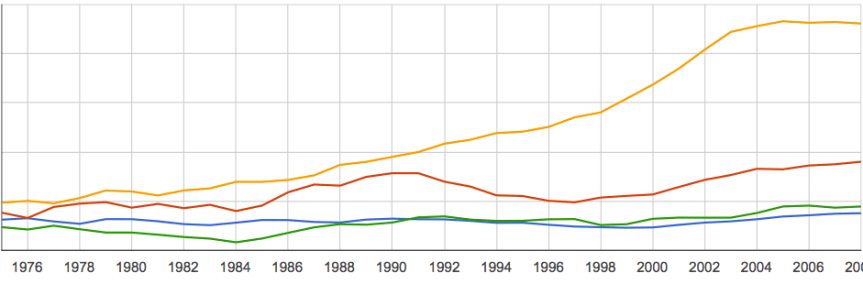
Final proof comes via Google’s Ngram Viewer, which, in an exciting development, now allows comparison of U.S. and British use of a word or phrase on the same chart! The Ngram below shows compares use of gap year in Britain (red) and the U.S. (blue) between 1995 and 2008:

Seen on the newsstand

Not really. This was the payoff of a Conan O’Brien bit where he lamented the demise of Newsweek and showed some magazines that have weirdly outlasted it, including “Pond Hoppin” (a cover lines notes that the periodical is “Brought to you by BASSIN’ and Crappie World”) and “Where to Retire.” He then brought in some fake mags, including the above compendium of ginger news. The fingers in the photo are Conan’s.