

Today’s New York Times has an article about FInland, for the fourth year in a row, being named the happiest country in the world. The article notes that this is somewhat ironic:
Finns embrace depictions of themselves as melancholic and reserved — a people who mastered social distancing long before the pandemic. A popular local saying goes, “Happiness will always end in tears.”
If you follow the link at the end, it will lead you to an article about Finnish idioms which gives the Finnish version of that one: “itku pitkästä ilosta.”
It reminded me that someone reader Tim Orr had not long ago suggested a post on “end in tears.” The phrase was used now and again in the nineteenth century, for example by a character in George Eliot’s 1868 narrative poem The Spanish Gypsy: “But soon that thought, struggling to be a hope, would end in tears.”
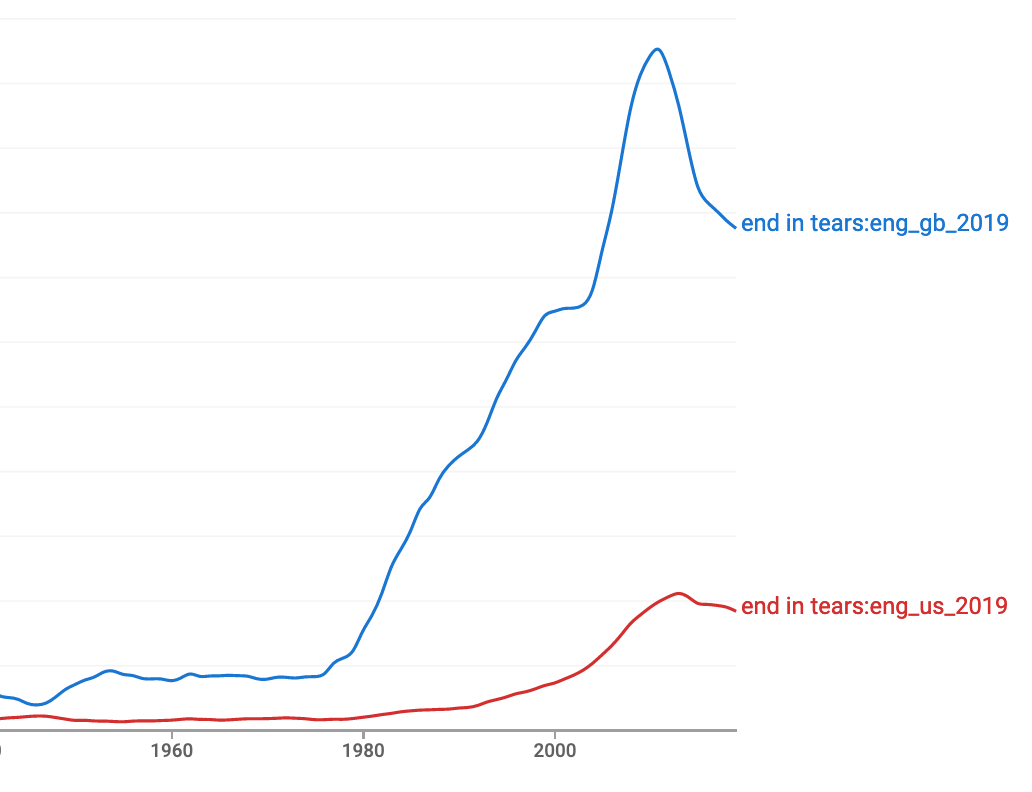
Google Books Ngram Viewer indicates it was used with roughly the same frequency in Britain and the U.S. until about 1920, when British use began gaining. Then, in the late ’70s, it took off as a “catch phrase” in the U.K., often with an ironic cast, and kept rising till 2010.
Toward the end of that span, in 2005, Ruth Rendell used the phrase as the title of one of her Inspector Wexford mysteries.
The chart shows a modest U.S. uptick in the ’90s and 2000s, suggesting NOOB-itude. A New York Times search confirms it, yielding three uses (not including the Finnish one) in the past nine months.
- “A lot of us have tried to move on, and when we saw the news, it wasn’t a huge surprise. The people who have served on the ground are the last people you need to tell that the war is going to end in tears.”–an American veteran of the Afghanistan war, on the news that the U.S. is pulling out all its troops.
- “’Why pay a lot for a wedding, and more for the divorce, for something that might end in tears?’ said Ms. Pfefferkorn, 38, a native of the Bay Area.”
- “I humbly note that naming your smart light bulb ‘Vestibule Hue light two’ will always end in tears.” — article by tech writer Jon Chase.
I’m not sure if it will really take off here. Americans may not have quite enough irony in their DNA.

 notoneoffbritishisms.com