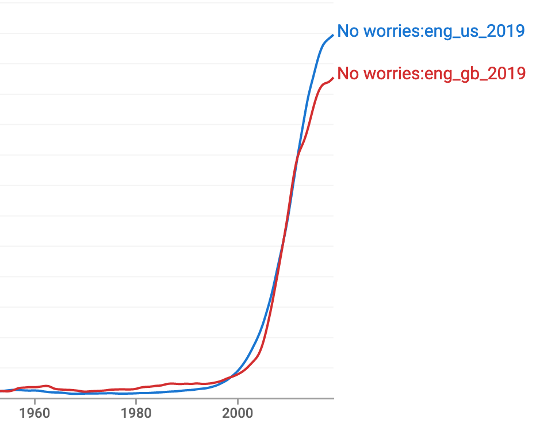
I wrote about the originally Australian “no worries” — as a response to “thank you” or an apology — in the first year of this blog, 2011. Since then it has continued a sharp increase in popularity, especially in the U.S., which has outpaced British use, as this Ngram Viewer graph shows.
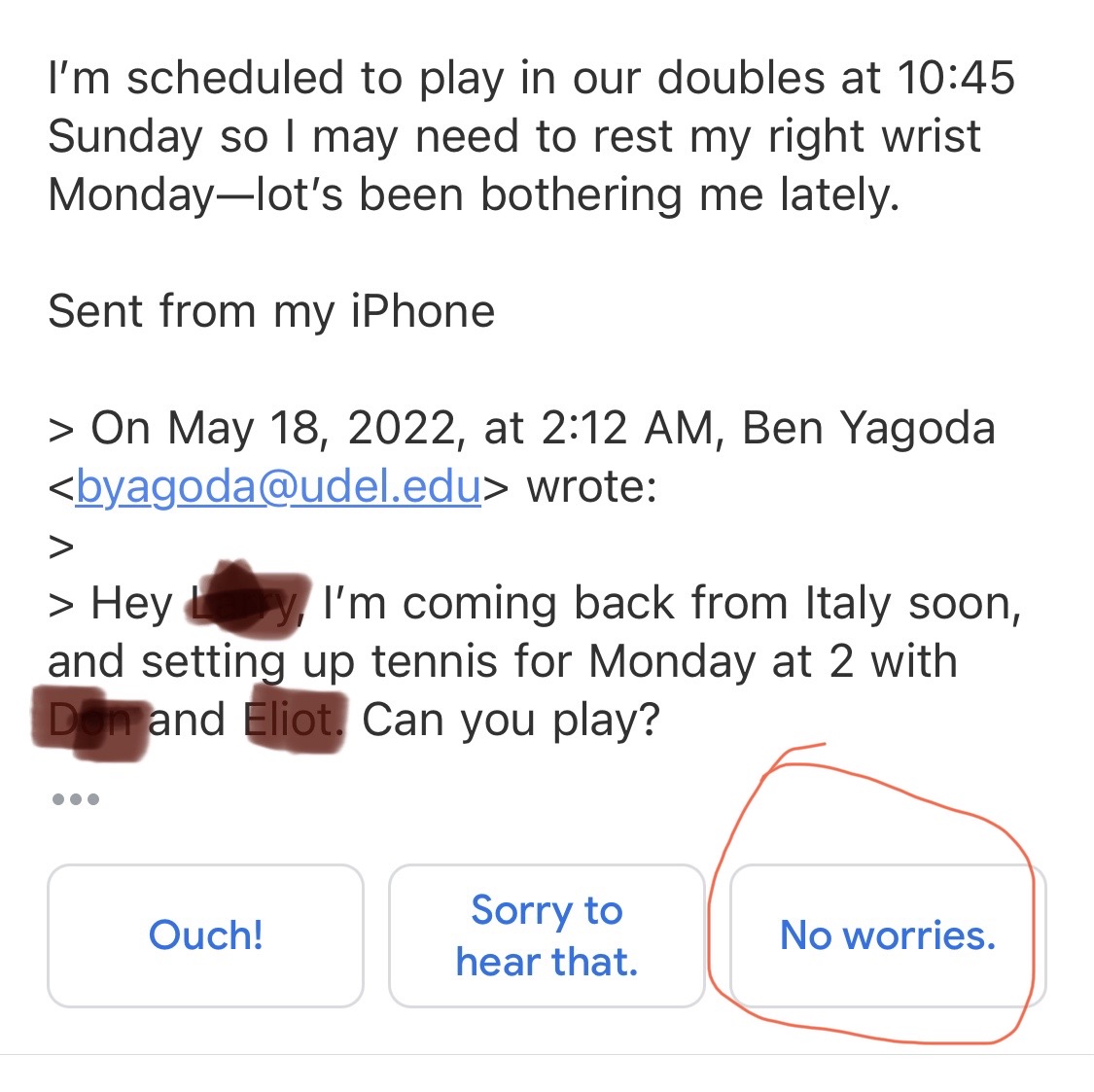
Apple’s iOS artificial intelligence has jumped on the bandwagon. For some time now, when I start to respond on my phone to an email, there are three options on the bottom of the screen for what to say. Here’s a screenshot of what appeared on my phone when I was about to respond to a friend who said he couldn’t play tennis because of an injury.
The phrase originates in education, specifically the custom of indicating every correct answer in an examination with a mark. Hence, “full marks” would be getting everything right. The phrase appears as early as 1852, according to the OED, with a figurative use in 1889: “I was once fifteen hours on the road… By rail I have done it in an hour and three-quarters. Full marks for steam, it may be thought…”
Though “full marks” shows up in an anonymous 1924 New York Times movie review — “the film version of ‘Monsleur Beaucaire’ is entitled to full marks for the splendor of the settings and the extraordinary beauty of the costimes” — I ascribe that to an Anglophile reviewer. Or, at least, the phrase fell out of favor after that and became unfamiliar here. In the U.S., “marks” is a more general term: one can talk of getting good or not-so-good marks, meaning grades. And I judge the modern American equivalent of “full marks” to be “full credit.”
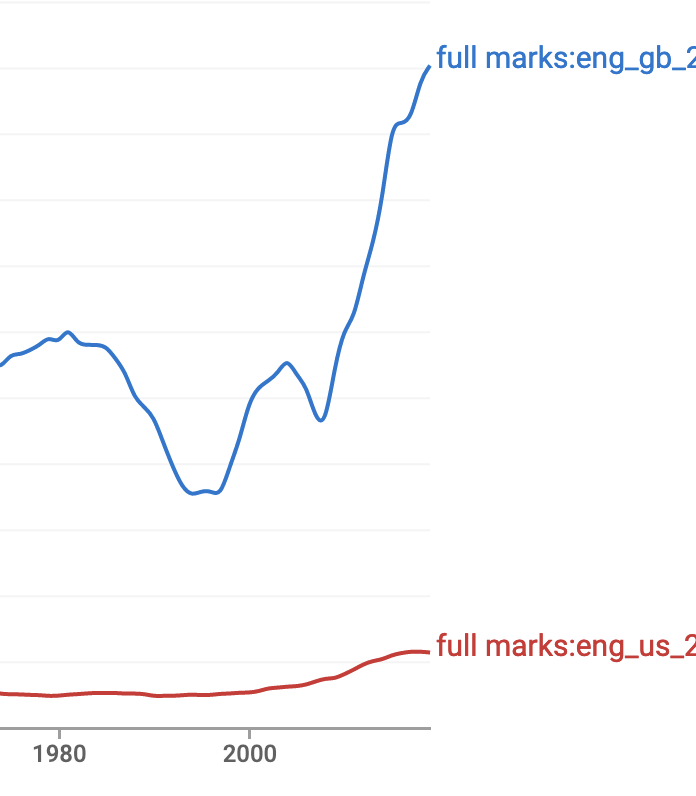
When I wrote about it in 2019, I categorized “full marks” as “On the Radar.” But it has started to get more popular here. Here’s the Ngram Viewer chart.
It actually showed up a week ago in the Times (as I write), from Bret Stephens in an exchange with fellow columnist Gail Collins: “[President Biden has] done a much better job standing up for Ukraine than I had expected he might, and I’ll give him and his national-security team full marks for that.”
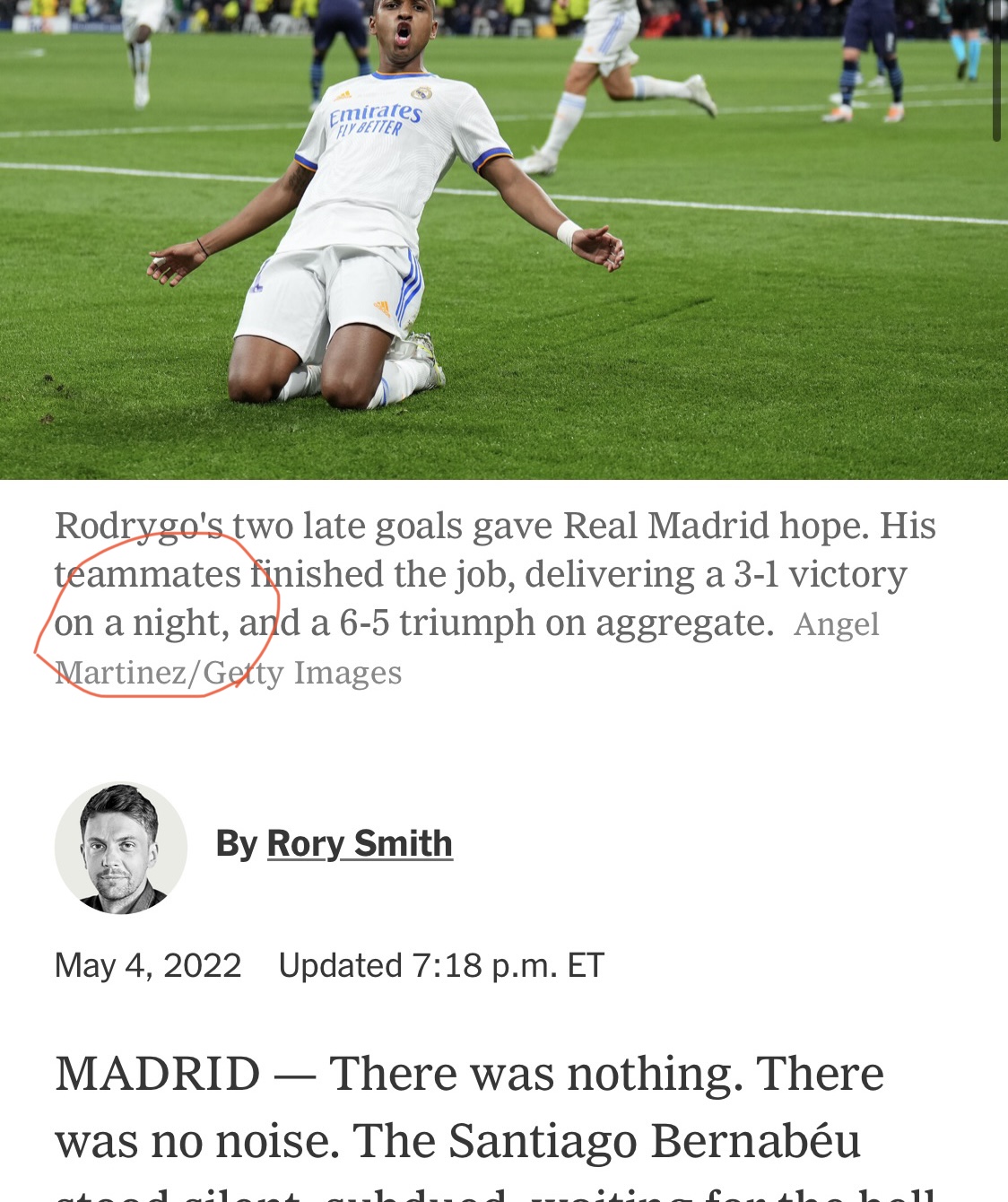
I recently discussed the expression “on the night,” meaning “on the night in question,” “night of the game/event/performance,” etc; that post has a link to the similar “on the day.” The phrase came to mind yesterday, when I was saw the online New York Times coverage of an epic Manchester City-Real Madrid Champions League match.
For those not versed in Champions League soccer/football (and for those who are, correct me if I botch this), it’s a tournament where, once the field gets down to sixteen teams, each contest consists of two games, and the team with the highest aggregate score advances. In this case, Manchester City won the first leg 4-3, but Real Madrid advanced on aggregate because they won the second leg 3-1.
Thus the caption should have read “on the night”; “on a night” is meaningless, to my ears. My theory is that a British person (perhaps Rory Smith, the author of the article) or someone well-versed in NOOBs originally wrote “on the night,” but some well-meaning but ill-informed person changed it.
In the course of putting together a book based on this blog (you heard it here first!), I found that I am standing on the shoulders of Richard Grant White. White, a nineteenth-century American literary critic (and father of the architect Stanford White), coined the word “Briticism” in 1868, to mean words and usages that had sprung up in Britain (but not America) in the century or so since the countries had been apart. White didn’t look kindly on this phenomenon. Among the instances he cited was a peculiar British use of the word “directly”:
Directly.—The radical meaning of this word is, in a right line, and hence, as a right line is the shortest distance between two points, it means at once, immediately. Its synonyme in both senses is a good English word, now, unhappily, somewhat obsolete, straightway—our equivalent of which, right away, is laughed at by brother Bull as an Americanism. But John Bull himself uses directly in a way which is quite insufferable—to wit, in the sense of when, as soon as. This use of the word is a widespread Briticism, and prevails even among the most cultivated writers. For instance, in the London “Spectator” of May 2, 1867, it is said that “Directly Mr. Disraeli finished speaking, Mr. Lowe rose to oppose,” etc. Anglice, As soon as Mr. Disraeli finished speaking, etc. It is difficult to trace by continuous steps the course of this strange perversion, for which there is neither justification nor palliation.
He also complained about a supposed British insistence on saying “ill” instead of “sick” to describe someone who was under the weather.
They sneer at us for not joining in the robbery and the imposition. I was present once when a British merchant receiving in his own house a Yankee youth at a little party, said, “Good evening! We haven’t seen you for a long while. Have you been seeck” (the sneer prolonged the word), “as you say in your country?” “No, thank you,” said the other, frankly and promptly, “I’ve been hill, as they say in yours.”
He went on, “For the use of ill—an adverb—as an adjective, thus: an ill man, there is no defence and no excuse, except the contamination of bad example.” Like many language peevers through the ages, he was on shaky ground. In fact there was nothing new about adjectival “ill”: “By my troth I am exceeding ill” is a line from Much Ado About Nothing).
Another complaint was “awfully” to mean “very,” instead of its early meaning of “in a manner that inspires awe or terror.” White wrote, “The misuse is a Briticism; but it has been spreading rapidly here during the last few years.” And here he was on the mark. In fact, I put forth this intensifier “awfully” as the very first Not One-Off-Britishism.
The early citations in the OED (which labels it “colloquial”) are all British, starting with one from The Times in 1820: “Let any one..say whether the illustrious defendant [sic]..has not awfully strong grounds for protesting against the tribunal.” I happen to be reading Thackeray’s Vanity Fair—published in 1847-48 and set in the 1810s—and came upon a line where Becky Sharp thinks, “I suppose he will be awfully proud, and that I shall be treated most contemptuously.”
It’s an interesting chart, showing significantly more frequent use in Britain in the second half of the nineteenth century (White’s era), and American topping Britain in about 1920.
Since then, the two countries’ use of the word have been awfully similar.
This expression means “in confidence” or “just between us” and is originally British. To expand on that a bit, the first citation in the OED is from the Irish writer George Moore’s 1885 novel A Mummer’s Wife: “It will be possible to have one spree on the strict q.t.” And the first citation in Green’s Dictionary of Slang, also from 1885, is some lines of verse from a Sydney, Australia, newspaper: “Oh, my! what a pious world it is, / And how very good they all seem to be – / But what a ’duffing’ lot you’d find / If you would only raise the blind, / And see ’em on the strict Q.T.” (Green’s also has a citation supposedly from an 1870 song, but that is pretty clearly inaccurate.)
In both the OED and Green’s, all the citations through 1904 except one use the formulation “on the strict q.t.” and are from British, Irish, or Commonwealth sources. The one exception (in Green’s) is from a Provo, Utah, newspaper in 1894: “We got this on the dead Q-T —and will ask you readers, please don’t give it away.” And incidentally, the expression gets some literary pedigree via James Joyce’s Ulysses (1922): “Sailing under false colours after having boxed the compass on the strict q.t. somewhere.”
All sources that I’ve found say that “q.t.” is short for “quiet,” and that’s convincing, especially since the phrase “on the quiet,” meaning the same thing, can be found pre-1874. However, I was intrigued by an alternate theory offered by a contributor to the Stack Exchange English Language and Usage bulletin board:
“Q.T.” is an odd abbreviation for “quiet.” Since it is of British origin, I would think it would derive from schoolboys’ abbreviations, often derived from Latin. The Latin taceo means “not to speak” and has solemn meaning sometimes, referring to “passing over in silence.” Thus quae tacenda, or q.t., would refer to “things about which one should not speak.” Cf. Horace, Epodes, 5.49, where Horace speaks of Canidia and quid dixit et quid tacuit, what she said and what she left unsaid.
Another Stack Exchange contributor, who goes by “Callithumpian,” antedated the OED and Green’s initial citations by more than ten years, unearthing a passage from a British play called My Husband’s Secret that debuted no later than 1874:
It quickly became a catchphrase: a Google Books search for “on the strict q.t.” yields about a dozen examples from 1877 to 1880, including these:
The phrase had fully arrived in the U.S. in the early 1900s. Green’s has fourteen citations between 1906 and 1999, and nine of them are American, including this lyric from a song by Merle Travis: “You thought your little romance was on the strict Q.T. / So if you want your freedom P.D.Q., / Divorce me C.O.D.”
The song came out in 1946, and indeed the phrase has a mid-century feel. The 1997 film L.A. Confidential was set in the early ’50s and the gossip monger played by Danny DeVito’s trademark line is “Off the record, on the QT, and very hush-hush.”
Nowadays, “on the q.t.” has been replaced by “on the downlow” or “on the d.l.”–though that phrase also has a very particular meaning of its own.
A popular new book of pop psychology by the American professor Arthur Brooks is called From Strength to Strength. I discussed the history of the phrase here.
The other day, someone mentioned this phrase as a NOOB. I checked and saw I had not yet covered it. The reason, I realized, is that at this point it’s so common in the U.S. that I don’t really think of it as a British in origin. (“The tone of the show, in what I have seen, is over the top “– New York Times opinion writer Kara Swisher, on the upcoming TV series Super Pumped, yesterday.)
But a Britishism it is. The OED labels the phrase “chiefly British” and defines it as: “To an excessive or exaggerated degree; beyond reasonable or acceptable limits; too far.” The OED also notes another, earlier meaning of “over the top,” stemming from World War I trench warfare: to literally climb over the top of a trench or parapet and go into battle. This took off in America, generating (as listed in the Library of Congress) no fewer than six popular songs called “Over the Top,” plus this one:
The phrase seems to have taken on a positive figurative meaning, akin to “going all out,” as seen in this item from a 1918 issue of The Rotarian:
The OED‘s first citation for the phrase with the “excessive” meaning is in a 1935 letter by the American writer Lincoln Steffens: “I had come to regard the New Capitalism as an experiment till, in 1929, the whole thing went over the top and slid down to an utter collapse.” But I take that as an outlier — a fresh metaphor on Steffens’s part, not his use of a phrase that was in currency. The first definite example I’m aware of comes from a 1965 novel called The Concrete Kimono (cited in Green’s Dictionary of Slang): “I seem to recall your ‘over the top’ waistcoats.” The quotation marks suggest unfamiliarity and recency.
By 1982, the phrase was popular enough in Britain to spawn an acronym. From The Sloane Ranger Handbook: “OTT adj. Over the top—outrageous. Usually ‘absolutely’ or ‘totally OTT’.”
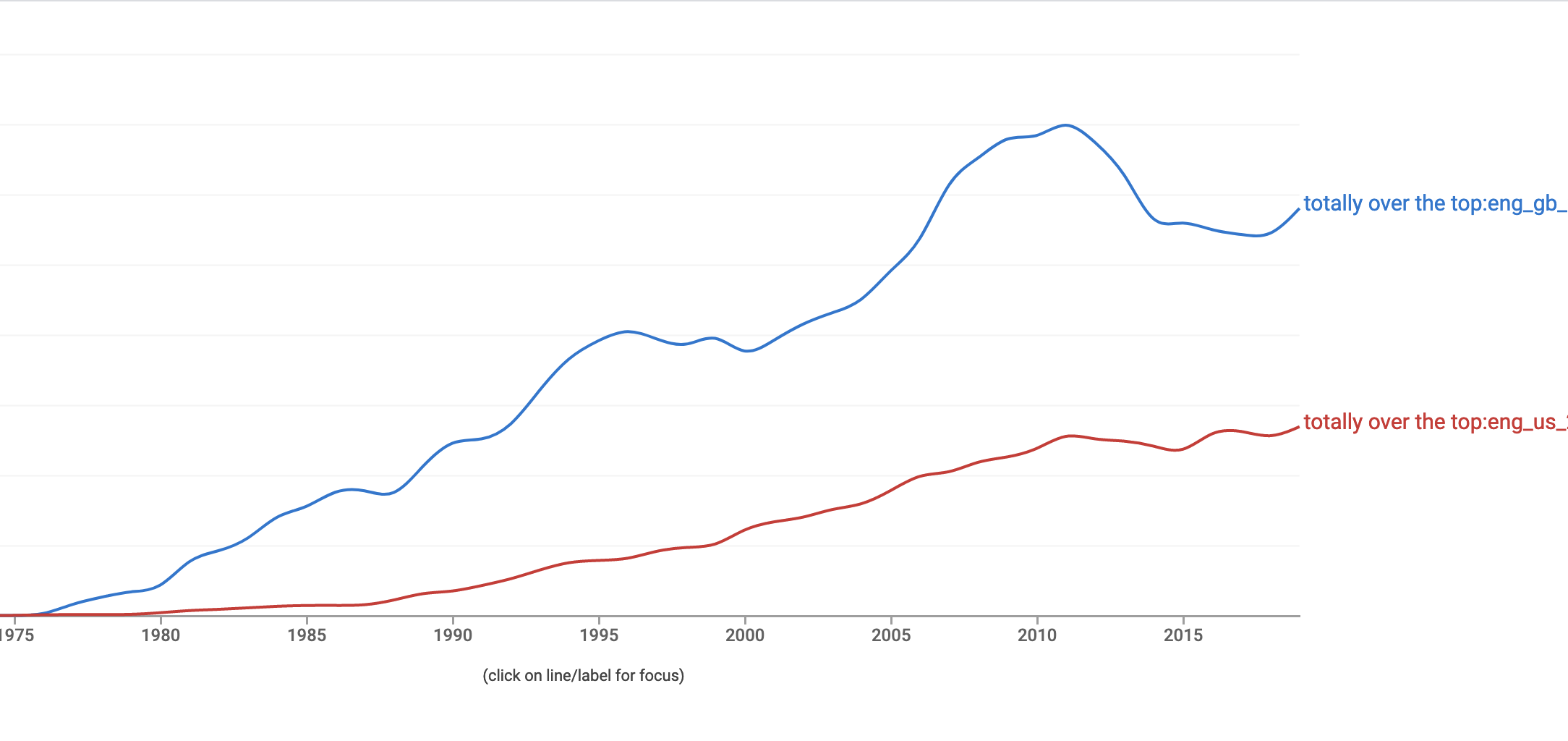
It’s difficult to use Ngram Viewer and the other databases I normally consult to track the progress of this phrase and its relative frequency of use in Britain and the U.S. That’s because searches for “over the top” yield a great deal of noise: references to climbing over the top of a hill, sprinkling sugar over the top of a cake, and so on. Lynne Murphy suggested slipping an intensifier before the phrase; taking a cue from the Sloane Rangers and searching for “totally over the top” in Ngram Viewer worked nicely:
It’s a classic NOOB graph. In fact, the only thing that surprises me is that it shows U.S. use as only about half of that in Britain.
I love it when the OED gets frisky. It definitely does with the above formulation, which the dictionary pegs as as a “hackneyed phrase.” The meaning, I probably don’t need to point out, isn’t literal but figurative: not “when the clock strikes midnight” or “when the sun goes down” but “eventually” or “when all is said and done.” The first OED citation is from 1974: “Eschatological language is useful because it is a convenient way of indicating..what at the end of the day we set most store by.”
But it was around and about long before that, principally — and fortunately, for the purposes of this blog — in Britain.
The Grammarphobia blog found it in an 1826 sermon:
Christ’s flock is but a little flock, comparatively considered. … They are but little in respect of their numbers. Indeed abstractly considered, at the end of the day, they will make an “innumerable company, which no man can number”; but, viewed in comparison of the wicked, they are but few.
“At the end of the day” is not only hackneyed, but also pompous and portentous, and thus it’s not surprising that the phrase found especially wide use in Parliament. In 1858, the Liberal Member of Commons William Gladstone said, “Coming in at the end of the day, then, Russia supported the union.” In 1896, an unidentified speaker said, “And now at the end of the day they had a Government which was brought in by a large majority for the purpose of doing justice…”
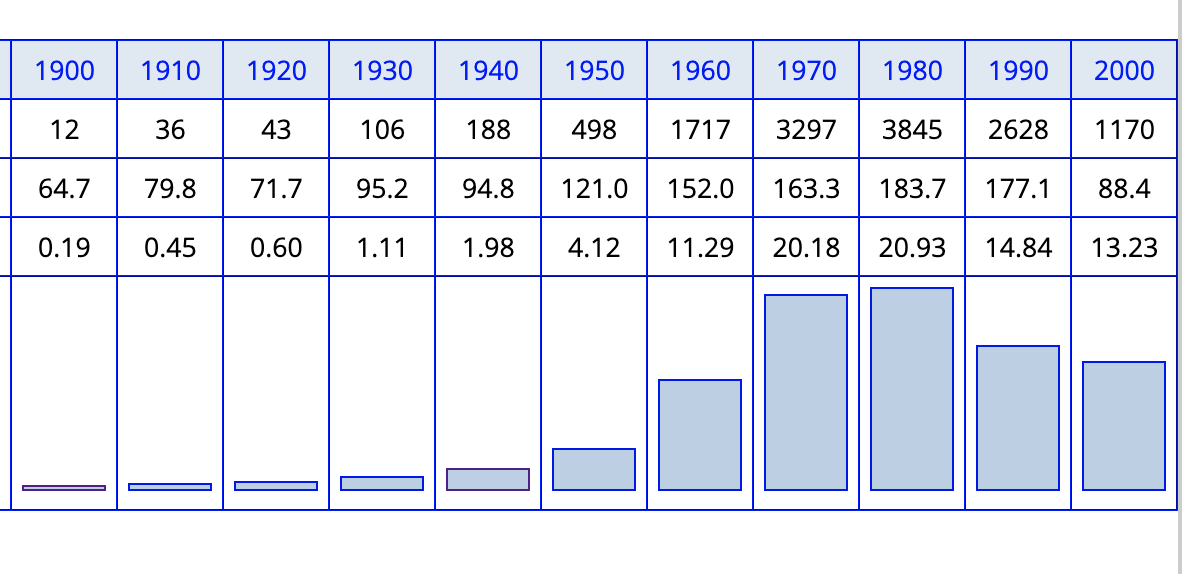
I got these quotes from the Hansard corpus, which shows the phrase becoming more and more popular in Parliament over the course of the twentieth century:
The top number indicates the times “at the end of the day” was uttered in Parliament in that decade: twelve in the 1900s, 36 in the 1910s, all the way up to 3,845 in the 1980s, at which point it began to decline.
The main reason for the decline, it’s clear to me, would have been the growing realization that it was a hackneyed phrase. Indeed, in 1986, New York Times language columnist William Safire complained about it as a “vogue term.” Fifteen years later, Safire returned to the theme. Prompted by a reader’s complaint, he looked at an interview between NBC’s Tim Russert and the chairman of the Democratic National Committee, Terry McAuliffe, and found McAuliffe “used the phrase … seventeen times in the twelve minutes he spoke on the air: ”At the end of the day we won on the issues’; ”At the end of the day if all the votes were counted”; ‘There was no swap at the end of the day.'”
The “at the end of the day” backlash continued apace. Respondents to a 2004 survey by the Plain English Campaign chose it as the number-one most annoying cliché. (“Second place in the vote was shared by ‘at this moment in time’ and the constant use of ‘like’ as if it were a form of punctuation. ‘With all due respect’ came fourth.”) And in 2010, a Pittsburgh Post-Gazette sportswriter awarded “at the end of the day” its annual Trite Trophy as the most egregious cliché of the year.
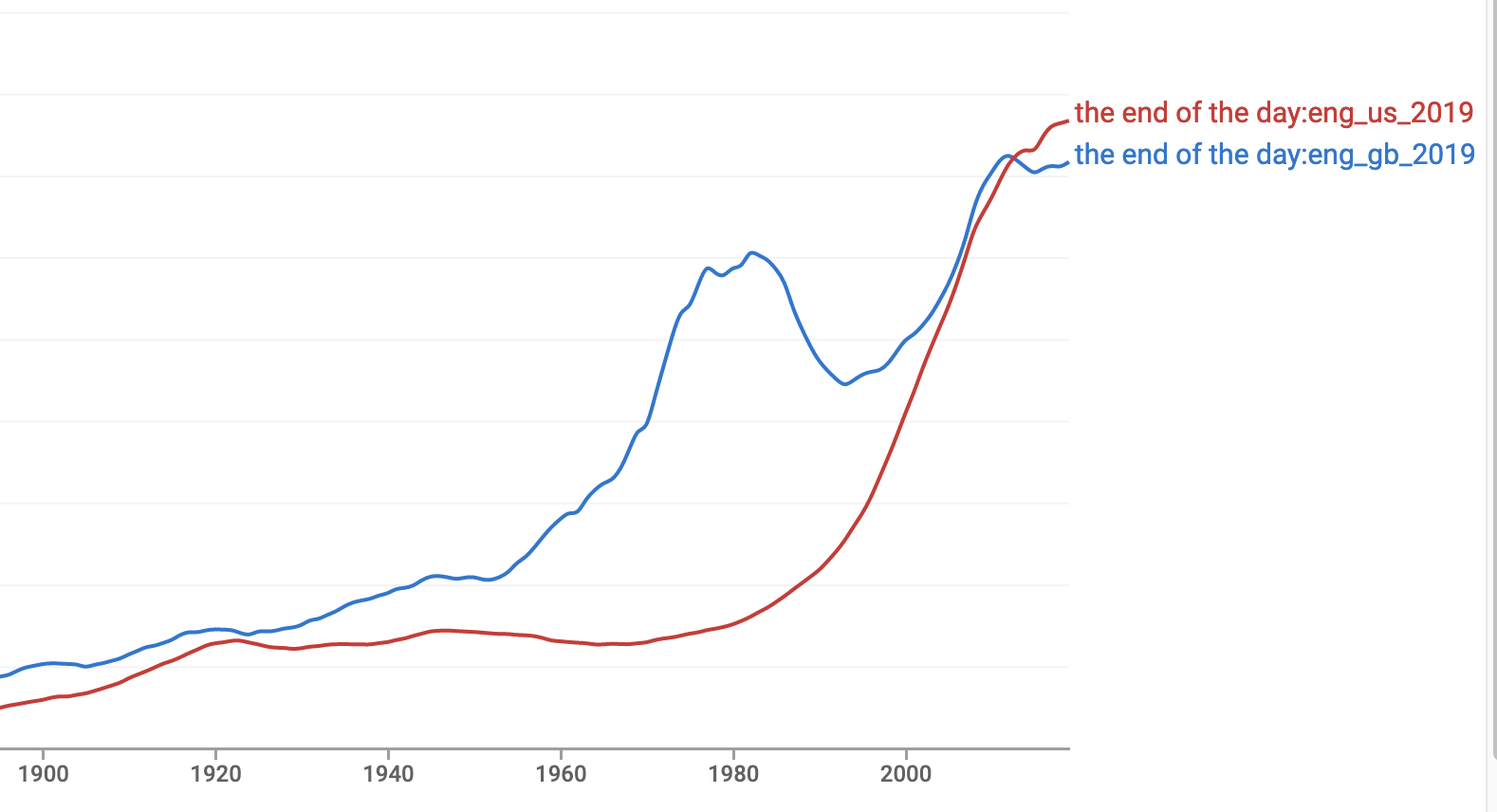
In contrast to Parliament, as this Google Books Ngram Viewer chart shows, the derision has not slowed the phrase’s general momentum.
(I searched for “the end of the day” rather than “at the end of the day” because Ngram Viewer works for phrases of a maximum of five words. And hence the graph includes a not-negligible amount of false-positive noise: that is, references to the literal end of the day.)
The chart tells an interesting story in regard to Anglo-American differences: British predominance for most of the century, until (following a British slump in the ’80s) Americans caught up and, at the end of the day, surpassed their trans-Atlantic cousins.
In the previous post, I discussed Britishisms in the American novel The Plot, and several British commentators zoomed in on the line “she straightaway found a job.” It was contended out that the actual British term is “straight away” (two words).
Backing up a bit, I see that in the early days of the blog, I did a post on “straightaway” and a separate one on “straight away” — things were a little bit chaotic back then. But I didn’t sort out the one word/two words issue, and I will try to do so now.
But first I’ll point out that the American equivalent is “right away” (always two words) or “immediately.” Here’s an Ngram Viewer chart showing frequency in American books:
Muddying the waters a little bit is the fact that one-word “straightaway” has another meaning, labeled “chiefly U.S.” by the OED: “A straight course in rowing or sailing. Also, a straight section of a road or racecourse, etc.” With that in mind, we can say that the two-word version for “immediately” is more common even in the U.S.
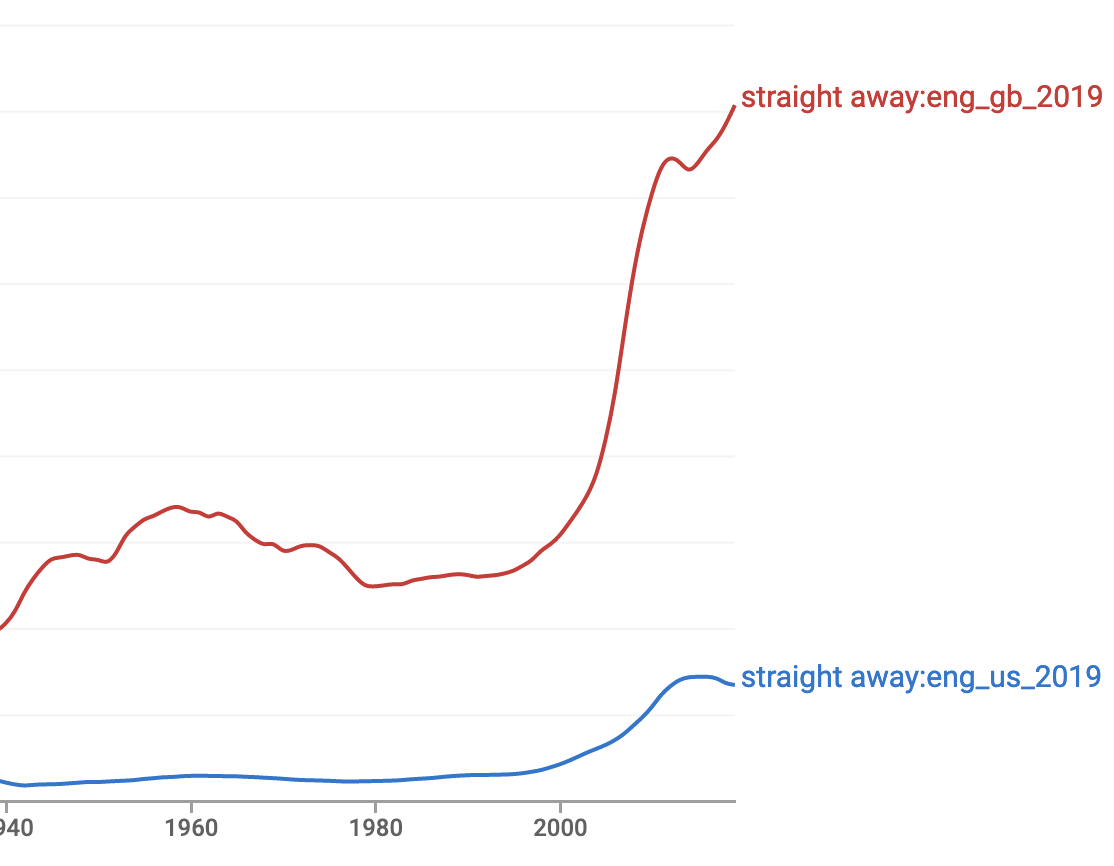
So now let’s compare the two-word version in Britain and the U.S.:
That is to say, it’s definitely a NOOB.
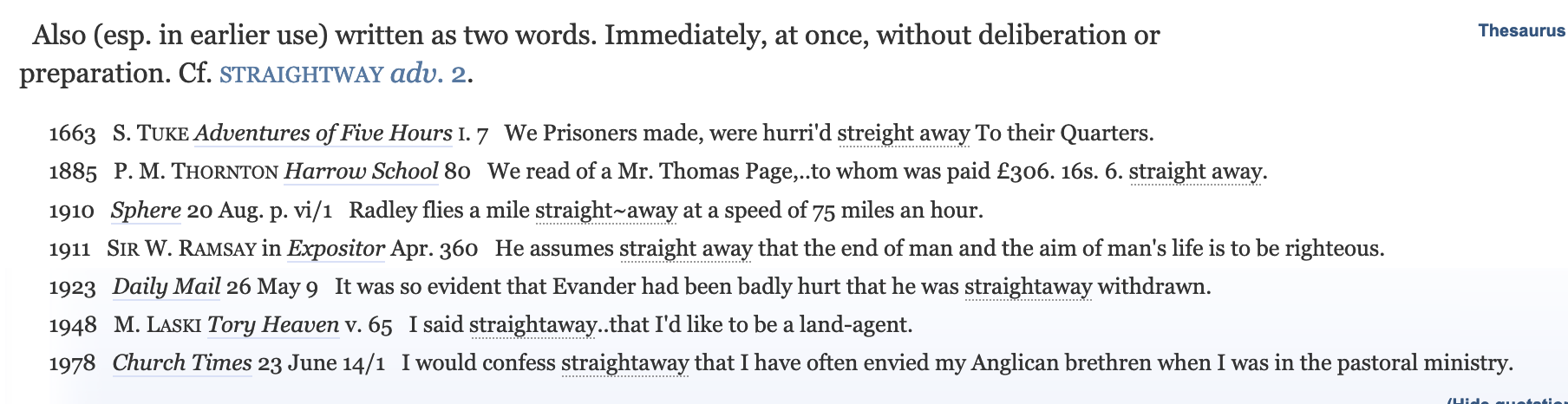
Finally, were my commentators correct in saying the two-word version prevails in Britain? The OED would indicate not. Here’s its entry:
The citations show a classic progression from two words, to hyphenated, to one word.
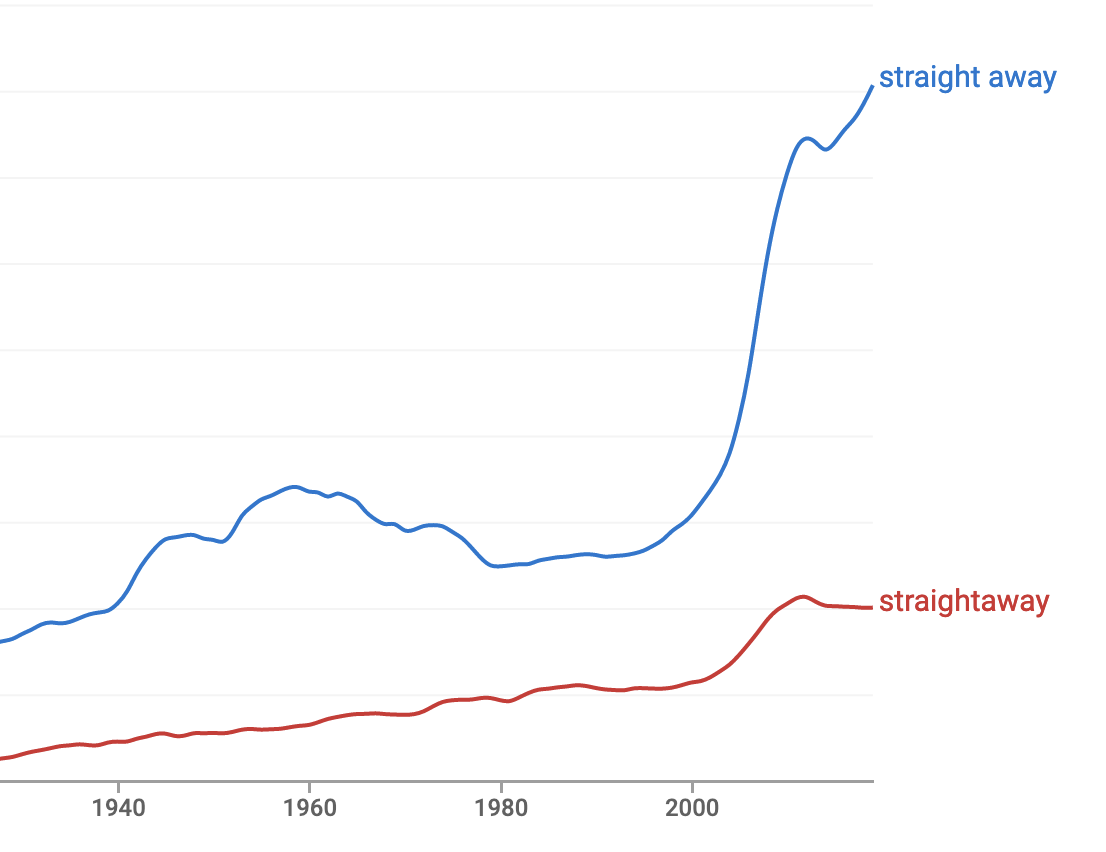
However, Ngram Viewer supports the commenters. Here’s the chart for the two versions’ frequency in British English. It shows that in 2019, the “straight away” was used about four times more frequently than “straightaway.”
Not to state the obvious, but the one word/two word distinction applies to written language, rather than spoken, where the question is moot. I imagine that to some extent the commenters were expressing their sense that there is a pause between “straight” and “away” when they say or hear the term.
Finally, one commenter, Tony C, said: “The word order is wrong in British English as well: ‘… she found a job straight away …'”
I have a hunch that he’s wrong, that both sentence structures are found in British English (see the Daily Mail quote from the OED), and in fact that this can elucidate the one word/two word issue. That is, before the verb, “straightaway” is one word, and after (as in Tony C’s rendition), it’s two.
But full investigation of this point will have to wait for another day.
I’ve written several times (most recently here) about the phenomenon of American characters in British novels using British expressions, seemingly because the writer didn’t realize they were British expressions. I’ve just read a book by an American novelist, with American characters, where Britishisms abound.
The book is The Plot, the author Jean Hanff Korelitz. In my view, some of the examples are nothing more than NOOBs — that is, British words and expressions that have become popular in the U.S., and hence an American character might use. Others are flat-out Britishisms that I’ve rarely or ever heard here. I’ll list them in order, from the most common NOOBs to the least likely. Examples in quotation marks are a character speaking, and the others are the author’s narration.
“Would it kill you to do an avocado toast?” (That’s “do” in the sense of a restaurant offering a dish.)
“who knows what else this Dianna Parker got up to?” (Instead of “got up to,” Americans would say “was up to” or “was involved with.)
the guy … supported the Red Sox… (“Support” meaning root for or be a fan of.)
Maybe the punters out there believed novels followed a visit from the muse …
Jake opted not to correct this remarkable statement in any of the ways he might have done. (An American would end the sentence with “he might have.” This verb construction is actually one of the White Whales of the blog — something I have been hoping in vain to observe an American using. Until now.)
I mentioned that the author, Jean Korelitz, is American. But she studied at the University of Cambridge in the 1980s, and since 1987 has been married to the Irish poet Paul Muldoon. So she comes by her Britishisms rightfully. But that doesn’t mean that her editor shouldn’t have flagged “punters” or “might have done.”