The phrase means “available for sale” or, more generally, “available.” The first OED citation is from the (London) Daily News in 1881: “Old wheat scarce and dear. Very little barley on offer.” But using Google Books, I came up with an example more than fifty years older, from a September 1826 issue of Cobbett’s Political Register:
But in any case, the phrase didn’t cross the Atlantic for another century or more:
A relatively early use came in the New York Times in 1990: “Tens of thousands of Apple Macintosh users visited the Macworld trade exposition here earlier this month, examining the hardware and software on offer.” It arrived in the New Yorker through British writers—Kenneth Tynan in 1977 and Salman Rushdie in 1992—and was first used there by an American one, Hendrik Hertzberg (using the magaqzine’s famous editoral “we”), in 1994: “We know, for example, that there are people who picked up their first copy of The New Yorker on account of a story or a “casual”–on account of something by O’Hara or Cheever or Salinger or Perelman or Munro or Updike–and only later, and gradually, became aware that other kinds of writing were on offer in these pages too.”
But it’s all over the place now. The Times used the phrase 112 times in 2021, from to January 21 (at a hair colorist’s studio, “Cappuccino and mineral water were served, and tuna and watercress salad was on offer”) to December 21 (“While the Omicron variant has thrown many people’s New Year’s Eve plans into doubt, there’s no shortage of events on offer in the televised realm”).
This popped up on my New York Times phone app this morning.
The headline, taken directly from the columnist Bret Stephens, spurred to me take another look at shambolic, which I first addressed almost precisely eleven years ago. (Time flies when you’re having fun.) The definition of the adjective is “Chaotic, disorderly, undisciplined” — that is, in a state of shambles. As I noted then, the OED‘s first citation is from The Times of London in 1970, but there’s also an odd note: “Reported to be ‘in common use’ in 1958.” Doesn’t say who’s doing the reporting.
In any case, there are definitely antedates to the 1970 quote, and even to 1958. Moving in reverse chronological order:
August 3, 1965: “Mr: William Yates The hon: Member must understand that so long as the country is willing to pour more and more money into this ancient, shambolic building in this area of London, there is no chance of getting that or having any of the facilities that he wants…”–Parliamentary debate
July 25, 1965: “Our social life is shambolic.”–The Sunday Times
1958: “He said his club had coined a new word ‘Shambolic,’ which meant spending more time watching the weather than playing.”–West Sussex Times
1952: “… one must admit there were those among us who were somewhat on the shambolic side.”–The Tank. (This citation appears in Wiktionary, which links to a Google Books entry, but I don’t 100 percent trust it because Google Books doesn’t offer a full view and its dating is often dodgy.)
Next is an interesting quote I turned up in the ProQuest database. It’s an abstract of a 1946 article from the Blackpool Tribune reviewing a book by Roland Gant called How Like a Wilderness. It’s not clear who write the abstract, or when, but it has the feel of being composed at the time–and also suggests “shambolic” might have been World War II military slang. The blurb begins: “THE AUTHOR parachuted into the Calvados country on D-Day in an operation which, in the language of those days, would have been described as ‘shambolic.'”
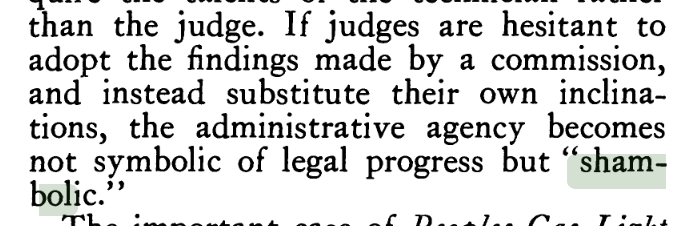
And there’s one more, a full seven years earlier, which I had cited in my earlier post. It’s from a May 1939 number of The Journal of Land & Public Utility Economics. (Previously, I had found it via Google Books, but it doesn’t appear to be there anymore, and this time I dug it up in the JSTOR database.)
I’m pretty certain that this doesn’t have any relation to the present-day “shambolic.” For one thing, it’s in an American journal, and Ngram Viewer shows the word not taking hold in the U.S. till the 1990s.
For another, the context (including quotation marks) suggests that the writer, David S. Wald, is inventing a new word based on “sham,” not “shambles.” But the word is undeniably there and I hope the OED takes note.
As I say, American use picked up at the end of the last century. It first turned up in the New York Times in a 1984 William Safire column taking note of the word. Between then and today’s Bret Stephens quote, the word appeared in the paper 365 times.
And finally, I should note that we should be grateful to “shambolic” if only because it spawned omnishambles!
I’ve written about several cases where Americans have adopted the British tendency to pluralize attributive nouns: to use drugs party, covers band, drinks menu, and books editor instead of the customary/traditional “drug party,” “cover band,” “drink menu,” and “book editor.” Check out those links if you’re interested in the ins and outs of the issue.
The latest instance comes via a current National Public Radio (NPR) corporate underwriting spot, intoned by the same plummy-sounding woman who (in another spot) talks about “what-if scenahhrios.” In this one, for Amazon Business, she touts the way it “helps simplify the supplies-buying process with a one-stop shopping experience.” The typical American term, I submit, would be “supply-buying process.”
I acknowledge that I can’t prove that. Both variations of the phrase are uncommon enough that Ngram Viewer and other tools aren’t able to shed much light. However, I can report that “supply buying” has been used nine times in the history of the New York Times and “supplies buying,” as of now, has never appeared in the paper.
If anyone thinks I’m off-base here, please have at me. (Not that you required encouragement.)
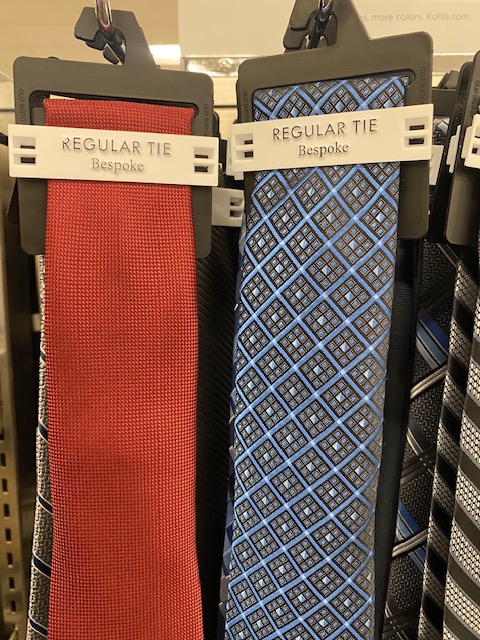
The other day I spotted this display of neckties in a local department store, Kohl’s.
To be clear, these ties are pretty much the opposite of “bespoke” — they’re mass-produced, of middling quality, and sold in bulk in a department store, for pete’s sake. Brings to mind what Humpty-Dumpty told Alice in Through the Looking Glass — “When I use a word, it means just what I choose it to mean — neither more nor less.” I reckon we’re living in a Lewis Carroll world.
Some years ago I looked at the expression “can’t be arsed” (that is, can’t be bothered) and the way it has been (mis)construed, notably by Americans, as “can’t be asked.” A couple of developments since then. First, the OED moved its first citation for the expression to 1968 (from 1978, as I recall). In Hunter Davies’s 1968 book The Beatles, Paul McCartney is quoted as saying: “If they can’t be arsed waiting for me, I can’t be arsed going after them.” In the same book, John Lennon says, “I like ‘A Day in the Life,’ but it’s still not half as nice as I thought it was when we were doing it. I suppose we could have worked harder on it. But I couldn’t be arsed doing any more.”
Second, I found a very long, multi-year thread on the wordreference.com forum debating the merits of “can’t be arsed” and “can’t be asked.” I’ll spare you the details, except to say that one commenter found a 1979 article in which the American pianist Keith Jarrett was quoted as saying, “There are things now that I can’t be asked to do that maybe five years ago I would…” Now, that raises the question of whether Jarrett actually said “can’t be asked” or whether he said the British “can’t be arsed” and the interviewer mistakenly rendered it as “can’t be asked.” By a stroke of luck, that 1979 interviewer, Mikal Gilmore, is a Facebook friend of mine and I asked him if he remembered what Jarrett said. In a kind of Annie Hall-Marshall McLuhan moment, he responded quickly and definitively: “He said ‘asked.’”
I can understand why Jarrett and others would have made the change. First, most British people pronounce “arse” and “arsed” without voicing the “r,” so it sounds like they could be saying “asked.” Second, “can’t be asked” actually makes more sense than “can’t be arsed”—suggesting the idea that I won’t do something even if someone asks me to.
Perhaps for those reasons, “can’t be asked” apparently spread to the U.K. quite some time ago. A commenter on my original post said, “Working in and with South Londoners in the late 90s, I can confirm ‘can’t be asked’ as a thing, albeit pronounced ‘can’t be axed’. Actually more common at that time than arsed…”
And in 2007, someone posted a definition of “can’t be asked” on Urban Dictionary: “Used by some Southern UK speakers in place of ‘can’t be arsed’ because they misheard it, or want to be more polite.”
Helpfully dispelling any “arsed”/“asked” confusion is the version that has apparently become popular among young people on both sides of the Atlantic in their texting and commenting: the initialism “CBA.”
A few years ago, I looked at the rather subtle differences between British and American use of the expression “meant to,” and a few examples of the British version being used in the U.S.
Briefly, Americans use it to mean “designed to” (“the speech was meant to convey a sense of solidarity”) or “destined to” (“our marriage was meant to be”). While in Britain there are additional meanings, all where Americans would probably say “supposed to”: “said to” (“this movie is meant to be good”); “tasked with” (“the builder was meant to expand the kitchen”); and a third, seen in this headline that appeared on the New York Times website the other day.
Dr. Bernard is an Indiana ob-gyn who, the essay explains, “became a target of a national smear campaign for speaking out about her 10-year-old patient, a rape victim from Ohio who needed an abortion and had to travel to Indiana to receive one, given the restrictions in her home state.” The “meant to” in the headline is yet another “supposed to,” this time indicating a plan or intention.
Its appearance in the Times is enough to remove the “on the radar” designation from the phrase. Clearly, it was meant to be.
The OED identifies this metonymic expression—which describes an early stage in an event or process, often implying too early, or premature—as “chiefly British” and finds a sixteenth-century citation from Sir Thomas More: “She telleth hym then that it is but early dayes, and he shall come tyme ynough.” It also shows up in Samuel Richardson’s 1740 Pamela (“’Tis early Days with Pamela, and she does not yet think of a Husband”) and frequently in the late 1700s and early 1800s, usually with the word “yet,” meaning “still,” at the end.
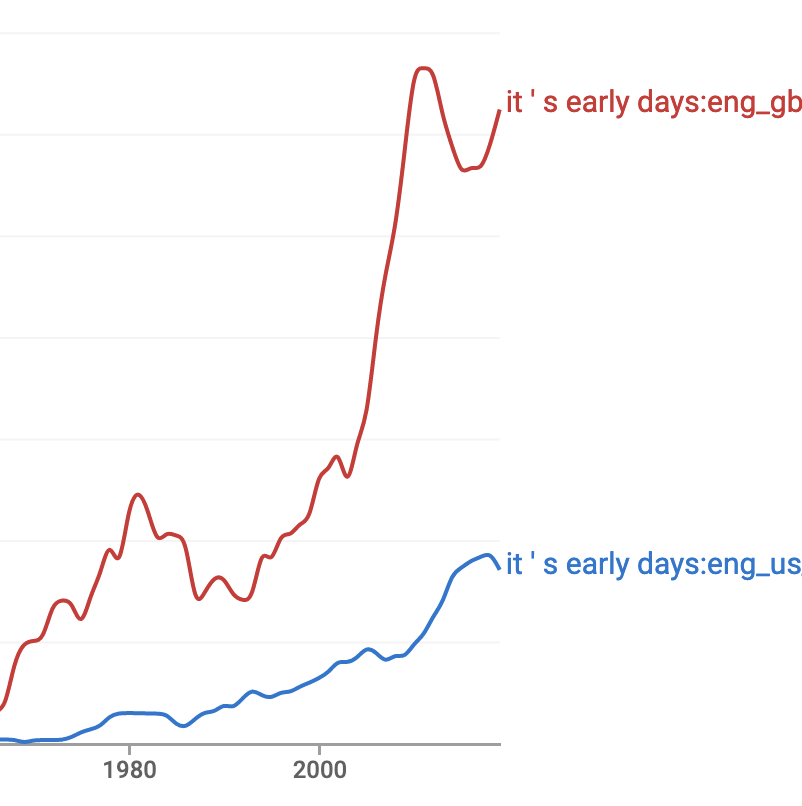
I should note that Americans have always referred to beginnings as “the early days of” something. It’s just that they only started saying “it’s early days” around 1980, as Ngram Viewer shows.
An early New York Times use came in 2001, when restaurant critic William Grimes wrote about the staff at a venerable French restaurant, after a change in management: “It’s early days yet, but I think they realize that Lutèce has turned a corner.”
By now, it’s common enough to be viewed as a cliché or—as the American tech writer Molly White observed in 2022—an excuse. White wrote that when she points out some of the shortcomings of blockchain currency (which has been around since about 2009), she’s often told “It’s early days.” However:
“So this raises the question: How long can it possibly be ‘early days’? How long do we need to wait before someone comes up with an actual application of blockchain technologies that isn’t a transparent attempt to retroactively justify a technology that is inefficient in every sense of the word? How much pollution must we justify pumping into our atmosphere while we wait to get out of the ‘early days’ of proof-of-work blockchains?… The more you think about it, the more ‘it’s early days!’ begins to sound like the desperate protestations of people with too much money sunk into a pyramid scheme, hoping they can bag a few more suckers and get out with their cash before the whole thing comes crashing down.”
Possibly creating confusion is the existence of another British expression (which hasn’t penetrated to the U.S.) with a similar sound and meaning. The website World Wide Words offers a 2010 quote, and then a fascinating history:
“We’ve got to make sure we don’t concede, especially early doors, but I think it’s definitely game on if we score first.”—Sporting Life
Why footballers, commentators and fans say “early doors,” when “early” or “early on” would work just as well is probably due to Big Ron, otherwise Ron Atkinson, a well-known television football commentator, a former player and manager now regarded as one of the characters of the sport.… However, my memories of the phrase go back to Brian Clough, a rather more famous football manager, who is on record as using it in 1979. …
In the days before liberalisation of hours, pubs would reopen for the evening at 5.30, just in time for a quick drink after work and before going home. An early-doors beer would be one grabbed as soon as possible after opening time….
We’ve actually got to go back well over a century to find the true origin… Then as now, a last-minute crush usually developed at the entrances [of theaters] just before the performance started, with the street outside crammed with vehicles…. Around the 1870s, the idea grew up of charging a small premium to members of the audience who were willing to arrive well ahead of the crowd; in return, they were allowed to choose their own seats in unreserved areas — the pit and the gallery in particular. This could be a considerable advantage, as sightlines in those areas were often poor and interrupted by pillars…
The system continued into the twentieth century and became very well known:“The park-keeper eyed him; thought better of the bitter words he had contemplated; contented himself with: ‘Funny, ain’t yer?’ ‘Screaming,’ said George. ‘One long roar of mirth. Hundreds turned away nightly. Early doors threepence extra. Bring the wife.’–Once Aboard The Lugger, by Arthur Stuart Menteth Hutchinson, 1908.
It was recorded by G.K. Chesterton as a First World War battle cry by Tommies going over the top to attack the enemy (‘If they had only heard those boys in France and Flanders who called out “Early Doors!” themselves in a theatrical memory, as they went so early in their youth to break down the doors of death.”). Theatres seem to have stopped the early-doors practice in the early 1920s.
Over the years, when I’ve been asked about the NOOBs phenomenon, part of my standard answer (along with the arrival in America of British journos like Andrew Sullivan, Christopher Hitchens and Tina Brown, and the rise of global internet culture) has been that the Harry Potter books introduced and popularized a lot of British words. The one example I always gave was “ginger,” in reference to Ron Weasley’s hair.
It finally occurred to me to check this assertion out. My local library had on offer a digital version of the first book in the series, Harry Potter and the Sorcerer’s Stone (… and the Philosopher’s Stone in the U.K). I checked it out and searched for “ginger.” Nothing. On the other hand, there were multiple references to Ron having “red hair” and one calling him “redheaded.”
My world was rocked.
Apparently, “ginger” becoming “red-haired” was one of the numerous changes from the British versions of the books to the American. Wondering if any Britishisms remained, I found an article called “Six British Words from Harry Potter That I Never Understood.” The author doesn’t specify, but I assume she’s referring to words found in American editions. The words are:
“Budgerigar” or “budgie” (American: “parakeet”).
“Wotcher!” (“An old informal greeting, possibly Cockney in origin, possibly a contraction of “what cheer.”)
The only ones of these that showed up in my digital edition were “tea cozy,” “treacle,” and “trifle”–an item and two foods that don’t have American equivalents. The foods appeared in the same sentence, an interesting one, describing the desserts at Hogwarts:
“Blocks of ice cream in every flavor you could think of, apple pies, treacle tarts, chocolate éclairs and jam doughnuts, trifle, strawberries, Jell-O, rice pudding . . .”
Here’s my take on the list. “Blocks of ice cream” and “jam doughnuts” are Britishisms that somehow made it through. (We would be more likely to refer to “scoops” of ice cream and much more likely to say “jelly donut.”) “Jell-O” (U.K.: “jelly”) was probably and “apple pies” (“apple tarts”) possibly changed for the American market. And chocolate éclairs, strawberries, and rice pudding work equally well in both countries.
Since I first wrote about the expression, I’ve learned that “easy peasy” and its origins are shrouded in mystery, or, at least, uncertainty. Start with most British people’s Mandela effect notion that it came from an advertising slogan for Sqezy [sic] dish-washing liquid, “Easy Peasy, Lemon Sqezy.” It is flat-out wrong. The language historian Barry Popik and Pascal Tréguer, who runs the WordHistories.net blog, have both established that there was never such a slogan. Rather, from 1957 until 1962, it was, “It’s Easy With Sqezy.”
A 1957 advert.
Shortly after that, the brand was discontinued. However, a commenter on my 2012 post noted that Star Brands, which had (temporarily) reintroduced Sqezy, had a message on its website which bought into the folk/faux/fake etymology: “From its origins in 1958 when Sqezy was launched as the world’s first washing up liquid in a plastic squeezy bottle, we’ve now brought it bang up to date. Although when you consider that 99.9% of people can complete the line ‘Easy peasy ..’ you’d hardly believe that it had ever been away!”
In fact, the first documented (by Tréguer) instance of the full phrase is in a 1983 article in The Guardian: “Chap comes in, sits down, says, ’I want to be a marine biologist.’ Easy peezy lemon squeezy.”
Another odd thing about the short version of the phrase is its nationality. Ngram Viewer confirms it’s a NOOB (and that widespread use began in the late ‘70s):
Yet two of the three early uses of it cited by the OED come from American sources. The first is very early and not American: in a 1923 article about traditional mummers’ plays, there is a reference to “The Berkshire Doctor’s cure of the ‘easy-peasy, palsy, and the gout.’” In the 1940 American film Long Voyage Home, the character played by John Wayne says, “Easy-peasy. Take it easy, Drisc!” And a 1953 article in the Cincinnati Enquirer noted, “There’s a brief air travelogue of highlights of a jet trip from London to Cairo… The flight is such an easy-peasy affair for the air travellers, they seem to be motionless in a fantastic and lovely, sun-drenched cloudland.”
My guess would be that in all three cases, the phrase was used not because it was in circulation but because the rhyme came easily to the tongue. The same is true of the other popular variant, “Easy peasy, Japanesey,” which Popik has spotted in 1982 (that is, a year earlier than the “Lemon Sqezy/Squeezy” version). The character played by James Whitmore uses the phrase in the 1994 film The Shawshank Redemption, which is set decades earlier and is therefore anachronistic.
“Easy peasy” has been used in the New York Times sixty-five times from its first appearance, in 2001, through 2021. That includes a 2012 article about a New York City burglar: “The following morning, he was awakened by police officers in his bedroom. One of them said, ‘Easy, peasy, lemon squeezy,’ first handcuffing, then dressing” him. The comma after “Easy” is the doing of the Times reporter and should not be there.
While the phrase is popular here, it hasn’t yet become a cliché and ripe for parody. It has in Britain, where in the 2009 satire In the Loop (Nancy Friedman has pointed out), a character says, “Difficult difficult lemon difficult.”
Here’s my most recent bit on “bit” — probably the word I’ve written the most about over the years. You can follow the link and go backwards through all the posts, but the basic deal is that British people commonly use “bits” where American would traditionally use “parts” — as in the good bits, the best bits, fiddly bits, lady bits and so on.
I’m inspired to write again because of a 1976 quote by the American science fiction writer Ursula Le Guin, originally published in the Times Literary Supplement and posted on Facebook by Benjamin Friedman:
[H.P.] Lovecraft was an exceptionally, almost Impeccably, bad writer. He was not even originally bad. He Imitated the worst bits of Poe quite accurately, but his efforts to catch [Lord] Dunsany’s sonorous rhythms show an ear of solid tin. Derivative, inept, and callow, his tales can satisfy only those who believe that a capital letter, some words, and a full stop make a sentence.
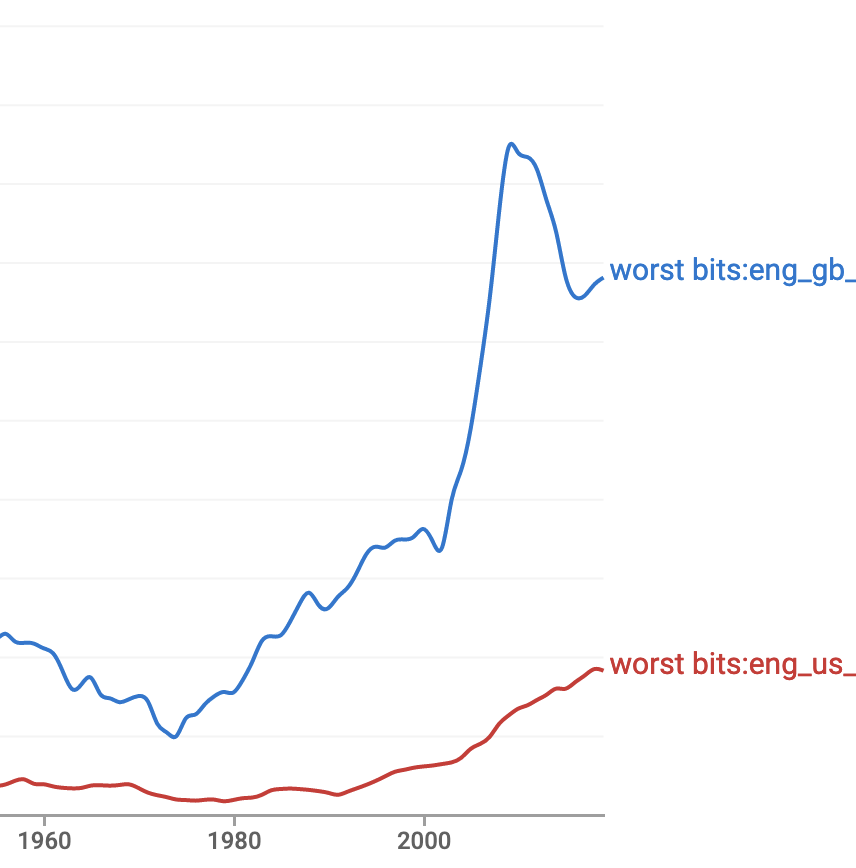
I was immediately suspicious that Le Guin would have written “worst bits” (or, for that matter, “full stop” rather than “period”). And indeed, Ngram Viewer shows 1976 to be pretty much the nadir of American “worst bits”:
I commented about this on Facebook and Friedman replied: “It’s quite possible that her TLS editor amended the piece to accord with British usage. That certainly happened to me more than once back when I used to occasionally write proper reviews for them. The revisions would part of the back-and-forth as the editor and I arrived at a final draft, so if that was the case with Le Guin, she would have agreed to them.”
We’ll probably never know the truth. But my bet is on editorial suggestion.