

Nancy Friedman recently alerted me to an American use of a Britishism I had been unfamiliar with. (As she does.) It was from a blog post by an American writer named Tim Carmody, referring to an interview with public radio figure Ira Glass, in which Carmody thought Glass was unforthcoming: “he kind of schtums up and falls back on generalities and a few broad compliments.”
The OED doesn’t have an entry for “schtum,” but, unsurprisingly, Green’s Dictionary of Slang does. Green’s says its origin was the Yiddish word for “silent” and gives these citations:
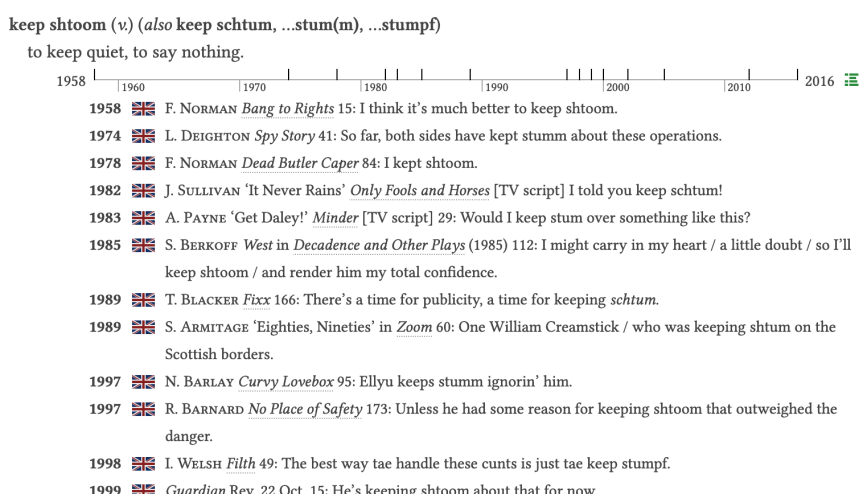
One immediately notices the array of spellings — shtoom, stumm, schtum, stumm, and stumpf — and the procession of Union Jacks, indicating all of the sources are British. In an admittedly less than comprehensive search, I was unable to find any other American uses beyond Carmody’s, other than an National Public Radio interview with the British author of a novel called Shtum (about a 10-year-old boy with autism who has never spoken). Therefore I’m classifying it as “Outlier.” (BTW, Green’s has a separate entry for the verb form Carmody used, “shtoom up.”)
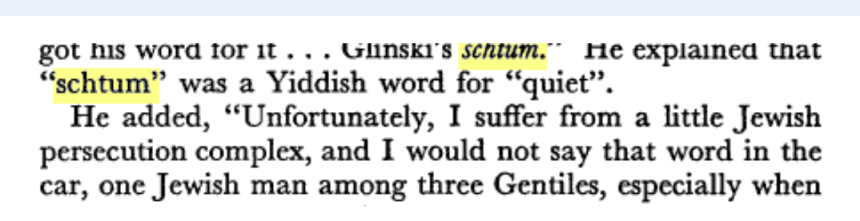
The word apparently emerged from Yiddish to the British criminal underground; Green’s first citation is from a memoir of petty crime and prison by Frank Norman. I was able to antedate that by one year. British journalist Laurence Wilkinson’s 1957 book Behind the Face of Crime has this passage (the snippet view was all I could get from Google Books):











 (Note the banning of “transpire.”)







 notoneoffbritishisms.com