I was reading an article in The New Yorker in which the (American) author, Alice Gregory, refers to someone “learning the vocabulary for kitchen utensils while laying the table.” I assumed the last three words meant what I had always called “setting the table” — putting dishes, utensils (cutlery in BrE) and napkins (serviettes) on it. And I had a hunch it was a Britishism.
Sure enough, Lynne Murphy wrote about the phrase back in 2006 as a straight-up Britishism — that is, no reference to use by Americans. There was, however, this anonymous comment on Lynne’s post, presumably written by an American: “In Code to Zero British author Ken Follett has his American character in 1958 America ‘lay’ the table…..I had to look it up!”
I don’t have any record of any American other than Gregory using the phrase, so will label it as “Outlier” for the time being. If I learn of any more, I’ll upgrade to “On the Radar.”
New York Times book critic Dwight Garner is always worth reading. He has excellent judgment, he’s widely read, he’s always ready with an apt and toothsome quotation (in fact, he’s published a book of his favorite quotes), he comes up with great metaphors and similes, and, not least, he’s fond of somewhat obscure Not One-Off Britishisms.
His column in today’s paper has two of them. He quotes the author of the book he’s reviewing (Songbooks: The Literature of Popular Music) as describing novelist Jonathan Lethem as “the greatest used bookstore clerk of all time.” Garner: “Lethem’s eventual biographer should nick that title.”
Later he (kind of fondly) calls the book “an omnishambles.”
That’s what I call going beyond the usual “gobsmacked” and “spot-on.”
I sometimes think fondly of the lively discussion engendered by my post on “can’t be arsed,” especially concerning the way the way the expression has sometimes been (mis)heard by Americans as “can’t be asked.”
In researching that post, I encountered “can’t be bothered” as an expression meaning roughly the same thing, that is, being unwilling to do something because it would take too much effort or you are too lazy. The Macmillan Dictionary identifies it as “British informal” and gives these examples: “
“I said I’d go out with them tonight, but I can’t be bothered.”
“She couldn’t even be bothered to say hello.”
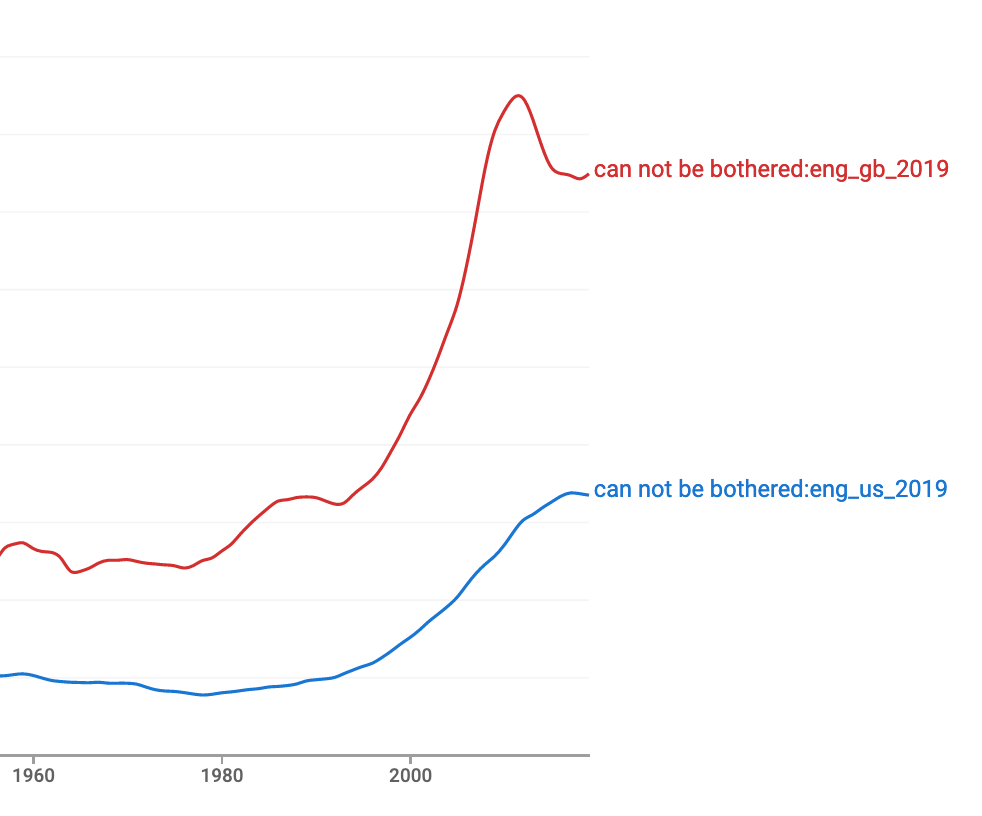
Google Books Ngram Viewer confirms the British predominance:
The ascending blue line post-1990 suggests NOOB status. Another piece of data is a 2005 song by country music’s Miranda Lambert:
And just a few weeks ago, this headline, referring to an obnoxious corporate executive who kept a list of employees who he felt were not up to the task, appeared in the New York Times:
N
Now all that said, I don’t believe Americans have as yet picked up on a related expression, “I’m not bothered,” meaning I don’t care one way or another. (“Would you like to go to a Chinese restaurant or a gastropub?” “I’m not bothered.”) Much less inverted and pronounced with th-fronting, a la the comedian Catherine Tate’s catchphrase:
I’m a big fan of the British author Anthony Horowitz’s mysteries. They’re old-fashioned, in the Agatha Christie vein, but also very clever and also frequently with the self-conscious meta aspect I’m partial to. Like in The Word Is Murder, there’s a character named “Anthony Horowitz” who’s a mystery writer. And a key part of Magpie Murders is a (fictional) mystery novel, the entirety of which is included in the text.
The same thing happens in his most recent book to be released in the U.S., Moonflower Murders. The novel-within-the-novel is called Atticus PündTakes the Case, Pünd being the detective main character. Horowitz does a delicate dance with this this text: it has to be good enough to hold our interest, but it’s also meant to be bit hokey — and certainly not as good as his own book that surrounds it.
One particular flaw in the embedded text has to do with a character named Charles Pargeter, who we’re told “had the look of a Harvard professor” and “spoke with an American accent.” He does have a home in Knightsbridge as well as New York. Yet I don’t think that can explain the number of Britishisms Pargeter uses. He says:
“The combination was sent to me by post.” (Americans would say “in the mail.”)
“We were actually at college together.” (Americans do indeed say “college” instead of “university,” but would phrase it as either “in college” or “went to college.”)
“He also got Harris out of bed and asked him if he’d heard anything, but there was no joy there.”
“That horse has bolted, as the saying goes.” (The American version of that British saying is “the horse has left the barn.”)
We’re not told the nationality of Pargeter’s wife, Elaine, but she talks British, too:
“They went upstairs and they also looked round the side of the house, where the window had been broken…. The next morning we had a whole crowd of people from Scotland Yard: forensics, photographers, the lot!”
“Looked round” and “the lot” are Britishisms.
As I say, Atticus PündTakes the Case is intentionally not great, but I don’t think the Parmenters’ misplaced language is intentional on Horowitz’s part. I can’t tell you why. In fact, I may have already said too much.
I am surprised that “dicey” is not on your list. Though fairly common in the US nowadays, I do recall having to ask my English mother about it back in the 1980s.
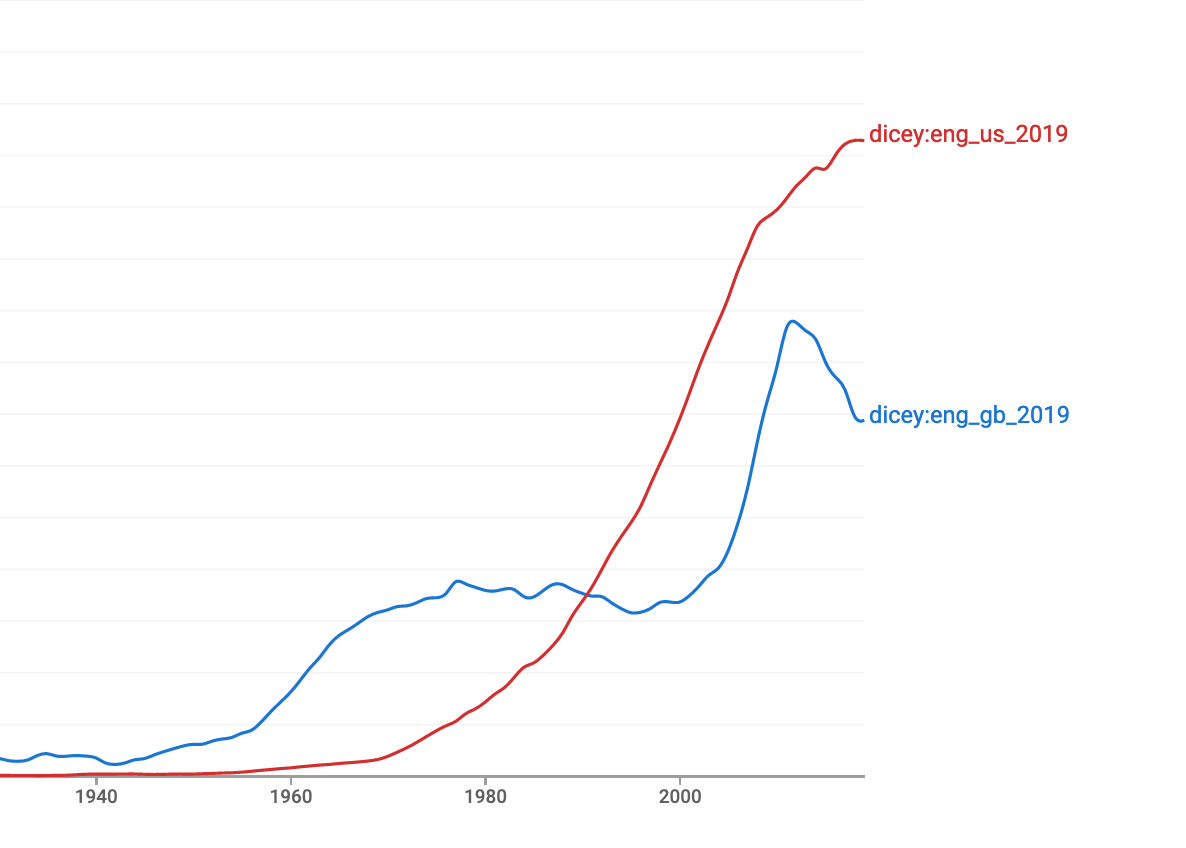
“Fairly common” might understate the case. Let’s go to Google Books Ngram Viewer. It tells a fairly clear story about the word, which the OED defines as “Risky, dangerous; uncertain, unreliable.”
That is, the word apparently originated in Britain, was picked up in the U.S. in the ’70s, started to be used more frequently here in about 1990, and is now so common that Americans (meaning me) had no idea it originated across the pond. In honor of the word, I have created a new category, “Outstripped.”
Green’s Dictionary of Slang classifies the word as “RAF slang” and gives its first citation Nevile Shute’s 1950 novel A Town Like Alice: “He […] made a tight, dicey turn round in the gorge with about a hundred feet to spare.” (Shute was an Englishman with an aeronautics background who moved to Australia late in his life.) The first American quote is from 1961.
Now, to repeat, “dicey” feels like an Americanism. Why else would the New York Times have used it 53 times in the last year alone?
Today’s New York Times has an article about FInland, for the fourth year in a row, being named the happiest country in the world. The article notes that this is somewhat ironic:
Finns embrace depictions of themselves as melancholic and reserved — a people who mastered social distancing long before the pandemic. A popular local saying goes, “Happiness will always end in tears.”
If you follow the link at the end, it will lead you to an article about Finnish idioms which gives the Finnish version of that one: “itku pitkästä ilosta.”
It reminded me that someone reader Tim Orr had not long ago suggested a post on “end in tears.” The phrase was used now and again in the nineteenth century, for example by a character in George Eliot’s 1868 narrative poem The Spanish Gypsy: “But soon that thought, struggling to be a hope, would end in tears.”
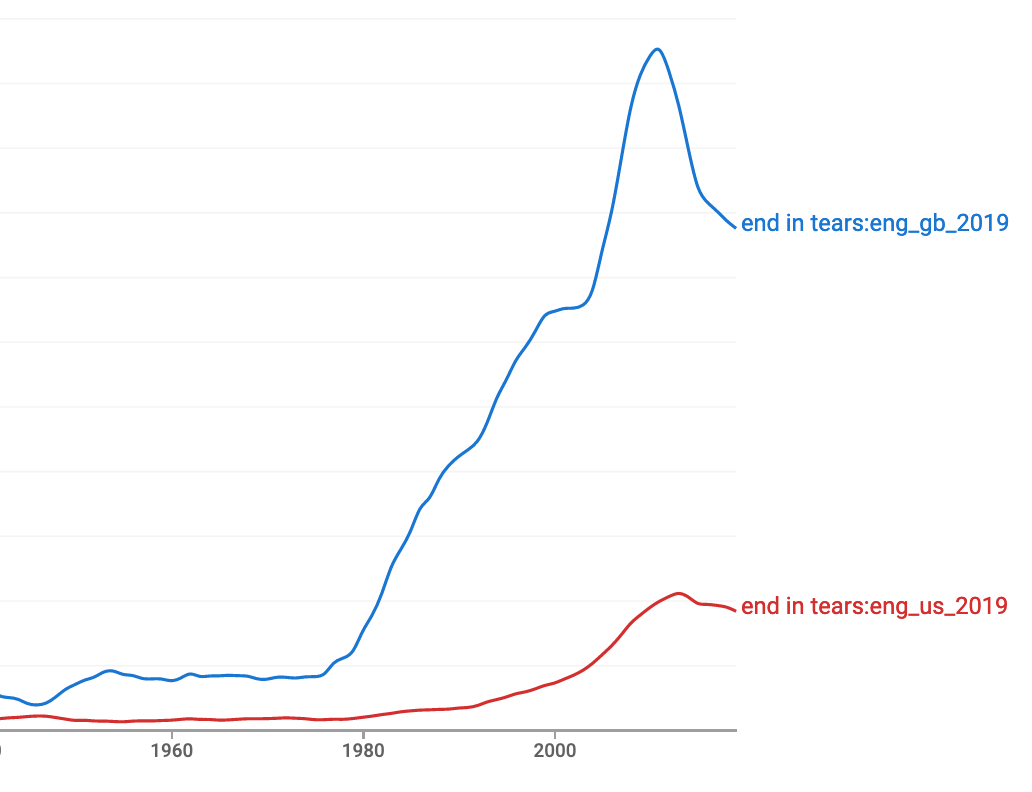
Google Books Ngram Viewer indicates it was used with roughly the same frequency in Britain and the U.S. until about 1920, when British use began gaining. Then, in the late ’70s, it took off as a “catch phrase” in the U.K., often with an ironic cast, and kept rising till 2010.
Toward the end of that span, in 2005, Ruth Rendell used the phrase as the title of one of her Inspector Wexford mysteries.
The chart shows a modest U.S. uptick in the ’90s and 2000s, suggesting NOOB-itude. A New York Times search confirms it, yielding three uses (not including the Finnish one) in the past nine months.
“A lot of us have tried to move on, and when we saw the news, it wasn’t a huge surprise. The people who have served on the ground are the last people you need to tell that the war is going to end in tears.”–an American veteran of the Afghanistan war, on the news that the U.S. is pulling out all its troops.
“’Why pay a lot for a wedding, and more for the divorce, for something that might end in tears?’ said Ms. Pfefferkorn, 38, a native of the Bay Area.”
“I humbly note that naming your smart light bulb ‘Vestibule Hue light two’ will always end in tears.” — article by tech writer Jon Chase.
I’m not sure if it will really take off here. Americans may not have quite enough irony in their DNA.
Sometimes, this blog writes itself. The most recent falling-in-lap bounty comes via the Wall Street Journal. And before I get into it, I’ll say that this past weekend, the Journal‘s language columnist, the redoubtable Ben Zimmer, has written a piece about the incursion into America of British “jab,” crediting NOOBs with the first noticing of the trend back in December.
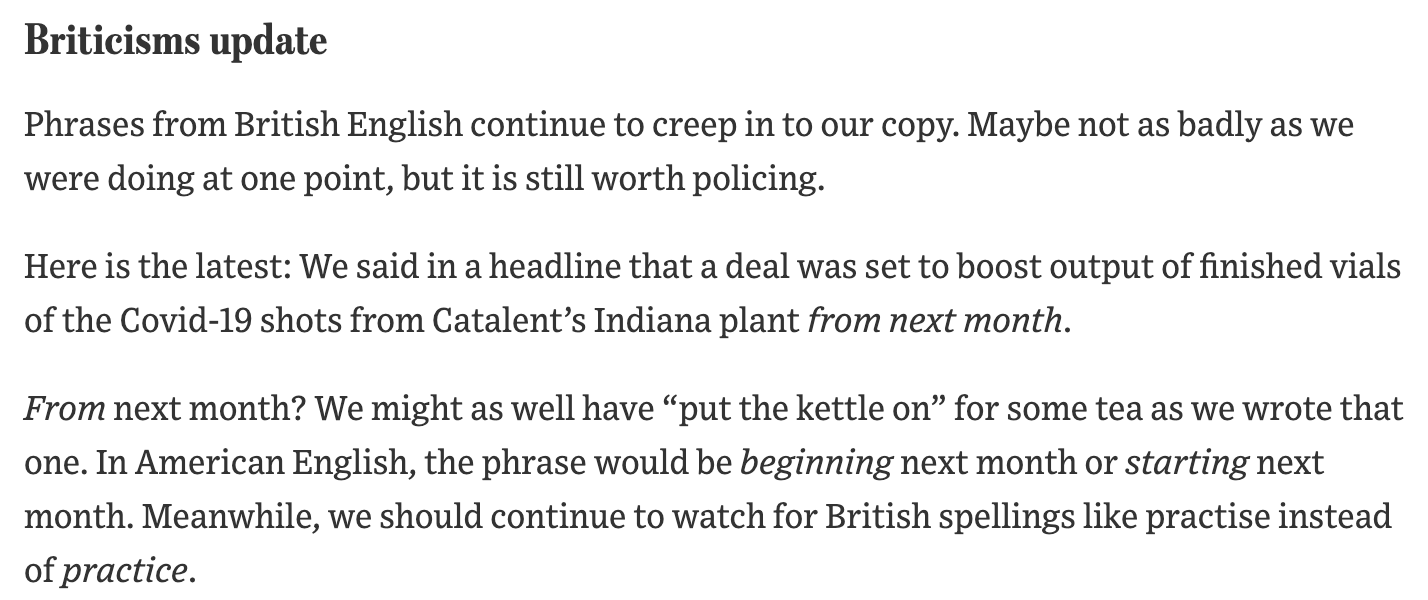
Around the same time, Caitlin Ostroff, a Journal staffer, noted on Twitter that the paper’s in-house style memos are now online. She shared this excerpt from one of them:
First of all, on the first word in the heading. There are two terms that indicate a particularly British word or phrase: “Briticism” (first OED cite 1868) and “Britishism” (1879). According to Google Books Ngram Viewer, “Briticism” was more commonly used till the decade of the 2010s, when it was surpassed by “Britishism.” And that’s the one I prefer, hence the name of this blog.
As for “from next month,” I confess I had no idea it existed, but yes, I agree with the author of the memo that it’s not idiomatic in American English. In addition to the alternatives he or she suggests, I’ll add “from next month on.”
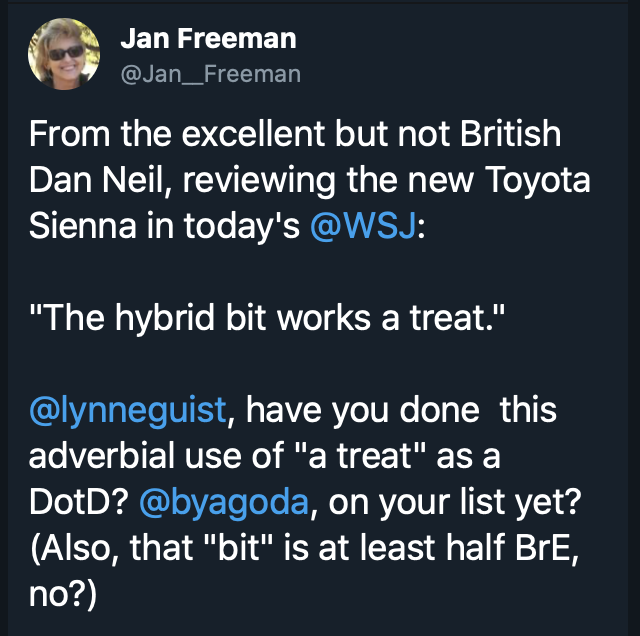
The day after Ostroff’s tweet, the always observant Jan Freeman had a tweet of her own:
Again, “works a treat” was a new one on me. The OED has an entry for “a treat,” defined as “so as to gratify highly; extremely well; also (gen. or ironically) extremely, excessively. colloquial.” All the citations are British, including one from Alan Sillitoe’s The Loneliness of the Long Distance Runner (1954): “The sports ground looked a treat: with big tea-tents all round and flags flying.” The most recent quotation is from the American magazine The New Yorker in 1984, but it was written by the Scottish poet Douglas Dunn: “I knew this floor had life left in it… It’s come up a treat.”
In any case, I bet the Journal style desk is on Dan Neil’s case even as we speak.
As for Jan Freeman’s final question, my answer is, Yes! That is, the British say “bit” where Americans would traditionally say “thing,” “part,” “aspect,” or “dimension,” and I believe I’ve covered it more than any other word, most recently here.
Two days later, yet another American used another British word in the Wall Street Journal–although, to the relief of the style desk, the American was a source, not a Journal writer. Dennis McNally, former publicist for the Grateful Dead, described seeing the band’s wall of amplifiers and speakers for the first time: ““It looked like a spaceship, a giant alchemical sculpture. I was gobsmacked.”
Lesley McCullough, who alerted NOOBs to “happy-clappy,” has a new hyphenated expression on her mind. She writes:
While reading a review in New York Magazine of “Six Minutes to Midnight” a new film written and starring Eddie Izzard, I noticed that the writer Helen Shaw referred to a performance by James D’Arcy as follows: “In D’Arcy’s case, he has chosen a wildly over-egged delivery, slicing each word onto the plate as though he’s serving Christmas ham.” I have always thought of “over-egged” as a particularly UK compound adjective derived from the idea of an over egged pudding being too rich and fluffy.
As with “happy-clappy,” I had no familiarity with “over-egged.” The OED confirms Lesley’s sense, defining the verb form, “over-egg,” as: “To embellish or supply to excess. Chiefly in to overegg the pudding: to go too far in exaggerating, embellishing, or doing something.” The first citation, from the 1845 book Hillingdon Hall, helpfully gives information on the term’s origin: “‘We mustn’t over-egg the pudding,’ as the Yorkshire farmers say.” It and all subsequent cites are from British sources. Interestingly, only the most recent one, from the Evening Standard in 2002, leaves out “pudding.” (“The bank was anxious however, not to overegg investor expectations for the current year.”)
The first time the expression appeared in the New York Times (other than written by or quoting British people) was in William Safire’s language column in 2003, in which Safire reported being asked about it and admitted never having heard it. The next time was in 2007, by the writer Paul Theroux, who is an honorary Englishmen. But then it showed up twice in 2020: in a film critic’s judgment of the 2020 film Fire Saga that “this over-egged farce whips slapstick and cheese into an authentic soufflé of tastelessness,” and in a book reviewer’s judgment that in a biography of Ted Kennedy, “scenes are often over-egged.” Both those writers are American.
As is Helen Shaw, whose review prompted Lesley to write. Or at least she went to Harvard.
I wanted to get this post in today, February 28, because it’s the last day I can with any claim to precision mark the tenth anniversary of this blog. The first post (on “advert“) was actually February 13, 2011 (or 13 February 2011) but I’m going by month.
Some numbers. I have written 616 posts, averaging a bit more than 300 words each, which amounts to some 200,000 words — the equivalent of two medium-sized books. (Actually, I now recall, I’ve only written 615 — Jack Bell did a guest post on soccer/football terminology.) There have been more than 2,597,000 page views. Because of some publicity in the New York Times and the BBC, 2012 saw the most traffic, with about 420,000 views, but it’s been quite steady since then, with between 210,000 and 310,000 views a year.
I keep thinking I’ll retire the blog, but new NOOBs keep popping up. Right now I’m tracking, among others, “jump the queue/line,” “end in tears,” “wicked,” and “right” as adverb (as in “It was a right rainy day”). And frankly I’m glad that it keeps plugging along, first, because it’s fun to do, and second, because of the comments (more than 9,000) so far. Having you lot (a Britishism that hasn’t risen to the level of NOOB … yet) out there –funny, smart, sometimes disputatious — has really made it worthwhile. All in all, I’m really looking forward to the next ten years.
I write to you from the Yukon Territory to ask about an expression I read in the Stephen Colbert profile by Joe Hagan, contained in the recent Holiday issue of Vanity Fair. Hagan writes, ” It’s all a reminder of how little distance there is between Colbert the CBS entertainer and Colbert the stuck inside a room like us, no happy-clappy circus at the Ed Sullivan Theatre to buoy him.”
I have always known “happy-clappy” as a scornful UK expression for super cheerful Christians who beat tambourines and sing modern hymns loudly and off key. I lived in Scotland as a kid and there it always seemed to be applied to evangelical English. And Google seems to bear my understanding out.
So, is this a one-time Britishism misused by the writer who I believe is from the States? Or is it evidence of a new Not One-Off Britishism? Or does the phrase have a different meaning in the U.S. than in the U.K. and Canada?
My answer’s to Lesley’s questions are yes, probably not, and I guess. The OED bears out her sense of the meaning of the expression, which falls under the classification “reduplicative” (like “arts-fartsy” and “argy-bargy“). It’s both a noun (“A member of a Christian charismatic or evangelical group whose worship is characterized by enthusiastic participation; [more generally] a charismatic or evangelical Christian”) and an adjective (“Of, relating to, or characterized by membership of such a group, or enthusiastic participation in worship; charismatic, evangelical”). The definitions probably should take note of the usual negative connotation. For example, someone wrote in The Times in 1993: “Is the man at the helm of the church an intelligent astute leader or a happy-clappy simpleton who will plunge his church into disestablishment?”
The phrase seems to have popped up first in Australia. The “Word Histories” blog reports:
The earliest instance of happy-clappy, used in this sense, that I have found is from the very beginning of the review of Dr J. I. Packer’s book Keep in Step with the Spirit, published in The Age (Melbourne, Victoria) on 1st April 1985:
“Two brands of Christianism making themselves felt today are the ‘born again’ kind professed by Jimmy Carter and supportive of Ronald Reagan, and the happy-clappy, tongues-speaking, faith-healing kind called Pentecostal until it invaded the mainline churches in the late 1960s and became ‘charismatic renewal’.
Subsequent examples from Word Histories and the OED are all from Australia, South Africa, or the U.K.
As for “happy-happy” having a different meaning in the U.S., my qualified answer has to do with the power of reduplicatives. Word Histories found two American examples. Neither one has the religious sense and in both cases, I would imagine, the writer felt he or she made it up: A 1958 article from North Carolina invoked “the soothing strains of a string band and the happy-clappy feet of nimble square dancers,” and a 1990 Illinois review of an outpost of the Olive Garden restaurant referred to “those happy-clappy waiters and waitresses who seem to love to sing birthday cheer, but appear to know next to nothing about the menu.”