The Taliban Are Plural

This is a (rare) timely post for the blog, and I wish it weren’t keyed to a somber occurrence, the Taliban’s taking control of Afghanistan. But it is, and that turn of events has been accompanied by headlines such as this.

Note the verb” “control” rather than “controls.” Wes Davis wondered if this was an example of American adoption of the British style of singular plural verb for collective noun, such as “Parliament have adjourned” or “Chelsea are expected to win today.” [Note: As commenters have pointed out, I was apparently wrong in saying that “Parliament” frequently, or maybe ever, takes a plural verb. A better example would be “the government are,” which I wrote about here. That post also contains links to previous discussions of this issue.]

The answer to Wes’s question is, in a word, no. Or mostly no. Merriam-Webster’s online dictionary describes “Taliban” as a plural noun and explains: “Pashto & Persian ṭālibān, plural of ṭālib student, seeker, from Arabic.”

Recognizing this, the Associated Press and National Public Radio treat the word as plural. I don’t have access to the New York Times style guide but judging by this headline and other examples, that paper appears to follow suit.

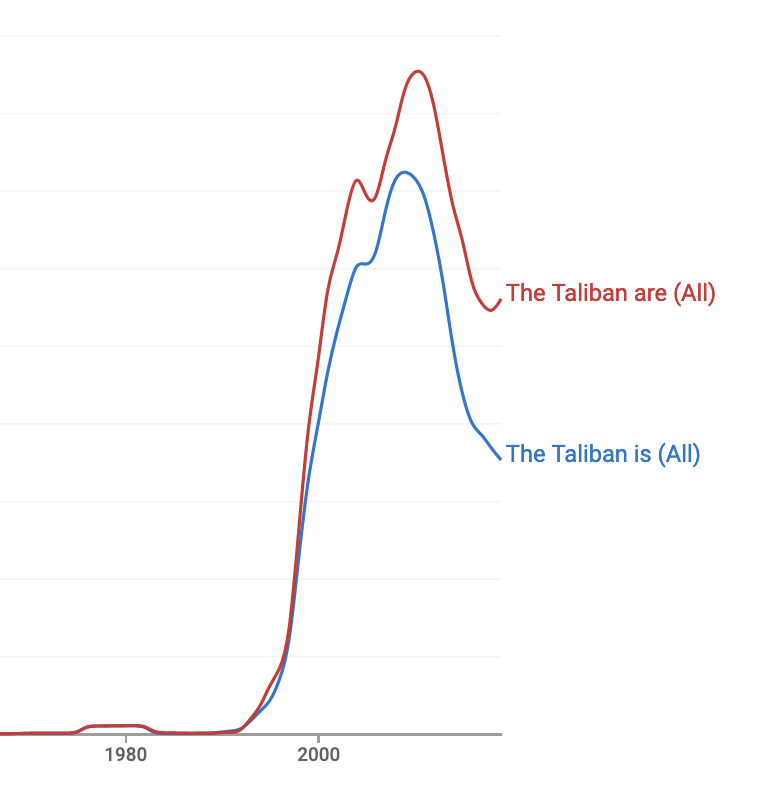
Google Books Ngram Viewer, working from a broad database of printed sources, shows that in America, the plural and singular were roughly equal until about the year 2000, when the plural form began to gain some separation.

Now, is that increased popularity a result of the NOOBs phenomenon? It’s impossible at this point to say, but it’s nice to think so.

“Have a go”; “Give it a go”

In a previous post about the “Peppa Pig Effect” — the phenomenon of American toddlers picking up British terminology and accent from a television cartoon — I mentioned a Guardian article on the subject whose title starts “Having a Go.”

“Have a go” is indeed a Not One-Off Britishism, of the historical variety (meaning that its U.S. adoption wasn’t recent). Its original meaning, says the OED, was “To aim a blow or shot at someone or something; to make an attack or onslaught upon someone or something.” The first citation is from Lady’s Magazine in 1792: “I felt such a flow of spirits and courage, that I hid myself behind a tree, determined to have a go at him—the moment he passed me, I fired my pistol.”

Fairly quickly it took on a broader sense of attacking verbally or criticizing, and the still broader sense (with which I associate the phrase) of “To make an attempt at something; to have a spell or turn of doing something.” An 1863 citation is from Charles Reade’s novel Hard Cash: “You have stumbled on a passage you can’t construe… Here, let me have a go at it.”

It and (at first glance) all the other citations for all three senses are from British sources. However, Green’s Dictionary of Slang, interestingly, has African-American sources for the attacking meaning, including John Ridley’s 2002 book A Conversation with the Mann: “He was fixing to have a go at these boys like he was Charlie Bad-Brother.”

And I can attest that the meaning of having a try or a turn has been widely used in the U.S. for some time. For example, a New York Times review of the 1961 film Voyage to the Bottom of the Sea has the line, “There’s no earthly or oceanic reason why [director Irwin] Allen shouldn’t have had a go at such a subject on a frank entertainment level.” And in a 2020 Times article about the television program Dispatches from Elsewhere, the (American) reporter writes of an actor, “He had a go at defining the show.”

The Guardian article (as opposed to the headline) says American Peppa Pig watchers have adopted a rather different phrase, “give it a go.” To my ears this means basically the same thing as “have a go.” Neither the OED not Green’s has an entry for it, but it shows up in two OED citations in a definition for “go” (as try or attempt). The second is a recent quote from an English newspaper but the first, surprisingly is from The Boston Daily Globe in 1892: “There was an air of diffidence about the different drug stores that were opened yesterday, which plainly said, ‘We are not sure of this matter, but we’ll give it a go and see how it comes out.’”

That would appear to be an outlier both linguistically and geographically. Searching the vast Google Books database, I don’t find “give it a go” showing up till 1915 or ’16, with the early uses all being from Commonwealth sources, especially Australia and New Zealand, as in this screen shot:

And Ngram Viewer, which is based on Google Books, shows that both phrases began in Britain (the blue and red lines), then gained popularity in the U.S. (orange and green) in the 2000s — which is, of course, the era of NOOBs.

Ngram Viewer also confirms my guess that “give it a shot” is the American version of the synonymous “give it a go.”

American Character, British Lingo

I’ve noted in the past examples of British writers (unwittingly?) putting Britishisms in the mouths of American characters. Actually, I’m surprised it doesn’t happen more often, as well as the opposite case of American writers having British characters utter Americanisms. There are so many big and small differences in the dialects: how can we possibly be aware of every case where our friends across the pond say it differently? An example that comes to mind is British “driving license”/American “driver’s license.” If I were writing a novel and didn’t happen to be obsessively attuned to such things, I would certainly have a British character say “driver’s license.” A copyeditor (subeditor in BrE) might catch it, but he or she might not.

My latest examples come from a very good novel (in my opinion) called Trio, by the very good English writer William Boyd. There’s an American actress in whose mouth Boyd — I am sure unwittingly — puts two Britishisms in one sentence. He has her describing her role in her current project: “I’m meant to be a famous film star who’s making a film in Brighton.”

Meant to” for this particular connotation of “supposed to” is pure British. And an American would say “movie star” instead of “film star.” Of course, it’s possible that Anny, as a when-in-Rome sort of thing, has adopted these expressions, but that’s pretty subtle (and there aren’t any other ones).

I was at first going to accuse Boyd of another slip. At one point, this character, Anny, says, “Now I have the money. Everything’s fine.” I initially read that as one sentence: “Now I have the money, everything’s fine.” Americans would say “Now that I have the money…” but a British locution (which Boyd’s British characters all use) leaves out the “that.” However, Anny’s dialogue, in two sentences, is two separate thoughts, and perfectly American. So we’re good.

And full marks to Boyd for having Anny say “cookies” instead of “biscuits“!

Note: As a commenter pointed out, I was not strictly correct in describing William Boyd’s nationality. Here’s what Wikipedia says:

“Boyd was born in Accra, Gold Coast, (present-day Ghana),to Scottish parents… His father Alexander, a doctor specialising in tropical medicine, and Boyd’s mother, who was a teacher, moved to the Gold Coast in 1950 to run the health clinic at the University College of the Gold Coast… In the early 1960s the family moved to western Nigeria… At the age of nine, [Boyd] went to a preparatory school and then to Gordonstoun school in Scotland, and, after that, to the University of Nice in France, followed by the University of Glasgow,…and finally Jesus College, Oxford.”

He currently divides his time between London and a farmhouse in southwest France.

The “Peppa Pig” Effect

I have never gotten more NOOBs-related emails and messages than the ones generated by an article that appeared in The Wall Street Journal on July 18. I believe you need a subscription to read the whole thing, but here’s a recap that appeared in The Guardian the next day.

The upshot is that an animated British kids’ TV show, Peppa Pig, has become so popular in the U.S. that many little kids are uttering Britishisms in plummy accents. A California father reports that his “daughter calls the gas station the ‘petrol station’ and cookies ‘biscuits,’ and when he’s holding a cup of coffee, Dani asks him, ‘Are you having tea now?’”

A Seattle mother attracted more than 10 million views with a TikTok video of her Peppa-obsessed daughter, who, she reported, “speaks in a fully British accent at all times.”

One thing I found interesting about the article and phenomenon is that only one of the examples are actually NOOBs. That is, adult Americans have not adopted “biscuits,” “petrol,” “telly,” “water closet,” or “power cut.” The exception is a word the little girl uses in the TikTok clip: “How clever!”

The Guardian article has in its headline a real live NOOB: “Having a go: US parents say Peppa Pig is giving their kids British accents.”

Americans do indeed use “have a go,” and I never realized it was of British origin, though I probably should have (done). Watch this space for a further investigation.

“Lay the Table”

I was reading an article in The New Yorker in which the (American) author, Alice Gregory, refers to someone “learning the vocabulary for kitchen utensils while laying the table.” I assumed the last three words meant what I had always called “setting the table” — putting dishes, utensils (cutlery in BrE) and napkins (serviettes) on it. And I had a hunch it was a Britishism.

Sure enough, Lynne Murphy wrote about the phrase back in 2006 as a straight-up Britishism — that is, no reference to use by Americans. There was, however, this anonymous comment on Lynne’s post, presumably written by an American: “In Code to Zero British author Ken Follett has his American character in 1958 America ‘lay’ the table…..I had to look it up!”

I don’t have any record of any American other than Gregory using the phrase, so will label it as “Outlier” for the time being. If I learn of any more, I’ll upgrade to “On the Radar.”

A Double Dose of NOOBs from Garner

New York Times book critic Dwight Garner is always worth reading. He has excellent judgment, he’s widely read, he’s always ready with an apt and toothsome quotation (in fact, he’s published a book of his favorite quotes), he comes up with great metaphors and similes, and, not least, he’s fond of somewhat obscure Not One-Off Britishisms.

His column in today’s paper has two of them. He quotes the author of the book he’s reviewing (Songbooks: The Literature of Popular Music) as describing novelist Jonathan Lethem as “the greatest used bookstore clerk of all time.” Garner: “Lethem’s eventual biographer should nick that title.”

Later he (kind of fondly) calls the book “an omnishambles.”

That’s what I call going beyond the usual “gobsmacked” and “spot-on.”

“Can’t be bothered”

I sometimes think fondly of the lively discussion engendered by my post on “can’t be arsed,” especially concerning the way the way the expression has sometimes been (mis)heard by Americans as “can’t be asked.”

In researching that post, I encountered “can’t be bothered” as an expression meaning roughly the same thing, that is, being unwilling to do something because it would take too much effort or you are too lazy. The Macmillan Dictionary identifies it as “British informal” and gives these examples: “

“I said I’d go out with them tonight, but I can’t be bothered.”

“She couldn’t even be bothered to say hello.”

Google Books Ngram Viewer confirms the British predominance:

The ascending blue line post-1990 suggests NOOB status. Another piece of data is a 2005 song by country music’s Miranda Lambert:

And just a few weeks ago, this headline, referring to an obnoxious corporate executive who kept a list of employees who he felt were not up to the task, appeared in the New York Times:

N

Now all that said, I don’t believe Americans have as yet picked up on a related expression, “I’m not bothered,” meaning I don’t care one way or another. (“Would you like to go to a Chinese restaurant or a gastropub?” “I’m not bothered.”) Much less inverted and pronounced with th-fronting, a la the comedian Catherine Tate’s catchphrase:

The Case of the Misplaced Britishisms

I’m a big fan of the British author Anthony Horowitz’s mysteries. They’re old-fashioned, in the Agatha Christie vein, but also very clever and also frequently with the self-conscious meta aspect I’m partial to. Like in The Word Is Murder, there’s a character named “Anthony Horowitz” who’s a mystery writer. And a key part of Magpie Murders is a (fictional) mystery novel, the entirety of which is included in the text.

The same thing happens in his most recent book to be released in the U.S., Moonflower Murders. The novel-within-the-novel is called Atticus Pünd Takes the Case, Pünd being the detective main character. Horowitz does a delicate dance with this this text: it has to be good enough to hold our interest, but it’s also meant to be bit hokey — and certainly not as good as his own book that surrounds it.

One particular flaw in the embedded text has to do with a character named Charles Pargeter, who we’re told “had the look of a Harvard professor” and “spoke with an American accent.” He does have a home in Knightsbridge as well as New York. Yet I don’t think that can explain the number of Britishisms Pargeter uses. He says:

“The combination was sent to me by post.” (Americans would say “in the mail.”)

“We were actually at college together.” (Americans do indeed say “college” instead of “university,” but would phrase it as either “in college” or “went to college.”)

“He also got Harris out of bed and asked him if he’d heard anything, but there was no joy there.”

“That horse has bolted, as the saying goes.” (The American version of that British saying is “the horse has left the barn.”)

We’re not told the nationality of Pargeter’s wife, Elaine, but she talks British, too:

“They went upstairs and they also looked round the side of the house, where the window had been broken…. The next morning we had a whole crowd of people from Scotland Yard: forensics, photographers, the lot!”

“Looked round” and “the lot” are Britishisms.

As I say, Atticus Pünd Takes the Case is intentionally not great, but I don’t think the Parmenters’ misplaced language is intentional on Horowitz’s part. I can’t tell you why. In fact, I may have already said too much.

“Dicey”

Reader Tony Mates, from Seattle, writes:

I am surprised that “dicey” is not on your list. Though fairly common in the US nowadays, I do recall having to ask my English mother about it back in the 1980s. 

“Fairly common” might understate the case. Let’s go to Google Books Ngram Viewer. It tells a fairly clear story about the word, which the OED defines as “Risky, dangerous; uncertain, unreliable.”

That is, the word apparently originated in Britain, was picked up in the U.S. in the ’70s, started to be used more frequently here in about 1990, and is now so common that Americans (meaning me) had no idea it originated across the pond. In honor of the word, I have created a new category, “Outstripped.”

Green’s Dictionary of Slang classifies the word as “RAF slang” and gives its first citation Nevile Shute’s 1950 novel A Town Like Alice: “He […] made a tight, dicey turn round in the gorge with about a hundred feet to spare.” (Shute was an Englishman with an aeronautics background who moved to Australia late in his life.) The first American quote is from 1961.

Now, to repeat, “dicey” feels like an Americanism. Why else would the New York Times have used it 53 times in the last year alone?

“End in tears”

Today’s New York Times has an article about FInland, for the fourth year in a row, being named the happiest country in the world. The article notes that this is somewhat ironic:

Finns embrace depictions of themselves as melancholic and reserved — a people who mastered social distancing long before the pandemic. A popular local saying goes, “Happiness will always end in tears.”

If you follow the link at the end, it will lead you to an article about Finnish idioms which gives the Finnish version of that one: “itku pitkästä ilosta.”

It reminded me that someone reader Tim Orr had not long ago suggested a post on “end in tears.” The phrase was used now and again in the nineteenth century, for example by a character in George Eliot’s 1868 narrative poem The Spanish Gypsy: “But soon that thought, struggling to be a hope, would end in tears.”

Google Books Ngram Viewer indicates it was used with roughly the same frequency in Britain and the U.S. until about 1920, when British use began gaining. Then, in the late ’70s, it took off as a “catch phrase” in the U.K., often with an ironic cast, and kept rising till 2010.

Toward the end of that span, in 2005, Ruth Rendell used the phrase as the title of one of her Inspector Wexford mysteries.

The chart shows a modest U.S. uptick in the ’90s and 2000s, suggesting NOOB-itude. A New York Times search confirms it, yielding three uses (not including the Finnish one) in the past nine months.

  • “A lot of us have tried to move on, and when we saw the news, it wasn’t a huge surprise. The people who have served on the ground are the last people you need to tell that the war is going to end in tears.”–an American veteran of the Afghanistan war, on the news that the U.S. is pulling out all its troops.
  • “’Why pay a lot for a wedding, and more for the divorce, for something that might end in tears?’ said Ms. Pfefferkorn, 38, a native of the Bay Area.”
  • “I humbly note that naming your smart light bulb ‘Vestibule Hue light two’ will always end in tears.” — article by tech writer Jon Chase.

I’m not sure if it will really take off here. Americans may not have quite enough irony in their DNA.