Lynne Murphy’s new book, The Prodigal Tongue: The Love-Hate Relationship Between British and American English, has a lot of insights and revelations, which I’ll have more to say about in a subsequent post. For today, I’ll just note Lynne’s inclusion of “bestie”–slang for best friend–in a list of British expressions. That surprised me, because it’s certainly all over the place in the U.S.
But she’s right. The OED says the word is “originally and chiefly British” and has as its first citation a 1991 quote from The Observer: “Diana’s friends often date from the days BC (Before Charles). Some are Besties—reliable pals from school.” That appears to be a bit of an outlier. The next cite is from a 2008 novel called Swingers, and that’s about when the word starts showing up in the Google Books database.
By that time, “bestie” was already out and about in the United States. The first use in the New York Times came in a 2007 Maureen Dowd column, complete with quotation marks and definition indicating it was new on the scene; Dowd referred to “Urbanista, an online Rolodex that dispenses advice for ‘hip’ girls in Manhattan, offering to be a ‘bestie’ (a best friend) and answer questions like ‘Where should I go to get my Marc Jacobs shoes reheeled?’”
The word appeared once in the Times in 2009 and 2010 and kept moving up: 2012, four times; 2013, five; 2014, seven; 2015, 13; 2016, 16; and 2017, 14. (The slight dropoff is probably explained by the novelty having worn off.) There’ve been three appearances this year, including a headline:
Kardashian Bestie Simon Huck Is Selling You Beer and Shampoo
I’d be interested if any readers–British or American–could recall a specific pre-2007 when you recall using, hearing, or reading “bestie.”
As noted in the previous post, I was surprised to see Harvard historian Jill Lepore use “bits and bobs” in a New Yorker piece; the phrase seemed just too British to be used by an American. But to paraphrase John Lennon, Lepore is “not the only one.”
Backing up a bit, “bits and bobs” does not have its own entry in the Oxford English Dictionary, but is included in a larger entry for various expressions that include “bit.” It’s lumped with “bits and pieces” (very familiar to Americans) and “bits and bats” (not so) and defined as “fragments, oddments, odds and ends; small articles, personal belongings, bric-à-brac.” The first citation is an entry in A Warwickshire Word-book, 1896, which gave a sample sentence: “Gather up your bits-and-bobs, and let me lay the tea.”
However, I have found in the Google Books database a use that seems to precede that by two years. It’s in the novel Baptist Lake, by John Davidson (a Scottish writer):
For an hour and more, Mrs. Tiplady entertained Salerne with gossip — light, if a little muddy, like the froth of porter — with bits and bobs of music-hall songs and step- dances, and with caresses brief and birdlike — the wariest of landladies, deep in love with her viking as she was.
Google Books also suggests that “Bits and Bobs” was used as a chapter heading in a photography yearbook a year earlier, in 1893, but the date can’t be confirmed from what Google shows of the book.
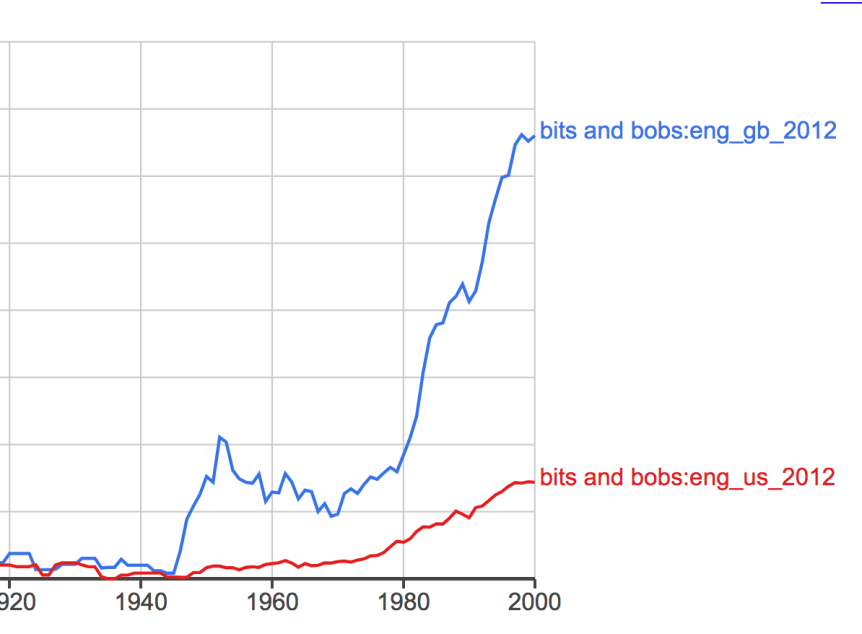
On the matter of “bits and bobs” appearing in American sources, Google Ngram Viewer shows sporadic use in the twentieth century, with a gradual increase starting in the ’70s.
The expression has been used 57 times in the New York Times, some but not all coming in quotes from British people. The first appearance is in a 1951 review of a children’s book about making puppets, using, for example, “the bits and bobs to be found in a young boy’s pocket.” And the most recent is in a December 2017 Vows column, which describes one of the two grooms: “He was always creative and enjoyed making crafts with bits and bobs of paper he had saved, ticket stubs and back-of-the-envelope doodles.”
In any case, it’s a useful expression, not quite the same as “bits and pieces”–which for me, anyway, always brings to mind the Dave Clark Five song. I imagine it’s here to stay.
The two publications I regularly read are the New York Times and the New Yorker. The latter has something of a reputation for Anglophilia (diminished somewhat since Tina Brown stepped down as editor) but in fact I tend to find more Britishisms in the Times.
However, I don’t think the Times has ever published three in one paragraph, as the New Yorker did in a January issue I just caught up with. The author is the Harvard historian Jill Lepore, and she’s writing about an intellectual-property dispute relating to two doll brands, Barbie and Bratz. Actually, Lepore has the three NOOBs in just two sentences! Can you spot them?
Carter Bryant was thirty-one and working at Mattel in August of 2000, designing clothes for Barbie, when he created Bratz, though he later said—and his legal defense turned on this claim—that he’d got the idea for the dolls while on a seven-month break from Mattel, two years earlier. He drew some sketches of clothes-obsessed, bratty-looking teen-agers—“The Girls with a Passion for Fashion!” he called them—and made a prototype by piecing together bits and bobs that he found in a trash bin at work and in his own collection at home: a doll head, a plastic body, and Ken boots.
Update: You could indeed spot them: he’d got, bits and bobs, and bin. As the links suggest, I’ve covered “he’d got” (Americans, except when writing for the New Yorker, universally say “gotten”) and “bin.” And as one commenter suggested, Lepore’s “trash bin” is a hybrid. I believe Brits would tend to say “rubbish bin” or just plain “bin,” with Americans preferring “trash can” or “waste-paper basket.” As for “bits and bobs,” I had always considered it one of those almost stereotypically British terms, like “telly” or “cheerio,” that would never be used by an American. Clearly, I was wrong, and I’ll take it up in my next post.
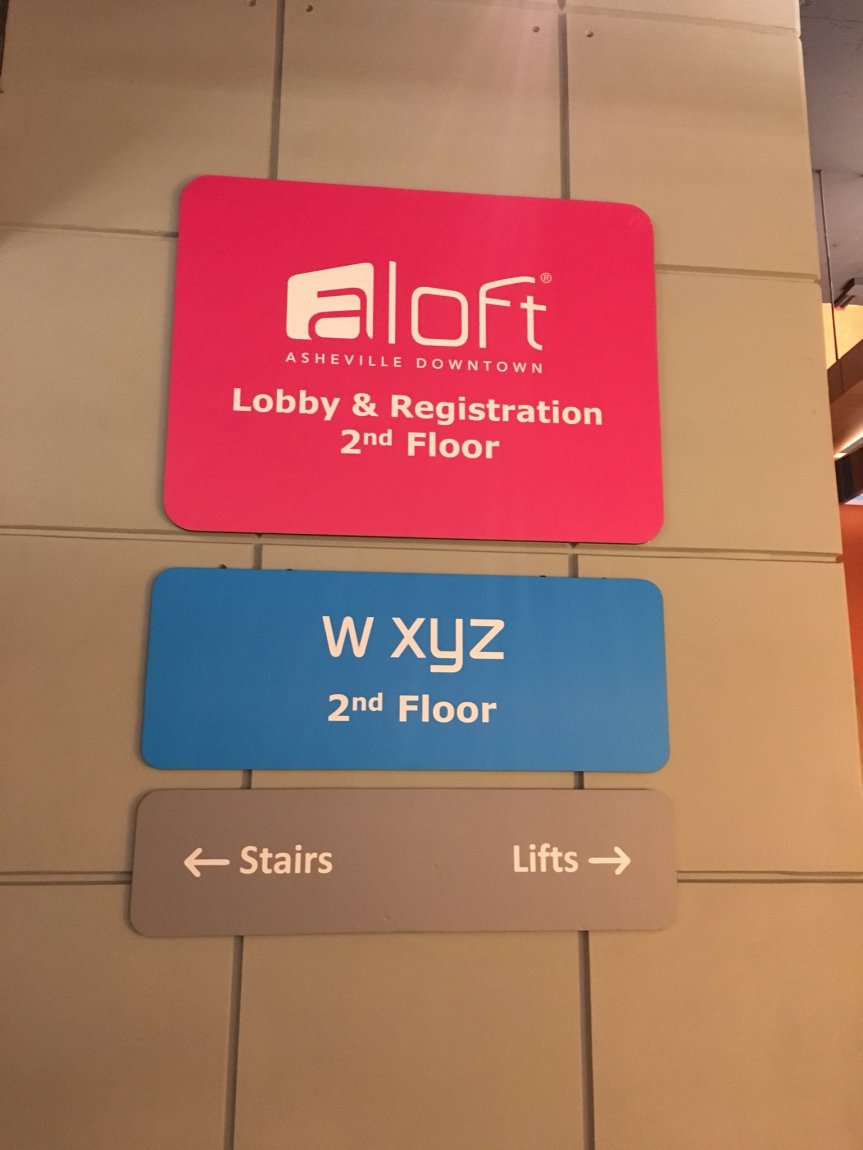
Just a couple of weeks ago, in New York City, I spotted an elevator being described as a “lift.” Now, one from an Aloft Hotel in Asheville, North Carolina. This seems to be a trend.
The all-time most popular post on this blog, with more than 146,000 views and 99 comments, is “European Date Format” (that is, rendering a date as date/month/year rather than the traditional U.S. month/date/year).
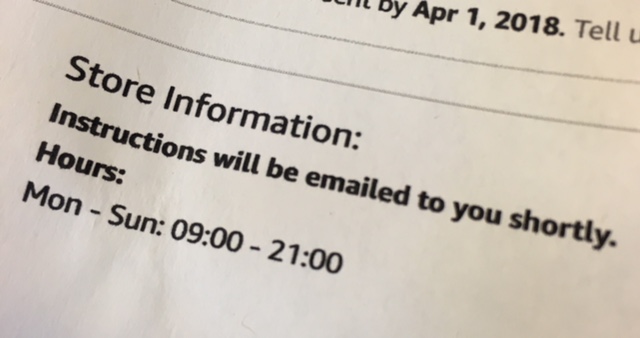
A communication I recently received from Amazon, giving instructions on returning an item to one of its Lockers, made me wonder if I might repeat that post’s success. Here’s what Amazon sent me:
The key is that “21:00.” The traditional American rendition of that time is 9:00 PM. So, I wondered, is there a trend of U.S. adoption of European time format?
For the purposes of this blog, the first question to answer is whether the 24-hour format is indeed a British thing. The answer is a bit mixed. I just read an entertaining free e-book on the subject called Counting Time: A Brief History of the 24-Hour Clock, by Peter Boardman. He recounts how this idea was broached following World War I, was adopted by the British Army and Navy, and was endlessly debated in the House of Lords and the letters pages of The Times in the 1920s and early ’30s. The Lords endorsed the 24-hour clock in 1933 and the BBC experimented with it the following year, but no one seemed to like the idea and it was pretty much dropped till 1964, when the railways and London Transport adopted. Boardman concludes, “Instead of having just one time system, we have two, and they’re both going to be with us indefinitely. ”
The book was published in 2011 and things may have changed in the intervening years, at least according to the responses I got when I asked British people on Twitter if they thought the 24-hour clock was common in the UK. Lynne Murphy said, “Very widespread–and I love it.” Mark Stradling ventured, “Written down, pretty much ubiquitous,” but noted a caveat: “Nobody talks like that, makes you sound like a robot.”
In the United States, the only home of 24-hour time has until now been the military, as one knows from movies where people talk about “Fourteen hundred hours.” But it’s also (not surprisingly) widespread in the computer world, which is presumably where Amazon picked it up.
In sum, I deem the 24-hour clock a Britishism and, in these parts, On the Radar. Let the page views and comments begin.
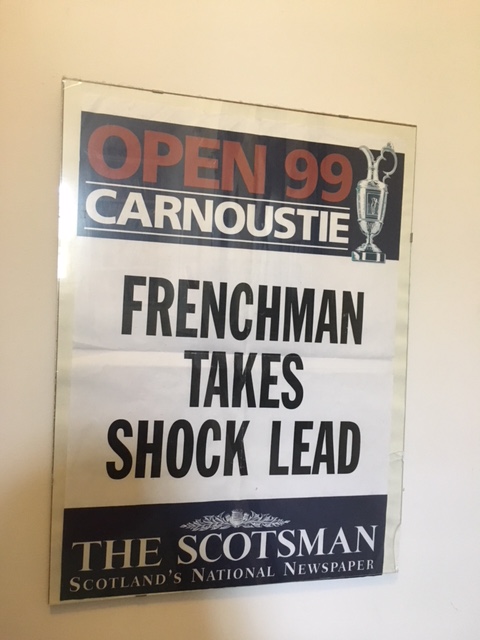
I was lucky enough to attend the British Open (Americans’ term for The Open Championship) in Scotland in 1999. After the second round, a French golfer, Jean van de Velde, who had won only one tournament in his career, improbably went ahead by a stroke. I snagged this poster from a newsstand and it still hangs in my house:
(The shocks would continue. Wikipedia says: “[Paul] Lawrie, down by ten strokes at the start of the fourth round, completed the biggest final round comeback in major championship history, headlined by van de Velde’s triple-bogey at the last hole.” The tournament ended in a three-way tie among Lawrite, van de Velde and another golfer, and Lawrie won the playoff.)
What caught my eye on the poster was the unusual, to me, use of “shock” as an attributive noun, meaning “shocking.” I later encountered other instances in the British press. There’s no relevant entry in Dictionary.com or Merriam-Webster’s online dictionary but the Oxford English Dictionary has a brief one: “of things that startle or shock.” The only example is a 1974 “heading” (US: “headline”) from The Times: “Shock news is broken to EEC ministers.”
Fortunately, Lynne Murphy of Separated by a Common Language wrote a substantial post about this “shock” in 2015. She reported a communication from David Sewell, an editor at the University of Virginia:
Some time within the last year or so I started noticing the distinctive usage of the phrase “shock poll” in the British news media; since then it seems to have migrated to the US, though apparently not in major news outlets. It appears so far as I can tell to mean simply “poll with startling results”, with adjectival “shock”. Some googling shows that “shock survey” and “shock study” are out there as well.
Is this use of “shock” as an adjective in fact coming out of British newspaperese, and is its usage spreading beyond a delimited set of nouns?
Lynne went to the corpora and was able to answer “yes” to the questions in the last sentence; some of the other nouns to which it’s been attached–all from British sources–are “victory,” “departure,” “resignation,” and “decision.”
Tantalizingly, Mr. Sewell didn’t explain why he thought the usage had migrated to the U.S. I for one had certainly never encountered it here until yesterday, when I read this sentence from a Washington Post dispatch in my local paper. (Emphasis added; the reference is to Trump’s announcement that he would raise tariffs on aluminum and steel, and was looking forward to a trade war.)
In an unorthodox presidency in which emotion, impulse and ego often drive events, Mr. Trump’s ominous moods manifested themselves last week in his zigzagging positions on gun control; his shock trade war that jolted markets and was opposed by Republican leaders and many in his own administration; and his roiling feud of playground insults with Attorney General Jeff Sessions.
This is filed under “On the radar” and I don’t especially expect it to ascend to larger acceptance here. One reason is that, being short, it’s especially useful for headlines in print newspapers. And it would take a shock reversal for print newspapers to start being important again.
“Lift” is such a sensible way to say “elevator,” if only because it has three fewer syllables, but I have never encountered it in the U.S., maybe because it is such a quintessential Britishism.
Never encountered it until now, that is. Here’s what I saw on the lower level of the Chelsea Market in New York City:
Was “lift” used here merely because “elevator” wouldn’t fit? Or is this the harbinger of a “lift” incursion on U.S. shores? Only time will tell.
Some friends and I were exchanging e-mails about two possible menus for a planned get-together. One of them wrote: “We, too, will happily tuck into either option.” (He was speaking for his wife, not using the royal “we.”)
That naturally made me think about the expression “tuck into”–meaning heartily eat–specifically that I’ve encountered it quite a bit recently. For example, a February 13 New York Times article about the American figure skater Adam Rippon notes that on the day of the interview, “he went to a restaurant and tucked into a lunch of leafy greens tossed in Caesar dressing and topped with pieces of seared ahi tuna.” A February 16 article from the (California) Mercury News about eating more healthily advises, “Tuck into a banana instead of a bag of pretzels.”
I suspected this was a Britishism, the rough American equivalent being “dig into.” My investigations confirmed my suspicions. A Google News search for “tuck into” yielded 18 hits, and the only American source was the Mercury News article. Most of the rest were British, with a few from Australia and one each from Israel and Malaysia.
I asked Anglo-American linguist Lynne Murphy her thoughts and she said she thought it sounded “Britishish.” Being a scientist, she tested the hypothesis with non-anecdotal evidence and searched the Corpus of Global Web-Based English (CoGWBE)–which contains 1.9 billion words, all from 2012–for the expression “tucked into a.” There are 46 hits from American sources, but none of them relate to food, instead to other things that can be tucked, such as shirts into pants or content into legislation; from PBS.org, “Even just a few lines tucked into a lengthy bill.” On the other hand, 17 of the 43 British hits referred to food, such as this caption to a DailyMail photo showing then-Prime Minister David Cameron watching a basketball game with Barack Obama: “As befits a spectator at a U.S. sports event, the PM … tucked into a hot dog, with Mr Obama, washed down with a Coke.”
According to the OED, the verb “tuck” began to be used in reference to food in the late 1700s, to imply “put away” or “put out of sight.” It quotes an 1834 source: “Now that I’ve cured you, you’ll be tucking all that into your own little breadbasket.” Note that the food is tucked into a person. Eventually, “tucking in” became an intransitive verb and is still about; Green’s Dictionary of Slang quotes The Guardian, 2000: “The 500 faithful meet, greet, chat and tuck-in.” The first to use transitive “tucking into,” not surprisingly, was Charles Dickens, one of the great literary appreciators of food. In Nicholas Nickleby (1839), a character says, “If you’ll just let little Wackford tuck into something fat.” According to Green’s, “tuck” was first used as a noun to mean food in 1835. In Australia and New Zealand, this was lengthened to “tucker” as early as 1858 and is still used. In Trevor Noah’s wonderful memoir Born a Crime, he talks about the “tuck shop”–snack bar–at the school he attended in South Africa.
All the above citations are from British or Commonwealth sources. And so are the rest in the OED and Green’s. As recently as 2012, the CoGWBE suggests, the expression was still overwhelmingly British. But–at least as far as “tuck into” goes–things have changed.
I need to come up with a term for the phenomenon where Americans adopt a British term but get it wrong. It has come up quite a bit on this blog, recently with “garden/ing leave,” and now with this term for what Americans call and “on [or entrance] ramp” or “off [or exit] ramp.”
The OED defines “slip road” as “a short (usually one-way) road giving access to or exit from a main highway, esp. a motorway; an approach road.” The first citation is from 1953; it and all the other ones are from British sources.
On January 25, Lynne Murphy, of the Separated by a Common Language blog, tweeted this as her “Difference of the Day.” @zekeys_mom responded, “‘Slip ramp’ is creeping into AmE. Used for toll road, minor exits to relieve congestion at major exits. Must have an auto-pay EZPass [the regional electronic toll collection system] to use it.”
Note: she said “slip ramp,” not “slip road.” When I checked Google Books for “slip road,” all the hits appeared to be from British sources, except a quote from a 2014 book by David Reynolds called Slow Road to Brownsville (Texas): “I took a slip road off 83, thinking it would lead into town—and found myself on a dark and crowded interstate heading west away from town.” But it turns out Reynolds is a Brit who wrote about his U.S. travels. I checked the New York Times archives and found “slip road” had been used exactly twice–once in a Reuters news article from London, and once in an article about Formula One car racing. Further research suggested that the term is used racing to mean a sort of escape path, for example: “That wing of his ended up 100 yards from where the car ended up down the Turn 1 slip road.”
That’s pretty much it for U.S. “slip road.” “Slip ramp” is another story. There is no definition for it in the OED, dictionary.com or merriam-webster.com. However, @zekeys_mom sent some links with uses of it, including a 2002 news release from the (U.S. state of) Pennsylvania, which helpfully defines the term: “The Pennsylvania Turnpike Commission today announced it will not advance preliminary plans to design and construct two ‘slip ramps’ — which are unmanned, E-ZPass only ramps built between existing interchanges.” The quotation marks indicate a newish usage, but as of 2015 it still hadn’t taken hold; a Pennsylvania newspaper article that year refers to “so-called slip ramps.”
Consulting Google Books, I found the earliest use of “slip ramp” in a 1959 issue of a state of California publication, “California Highways and Public Works.” The caption to a map says, “The circled ‘A’ and arrow point out the new slip ramp on the Harbor Freeway.” This was long before the invention of E-ZPass and such systems and suggests the term was used more generally, for exit ramp.
But it’s been used in different ways as well, as shown by a 2011 discussion on the AARoads Forum. Someone asked, “Maybe I’m crazy, but I don’t know exactly what a slip ramp is? What is it, and how does it differ from a normal freeway exit ramp?”
The answers were somewhat all over the map. A San Diegan said he had always used it to mean “a ramp between parallel sets of carriageways – for example, freeway main lanes to the frontage road, or vice versa. Basically, you end up ‘slipping’ over a few feet, but going in the same direction as before.” A number of commenters agreed with this, but a New Jerseyan posted, “My understanding was that it was a connector between two freeways, that was full speed, at least that is what I think.”
Then a Bostonian said, “I’ve regularly heard and used the term to refer to a right turn at an intersection separated by an island of some sort from the intersection, like this example at Causeway and Washington Streets in Boston.” But then someone else said that what he was really talking about was a “slip lane,” not a “slip ramp.” (I’m not sure why I assume all these people are male, but I feel pretty confident about it.)
Someone from Virginia said, “I remember the old version of the AAA map of Northern Virginia from the mid-1980s used the term ‘slip ramps’ … in reference to the ramps connecting the Dulles Toll Road and the Dulles Access Road. For those unfamiliar, it’s a quad-carriageway with two carriageways in each direction; the inner (free) ones serve airport traffic and the outer (tolled) ones serve local traffic.”
No one could top (or possibly understand) that, and the discussion ended.
Every December, Lynne Murphy, who runs the blog Separated By A Common Language, chooses two Words of the Year: an American word that has gained popularity in the United Kingdom (US>UK) and one that has gone the other way (UK>US). Recent winners in the latter category (obviously more interesting for NOOBS purposes) are gutted, backbencher, gap year, dodgy, and bum.
Yesterday, Lynne announced “shitgibbon” as her 2017 UK>US word, and I’m chagrined to say I have not yet covered it. It first got notice in the U.S. as one of a flurry of insults hurled at Donald Trump in 2016, the only one of which I wrote about was “wazzock.”
One of the prominent insults was this tweet, posted after Trump (falsely) claimed that Scotland had voted in favor of Brexit.
Among the prominent Americans to pick it up, Lynne notes, was a Pennsylvania Democratic state legislator from my home region, the suburbs of Philadelphia.
Leach seems to have come up with “loofa-faced” on his own. Coincidentally, he is currently in a bit of hot water for matters unrelated to his Trump insults.
“Shitgibbon” is an insult of rather recent provenance. Uber language guy Ben Zimmer investigated its history in two articles published in Slate. He reported
My fellow word sleuth Hugo van Kemenade found examples as early as 2000 in Usenet forum posts about bootlegging in the British music scene, where shitgibbon was deployed against ungrateful traders of copied music. More than a decade later, it got a boost from an early episode of HBO’s Veep in 2012, wherein the character Sen. Andrew Doyle calls a rival a “gold-plated fucking shitgibbon.”
And there the hunt might have remained, if not for a comment on my original post on the Strong Language blog. The British writer David Quantick dropped this bomb:
“Hi, I wrote the Veep line. It was originally ‘spunk-faced shitgibbon,’ a phrase I used in a 1988 column in New Musical Express and have put in most of my writing since. PS I’m not Scottish and have nothing to do with bootlegging.
Ben confirmed Quantick’s claim.
Well, this is probably my last post of 2017, so I will say Merry Christmas and Happy New Year to all you wazzocks and shitgibbons.