Collective Nouns

I was intrigued by something New York Times soccer (football) writer Rory Smith mentioned the other day. Apparently there had been a discussion on his newsletter about the way British usage considers a team plural, but American usage has it singular:  “Chelsea are playing today” versus “New York is playing today.” (If only). I’ve looked at the issue a a few times on the blog, most recently here; you can see all the posts by typing the word “plural” into the search field at right.

But I haven’t covered why this difference exists, and Smith reported getting a message from a reader with an explanation:

I think the American use of the singular “is” as opposed to the plural “are” came about as a result of the Civil War. Prior to the war Americans talked and wrote about the United States using the plural — these United States “are.” After the war common usage changed to the United States “is.” Gradually that usage came to be applied to other groups such as sports teams.

I found myself reacting skeptically, and sure enough, when I ran it by linguist Lynne Murphy, she was dubious about both of the reader’s claims. First, she said, “The relevance of the Civil War to the singularisation of the US is something that’s been said and debunked in various places (or at least, claimed to be too simplistic). Language Log has done some: languagelog.ldc.upenn.edu/nll/?p=1794 and there’s this: https://t.co/teBf5Xo4t6.”

I subsequently found, in addition, an article by Ben Zimmer on the Visual Thesaurus website that pinpoints where Smith’s reader probably got his take. In Ken Burns’s wildly popular 1990 documentary about the Civil War, historian Shelby Foote says:

Before the war, it was said “the United States are.” Grammatically, it was spoken that way and thought of as a collection of independent states. And after the war, it was always “the United States is,” as we say today without being self-conscious at all. And that sums up what the war accomplished. It made us an “is.”

Foote didn’t make the idea up; Zimmer quotes several others who espoused it starting in the 1890s. But none of them had any hard evidence. It turns out the War did not in fact mark an abrupt change. One scholar analyzed Supreme Court decisions and found, “justices continued to use the plural form through the end of the nineteenth century. Indeed, the plural usage was the predominant usage in the 1870s, 1880s, and 1890s. Only in the beginning of the twentieth century did the singular usage achieve preeminence and the plural usage disappear almost entirely.”

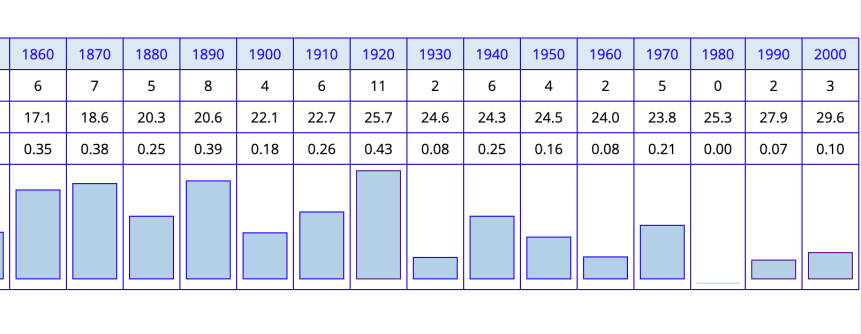
Google Books Ngram Viewer similarly finds that in U.S. books, “The United States are” (red line) prevailed until about 1880, after which “The United States is” (blue line) commenced a rapid ascent.

Screen Shot 2020-04-08 at 3.18.16 PM

Smith’s reader’s other claim is that singular verbs for sports teams and other groups followed the example of “the United States.” Lynne Murphy didn’t buy that, either, calling it “fanciful/misguided.” There’s a section on this (complicated) topic in her book The Prodigal Tongue: The Love-Hate Relationship Between American and British English, in which she cites research to the effect that singular use for collective nouns (“the government,” “the army,” “Parliament,” “Congress,” “New York,” “Chelsea”) has been on the rise worldwide since the 18th century. Americans have been the trailblazers, in other words, and the British the laggards.

One interesting line of research suggests that, in the 20th century, the British reversed course and started doing the plural-verb-for-collective noun bit more, possibly to set themselves apart from the Yanks. (A similar thing happened in Britain with the end of words like “realize/realise” and “organize/organise.” The “ize” form was more popular until the late 19th century, when the very-much-non-American “ise” started to surge.)

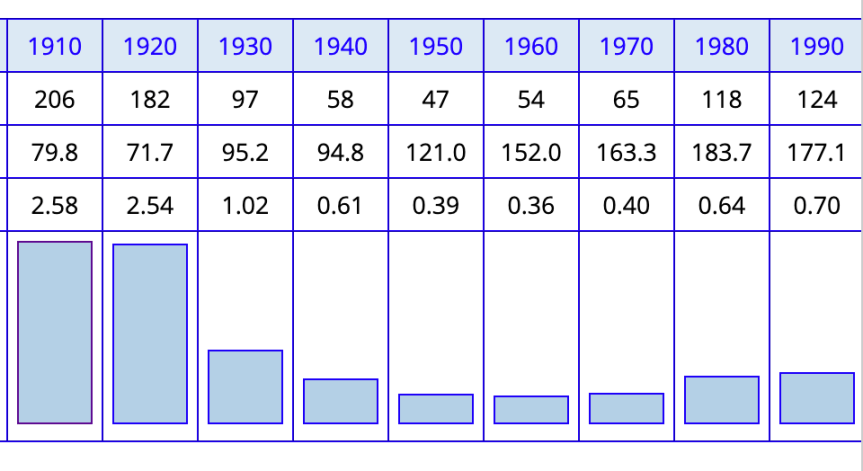
An example comes from a database containing Hansard, the proceedings of the house of Parliament. Here’s a chart showing the declining frequency of the phrase “the government is”* since 1910. (The bottom number — 2.58 in 1910, 0.70 in 1990 — is key, indicating how often the phrase occurs per million words.)

Screen Shot 2020-04-08 at 4.07.55 PM

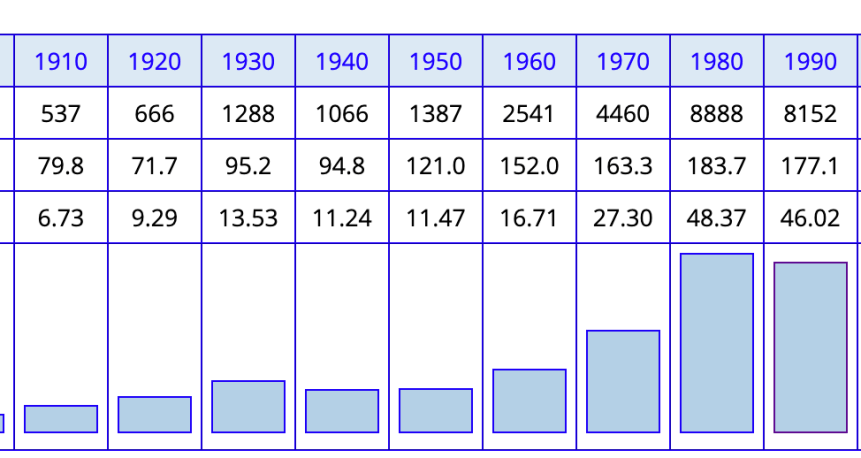
And here’s the chart for “the government are”:

Screen Shot 2020-04-08 at 4.08.22 PM

All of which leads me to suggest that Rory Smith’s readers take up a new topic: why do Britain have the odd habit of using plural verbs for collective nouns?

*Note. Pure searches for “the government is” and “the government are” would lead to false positives, for example, sentences like “Members of the government are working hard.” To avoid these, I searched for instances where the phrase followed a colon and thus began a clause.

“In the Event”–a Little Help, Please?

For reasons that are clear when you read the date of this post, I’ve had a lot of time on my hands, part of which I’ve spent by reading Stephen King’s novel The Institute (a page-turner). My NOOBs-dar was struck by two sentences. The first was in the line of dialogue, “I hope you’re sure they’re keeping shtum, as the saying is.” For “shtum,” see this post.

The second was this: “In the event, no gunshot came.” That “in the event” is equivalent to “as it happened” or “as it turned out,” and I had always thought of it as a Britishism. The OED has a couple of (obviously non-American) citations from 1570 and 1612. The next is from British-born Yank Thomas Paine in 1791: “But all his plans deceived him, and in the event became his overthrow.” All the rest are from Britain, up to novelist A.S. Byatt in 2009: “In the event, they were overwhelmed by rain.”

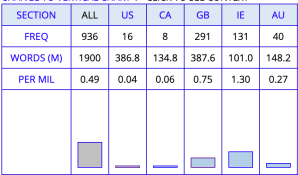
But that’s anecdotal evidence, and I have been having a hard time proving this expression is a Britishism, much less a NOOB. The Corpus of Global Web-Based English, containing about 2 billion words published on the web in 2012-2013, indeed shows higher use of “in the event” in Britain, and especially Ireland, than in the U.S.

Screen Shot 2020-04-03 at 10.28.18 AM

But the trouble is, the vast majority times in every country, “in the event” isn’t used the Stephen King/A.S. Byatt way. Rather it’s “In the event that it rains …” or “in the event of a sellout” or “Anyone participating in the event…,” etc. I have not figured out a way for singling out this particular meaning in GloWbE or any of my other usual suspects, including Google Books or Ngram Viewer and the New York Times. (The Times is worst of all in this investigation because a search for “in the event” turns up every time the paper has used the word “event”; it considers “in” and “the” non-searchworthy minor words.)

So: if anybody has any bright ideas on how to quantify the use of “in the event” meaning “as it turned out” in Britain and the U.S., I am all ears.

Update, later that same day. Two things. First, judging from the comments, I didn’t make it clear enough that I’m not only talking about “in the event” as a standalone phrase, almost always followed by a comma, and not phrases that begin “in the event that” or “in the event of.” For some reason, the latter are common in the U.S. but not the former. Go figure.

More important, I sent my plea out over Twitter and immediately got some great information and suggestions. Writer James Marcus, acting on a hunch, searched for “in the event” and “Henry James” and got this from The Master’s 1903 novella The Beast in the Jungle: “And the touch, in the event, was the face of a fellow-mortal.” Of course, James, though born and bred in the U.S., veered toward Britain in language, manner and eventually residence, in a sort of human heliotropism.

Actual linguist Lynne Murphy gave me a great tip for using GloWbE and the other databases at English-corpora.org. By searching for “. In the event ,” (no quotes), I could eliminate a lot of the noise and produce only cases where the phrase starts a sentence and is followed by a comma. Sure enough, on GloWbE, that produced an even more pronounced frequency in Britain.

Screen Shot 2020-04-03 at 3.33.00 PM

And even the low U.S. figure is deceptively high because a lot of the hits, though mostly published in U.S. journals or websites (one’s from the Daily Mail), were written by British people. For example, this is from an article about soccer (football) from the Seattle Post-Intelligencer: “In the event, the only ‘crack’ was the sound of the ball flying off Mario’s boot into the far corner.” But right there on the page, it says that the author of the article, Simon Moyse, was “Born in London.”

But a handful of the hits are legit American, for example this from the Daily Kos, by Matt Pociask: “In the event, though, the various statesmen who assembled at the Convention in 1787 had a fairly clear mandate for change.” Pociask identifies himself as an “Atlanta area lawyer.” (He may have gotten the lingo at work. On LinkedIn, Pociask says, “I’m currently a claims counsel for Hiscox … a leading specialist insurer rooted in England.”)

Another resource at English-corpora.org is the Corpus of Contemporary American English, which contains 2 billion words published between 1990 and 2019. It yields 71 examples of ” . In the event ,” in that time, again, some of them published in the U.S. but written by English people. But also again, some are legit, including this from a 2019 Slate article about Game of Thrones, by the American military strategist Robert Farley: “In the event , the snowstorm made it difficult for Team Alive to even take note of the weapons, and Team Dead squandered one of its biggest advantages.”

So Stephen King is not alone.


“Schooner”

In my Brooklyn wanderings the other week, I came upon this sign outside a bar:

87365773_10158173382771383_1071393267163070464_n

I had encountered “schooner” as a portion size for beer in my recent Australia visit, but didn’t have a clear sense of what it meant, other than larger than the smallest size (called “pot,” as I recalled). And by the way, if you’re not from here, “Bud” is Budweiser, probably the most famous American beer.

I checked the OED, which told an interesting, somewhat complicated story. It gives a United State origin for “schooner” as a beer vessel, citing a definition in an 1879 edition of Webster’s dictionary: “A tall glass, used for lager-beer and ale, and containing about double the quantity of an ordinary tumbler.” An 1896 quote from a Scottish newspaper shows the term had crossed the Atlantic, and specifies its size: “‘the schooner’ [contains] 14 fluid ounces, or 2 4-5ths imperial gills … [and is] found in everyday use, under various names, in London, Glasgow, Aberdeen, and elsewhere.”

But then, the term seems to have subsided both in Britain and the U.S., only to reappear, by the 1930s, in Australia and New Zealand. A fascinating 2011 article in Australia Beer News traced the tangled history of “schooner” in New South Wales. The author, Dr. Brett J. Stubbs, limits himself to that state because “tracing the history of the schooner glass (let alone of beer glasses in general) in Australia requires more than just a short article.” To summarize his tale would require more than just a short blog post, but fortunately, this graphic is floating around the internet (apologies for not being able to figure out and cite the original source). It brings to mind the apocryphal factoid about Eskimos having 100 or some other large number words for snow.

1539672139424

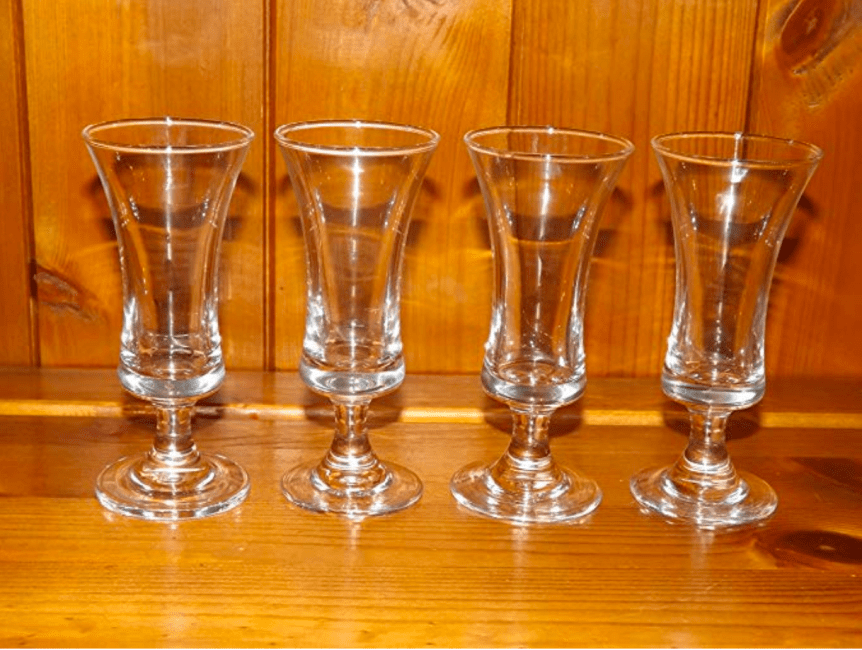
Meanwhile, by the 1960s the meaning of “schooner” in Britain had changed to, as the OED puts it, “A tall, waisted sherry glass” holding 3.5 ounces. The writer of a 1973 article in The Times wasn’t happy with this development, referring to “the abominably proportioned waisted Elgin glass, sometimes used for sherry, or its vulgar outsize version, the schooner.”

Screen Shot 2020-03-05 at 10.22.21 AM
Schooners for sherry.

And what of North America? Not surprisingly, we have super-sized the schooner. The OED is no help here, but this is what Wikipedia has to say:

In Canada, a “schooner” refers to a large capacity beer glass. Unlike the Australian schooner, which is smaller than a pint, a Canadian schooner is always larger. Although not standardized, the most common size of schooner served in Canadian bars is 946 ml (32 US fl oz); the volume of two US pints. It is usually a tankard (mug) shaped glass, rather than a pint-shaped glass….

In the United States, “schooner” refers to the shape of the glass (rounded with a short stem), rather than the capacity. It can range from 18 to 32 US fl oz (532 to 946 ml).

Sure enough, here’s an article from a Lawrence, Kansas, newspaper about a bar in that college town that serves 32 oz. schooners in the rounded shape — though “If the bar runs out of clean glasses on a busy night, you’ll get your 32 ounces of beer in a giant plastic cup.”

In my preliminary research on the topic, I posted on Facebook the Brooklyn sign and a query as to the meaning of “schooner.” Someone replied that in New England, it’s 10 ounces — perhaps an example of a British usage that has been retained in that region, like “rubbish.” But my favorite comment came from my friend Jan Ambrose, who is discriminating in her beer tastes: “There is no amount of Bud I would pay $3 for.”


“En suite”

Walking around in a hipsterish area of Brooklyn over the weekend, I came upon this sign:

IMG_0896

What caught my eye was the word “ensuite.” I had come across it — usually as two words, “en suite” — in Britain and Australia, meaning, I believe, that a bathroom is included in a hotel room or some other accommodation.

Research pretty much confirmed my impression. The OED shows a not-surprising progression of the meaning put to the phrase, starting with what I take to be a pretty literal translation from the French: “So as to form (part of) a set, group, or suite.” (“Match-box, stamp-box, and paper-knife, all en suite,” 1862.) In the late eighteenth century, it started to be used to refer to a set of connected rooms; then, crucially (as in the Brooklyn sign), to a bathroom connected to another room. The first such citation is from Canadian Railway and Marine World, in 1925: “Abaft the en suite rooms there is a state room with a single bed, armchair and wardrobe, and an en suite bath room and w.c.” (“Abaft” is a nautical term meaning “behind.”)

The final stage (so far) is “en suite” as a noun referring to the bathroom in question. That shows up in 1968, in an ad in the Canberra (Australia) Times: “Home suitable for a large family, 4 large bedrooms, en-suite off master, panelled study, large kitchen and dining room.”

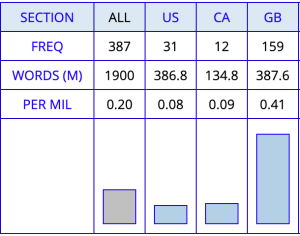
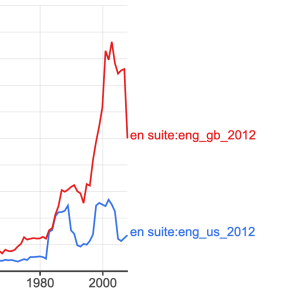
All of the bathroom-related citations in the OED are from British, Irish, Australian, or Canadian sources. Google Ngram Viewer suggests “en suite” took off in Britain in the 1980s, presumably as a real-estate buzz phrase, which makes sense, given that bathrooms would be the sweet spot for a Frenchified fancy euphemism:

Screen Shot 2020-02-24 at 7.30.34 PM

The Corpus of Global Web-Based English, charting billions of words from the early 2010s, shows Ireland (especially) and Britain as heavy “en suite” users, with Canada and Australia lagging behind with the United States.

Screen Shot 2020-02-25 at 9.09.11 AM

But “en suite” has hit the U.S., and not just in Brooklyn. In February 2020 alone, the phrase was used in nine articles in the New York Times Real Estate section, including this referring to a $2 million house for sale in Fairfax, California: “The en suite bathroom has a walk-in shower as well as a separate soaking tub.” Beyond real estate, a February 12 Times review of the movie Swallow notes of a character, “She was a retail worker who bagged a rich man. Bearing his child is just another privilege, like en suite bathrooms or the latest iPhone.”


“Tall Poppy”

In honor of my return from a five-week stay in Australia, a post in honor of one of the first Australianisms I encountered on my first visit there, four years ago. Stuart — who collected me and the student group I was leading at the Melbourne airport and drove us to town — commented, vis a vis the national character, on the “tall poppy.” I forget his exact explanation but here’s the OED definition: “chiefly Australian. a prominent or conspicuously successful person or thing, frequently with implication of attracting hostility from envious detractors.” Stuart suggested that the tall poppy syndrome — the reflex to attack anybody who stood out from the crowd by accomplishing anything — was a national characteristic and, to some extent, problem.

The metaphor originated in sixth century B.C.E. Rome — specifically, Wikipedia says, in

Livy’s account of the tyrannical Roman king, Lucius Tarquinius Superbus. He is said to have received a messenger from his son Sextus Tarquinius asking what he should do next in Gabii, since he had become all-powerful there. Rather than answering the messenger verbally, Tarquin went into his garden, took a stick, and symbolically swept it across his garden, thus cutting off the heads of the tallest poppies that were growing there. The messenger, tired of waiting for an answer, returned to Gabii and told Sextus what he had seen. Sextus realised that his father wished him to put to death all of the most eminent people of Gabii, which he then did.

Green’s Dictionary of Slang lists examples of the term being used in nineteenth-century Britain, but fifteen of the twenty citations from 1869 on are from or in reference to Australia or New Zealand, including this from Richard Beckett’s 1986 Dinkum Aussie Dictionary:

Tall poppy: Any Australian who reads more than the sporting results and knows how to use snail tongs. Someone who aspires to intellectual excellence and cannot tell the difference between one make of car and another. The species is much hated in Australia and is always being cut down to size.

Here’s what the News on the Web (NOW) corpus, which contains 9 billion articles from 2010 to the present, says about the frequency of use of “tall poppy” by country:

Screen Shot 2020-02-08 at 3.48.26 PM

About half of the twenty-three U.S. hits are actually by or about Australians. But that still leaves a few examples.

  • Actress and singer Carrie Brownstein said in an interview: “How comfortable one is taking credit for their work depends on the person. I think tall poppy syndrome is endemic to smaller creative communities, but I also really value the fairly anti-capitalist approach of the more radical artistic communities from which I came.
  • Tech businesswoman Marian Salzman wrote in a Forbes article that Meghan Markle “may be under great scrutiny because the tall poppy often gets chopped down, but I think she’s a 2020 version of John F. Kennedy Jr. circa the mid-’80s.” (This was written in July 2019.)
  • New York Times columnist Maureen Dowd, in her scorecard for the second Democratic presidential debate in August 2019 (how long ago that seems), wrote of then-candidate Kamala Harris: “Tall poppy syndrome. After she garroted Biden in the first debate, everyone came after her, challenging her health care plan as she struggled to explain it herself.”

As we are wont to do, some Americans have tried to turn the expression on his head. In 2018, two entrepreneurs started a company to protect people, especially women, against online harassment. They called it Tall Poppy. One of the founders, Leigh Honeywell, explained it to Fast Company:  “The idea of tall poppy syndrome is that…anyone who becomes prominent in their field or in politics or whatever, they get cut down. So we protect the tall poppies.”

“Tipped to”

A recent New York Times article about the British Academy of Film and Television Arts (BAFTA) awards noted that the film Joker “had been tipped to win big at the awards.”

I’ve been in Australia for the past month or so, and that phrase “tipped to” is quite common here. Merriam-Webster online provides a definition: “chiefly British: to mention as a likely candidate, prospective winner, or profitable investment.”

The results for a Google News search for a phrase are all British, Irish, or Australian, for example this Daily Mail Headline: ‘Meet your new Bachelor! Jett Kenny is tipped to be this year’s suitor.”

It’s hard to pinpoint the origin of the term, since the OED doesn’t have an entry for it. It is, however, used in a citation for another word (“super,” meaning “superannuation,” which is what Americans refer to as 401 (k) plan). It’s from the Sydney Bulletin in 1973: “In some cases where the executive’s own company contributes substantial sums to his super scheme … the tax commissioner is tipped to take a far more sceptical view.”

Google Books has only use prior to that. It’s from the 1964 proceedings of the Kenya National Assembly.

Screen Shot 2020-02-04 at 1.57.55 PM

As for American use, there isn’t much. The only other recent use in the Times was in the article about last year’s BAFTA awards, which noted that The Favourite “had been tipped to win big.”

But it turns out that both articles were written by Times correspondent Alex Marshall, who is British. And so I dub “tipped to” a faux NOOB. But it is very much a British/Australianism, so shouldn’t it have an OED entry?


“Swan about”

Sam Sifton, the food editor of the New York Times, sends out an email newsletter a couple of times a week. Not to be harsh, but I find his style a little precious. In a recent dispatch, for example, he talked about a roast chicken recipe which is so good that, he predicts, “it’s all anyone in your set will be talking about in coming days.” I don’t feel like anyone has had a “set” since the 1950s.

Then there are the Britishisms — two in a mere 699 words. He writes, generously, “We are standing by if something goes pear-shaped with your cooking or your [Times] account.”

Elsewhere, he notes that he and his colleagues are accessible on social media. For example, “We swan around on Facebook.”

“Swan around” was a new one on me, but it had a British feel, akin to “lark about.” And British it is. The OED definition for the verb “swan” in this context is: “To move about freely or in an (apparently) aimless way (formerly, spec. of armoured vehicles); hence, to travel idly or for pleasure. Frequently with about, around, or off. slang (originally Military).” All the citations are British, starting with the first, from The Daily Telegraph, in 1942: “Breaking up his armour into comparatively small groups of..tanks, he began ‘swanning about’, feeling north, north-west and east for them [sc. British tanks].”

The most recent is from Dirk Bogarde’s 1980 novel A Gentle Occupation: “She swanned about at the party like the Queen Mother.”

The expression found its way into American English not long after that. Times columnist Maureen Dowd wrote in 1996, “There are a slew of books about making newspapers more civic-minded and a slew of ideologues and burnt-out journalists swanning about, calling themselves journalism experts and reformers.” (Note also the British “burnt” instead of American “burned.”)

In his 2000 book Kitchen Confidential, Anthony Bourdain wrote of a hypothetical dilettante restaurant owner: “He wants to get in the business — not to make money, not really, but to swan about the dining room signing dinner checks like Rick in Casablanca.

By the way, “swan about” sounds more authentically British to my ears, but according to Google Ngrams Viewer, “swan around” has been more commonly used since the ’70s.

There have been a couple of dozen other examples of both versions in the Times over the last two decades. Even so, I don’t think it will catch on in my set.

“Tie-up”

I was listening to NPR the other day, and heard the proposed merger between Jeep and Peugeot referred to as a “tie-up.” I can’t actually find the show but there are quite a few other uses of the term, for example in an NPR story last August: “In their latest gasp for fresh ideas, Macy’s and J.C. Penney made the same choice: A tie-up with ThredUp, the largest online store for second-hand clothes.” And the New York Times in July referred to “talks of a tie-up between Fiat Chrysler and Renault.” (I guess Peugeot won out over Renault.)

I suspected a NOOB, a, because I had never encountered this meaning of “tie-up” and, b, because Americans have such a familiar and very different use of the noun. The OED defines this as: “A stoppage of work or business, esp. on account of a lock-out or strike; a stoppage of transport, a traffic hold-up.”

The dictionary’s information on merger/”tie-up” interesting. It started as a U.S. phrasal verb meaning ‘To associate or unite oneself or one’s interests with (or to).” From the New York Evening Post in 1903: “It becomes his first interest to make business for that yard. He can best do this by tying up with the other navy yard representatives on the committee.” The verb had migrated across the Atlantic by 1928, when The Daily Express wrote, ” Registered readers..have..‘tied up’ with the newspaper which..offers the best..insurance benefits,” the quotation marks indicating a relatively new usage. (I suspect also that by this time it was fading away in the U.S.)

The OED defines the noun rather generally, as “a connection or association,” and the first citation is from 1927, also from The Daily Express: “There is a tie-up, too, over this firm with the gramophone records. Every record of the ‘Happiness Boys’ is an advertisement for Happiness Chocolates.” (We might refer to that as a “tie-in.”) The citations run through 1974. All, with the exception of an F. Scott Fitzgerald quote, are British, and none refer specifically to a financial merger, leading me to think that this is a rather recent usage.

I asked Michael Regan, senior markets editor at Bloomberg, the worldwide business news enterprise, and he agreed with my hypotheses. “My sense,” he wrote me, “is that ‘tie-up’ is a Britishism that has crept into the language of the American financial press over, say, the past decade.”

Better yet, he gave me some data. He was able to chart the use of both “merger” and “tie-up” in the myriad business-news sources that are published on the Bloomberg terminal. (They’re international but dominated by U.S. sources, Mike told me). He came up with two nifty graphs. This one shows the relative frequency of “merger” over the past ten years:Screen Shot 2019-12-20 at 10.33.20 AM

And here’s “tie-up”:

Screen Shot 2019-12-20 at 10.35.42 AM

It’s almost too neat: over the past five years (not ten, as Mike guessed), “merger” has fallen and “tie-up” has risen.

Mike also had a theory about “tie-up”‘s popularity:

I’ve been in financial journalism so long that I’m not sure how big of a deal they are to regular-news editors, but editors here and at other financial pubs are big sticklers for avoiding word echoes. It sort of makes sense in this corner of the journalism world, since you’re more prone to word echoes when writing about, say, a merger. And tie-up is a good synonym for merger because its short character count makes it good for headlines.

Word echoes, also known as word repetition, are what writers and editors are trying to avoid when they use what H.W. Fowler, in The King’s English (1908), called “elegant variation.” It’s the sort of thing sportswriters do when they refer to a second baseman not by name, but as “the fleet-footed second-sacker.” Fowler was not a fan, observing that “Many writers of the present day abound in types of variation that are not justified by expediency, and have consequently the air of cheap ornament.” Fowler listed many examples, including an article from the Westminster Gazette that, in the space of twenty lines, described paintings that “made, fetched, changed hands for, went for, produced, elicited, drew, fell at, accounted for, realized, and were knocked down for, various sums.”

One can only imagine what he would have made of “tie-up.”


“Splashed Out”

Jan Freeman, former language columnist for the Boston Globe, is one of the sharpest observers I know, and when she passes on a tip, it’s always worth listening to. So it was the other day when, on Twitter (@Jan_Freeman) she directed me to an article about holiday tipping in the November issue of Real Simple Magazine. The paragraph in question:

Rounding up to the nearest dollar on your coffee run is not necessary, but it’s a nice gesture, especially if you’re a regular or a barista has gone out of their way to make your visit special. “If they’ve really splashed out on the latte art or given you a great recommendation for walking around the neighborhood, go ahead and make it at least 20 percent,” says Emilio Baltodano, founder of Eleva Coffee in Brooklyn, New York.

And the phrase in question is “splashed out.” It was a new one to me, and when I looked into it I confirmed (as Jan suspected) that it wasn’t being used in the traditional way. The phenomenon of Americans slightly or not so slightly changing the meaning of a British expression isn’t a new one: see “cheers.” On the blog, I label these terms “shape-shifters.” Mr. Baltodano used it to indicate making a big effort, but the OED confirms that’s not the traditional British meaning.

d. colloquial. To spend (money) extravagantly or ostentatiously. Frequently const. adverbs, esp. in to splash (money) out on (something). Also absol.

1934   Times 7 Mar. 7/5   Public money ought not to be splashed about in this manner without grave and searching examination by the House of Commons.
1946   F. Sargeson That Summer 82   After we’d splashed on a talkie we went home.
1960   S. Barstow Kind of Loving ii. ii. 170   I splash eight-and-six on a pound box of chocolates and send them with a little note.
1973   Courier & Advertiser (Dundee) 1 Mar. 2/2   Allied now plan to splash out an extra £150,000 on advertising.
1978   Morecambe Guardian 14 Mar. 17/2   Splash out on something new to wear; the result will be worthwhile.


So it seems to have started as “splashed” or “splashed about,” with the “splashed out” form taking hold in the 1970s. Judging by the New York Times, it’s gotten some use on these shores, mostly in reference to business or sports moguls shelling out cash. From 2016: Disney chief Bob Iger “splashed out $1 billion for a one-third stake in Major League Baseball’s streaming technology, with the option to buy it out.” 2017: former Microsoft CEO Steve Ballmer “splashed out $2 billion for the Los Angeles Clippers in August 2014.” And in 2018, “teams in the decidedly mediocre Chinese Super League splashed out more than $400 million on international stars like Carlos Tevez and Oscar, outspending even the English Premier League.”

As far as I can tell, it’s the precise equivalent of the traditional U.S. “shell out,” the moral being, never underestimate the appeal to journos of elegant variation.

Update: A lively discussion in the comments has persuaded me that, in Britain at least, “splashed out” is not the same as “shelled out.” I don’t agree that “shelled out” always or even usually implies reluctance, but, clearly, “splashed out” conveys enthusiasm (sometimes deployed ironically) or splurging. I still maintain, however, that the three New York Times examples are equivalent to “shelled out,” suggesting that U.S. use of “splashed out” has shape-shifted it a bit.

Stalking the Elusive “Meant to”

Some of the differences between British and American English are quite subtle. I give you the expression “meant to.” It’s certainly used here, with the meaning “designed to” or “intended to.” We would say, “I meant to get here early but I was delayed,” or, “In ‘Mona Lisa,’ the clouds are meant to represent God.”

But in recent decades, the British have used it in a distinctive way, as did the model Naomi Campbell in this quote from The Guardian:

I remember the day I was spotted in the street. It was a warm April afternoon, and I was hanging out with my friends after school. The three of us were dressed in our Italia Conti uniforms: a pale blue dogtooth kilt, a dark blue V-neck sweater, shirt, blazer, tie. We were meant to wear straw boaters, too, but never did.

An American would say “supposed to,” and that’s basically what this British “meant to” means. Another example comes from an NPR interview with the British novelist Sadie Jones: “The hotel — he’s meant to be renovating it — and he’s sort of meant to be renovating himself.” Her meaning is along the lines of “tasked with.”

Interestingly, the OED stresses a slightly different sense in its relevant entry.

d. In passive, with infinitive clause: to be reputed, considered, said to be something.

1878   R. Simpson School of Shakspere I. 34  It is confessed that Hawkins and Cobham were meant to be buccaneers, and it is absurd to deny the like of Stucley.
1945   Queen 18 Apr. 17/1   ‘Such and such a play,’ they [my children] will say, ‘is meant to be jolly good.’
1972   Listener 9 Mar. 310/1   America..is meant to be a great melting-pot.
1989   Times 30 Mar. 15/1   It [sc. evening primrose oil] is also meant to be good for arthritis.


The 1945 quote from Queen indicates that it was at that time a fairly new (and youth-based) usage. But it still apparently provokes some ire, as in this sniffy comment on an English-language website: “The now-common use of ‘meant’ instead of ‘supposed’ in that context is a relatively recent phenomenon in the UK, and appears to have come in from the bottom, like so many other instances of poor usage and mispronunciation. The usage is rare in other speakers of Commonwealth English.”

Here are a couple of examples from British Twitter:

Screen Shot 2019-11-30 at 10.28.54 AM

Now, as far as this blog goes, the question is whether British “meant to” has crossed to the U.S. I recently spotted it for the first time, in an article by the Maryland-born, Berlin-based writer Ben Mauk, reprinted in the anthology The Best American Travel Writing 2019. He’s talking about a pagoda in Cambodia and he says, “Only monks and laypeople are meant to live at the pagoda.”

That’s not much to go on, so I asked my sharp-eared daughter Maria Yagoda, who had alerted me years back to “fully“–come to think of it, a similar case, since there’s overlap in usage and the differences are subtle. She said she had definitely heard it aand would send on some examples–but she hasn’t come across any yet.

So I went on American Twitter and found this:

Screen Shot 2019-11-30 at 10.39.38 AMScreen Shot 2019-11-30 at 10.38.47 AM

At this point, “meant to” is On the Radar. Stay tuned.