“Gap year”

There was some grumbling after gap year–meaning a year taken off between high school and college–made a good showing in the recent  poll asking readers to vote on potential new NOOBs. Not really a Britishism, some said. We Americans were saying it back in the 70s, one person claimed.

I don’t think so.

It’s certainly the case that gap year is common in the U.S. now. My own kids and their friends tossed around the phrase when they were at that age a half-dozen years ago. The New York Times observed a couple of months ago, “The idea of a gap year between high school and college could be tempting to students who are not ready to transition to the next level of education.” There is an organization called USA Gap Year Fairs that hooks students up with gap year providers. Moreover, I have no doubt that U.S. students were taking a year off before college in the 70s.

But they weren’t calling it a gap year. That is a Britishism, without a doubt. The OED’s first citation is from The Times (the one in London) in December 1985: “Many young people are making deliberate decisions to take a year off, often referred to as the gap year.” The wording suggests the phrase had been relatively recently coined. The use of the word gap in this context may have been a contribution of a British organization called Latitude Global Volunteering whose website states that it was founded forty years ago under the name Gap Activity Projects.

The first U.S. use of the phrase on the Lexis-Nexis database comes from a 1996 Atlanta Journal Constitution article that leaves no
doubt as to the phrase’s newness in the U.S. or its national origin: “… taking a break before or during college can be beneficial, according to a new book, ‘Taking Time Off’… It’s a practice common in other countries. For example, in England many college-bound students take a “gap year” for travel before beginning their studies.”

The New York Times’ first reference came in 2000 and has the same vibe: “Students taking a year off prior to Harvard are doing what students from the U.K. do with their so-called ‘gap year.'”

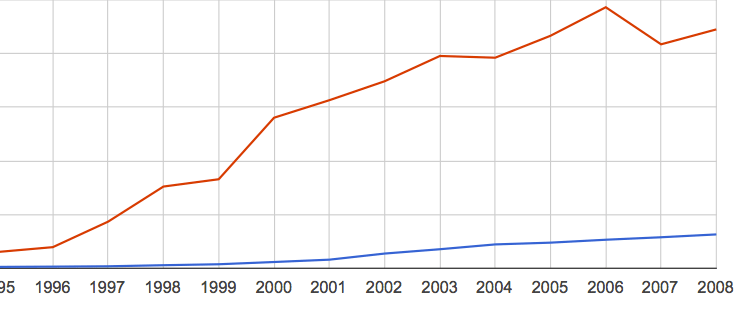
Final proof comes via Google’s Ngram Viewer, which, in an exciting development, now allows comparison of U.S. and British use of a word or phrase on the same chart! The Ngram below shows compares use of gap year in Britain (red) and the U.S. (blue) between 1995 and 2008:
Seen on the newsstand

Not really. This was the payoff of a Conan O’Brien bit where he lamented the demise of Newsweek and showed some magazines that have weirdly outlasted it, including “Pond Hoppin” (a cover lines notes that the periodical is “Brought to you by BASSIN’ and Crappie World”) and “Where to Retire.” He then brought in some fake mags, including the above compendium of ginger news. The fingers in the photo are Conan’s.

“Aggro”

Via Twitter, @I_Am_Maylin_Now suggested that I look at aggro, and when I said it was a term with which I was not familiar, he directed me to a World of Warcraft (WoW) wiki site with this definition:

Aggro is a jargon word in WoW, probably originally derived from the English words “aggravation” or “aggression”, and used since at least the 1960s in British slang. In MMORPGs [Massively multiplayer online role-playing games], such as WoW, aggro denotes the aggressive interests of a monster/NPC. Some examples are “We’ve got aggro!” and “Go aggro that monster”.

The OED bears out  this out (regarding the origin), citing a 1969 article in It magazine (“At the moment kids are split up into different subcultural groups which have been driven by the system into a permanent state of aggro with each other”) and Martin Amis’s 1973 novel The Rachel Papers: “It wasn’t day-to-day aggro, nor the drooped, guilty, somehow sexless disgruntlement I had seen overtake many relationship.”

The dictionary doesn’t recognize aggro as a verb, but does locate an adjectival use in Australia, as in “My New York paintings were all pretty aggro, with plenty of black” (Sunday Mail of Brisbane, 1985).

As my Twitter friend might have predicted, the term seems to have entered the U.S. through the world of gaming, with the OED citing Wired magazine in 1999: “A gaming device that brings skiing, snowboarding, and skateboarding into your house without thrashing the furniture… The 2-foot X Board lets vid kids stand and deliver aggro drops, extreme spins, and more.” But it’s spread out since then, with Time Out New York asking in 2008, “Are bike enthusiasts too aggro in defending their rights to NYC’s thoroughfares?” and Vanity Fair referring last year to “steroids, which bulk the muscles and ramp up the aggro.”

“Shag” it is

A couple of days ago, I asked you to vote on a new NOOB most likely to succeed, from the suggestions offered by BBC listeners.

The results are in, and all I can say is, you’re a predictable lot. Shag won in a veritable landslide, followed by flat; row and gap year tied for third. I will consider all of them in due course, though I have to say I’m highly skeptical that I will find much evidence on these shores of row, either as a noun or verb meaning argue/ment.

I actually forgot to include twit in the poll, so I’ll look at that one as well.
Many thanks for voting–all the Yanks out there, make sure you do the same on the first Tuesday in November.

More on NOOBS from the Beeb

The BBC’s online article about not one-off Britishisms asked readers to send in their favorite examples, and the results of that exercise have now been published. Going through the list, I see I have already weighed in on quite a few of the nominated terms: bloody, bum (meaning buttocks), cheeky, cheers, fancy (verb), gobsmacked, holiday (meaning vacation), kit, loo, mate, mobile (as in “call me on my mobile”), proper, queue, roundabout, and suss out. (My God, I have been doing this for a long time.)

A few of the others are indeed common in American English, but I’m highly doubtful that they can be called Britishisms: autumn, an item (meaning a romantic couple), and frock (meaning a girl’s or woman’s dress). One reader suggests pop over, meaning to come by for a visit; am I nuts, or have Americans been saying that for decades? Knickers is used here exclusively in the expression knickers in a twist, never as an actual term for a woman’s undergarment. I have actually been working on a post about wonky, which, like snarky, has taken on a decidedly different meaning in the U.S. than it originally had in the U.K.

Here are the remaining terms  (definitions are from the BBC post)

  • Chav, n. Pejorative term to express young person who displays loutish behaviour, sometimes with connotations of low social status.
  • Flat, n. An apartment on one floor of a building.
  • Gap year, n. A year’s break taken by a student between leaving school and starting further education.
  • Innit, adv. A contraction of isn’t it? Used to invite agreement with a statement.
  • Muppet, n. A stupid person; from the name for the puppets used in the TV programme The Muppet Show.
  • Numpty, n. A stupid person.
  • Row, n. and v. A noisy or violent argument, a quarrel with someone.
  • Shag, v. To copulate with.
  • Skint, adj. Penniless, broke.
  • Twit, n. A fool; a stupid or ineffectual person.

Bringing back a favorite feature from NOOB’s past (I’m talking to you, Hal Hall), I ask readers to vote on up to three of these expressions that they feel have actually taken hold in the U.S. It’s a free world out there, but I would ask those of you from the U.K, Oz, Canada, etc., not to vote, unless you’ve been observing American usage. I’ll announce the results tomorrow and get to work on posting about the winners.

“Ahead of”

Meaning before (a particular event or occurrence), and as seen in these U.S. headlines I spied on the morning of the first presidential debate:

  • “Ahead of First Debate, NPR Finds Romney Within Striking Distance”—NPR
  • “Ahead of Presidential Debate, Christie Raises the Bar for Romney”—NJ Today
  • “Ahead of Obama-Romney Debate, Skeptics Abound”—Cherry Hill, N.J., Courier-Post
  • “Ahead of Presidential Debate, Polls Show Obama Favored on Key Issues”—The Washington Post

And so on. It is not a phrase real people use in speaking to each other, but is the province of journalism (mainly headlines, but also creeping into the text of articles and, especially, broadcast reports), business jargon, and other environments where it’s perceived as helpful to express things in as wordy a way as possible. As for its presence on this blog, I’m not absolutely certain but I’m fairly confident that ahead of with this particular connotation is a solid NOOB.

The fuzziness comes from the fact that ahead of time and ahead of schedule are venerable idioms on both sides of the Atlantic, dating to roughly the turn of the 20th century. Ahead of-(event) pops in the early twentieth century, but very rarely. When I discussed this phrase on the Chronicle of Higher Education’s Lingua Franca blog, a friendly commenter directed me to a 1910 Atlantic Monthly article titled “Football at Harvard and at Yale” (that’s American football): “Harvard always insisted that her Pennsylvania game (a major contest) should be two weeks ahead of her Yale game.”

But I believe that is an outlier.  I searched for ahead of in headlines from The Times (of London), and the first relevant hit was in 1964, with “Investors Cautious Ahead of Elections,” followed the next year by “Shares Finish Flat Ahead of Trade Figures.” The New York Times didn’t use the phrase in a headline until 1981, with “Maritime Pacts Reached Ahead of Expirations.” But even that was a temporal one-off, as the phrase didn’t show up again in the paper until 1990.

And now, of course, it’s everywhere.


The “sarky”/”snarky” conundrum

My post on snarky elicited many comments from British people, the tenor of which can be gleaned from the first two posted:

Jan: That’s bizarre. The word I and all the British people of my acquaintance use is “sarky”, which I’ve always assumed was taken from “sarcastic”, seeing as being sarky so often involves being sarcastic. Sticking an “n” in there makes absolutely no sense at all. Maybe sarky is some kind of backformation.

Cameron: I think there were originally two distinct usages of snark/snarky. The British usage meant “nasty, irritable, unfriendly” and is reflected nicely in the 1913 text cited in the post. The other usage was (I think) originally from Australia/New Zealand and in that sense snarky was a portmanteau word combining nasty and sarcastic. I suspect the increasing usage of snarky in both Britain and North America is the originally antipodean usage becoming part of standard English.
First of all, I looked up antiopdean in the OED so I saved you the trouble. “Of or pertaining to the opposite side of the world; esp. Australasian.”
Second, I believe Jan and all the others who say they have never heard snarky in the U.K. until recently (if at all). Nevertheless, the word was in currency there in the mid-twentieth century.  In addition to the 1913 Vaizey and 1976 Crossman quotes in the original post, the OED cites Eileen Coxhead’s 1953 novel Midlanders: “I’ve known you were the soul of kindness, under that snarky way.”

Poking around on Google Books, I also found this:

 “There’s no need to be snarky,” said Sally clearly. “What’d you say?” Daphne stopped looking bored and stood up straight. “I said you didn’t have to be snarky. I’m not a kid.” “Are you not?” said Daphne, trying to imitate Sally’s accent.

The quote is from the 1973 novel No Place for Love, by Joan Lingard. Ms. Lingard writes on her website:  “I was born in Edinburgh, in the very heart of its old town, the Royal Mile, but when I was two years’ old I went to live in Belfast and stayed there until I was 18. It was there that I grew up, went to school, made my first friends, learned to read and write. Inevitably, then, Belfast and Northern Ireland have had a strong influence on my writing.”

In Captain Cat (1960), Robert Holles writes,  “My mother was snarky that day because my father had gone off early in a coach to some place about two hundred miles away, for a pigeon race.” (According to Wikipedia, Holles [1926-1999] “was the son of a sergeant major, and enlisted in the British army as a boy soldier at 14. He served in Korea as a sergeant with the 1st battalion of the Gloucestershire Regiment, and saw action during the Battle of Imjin in 1951, one of ‘The Glorious Glosters’ greatest battle honours.”)

Finally, in Games of Chance (1965), by the British novelist Thomas Hinde, one can read, “‘No need to get snarky,’ I heard him say. ‘Just stop asking,’ I shouted. ‘Stop, d’you hear. Stop.'”

Now for sarky. First, I can confirm that the word has not reached the U.S.  The OED defines it as “sarcastic” and notes, “Widely used amongst schoolchildren.” The first citation is from a 1912 letter in which D.H. Lawrence asks his correspondent, “Why are you so sarky?” Then, in 1924, Hugh de Sélincourt (an English author) wrote in Cricket Match, “He says it sarky-like and sneering.”

Giving some credence to Cameron’s antipodean theory, and suggesting that even by the ’30s, the term wasn’t universally familiar, is a quote (not cited by the OED) from The Jasmine Farm (1934), by Elizabeth von Arnim, an Australian-born British novelist: “‘Don’t be sarky,’ she at once cut him short. ‘Sarky?’ was all that, pulled up in his stride, he could find to say. ‘Sarcastic. Thinking you’re more than a match for me, when I shouldn’t be surprised if it was the other way about.'”

(Query to readers: is “the other way about” a Britishism, an Australianism, or merely an archaicism?)

My feeling is that, as Cameron says, the original, British meaning of snarky was “nasty, irritable, unfriendly.” I am also with him on the idea, in that its current use, on both sides of the Atlantic and in antipodean regions as well, it is a portmanteau–combining not only nasty and sarcastic, but snide for good measure. The first use of this connotation I have been able to find is still the 1970 Billboard review quoted in the original post.

I await your comments.