

In addition to went missing (and I sincerely hope that Thurston has “turned up”!), I like how the owners fudged on the question of British vs American date style by doing both: “March 14th March.” Or almost both–the th is American.

In addition to went missing (and I sincerely hope that Thurston has “turned up”!), I like how the owners fudged on the question of British vs American date style by doing both: “March 14th March.” Or almost both–the th is American.

As I realized when I first looked at London tube maps, in British English, journey basically means trip. In American English, the word is almost always used either metaphorically or to refer to a really long and momentous trip–journey though life, journey into terror, journey to the center of the earth, etc.
Are we starting to adopt the British use? Well, maybe. Megabus–a Canadian-owned company, admittedly–is big on journey. (They also ask for the expiry, rather than expiration, date on your credit card.) And an item in the June 3 Hattiesburg (Mississippi) American notes, “TripIt is one of many apps that helps you organize your journey.” (Possibly the writer was using elegant variation to try to avoid repeating trip.)
Meanwhile, perhaps British use is changing as well. I note that the new Steve Coogan film about a journey (literal and figurative) he takes with his buddy is called “The Trip.” Stay tuned.
One of my Facebook friends posted this, or should I say one of me Facebook mates. Click the graphic to see the whole thing.
Puts me in mind that I’ve noticed my (college-age) children facetiously using me=my. Possibly they are taking it from Popeye rather than working-class Britain. In any event it is now officially on the radar.

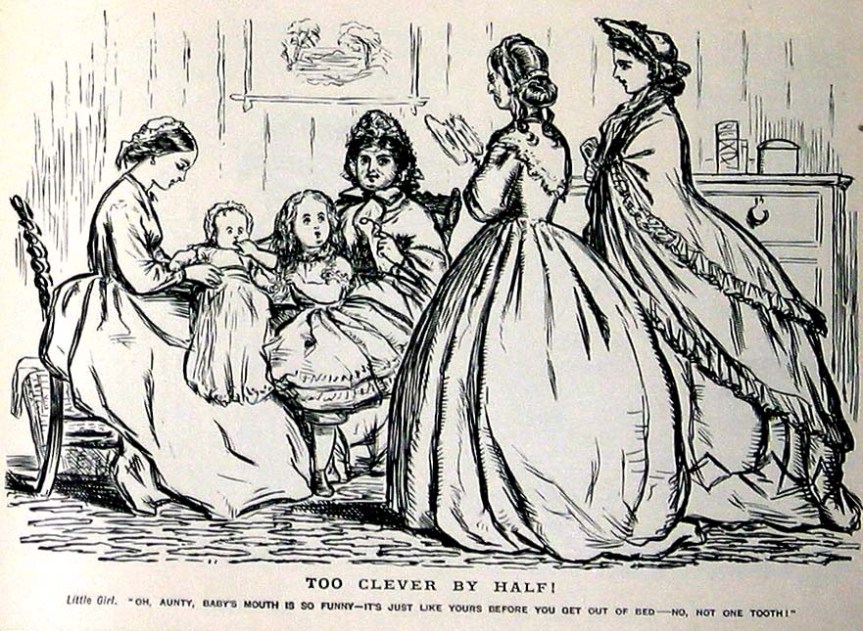
Too smart for his/her/its own good (British clever being roughly equivalent to U.S. smart). OED notes the first use of … by half formulation in Sheridan’s 1780 School for Scandal–“Oh, he’s too moral by half”–and of too clever by half in 1858. As the Punch cartoon suggests, it quickly became a popular catchphrase and remains so.
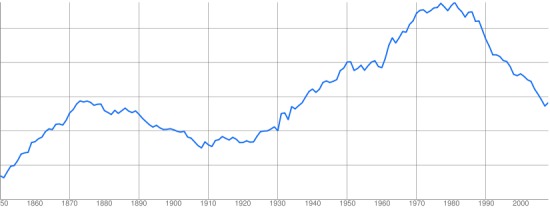
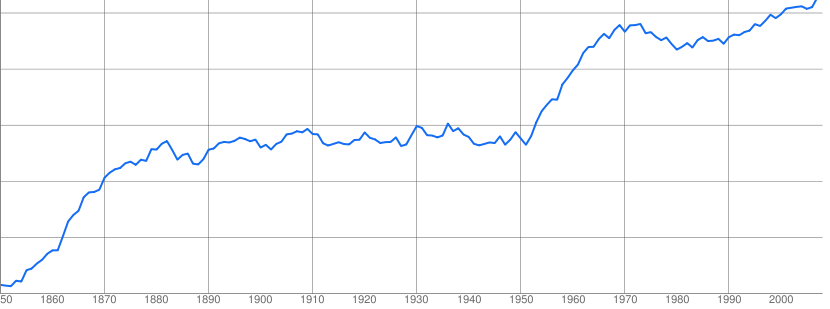
Google Ngram shows an interesting (and common) pattern in U.S. and Britain. British use peaks in about 1980, then declines. American use has roughly doubled since 1950. Currently, use is about equal in both countries.
The punctuation mark that comes at the end of a sentence; apparently coined by Shakespeare in “The Merchant of Venice.” The word Americans are familiar with, period, dates from the 16th century, but OED labels it “Now chiefly N. Amer.”; judging from the citations, that has been the case for about two hundred years. The mark has also sometimes been referred to as a point. (All of these probably eventually be supplanted by a new term: the dot indicating a period in computer addresses.)
Americans have taken to using full stop not to literally mean a period, but to emphasize that they are referring to a complete sentence, or by extension, a complete idea or phenomenon.
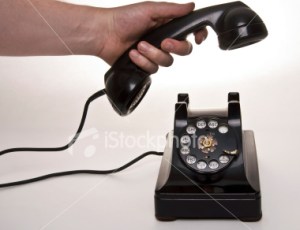 Coined through onomatopoeic metonymy (approximating the sound telephones used to make), and appeared surprisingly soon after the phone’s invention. First use in the OED is from Punch in 1880: “For you upon them both may frown, And say that you are shocked, or May knock the Secretary down, And then ring up the Doctor.”
That is a verb form, meaning “to place a phone call to”; American equivalents are call, call up, or phone. The noun form give (someone) a ring appears roughly the same time.

Google Ngram shows interesting patterns in the various forms in British and American English. For one thing, the phrase give me a ring has historically been about equally popular in Britain and the U.S. Currently, following a three-decade upswing, it shows significantly more frequent use here. We also will frequently say something like, “I answered on the fourth ring”–notwithstanding, of course, that telephones don’t make ring-like sounds anymore. And who can forget Ernestine’s “One ringy dingy, two ringy dingies…”?
Verb forms are still more frequent in the U.K. although, typically for a NOOB, U.S. use has spiked since 1990.
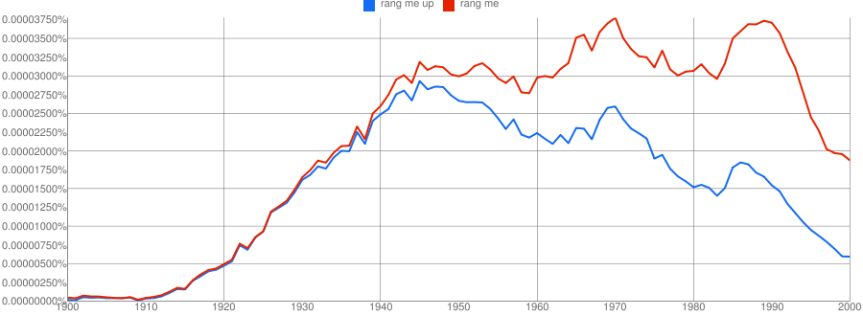
The British verb use is more complicated and interesting. The chart below shows British usage of “ring me up” (blue) and “ring me” (red) between 1900 and 2008. Up until about 1940, hardly said merely “ring me”–the phrase had to be “ring me up.” (The OED’s first cite for the up-less ring is 1930) The short form achieved equal popularity around 1980, and currently is used about twice as often. My hypothesis is that ring up sounds to British ears like a stage caricature of the way they talk, so they are in the process of rejecting it–kind of like “telly” or “I say, old boy.”
 Verb, transitive, from the brand of vacuum cleaner, which was apparently hugely popular in the U.K in the mid-20th-century period. The OED reports that the literal verb–that is, to clean by means of a vacum cleaner–appeared no later than 1939 (impressive, since Hoover was patented only in 1927). The first cite for the metaphorical verb (“To consume voraciously; to devour completely. Freq. with up or (occas.) in”) is from the 1970 Times: “The populace‥sit hoovering up the drivel poured out on television at peak viewing times.” A Google Ngram suggests that, as with so many Britishisms, U.S. use started to rise in the early 90s and is still going up.
Urban Dictionary offers two additional meanings for the verb. One of them you can guess. The other:
Being manipulated back into a relationship against your will with threats of suicide or self-harm, threats of harm to others or property, or threats of false criminal accusations. A “hoover” is relationship blackmail. This slang term is often associated with individuals suffering from personality disorders like Borderline Personality Disorder or Narcissistic Personality Disorder.
“Where are we rolling?” “Into the heart of the night. Wherever there are dances to be danced, drugs to be hoovered.” (Jay McInerney, Bright Lights, Big City, 1984)/For years, Mr. Madoff’s elusive genius act beguiled his Jewish neighbors, as well as friends of those neighbors, and so on, and so on, until vast chunks of local money were hoovered into his Ponzi scheme. (New York Times, April 11, 2009)
A (n American) person I follow on Twitter–no names–just used “by-election” to refer to the recent Congressional race in upstate New York.
My work here is done.
 Varies in meaning according to context, and preposition. Thus keen to+verb, and keen by itself as an adjective both mean, roughly, eager. Keen on+gerund or +noun means enjoying that activity or thing, while to be keen on a person means to fancy him or her (in the British sense). An example of the last is an oft-quoted–in my family–exchange from the wonderful film (and fount of Britishisms) “About a Boy.” The Hugh Grant character, Will, is developing feelings for a woman, as Will’s young mate, Marcus, explains to the woman’s son, Ali:
Marcus: Oh, don’t worry, I think your mum is keen on him.
Ali: [shouting] She’s not keen on him! She’s only keen on me!
Google Ngram shows a roughly 100 percent increase in the use of both keen on and keen to in American English between 1990 and 2008.
Scientists are keen to explore cloning as a potential source of embryonic stem cells, which could be used to treat diseases such as Alzheimer’s or Parkinson’s. (Time, Dec. 11, 2001)/ If You’re Keen on Quinoa (New York Times headline, May 27, 2011).
 Noun or adjective corresponding, respectively, to the U.S. redhead and redheaded or red-haired. Also a nickname for a ginger person (equivalent to U.S. Red) as in drummer Ginger Baker or singer Geri “Ginger Spice” Halliwell (impressively, the second consecutive Spice Girls reference in NOOBs).
The term first appeared on my radar when, in London in 2004, I read this sentence in the Daily Telegraph: “The ginger asthmatic was always going to struggle in Coimbra’s oppressive heat.” I eventually figured out that this was a reference to footballer Paul Scholes–and “the ginger asthmatic” still ranks as my favorite all-time example of the class of misguided synonym that H.W. Fowler referred to as “elegant variation.”
Undoubtedly, the term gained traction in the U.S. with the popularity of the Harry Potter books. According to the Harry Potter Wiki, “Scabior, Fenrir Greyback, and a drunk man on Tottenham Court Road” all referred to Harry Potter’s famously ginger-haired mate Ron Weasely by this term.

The term has a long and sometimes unsettling history in Britain. According to Wikipedia (don’t judge me! there are footnotes!)
A UK woman recently won an award from a tribunal after being sexually harassed and receiving abuse because of her red hair;[55] a family in Newcastle upon Tyne, England, was forced to move twice after being targeted for abuse and hate crime on account of their red hair;[56] and in 2003, a 20 year old was stabbed in the back for “being ginger”.[57] In May 2009, a British schoolboy committed suicide after being bullied for having red hair.[58] The British singer Mick Hucknall, who believes that he has repeatedly faced prejudice or been described as ugly on account of his hair color, argues that Gingerism should be described as a form of racism.
Ginger prejudice arrived in the U.S. in 2005 with an episode of the animated comedy series “South Park” entitled “Ginger Kids.” In the episode, a satire on racial and other sorts of prejudice, “Cartman rallies all other ginger kids to rise up and assume their role as the master race” (in the words of the series website). As is often the case with satire, there were unintended consequences. A 14-year-old Vancouver boy started a Facebook group devoted to “National Kick a Ginger Day”; it attracted almost 5,000 members, and the founder was eventually investigated by the Royal Canadian Mounted Police for possible hate crimes
Marc Torsilieri, who looked like a ginger-bearded lumberjack and played the part in splendid fashion by annually felling the Christmas tree for Rockefeller Center, died on March 12 in Somerville, N.J. (Douglas Martin, New York Times, March 17, 2007)/Scarlett Johansson, who is now a ginger, and Donald Trump. Really, I would love to know what’s being said here. “Scarlett, I’d like to bring you back to the Trump Tower so I could tell you you’re fired while we make love on a bearskin rug.” “OH DONALD YOU’RE TOO MUCH! HAHAHAH, don’t you know I’m with Sean Penn now?!” (photo caption, BostonHerald.com, May 1, 2011)
 notoneoffbritishisms.com