On the radar: “Nick”

Steal; verb, transitive. Slang.

Just a few months ago, the New York Times gave this word the full quotation marks/translation treatment: Now, every ”splash” — a tabloid’s Page 1 story — is assumed to have been ”nicked,” or stolen, by a hacked phone or other illicit means.

But in a September 25 Arts review by Steve Smith, the word was used without the bat of an eyelash: Sultry string figures embellished with sweeping harp recalled what Hollywood composers nicked from Duke Ellington; staggered section entries piled up with Gershwin-esque swagger.

Is nicked ready for the big time? Stay tuned. (Thanks to Devin Harner.)

“Advisor”

Hold your fire! I know that the spelling “advisor” is not British. However, people think it’s British (someone even said that exact thing at a faculty meeting last week, unprompted by me), so I present the post below. (It originally appeared in the Chronicle of Higher Education’s Lingua Franca blog.) And I have devised for it a new category, “Faux NOOBs.” Additional nominations welcome.

Quick quiz: What do you call a person whose job is to offer advice? Or, rather, how do you spell that job?

If you said advisor, you would be in accordance with 100 percent of my students; with the practice of my university and I believe most others in this country; with the popular Web site TripAdvisor; with Merrill Lynch, which sends to its customers a publication called Merrill Lynch Advisor; and, in fact, with the English-speaking world generally.

If you answered adviser, you would be right. Or, to be more precise, right from the perspective of The New York Times, the Associated Press, The Chronicle of Higher Education, and history. Adviser first appeared in 1611, according to the Oxford English Dictionary. It was formed by appending the suffix –er (in this case, merely the letter r) to the verb advise, along the lines of such similar constructions as baker, candlestick-maker and, well, not butcher, which comes from the Old French bouchier, but teacher, seeker, and beekeeper.

The OED’s first citation of a different spelling is a periodical that first came out in 1899 and was called, simply, Advisor. The dictionary doesn’t specify its country of origin, but the new spelling became sufficiently popular in the United States that American Speech, the journal of the American Dialect Society, mocked it in 1931: “Following the advent and acceptance in this country of advisors, newspapers now occasionally mention debators.” (There are, of course, -or nouns for occupations and identifications, but they are usually not formed from verbs: doctor, debtor, proctor, author, executor, curator, donor.)

The chart below is a Google Ngram showing the comparative frequency, in books published in America between 1900 and 2008, of adviser (blue line) and advisor (red line). The -or spelling pulls ahead in about 1999. (In Britain, -er is still ahead though its lead is fading.)

Ngram’s database, as I say, consists of books, which tend to stick with traditional usages longer than other forms of writing do. The Internet itself gives a more accurate snapshot of current usage, and if you stage a Google Fight between the two spellings, -or blows -er away, by 23.7 million to 5.7 million.

How to explain the dominion of advisor? First, it sounds fancy (because, I conjecture, the real –or nouns have longer pedigrees than the formed-from-verbs -er ones). Second, it sounds British. And when it comes to language in our country, that is an unbeatable combination.

“Sit for” (an exam)

Americans traditionally “took” tests or exams. Now, increasingly, they are sitting. What’s next: standing for a by-election?

Certain readers of ”Herzog” complained the book was difficult. Much as they might have sympathized with the unhappy and comical history professor, they were occasionally put off by his long and erudite letters. Some felt that they were being asked to sit for a difficult exam in a survey course in intellectual history. (Saul Bellow, New York Times, March 8, 1987)/City School Superintendent Neel Durbin opened the meeting by celebrating the number of Dyersburg High School students enrolled in AP courses as well as the number that are passing the AP exams at the end of the course. …”Fifty-five percent of our students that sit for the exam pass it,” said Durbin… (Dyersburg [PA] State Gazette, October 18, 2011)

“Sort of”

Tina Brown: a kind of sort of archetypal Brit

I fired up my e-mail this morning to find a note containing the following blurb for a collection of poems:

I was made silent and watchful by the continuing poetry here. I kept reading, sort of mesmerized by the consistent achievement, watching out for the occasional weakness. Surely the level couldn’t be maintained. But the weakness never showed.

One phrase jumped out at me. The phrase was sort of. A couple of years ago, my daughter Maria, then and now a college student (and a sharp observer of linguistic trends), commented to me that these two words were crack cocaine to her professors: irresistible and deadly. Note that she didn’t say “sort of crack cocaine”; she recognized that the qualifier would have sort of ruined her metaphor.

Ever since then, I had noticed my colleagues’ (and, truth to tell, my own) overuse-verging-on-abuse of the phrase in department meetings and lectures. The poetry blurb was a sign that it has migrated from speech to print.

Sort of is an adverbial phrase with two bloodlines, one distinctly British and the other American. The latter is a homespun qualifier; think of the bashful cowboy who is sorter (as it’s often rendered) sweet on the schoolmarm. The academic sort of follows the British tradition in suggesting an attitude of qualification and noncommittal diffidence that’s at once specific and universal. It is characteristically used either between noun and verb or in the construction a-sort of-noun or noun phrase. The Oxford English Dictionary cites a 1780 quote from The Mirror (“There is a sort of classic privilege in the very names of places in London”) and a line from Shaw’s 1903 “Man and Superman”: “I’ll sort of borrow the money from my dad until I get on my own feet.”

More recently, Tom Stoppard brilliantly nailed the Englishness of a character, Henry, in “The Real Thing” who is defensive about his love of popular music. Henry says: “I was taken once to Covent Garden to hear a woman called Callas in a sort of foreign musical with no dancing. … As though the place were a kind of Lourdes for the musically disadvantaged.” (Kind of is synonymous with sort of.) Graham Greene, meanwhile, invoked a cosmic sense of the phrase in entitling one of his memoirs A Sort of Life.

The academic sort  of is in the British tradition and is neither brilliant nor cosmic. Sometimes it is a signal that a metaphor or figure of speech is coming up (an only marginally less smarmy as it were), and sometimes it merely signals a reluctance to stand fully behind what we have to say. It is uncannily like our students’ like: a crutch that has sort of turned into a tic.

Note: this above post originally appeared in the Chronicle of Higher Education’s Lingua Franca blog. I would like to update it with a sort of (sorry) crowdsourcing contest. This morning, the (British) Newsweek editor Tina Brown appeared on NPR’s Morning Edition for her weekly “Must Reads” segment. The seven-minute appearance was interlarded with so many sort ofs and kind ofs that the capacity of my fingers and toes to count them was quickly exceeded. I will send a free copy of my book The Sound on the Page: Style and Voice in Writing to the first reader to give me an accurate count of how many time Tina used each phrase.

“Grey”

The color or colour between black and white. U.S. spelling has traditionally been gray, and British (or at least modern British) grey. The OED notes:


With regard to the question of usage, an inquiry by Dr. Murray in Nov. 1893 elicited a large number of replies, from which it appeared that in Great Britain the form grey is the more frequent in use, notwithstanding the authority of Johnson and later English lexicographers, who have all given the preference to gray . In answer to questions as to their practice, the printers of The Times stated that they always used the form gray ; Messrs. Spottiswoode and Messrs. Clowes always used grey ; other eminent printing firms had no fixed rule. Many correspondents said that they used the two forms with a difference of meaning or application: the distinction most generally recognized being that grey denotes a more delicate or a lighter tint than gray . Others considered the difference to be that gray is a ‘warmer’ colour, or that it has a mixture of red or brown …. In the twentieth century, grey has become the established spelling in the U.K., whilst gray is standard in the United States.

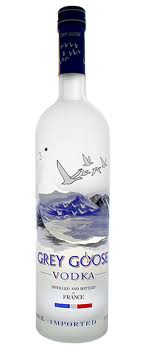
I would definitely agree with the last statement. The New York Times used gray more than 195,000 times between 1851 and 1980, and grey only 32,255. (The statistics are complicated by the fact that both spellings constitute a common last name.) However, my (American college) students almost unanimously choose grey. I hypothesize that this reflects the popularity of Grey Goose Vodka, designed for the American market and introduced in 1997, and of the TV show “Grey’s Anatomy,” which debuted in 2005. (The book to which the title refers is “Gray’s Anatomy.”)

Visiting the Tomb of the Unknown Soldier on a grey and misty morning, the President told thousands of mourners: “They fell so we might have the freedom, which too many of us take for granted, but at least on this day we know is still our greatest blessing.” (Time, May 29, 1995)/ The hills are shedding their summer gold for their fall grey. (San Jose Mercury News, October 13, 2011)

“On offer”

This image, weirdly, advertises the Australian Government's "Defence Work Experience Program"

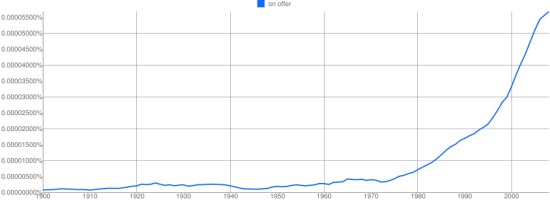
For sale, or on sale (that is, discounted); more generally, available. First cited in the OED in a (London) Daily News in 1881: “Old wheat scarce and dear. Very little barley on offer.”

The Google Ngram chart below shows the use of the expression in American English from 1900 through 2008, with the relentless increase commencing in about 1972.

Tens of thousands of Apple Macintosh users visited the Macworld trade exposition here earlier this month, examining the hardware and software on offer.(Peter H. Lewis, New York Times, April 22, 1990)/Self-improvement has always found a ready market, and most of what’s on offer is simply one-on-one instruction to get amateurs through the essentials. (Atul Gawande, The New Yorker, October 3, 2011)

“Book” (tickets, table, room)

When I first spent significant time in London, about fifteen years ago, one of the first words that struck me as unusual was book–used as an all-purpose verb to indicate, well, as the Oxford English Dictionary puts it: “To engage for oneself by payment (a seat or place in a travelling conveyance or in a theatre or other place of entertainment).” The OED cites a first use in Disraeli’s 1826 novel Vivian Grey –“I’ll give orders for them to book an inside place for the poodle”–and then an 1887 theatrical advert: “Seats can be booked one month in advance.”
In London a hundred-plus years later, people were always talking about booking theater, excuse me theatre, tickets, hotel rooms, tables at restaurants. (Granted, this came up a lot because I was in a tourism/study abroad situation.)

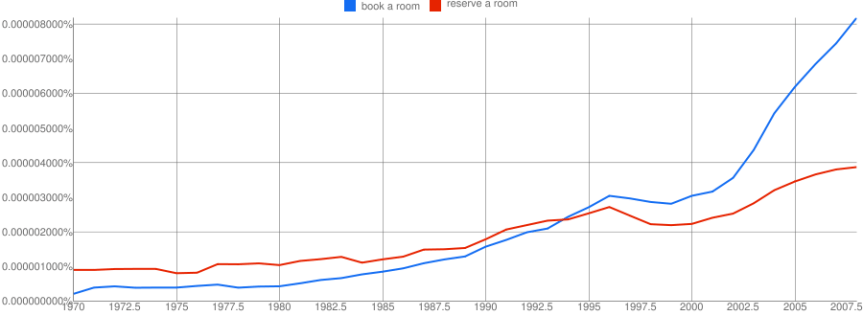
The usage was not unheard of in the U.S., but (the significantly less strong) reserve was much more common in reference to eating and sleeping. For theatre, I guess our best word has been get, which isn’t very good. Hence it’s not surprising that book has gotten traction here.

This Google Ngram shows the change in use of book a room (blue) and reserve a room (red) in American English, 1970-2008. Book surges ahead in 1993, which puts it in a sweet spot for NOOBs.

With the proper “Web browsing” software — available free on the Internet — the traveler can see photographs of a hotel’s lobby and of a typical room, check maps of its neighborhood, and even book a room and get a confirmation via the PC. (Peter H. Lewis, New York Times, December 11, 1994)/Combined with the iPhone’s rich location services, that allows for voice commands and questions like “Find the best vintage clothing store around here,” and “What was Apple’s net revenue in 2010,” or “Book a table for four at East End Kitchen for 7 tonight.” (Fast Company, October 5, 2011)

“Baby bump”

Graco has an "I Love My Baby Bump" Facebook page

I have to say I was gobsmacked when a reader suggested baby bump as a NOOB. I always thought of this euphemism for a pregnant celebrity’s stomach as a relatively recent invention of American tabloids. How wrong I was.

The term seems to have originated in late 1980s Britain as merely bump, sans the “baby.” The OED’s first citation (with telling quotation marks) is from The Times (of London) in January ’86: “The old idea was to hide ‘the bump’ under voluminous maternity dresses.”

Interestingly, as my correspondent pointed out, bump–sometimes, facetiously, the bump–came to refer not only to the protuberance but to the future child beneath it.

The OED quotes a 1999 novel by Charlotte Grimshaw, Provocation:  “Harry … wiped his hands on his kiddie jeans and leaned against her and the bump, his sibling-to-be.”

The addition of the alliterative baby now seems to be inevitable. But it came only in December 2003, my investigations suggest, in the pages of the Australian publication MX: “While Danielle Spencer’s baby bump has really popped out, hubby Rusty Crowe is hitting the streets and parks of Sydney to lose any tummy bulges for his next flick.”

First British sighting: Liverpool Daily Post and Echo caption from September 22, 2004, “Sarah with and without her baby bump.”

And the first U.S. one goes to the San Antonio Express-News, January 27, 2005:

“For the last couple of years, it seemed all of Hollywood’s reigning clotheshorses and glamourpusses were trading in their Birkin bags for diaper bags, their Pilates bellies for baby bumps.”

The most recent use? Well, USA Today posted this sentence two hours ago as I write: “Beyonce debuted her baby bump at the MTV Video Music Awards on Aug. 28.”

Enough already! I am baby bummed.

Make your voice heard!

Back in April, I did some crowdsourcing, asking readers to vote on future NOOBs entries. The winner was twee, which I dutifully explored. Many of the (now more than 400) comments on my Slate piece last week nominated specific Britishisms for consideration, so I thought another poll was in order.

Following are some of the words most frequently mentioned, plus the runners-up from the previous poll–knackered and prat. Vote for up to three.