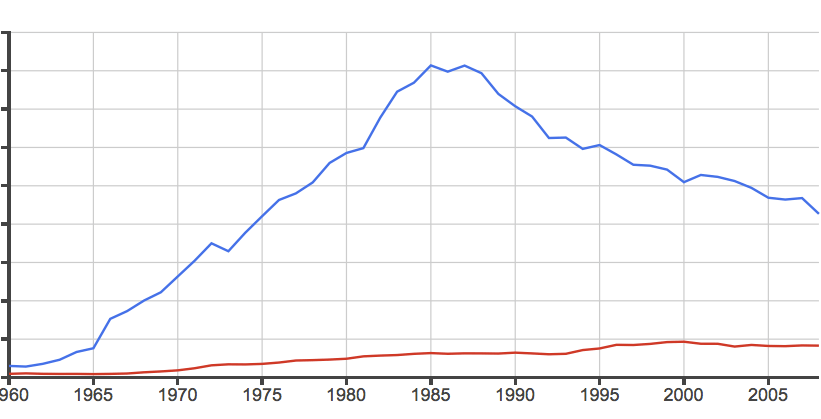
When I started Not One-Off Britishisms, nearly three years ago, it was a sort of experiment. In retrospect, I see that I was testing the commonly voiced proposition that the best blogs tend to be about the narrowest topics.
Well, narrow I have been. And while I won’t make any judgments about “best,” NOOBs recently passed the 750,000 page view mark, which is not nothing. (273,894 have come from the U.S. and 257,247 from the U.K.) Beyond the numbers, it’s been greatly rewarding for me. I’ve been able to explore a fun hobby and add infinitesimally to the fount of knowledge, all while never (knowingly) harming anybody. Best of all for me have been the comments, which continually delight and instruct. There are too many examples to name, but just in the past week, in the discussion of Titbits, I learned about the venerable magazine of that name and even heard from someone who’d worked as an editor there in its last days.
In this general air of self-congratulation, I thought I’d pass along some statistics, To start with comments, there have been 3,981 of them, and the most prolific recent commenters are:
- Hal Hall
- Martin James
- IvanOpinion
- czyrko
- DW
- Bren
Thanks, mates.
The most commented entry has been “Arse” with 99 of them, followed by:
European Date Format is the most-read single post, followed by
- “Mewling Quim“
- “Ginger“
- “xx“
- “Streets Ahead“
- “Easy Peasy“
All that must mean something, but for the life of my I can’t think of what it is. Anyway, thanks again for stopping by. Talk to you again when we reach a million.