“____ Years’ Time”

Astute reader John Wall points to a sentence in today’s New York Times: “The Guardian said on Monday that it intended to cut its costs sharply in an effort to reduce its losses and break even at an operating level in three years’ time.”

He notes, “I think of the phrase with ‘time’ preceded by the possessive form of a measure of time as a very British expression, as in ‘two hours’ time’ or, in this case ‘three years’ time.’ … A native USA speaker/writer of English would, I think, write ‘in three years,’ without the possessive apostrophe or the word ‘time.'”

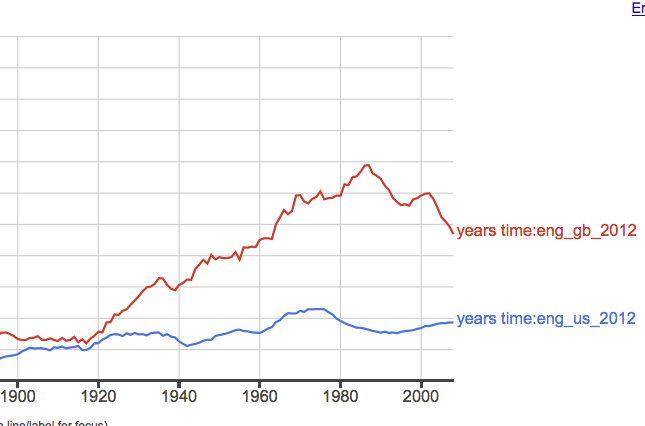
I was not aware of the Britishness of the formulation, but John is correct, according to this Google Ngrams Viewer graph showing the relative frequency of the phrase “years time” in British and U.S. sources. (Ngram viewer doesn’t recognize apostrophes, so I left it out; and I didn’t include the number of years, so as to include a wider range of citations.)

Screen Shot 2016-01-26 at 9.42.25 PM

Like a number of other NOOBs, “___ years’ time” wasn’t especially British until fairly recently–in this case, the 1920s. It steadily increased in popularity till the late 1980s–the moment when the modest American revival commenced.

Off to OZ

As the end of the year approaches, it’s a good time to thank readers, commentators, and tipsters for another good one. Statistically speaking, 197,444 people visited the blog in 2015, leaving 768 comments. Counting this one, I filed 52 posts–an even one a week. The most-viewed posts were the usual golden oldies: number one was European Date Format, followed by “Mewling quim,” “xx,” “ta-ta,” and “easy peasy.”

Right after the New Year, I am off to Melbourne for a month, where I will be teaching a group of University of Delaware students, soaking up the sunshine, and–not last–on the lookout for not one-off Australianisms.

I’ll be reporting in this space on what I find. Until then, have the merriest of happies.

“Two a penny”

From last week’s New York Times:

“Weather apps are two a penny, but I’ve used one more than any other this year: Yahoo Weather.”

The Oxford English Dictionary’s definition for “two a penny” (“ten a penny” is a variant): “plentiful and consequently of little value, commonplace; easily obtainable or available; occurring frequently.” The OED quotes a 1948 novel by Neville Shute: “In Hollywood beauties were two a penny, and it was years before she got an inkling what it was that differentiated her from all the stand-ins and walkers-on.”

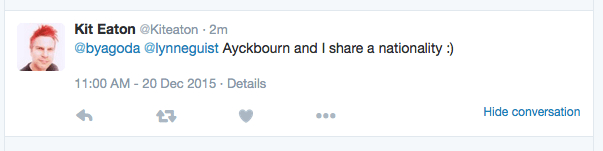
Before reading the quote in the Times, I was unfamiliar with “two a penny.”  Searching the the newspaper’s archives, I see the last time it was used was in a 2005 review of a play by Alan Ayckbourn, which was kind of appropriate, in view of Ayckbourn’s nationality. Given that there is an apparently completely synonymous American cliche–“a dime a dozen”–I don’t expect to encounter “two a penny” here again. But as Fats Waller immortally said, one never knows, do one?

News flash: Mere minutes after this was posted, the following came over Twitter, from Kit Eaton, who wrote the line about Yahoo Weather:

Screen Shot 2015-12-20 at 11.02.37 AM

“Square brackets”

Delegates at the recently concluded Paris climate talks worked from a draft document in which alternate wordings were laid out next to each other. For example:

Parties [shall][agree to] to take urgent action and enhance [cooperation][support] so as to (a) Hold the increase in the global average temperature [below 2 °C][below 1.5 °C][well below 2 °C][below 2 °C or 1.5 °C] [below 1.5 °C or 2 °C][as far below 2 °C as possible] …

An article in the American publication The Atlantic noted that the draft agreement contained “well over 1,000 square brackets.”

“Square brackets” is British English for what Americans call simply “brackets.” I had never encountered the expression until a couple of months who, when an English fellow remarked how odd it seemed when something I’d written referred merely to “brackets.”

“Square brackets” has appeared very occasionally in the New York Times, for example in this 2009 blog post by Jennifer 8. Lee.

My English friend also informed me that in AmE “parentheses” (like this) are “round brackets” in BrE. “Round brackets” has never appeared in the New York Times and I imagine it never will. But as Fats Waller so eloquently said, “One never knows, do one.”

[Update. Some British commenters have said that they are not familiar with “round brackets” but merely say “brackets” for what Americans call parentheses. I certainly take them at their word but the Oxford English Dictionary does have an entry for “round brackets” with British citations, including J. P. Mahaffy Empire of Ptolemies vi. 228: “Superfluous words and syllables, written by mistake of the scribe, are enclosed in square brackets. Necessary additions or corrections in round brackets.” I have also learned from my investigations that “brackets”/”square brackets” were formerly called “crotchets.”]

“Different to,” upgraded

A few years ago, I called “different to” (as opposed to the American “different from” or “different than”) a “doobious NOOB”–meaning that there was no sign of it becoming popular in the U.S. But since reader Hal Hall recently spotted this sentence in the online publication Quartz

One company, Canada’s D-Wave, which uses a different process to IBM’s, claims to have already built a commercially viable computer with 1,000 qubits.

–I’m upgrading it to “On the Radar.”


“Range”; “offer”

There’s a whole set of distinctly British retail terms. One is “offer” for the American “sale.” The other is “range” to mean (in the OED’s definition) “A set of goods manufactured or for sale.” (The dictionary quotes this quintessentially British line from a 1963 issue of Punch: “Harvey Nichols have a new range of Californian swimwear.”)

Both of them turned up in an advert in today’s Philadelphia Inquirer.

dysonI know Dyson originates in the U.K. but still, gee whiz.

“Follow-On” (adj.)

A few days after the Paris terrorist attacks, Dina Temple-Raston of NPR reported that French authorities “were very focused on trying to abort a second attack. And they’re worried another one, a follow-on attack, will happen.” That night, I heard Rachel Maddow use “follow-on” the same way in her MSNBC broadcast.

Not being familiar with the term, I looked it up in the Merriam-Webster Dictionary and found this definition: “being or relating to something that follows as a natural or logical consequence, development, or progression.” It would seem a useful term, but the origins are murky. The OED reveals a cricket etymology for “follow on,” starting as a verb referring to a side that “go[es]  in again at once after completing the first innings, in consequence of having made a prescribed number of runs less than their opponents in the first innings.” (I can only assume that that sentence makes sense.)  The dictionary quotes an 1865 cricketers’ guide: “Surrey ‘followed on’, but left only 23 runs for Oxford to get to win.”

The first non-cricket use cited by the OED is from a 1960 advertisement in “Farmer & Stockbreeder”: “This new booklet contains advice about ‘follow-on’ feeding.” Not sure what “follow-on feeding” would be, or how it followed (no pun intended) from the cricket term.

Non-cricket “follow-on” was subsequently picked up in various contexts, maybe most commonly in the business term “follow-on effect.” I feel that it’s mainly been a Britishism, but at this point I am unable to say for sure. I can report, however, that the the majority of the results in a Google News search for “follow-on effect” are from Australian sources.


“Inverted commas”

From a recent article in The New Yorker:

Screen Shot 2015-11-06 at 8.56.41 AM

“Inverted commas” is in the category of Britishism for which there’s an exact American equivalent, like “advert” (“advertisement,” “ad”); in this case, it’s “quotation marks.” It’s actually more annoying than that because the whole notion of inverted commas doesn’t make sense in the U.S., where we use double quotation marks, like “this.” (The British single quotes, like ‘this,” do resemble upside-down commas.)

I would have thought this would be a one-off, but in The New Yorker alone, “inverted commas” have been mentioned several times in the past decade, by such writers as Adam Gopnik and Hendrik Hertzberg.

I say stop it now.

“A right”

Chip Kelly, the coach of the (American) football Philadelphia Eagles was questioned the other day about the Eagles’ play calling: specifically, why relatively few plays have been called for star running back DeMarco Murray to carry the ball. Kelly replied in part: “I would love to get everybody in a right lather and going, but when we’re not having success running the ball at all, then it’s tough to say, ‘Hey, we’re just going to make sure we get [running back DeMarco Murray] 22 carries and he’s lathered up.'”

OK, so the “lather” thing is taken from horse racing, referring to the frothy sweat of a horse. The OED cites an 1837 novel: “Miss Bell had already exercised her [a mare] so well, that, to use a jockey term, she was all in a lather.” The novel is British, but I sense that “in a lather” has been used in racing circles on both sides of the Atlantic.

You’ll notice that Kelly used the term, figuratively, in two different expressions. “In a lather” is a venerable one, but traditionally has been used to mean being in a state of high anxiety, irritation and/or agitation. The OED’s first citation is from Frances Trollope, quoting an American in 1849: “Don’t be in a lather, father, before you are shaved. I’ll do your job, I expect, if you won’t be in such a tarnation fuss.”

“Lathered up” seems to have departed from  horse-racing parlance rather more recently. Searching Google News, I find Kelly is not the only American coach to lately use it about human athletes, especially football players (who are often described with words and expressions traditionally associated with animals). A Louisiana college football coach was quoted as saying about a receiver, “It’s hard to get into a rhythm until you get lathered up a little bit, it’s like a running back.” And the San Francisco 49ers coach said of an injured player, “he will be out there and going through that extended stretch that we do and try to get him into the team, get him warmed up and lathered up.”

But the real reason Kelly’s quotes spawned this post is the first two words in “a right lather.” The OED defines this “right” as “colloq. (chiefly Brit. and Irish English). As an intensifier (usu. in derogatory and ironical contexts): complete, absolute, total, utter.” It cites The Observer writing in 1974: “‘The Government did not know that there was no settlement in writing, and how could an order apply to something which did not exist,’ he said. ‘The Government made a right mess of it.’”

I would hazard to say that until Chip Kelly spoke, this usage of “a right” has never been uttered, non-ironically, by an American.

“Peckish”

The public radio program “Marketplace” recently aired a piece about a new sitcom called “Crazy Ex-Girlfriend,” which is set in West Covina, California. Discussing why she chose that town, one of the show’s producers (a female American, complete with vocal fry) said among other things she liked the fact that the local mall had pretzel shops at both entrances, “just in case you got peckish for a pretzel.” [Note: A commenter observes that “peckish for” is unidiomatic. It strikes me that this woman’s use of it grew out of the currently popular “hungry for”–as in “hungry for lunch”–as discussed here.]

This was the first time I was aware of encountering an American use of “peckish”–defined concisely by the OED as “somewhat hungry.” All of the dictionary’s citations are British with the exception of this from Laurie Colwin’s 1988 book Home Cooking: “At four in the afternoon, everyone feels a little peckish, but only the British have institutionalised this feeling.” (I wondered whether Colwin eschewed the American spelling “institutionalized”; Google Books told me “no.”)

It’s interesting that she would have mentioned 4 p.m., because I personally tend to get peckish in the morning. Many other people apparently do as well, hence the (British) custom of “elevenses,” for which Winnie-the-Pooh Paddington favored  honey on bread with condensed milk.

Anyway, it turns out that “peckish” shows up here now and again. It’s appeared sporadically in the New York Times in recent years, most recently in a review of a bar on the Lower East Side: “If peckish, try the matzo-meal fried chicken with pastrami-spiced gravy ($23).” Somehow, I don’t think Winnie-the-Pooh would approve.