
… (discussed here ) and now, courtesy of Lauren Collins (@laurenzcollins),


The other day, tiresomely, someone hacked the Twitter account of the National Football League and tweeted that Roger Goodell, the NFL commissioner, was dead. The tweet was deleted. Then the perpetrator sent out another tweet:
Oi, I said Roger Goodell has died. Don’t delete that tweet.
If the NFL has a forensic team working on the case, I would advise them to concentrate their efforts in Great Britain, Australia, New Zealand, Singapore, and South Africa, because that, according to Wikipedia, is where people say “oi.”
According to the OED, the word originated as the naval interjection “hoy!” (related to “ahoy”). “Oi” was originally associated with Cockney argot, and the first OED citation is a bit of dialect from the Evening Standard in 1937: “Oi, there’s a lidy ‘ere wants some juice on the knocker!” The same year, it appeared in the lyrics to the song “Doing the Lambeth Walk,” from “Me and My Girl,” a musical about a Cockney barrow boy who inherits an earldom:
Once you get down Lambeth way
Every evening, every day,
You’ll find yourself
Doing the Lambeth Walk. oi!
Since then it has provided the name to a British punk-rock subgenre and more generally gone mainstream. You can hear it shouted in streets and sporting events of Commonwealth countries, especially Australia, where “Aussie! Aussie! Aussie! Oi! Oi! Oi!” is a popular chant. But you don’t hear it in the U.S.
So get on it, NFL security. Your work is cut out for you.
On Twitter, NOOB friend Jan Freeman reported some British colleagues describing a balky pin as “fiddly,” and remarked, “There’s a word we could use in AmE.”
It turns out we already have it, more or less.
First, the Oxford English Dictionary’s definition: “Requiring time or dexterity; pernickety.” The first citation is from Blackwood’s Magazine in 1926 but the second isn’t until 1960, from The Times– “‘Fiddly things’ should be done by automatic machines.” On my own, I found a 1958 quotation from the same newspaper, referring to the practice of picking snowdrops (the flower), and also, interestingly, modifying “things”: “They were fiddly things and it was cold work.” In any case, that’s about when the word started its ascent–in the U.K., not the U.S., as seen in this Google Ngram Viewer chart:

The word’s first appearance in the New York Times (other than from British writers or quotes from British people) came in 1984, in a article about cooking grand dishes: “It must be a dish that is prepared infrequently and that requires long, slow, thoughful, but no necessarily fussy or fiddly preparation.” (Pairing fiddly with “fussy” suggests readers may have needed a contextual definition.)
It doesn’t show up again till 1996, but since then has been used 56 times, most recently today, in another food article, about making ravioli at home: “The process is fiddly, but the result is worth the effort.”
The word turns out to be popular not only in food but also in computers and gaming. The question, “What the hell does ‘fiddly’ mean?” on a website about board-game war games generated 92 responses. One succinct definition: “My understanding of the word is ‘full of tiny components’, or ‘requires a lot of small actions (like upkeep) that get annoying after a while’. Basically, things that get in the way of the actual enjoyment of the game.”
Just the other day, my daughter Elizabeth Yagoda used “fiddly” unselfconsciously. Bottom line, it’s out there as a NOOB.
But that’s not the case with the phrase that’s replaced “fiddly things” of the earlier quotations. Indeed, I might nominate it as the quintessential British expression. One of the first uses in the Google Books database is a 1952 quote from a building journal: “Notre Dame Catheral may have more gargoyles and fiddly bits, the Empire State Building may be higher, but none of them compare with the utilitarian might of a machine house roof.”
“Fiddly bits” is inescapable in the Commonwealth. It has been used 32 times in The Times since 2002, including this line from a letter to the editor: “While I am perfectly happy to iron my own shirts, etc, women’s clothes, with all those fiddly bits and pieces all over the place, defeat me.” It is also the name of an Australian spray paint

An American can say “fiddly” with absolute impunity, but “fiddly bits” is very much–and probably will remain–in the outlier stage.
The trendy online eyeglasses company Warby Parker apparently thinks that it’s trendy to eschew the traditional American “take a look” for its British equivalent. Have a look at a chunk of Warby’s Memorial Day promotional e-mail:

Some years back, I commented that the Great White Whale of this blog–the Britishism that seems least likely to succeed in the U.S.–is plural verb for collective noun, as in “Parliament are voting.” Over the years, most of the examples I’ve found relate to soccer/football, or more broadly to sports: “the Miami Heat are..” or (infrequently) “the team are…”
Today, NOOBs friend Wes Davis points out a New York Times headline that demonstrates the usage in a non-athletic context:
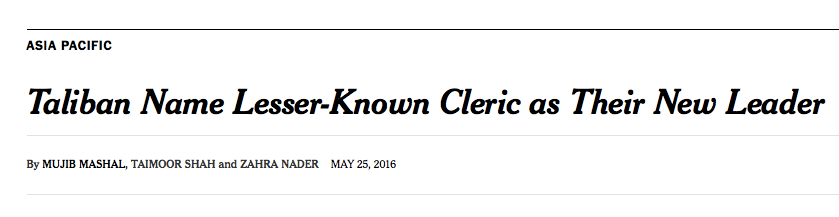 I don’t have access to the Times stylebook but I did search the newspaper’s archives for “Taliban believe” (11 hits) and “Taliban believes” (two hits), so the headline is consistent with past practice. But it may be less a matter of using British style than paying attention to etymology. According to Wikipedia, “Taliban” is Pashto for “students–that is, it’s a plural.
On Sunday, June 17, the New York division of the publisher Penguin Random House is holding a walk to raise money for Camba, a local charity. Groups within the company form their own “teams.” Geoffrey Kloske, the head guy at Riverhead (which published my last three books), has organized one called “The Girl in the Trainers.” This is brilliant because:
Well played, Kloske.
When a friend wrote in a Facebook post the other day that a certain political figure had “lost the plot,” my NOOB-dar came on. I wasn’t familiar with the phrase but it had the definite feel of a Britishism, and sure enough, it is.
The Oxford English Dictionary defines “lose the plot” as “to lose one’s ability to understand or cope with events; to lose one’s touch; to go off the rails.” There is a dubious 17th-century citation, with the next not coming till a 1984 quote from The Times, presumably about a fashion show: “Arabella Pollen showed sharp linens, lost the plot in a sarong skirt and brought out curvaceous racing silk and a show-stopping bow-legged Willie Carson.”
As to the phrase’s national origin, the OED doesn’t say. A 1994 article in The American Scholar claims it’s Australian. It would be interesting to hear about that from an Australian. In any case, it definitely is a Britishism, as shown in this Google Ngram Viewer chart comparing uses of the phrase “lost the plot” in books published in the U.S. and the U.K:

Interestingly, the first time it shows up in the New York Times, in 1998, it’s also in a fashion article:
From the parade of Mao worker jackets with frog closures and cheongsam dresses at Ferragamo to the indiscriminate layering of tulle and other sheer fabrics over trousers and skirts at Anna Molinari, many designers in Milan had a story’s worth of ideas, but they had lost the plot.
It’s been used a few dozen of times since then, most recently less than a week ago, in a May 14 article about entertainment mogul Sumner Redstone:
The legal fracas has changed Mr. Redstone’s public image from a firebrand whose business acumen and ruthlessness won him control of Viacom, Paramount Pictures and CBS, a $40 billion empire, into something quite different. In the local parlance, he lost the plot.
A New York Times obituary the other day of George “Frolic” Weymouth had this sentence: “A bon vivant and a character, Mr. Weymouth was a toff of the old school, with a global network of friends in high places.”
Unless I’m mistaken, in British English, toff always has a negative connotation, signifying “upper-class twit.” That was surely the case in the flurry of uses four years ago, all referring to Mitt Romney.
I don’t imagine the Times meant to cast Mr. Weymouth in such a light.
The Office of the First Lady issued this statement yesterday:

I took a look at “gap year” here. The bottom line is that it originated as a British term in the 1980s, and has been in common use in the U.S. since the early 2000s.
More important, good on ya, Malia, and have a brilliant year.
Last week, when U.S. President Obama was in England, he created a bit of a kerfuffle when he spoke against the U.K. leaving the European Union. That would portend badly for any U.S..-U.K. trade deals, he said:
I think it’s fair to say maybe some point down the line, but it’s not going to happen any time soon because our focus is on negotiating with the E.U. The U.K. is going to be at the back of the queue.
Leaving aside the policy aspect, British commentators jumped on the president’s use of “queue,” which of course is British English for the American “line” and has been covered many times on this blog, for example here. Writing about the episode in the Washington Post, Adam Taylor reproduced tweets whose authors purported to be shocked, shocked, that Obama would use such a word, some of them suggesting that he had been “fed” it by Prime Minister David Cameron.
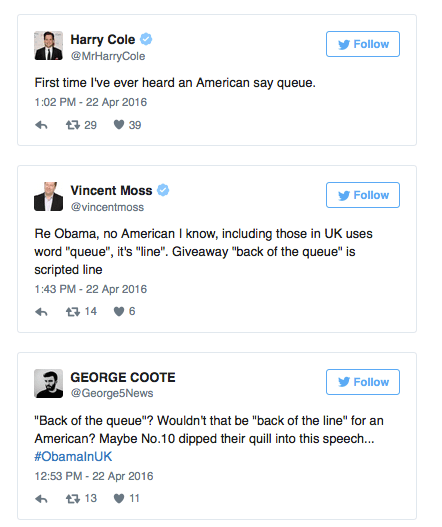
This was of course absurd. Taylor pointed out that Obama had uttered “queue” numerous times in the past, and was kind enough to cite NOOBs on POTUS’s use of the Britishisms “full stop,” “run to ground,” and “take a decision.”
A couple of other factors were at play. First, Obama is an inveterate “code-switcher,” changing his vocabulary and cadences to fit his audience. Thus, in front of a British crowd, he would be even more likely than usual to haul out “queue.”
The second is what I call the “Elegant Variation Effect” (EVE), after the great writer on usage H.W. Fowler. He coined the term “elegant variation” to mean the deliberate use of a synonym to avoid word repetition. In the quotation above, Obama uses “line” in the first sentence; hence, “queue” in the second.
When there are British and American English terms that mean exactly the same thing, Americans often use the British one on subsequent reference, due to EVE. One saw this recently in the announcement that Harriet Tubman would replace Andrew Jackson as person pictured on the front of the American twenty-dollar bill. “Bill” is the American word, which the Brits refer to as “note.” Here’s the opening paragraph of the New York Times article announcing the change (underlining mine):
Treasury Secretary Jacob J. Lew on Wednesday announced the most sweeping and historically symbolic makeover of American currency in a century, proposing to replace the slaveholding Andrew Jackson on the $20 bill with Harriet Tubman, the former slave and abolitionist, and to add women and civil rights leaders to the $5 and $10 notes.
Over the rest of the article, the terms were used interchangeably. And no kerfuffle ensued.

