Faithful correspondent Nanette Tobin alerted me to a line which appeared in a New York Times Book Review column by romance reviewer Olivia Waite on Sunday, April 10. The book under discussion is a novel in which characters are “contestants on a high-concept reality show, where for a wodge of cash they have to convince their families that they’re getting married in a matter of weeks.”
Nanette wasn’t familiar with “wodge” but thought it sounded British; I had the same reaction. We were both right. The OED identifies it as originally a Midlands (the first citation is from 1847) but now broadly British colloquial term meaning “A bulky mass; a chunk or lump; a wad of paper, banknotes, etc. Hence also: a huge amount, a lot.” All the citations are British with the interesting exception of the American poet Ezra Pound, who wrote in a 1913 letter “I don’t want a great wadge of prose, but about double what we have at present.” (“Wadge” was originally a common alternate spelling.) The dictionary does not mention that Wodge Wodge Boodley Oodle Poo was considered as a title for the television show that eventually became Monty Python’s Flying Circus.
Looking up “wodge” in the New York Times archives, I find that, until now, every use of it had been by a British person or, in one case, an American who had spent more than half his life in England. (Charles Marowitz.) That led me to wonder whether Waite is British. I found her on Twitter (@O_Waite) and asked her. Her reply:
“Not British, just watched too much Blackadder! And ‘wodge’ as a sound has the heft and awkwardness of a fat roll of bills, so it stuck with me.”
This expression means “in confidence” or “just between us” and is originally British. To expand on that a bit, the first citation in the OED is from the Irish writer George Moore’s 1885 novel A Mummer’s Wife: “It will be possible to have one spree on the strict q.t.” And the first citation in Green’s Dictionary of Slang, also from 1885, is some lines of verse from a Sydney, Australia, newspaper: “Oh, my! what a pious world it is, / And how very good they all seem to be – / But what a ’duffing’ lot you’d find / If you would only raise the blind, / And see ’em on the strict Q.T.” (Green’s also has a citation supposedly from an 1870 song, but that is pretty clearly inaccurate.)
In both the OED and Green’s, all the citations through 1904 except one use the formulation “on the strict q.t.” and are from British, Irish, or Commonwealth sources. The one exception (in Green’s) is from a Provo, Utah, newspaper in 1894: “We got this on the dead Q-T —and will ask you readers, please don’t give it away.” And incidentally, the expression gets some literary pedigree via James Joyce’s Ulysses (1922): “Sailing under false colours after having boxed the compass on the strict q.t. somewhere.”
All sources that I’ve found say that “q.t.” is short for “quiet,” and that’s convincing, especially since the phrase “on the quiet,” meaning the same thing, can be found pre-1874. However, I was intrigued by an alternate theory offered by a contributor to the Stack Exchange English Language and Usage bulletin board:
“Q.T.” is an odd abbreviation for “quiet.” Since it is of British origin, I would think it would derive from schoolboys’ abbreviations, often derived from Latin. The Latin taceo means “not to speak” and has solemn meaning sometimes, referring to “passing over in silence.” Thus quae tacenda, or q.t., would refer to “things about which one should not speak.” Cf. Horace, Epodes, 5.49, where Horace speaks of Canidia and quid dixit et quid tacuit, what she said and what she left unsaid.
Another Stack Exchange contributor, who goes by “Callithumpian,” antedated the OED and Green’s initial citations by more than ten years, unearthing a passage from a British play called My Husband’s Secret that debuted no later than 1874:
It quickly became a catchphrase: a Google Books search for “on the strict q.t.” yields about a dozen examples from 1877 to 1880, including these:
The phrase had fully arrived in the U.S. in the early 1900s. Green’s has fourteen citations between 1906 and 1999, and nine of them are American, including this lyric from a song by Merle Travis: “You thought your little romance was on the strict Q.T. / So if you want your freedom P.D.Q., / Divorce me C.O.D.”
The song came out in 1946, and indeed the phrase has a mid-century feel. The 1997 film L.A. Confidential was set in the early ’50s and the gossip monger played by Danny DeVito’s trademark line is “Off the record, on the QT, and very hush-hush.”
Nowadays, “on the q.t.” has been replaced by “on the downlow” or “on the d.l.”–though that phrase also has a very particular meaning of its own.
A popular new book of pop psychology by the American professor Arthur Brooks is called From Strength to Strength. I discussed the history of the phrase here.
The other day, someone mentioned this phrase as a NOOB. I checked and saw I had not yet covered it. The reason, I realized, is that at this point it’s so common in the U.S. that I don’t really think of it as a British in origin. (“The tone of the show, in what I have seen, is over the top “– New York Times opinion writer Kara Swisher, on the upcoming TV series Super Pumped, yesterday.)
But a Britishism it is. The OED labels the phrase “chiefly British” and defines it as: “To an excessive or exaggerated degree; beyond reasonable or acceptable limits; too far.” The OED also notes another, earlier meaning of “over the top,” stemming from World War I trench warfare: to literally climb over the top of a trench or parapet and go into battle. This took off in America, generating (as listed in the Library of Congress) no fewer than six popular songs called “Over the Top,” plus this one:
The phrase seems to have taken on a positive figurative meaning, akin to “going all out,” as seen in this item from a 1918 issue of The Rotarian:
The OED‘s first citation for the phrase with the “excessive” meaning is in a 1935 letter by the American writer Lincoln Steffens: “I had come to regard the New Capitalism as an experiment till, in 1929, the whole thing went over the top and slid down to an utter collapse.” But I take that as an outlier — a fresh metaphor on Steffens’s part, not his use of a phrase that was in currency. The first definite example I’m aware of comes from a 1965 novel called The Concrete Kimono (cited in Green’s Dictionary of Slang): “I seem to recall your ‘over the top’ waistcoats.” The quotation marks suggest unfamiliarity and recency.
By 1982, the phrase was popular enough in Britain to spawn an acronym. From The Sloane Ranger Handbook: “OTT adj. Over the top—outrageous. Usually ‘absolutely’ or ‘totally OTT’.”
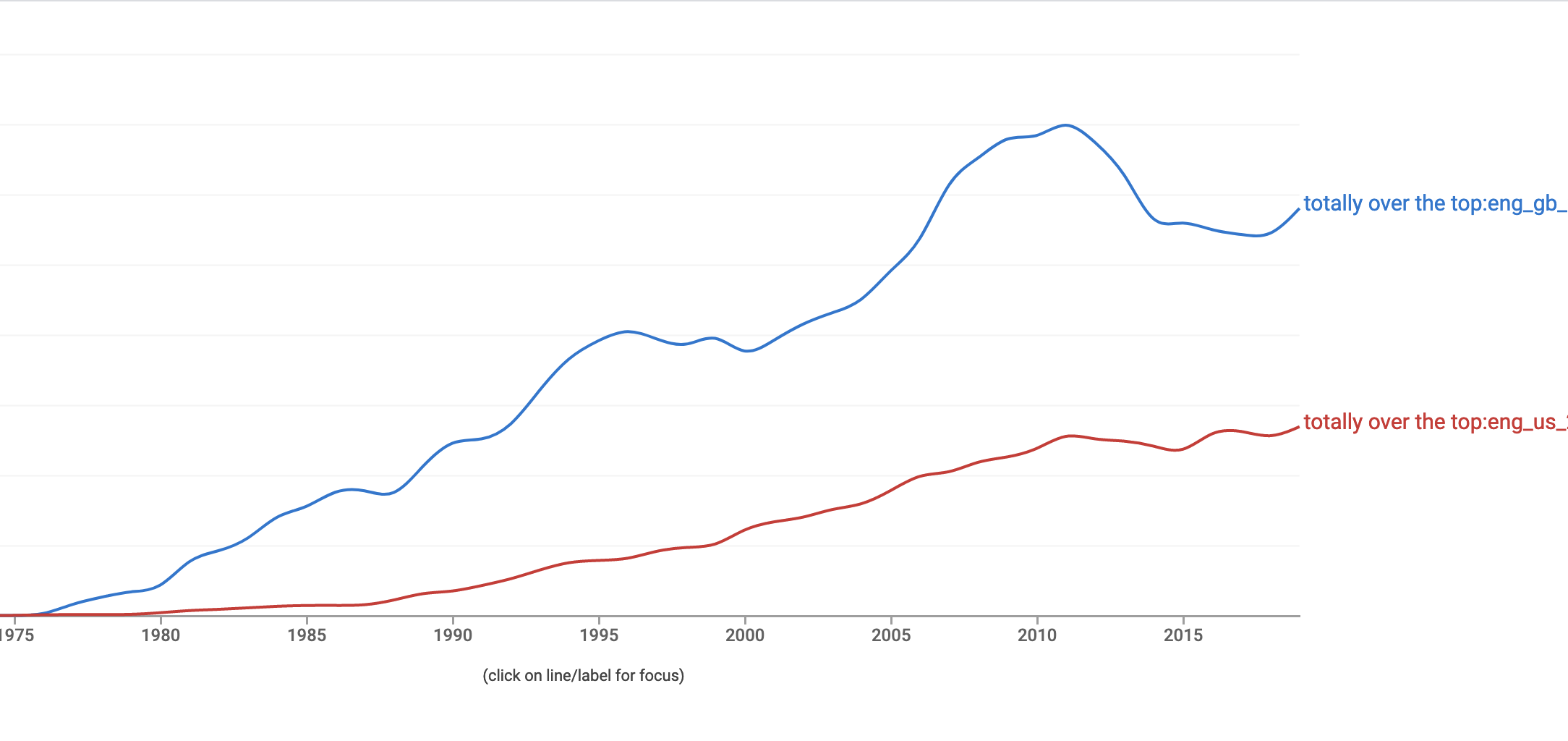
It’s difficult to use Ngram Viewer and the other databases I normally consult to track the progress of this phrase and its relative frequency of use in Britain and the U.S. That’s because searches for “over the top” yield a great deal of noise: references to climbing over the top of a hill, sprinkling sugar over the top of a cake, and so on. Lynne Murphy suggested slipping an intensifier before the phrase; taking a cue from the Sloane Rangers and searching for “totally over the top” in Ngram Viewer worked nicely:
It’s a classic NOOB graph. In fact, the only thing that surprises me is that it shows U.S. use as only about half of that in Britain.
I love it when the OED gets frisky. It definitely does with the above formulation, which the dictionary pegs as as a “hackneyed phrase.” The meaning, I probably don’t need to point out, isn’t literal but figurative: not “when the clock strikes midnight” or “when the sun goes down” but “eventually” or “when all is said and done.” The first OED citation is from 1974: “Eschatological language is useful because it is a convenient way of indicating..what at the end of the day we set most store by.”
But it was around and about long before that, principally — and fortunately, for the purposes of this blog — in Britain.
The Grammarphobia blog found it in an 1826 sermon:
Christ’s flock is but a little flock, comparatively considered. … They are but little in respect of their numbers. Indeed abstractly considered, at the end of the day, they will make an “innumerable company, which no man can number”; but, viewed in comparison of the wicked, they are but few.
“At the end of the day” is not only hackneyed, but also pompous and portentous, and thus it’s not surprising that the phrase found especially wide use in Parliament. In 1858, the Liberal Member of Commons William Gladstone said, “Coming in at the end of the day, then, Russia supported the union.” In 1896, an unidentified speaker said, “And now at the end of the day they had a Government which was brought in by a large majority for the purpose of doing justice…”
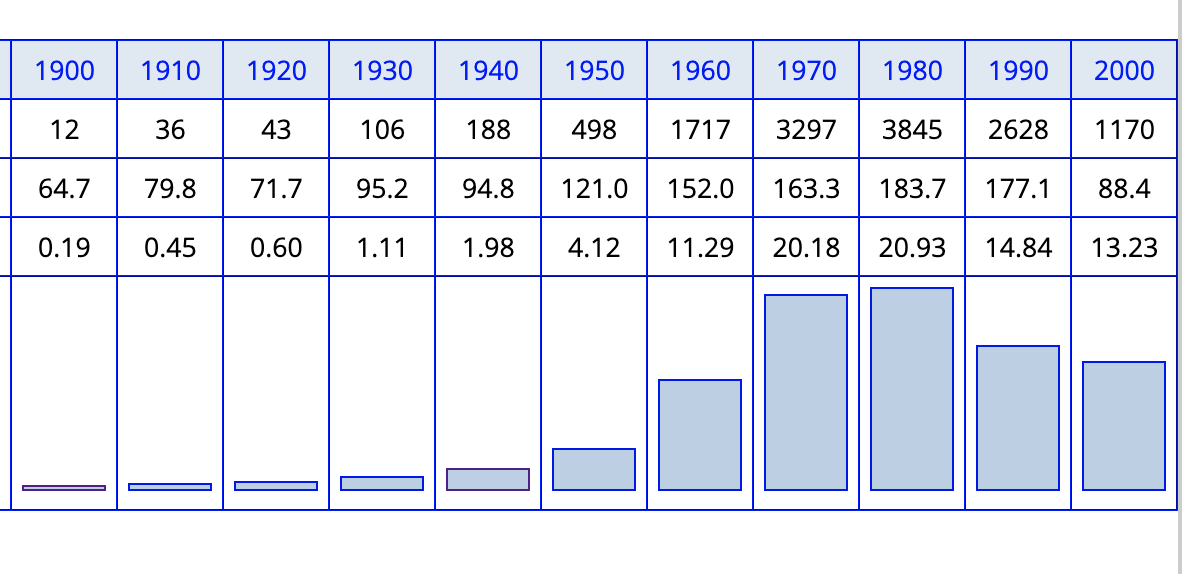
I got these quotes from the Hansard corpus, which shows the phrase becoming more and more popular in Parliament over the course of the twentieth century:
The top number indicates the times “at the end of the day” was uttered in Parliament in that decade: twelve in the 1900s, 36 in the 1910s, all the way up to 3,845 in the 1980s, at which point it began to decline.
The main reason for the decline, it’s clear to me, would have been the growing realization that it was a hackneyed phrase. Indeed, in 1986, New York Times language columnist William Safire complained about it as a “vogue term.” Fifteen years later, Safire returned to the theme. Prompted by a reader’s complaint, he looked at an interview between NBC’s Tim Russert and the chairman of the Democratic National Committee, Terry McAuliffe, and found McAuliffe “used the phrase … seventeen times in the twelve minutes he spoke on the air: ”At the end of the day we won on the issues’; ”At the end of the day if all the votes were counted”; ‘There was no swap at the end of the day.'”
The “at the end of the day” backlash continued apace. Respondents to a 2004 survey by the Plain English Campaign chose it as the number-one most annoying cliché. (“Second place in the vote was shared by ‘at this moment in time’ and the constant use of ‘like’ as if it were a form of punctuation. ‘With all due respect’ came fourth.”) And in 2010, a Pittsburgh Post-Gazette sportswriter awarded “at the end of the day” its annual Trite Trophy as the most egregious cliché of the year.
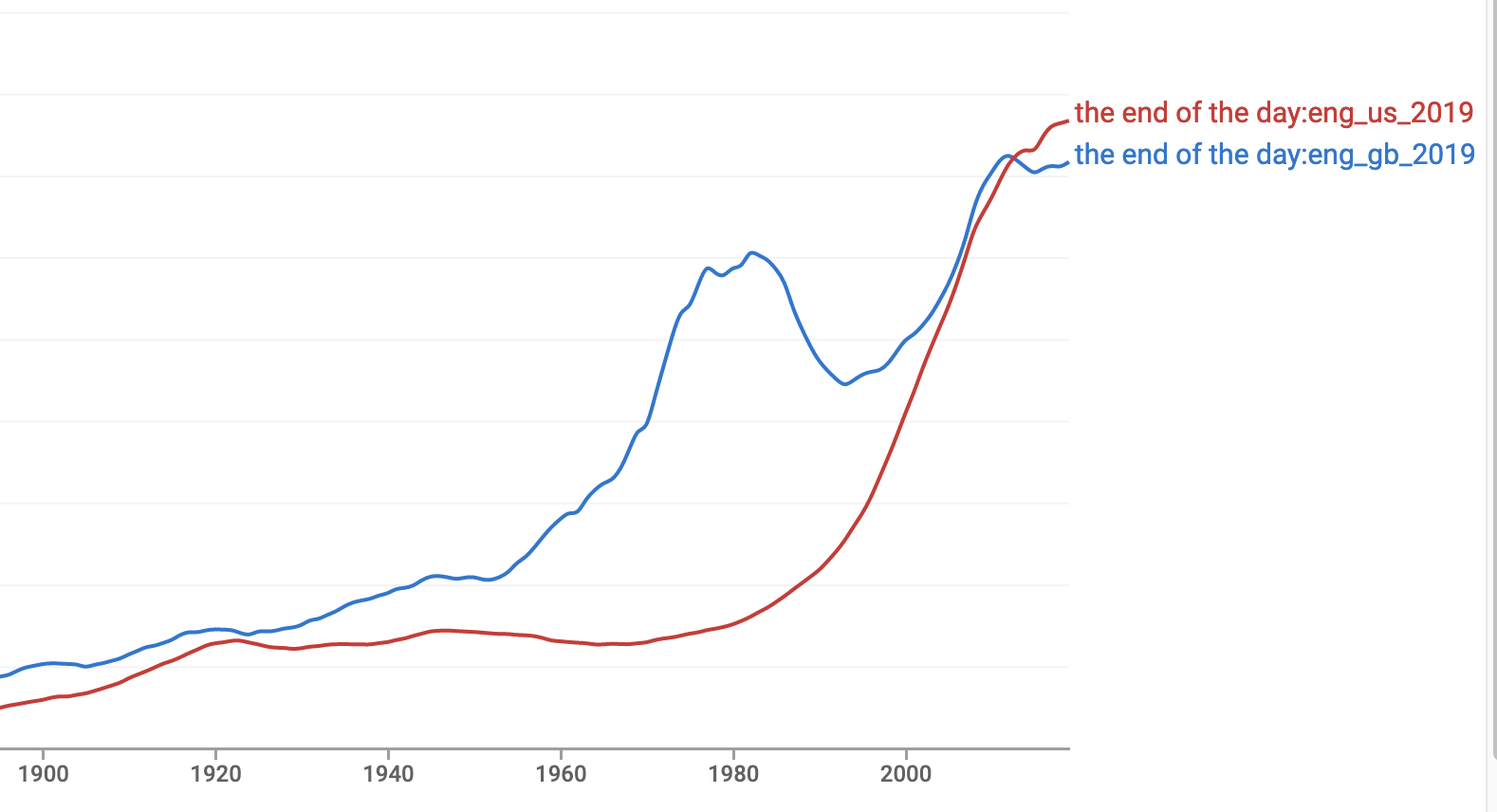
In contrast to Parliament, as this Google Books Ngram Viewer chart shows, the derision has not slowed the phrase’s general momentum.
(I searched for “the end of the day” rather than “at the end of the day” because Ngram Viewer works for phrases of a maximum of five words. And hence the graph includes a not-negligible amount of false-positive noise: that is, references to the literal end of the day.)
The chart tells an interesting story in regard to Anglo-American differences: British predominance for most of the century, until (following a British slump in the ’80s) Americans caught up and, at the end of the day, surpassed their trans-Atlantic cousins.
In the previous post, I discussed Britishisms in the American novel The Plot, and several British commentators zoomed in on the line “she straightaway found a job.” It was contended out that the actual British term is “straight away” (two words).
Backing up a bit, I see that in the early days of the blog, I did a post on “straightaway” and a separate one on “straight away” — things were a little bit chaotic back then. But I didn’t sort out the one word/two words issue, and I will try to do so now.
But first I’ll point out that the American equivalent is “right away” (always two words) or “immediately.” Here’s an Ngram Viewer chart showing frequency in American books:
Muddying the waters a little bit is the fact that one-word “straightaway” has another meaning, labeled “chiefly U.S.” by the OED: “A straight course in rowing or sailing. Also, a straight section of a road or racecourse, etc.” With that in mind, we can say that the two-word version for “immediately” is more common even in the U.S.
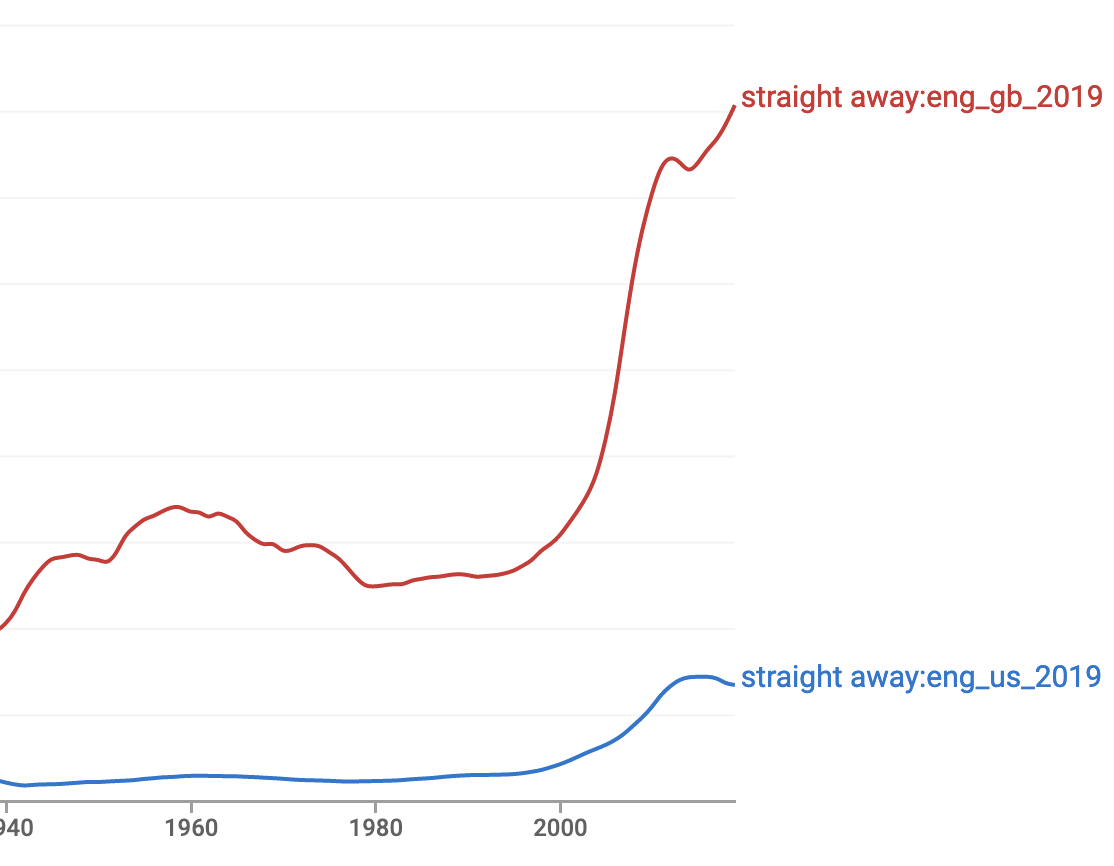
So now let’s compare the two-word version in Britain and the U.S.:
That is to say, it’s definitely a NOOB.
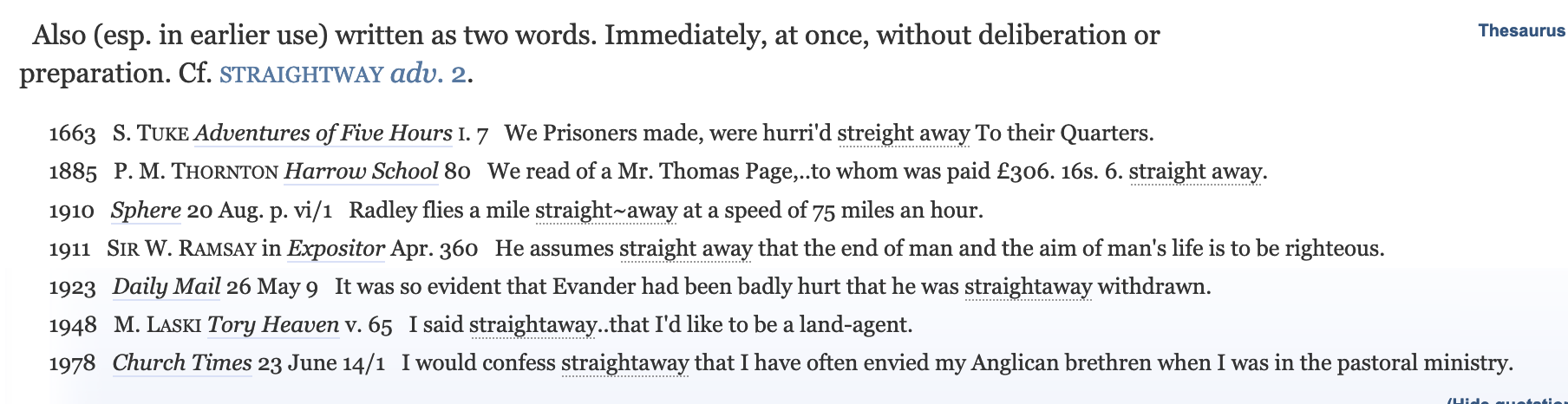
Finally, were my commentators correct in saying the two-word version prevails in Britain? The OED would indicate not. Here’s its entry:
The citations show a classic progression from two words, to hyphenated, to one word.
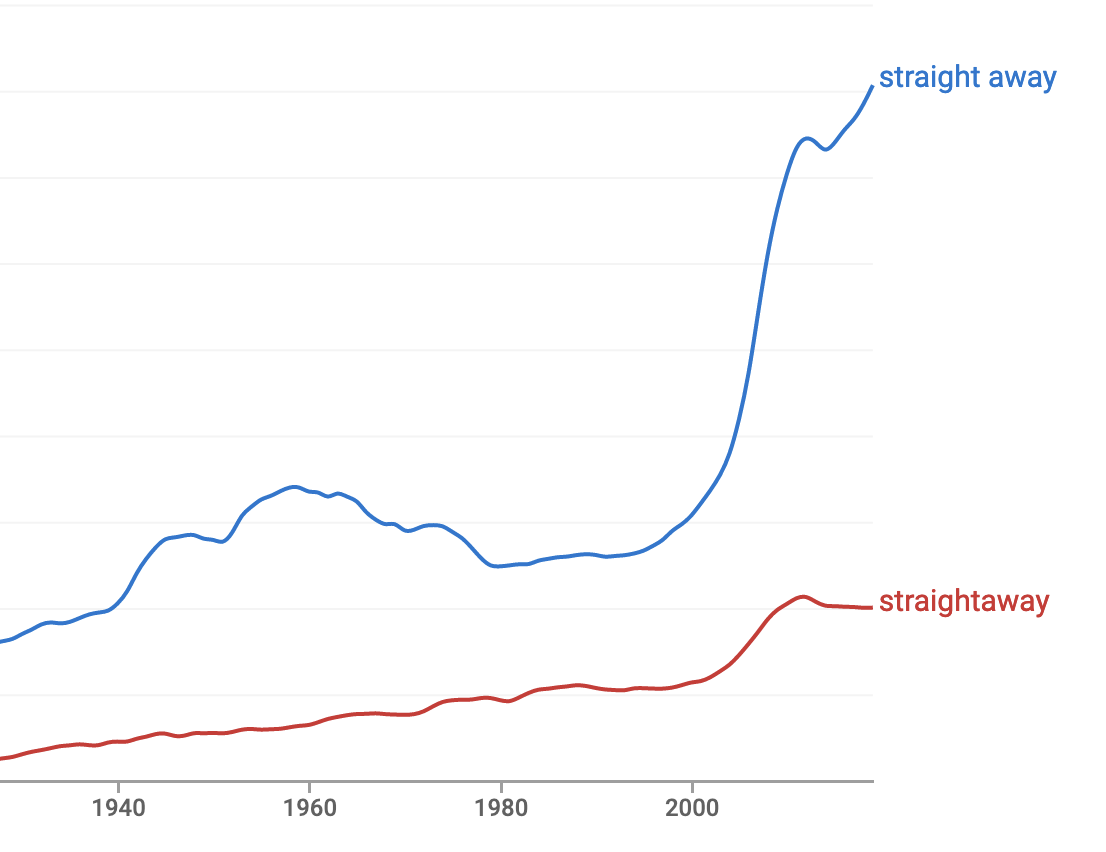
However, Ngram Viewer supports the commenters. Here’s the chart for the two versions’ frequency in British English. It shows that in 2019, the “straight away” was used about four times more frequently than “straightaway.”
Not to state the obvious, but the one word/two word distinction applies to written language, rather than spoken, where the question is moot. I imagine that to some extent the commenters were expressing their sense that there is a pause between “straight” and “away” when they say or hear the term.
Finally, one commenter, Tony C, said: “The word order is wrong in British English as well: ‘… she found a job straight away …'”
I have a hunch that he’s wrong, that both sentence structures are found in British English (see the Daily Mail quote from the OED), and in fact that this can elucidate the one word/two word issue. That is, before the verb, “straightaway” is one word, and after (as in Tony C’s rendition), it’s two.
But full investigation of this point will have to wait for another day.
I’ve written several times (most recently here) about the phenomenon of American characters in British novels using British expressions, seemingly because the writer didn’t realize they were British expressions. I’ve just read a book by an American novelist, with American characters, where Britishisms abound.
The book is The Plot, the author Jean Hanff Korelitz. In my view, some of the examples are nothing more than NOOBs — that is, British words and expressions that have become popular in the U.S., and hence an American character might use. Others are flat-out Britishisms that I’ve rarely or ever heard here. I’ll list them in order, from the most common NOOBs to the least likely. Examples in quotation marks are a character speaking, and the others are the author’s narration.
“Would it kill you to do an avocado toast?” (That’s “do” in the sense of a restaurant offering a dish.)
“who knows what else this Dianna Parker got up to?” (Instead of “got up to,” Americans would say “was up to” or “was involved with.)
the guy … supported the Red Sox… (“Support” meaning root for or be a fan of.)
Maybe the punters out there believed novels followed a visit from the muse …
Jake opted not to correct this remarkable statement in any of the ways he might have done. (An American would end the sentence with “he might have.” This verb construction is actually one of the White Whales of the blog — something I have been hoping in vain to observe an American using. Until now.)
I mentioned that the author, Jean Korelitz, is American. But she studied at the University of Cambridge in the 1980s, and since 1987 has been married to the Irish poet Paul Muldoon. So she comes by her Britishisms rightfully. But that doesn’t mean that her editor shouldn’t have flagged “punters” or “might have done.”
This blog has been around eleven years, so I missed my chance to choose a Person of the Decade, but if I did it would be New York Times book critic Dwight Garner. He has been featured eight times, most recently here; put his name in the search field at right to see the rest. His ninth appearance comes via Nancy Friedman, who reports this sentence in his review yesterday of a collection of speeches and essays by Margaret Atwood: “there is some smart material and pawky wit in Burning Questions, even if they huddle, trembling, like ferns behind a waterfall.” (Besides NOOBs, Garner is a dab hand at similes.)
I confess I was unfamiliar with “pawky.” The OED says it originated in Scotland, Ireland and the North of England, and provides as definition an impressive list of adjectives: “Artful, sly, shrewd; arch, roguish; jaunty. Now usually: having or showing a sardonic sense of humour; wry, quirky, subtle.” There’s also a secondary definition: “Haughty, proud; insolent, impertinent.”
There seems to have been yet another meaning for the word — either taciturnity or cheapness, judging by the context clues in this item the Times picked up from the London Globe and printed in 1904:
Ngram Viewer shows the word reaching its peak in Britain in about 1895 and declining steadily since then; at this point, it presumably comes off as archaic. And it never really caught on in America. Indeed, the Times is a font of NOOBs, but its most recent use before Garner’s came in a 2012 review of a memoir by British author Candia McWilliam:
“American readers of What to Look For in Winter may experience the uncomfortable feeling of having been forced to swallow a dictionary of Scottish and British colloquialisms — ‘shoogling,’ ‘bodging,’ ‘couthie,’ ‘pawky,’ ‘kenspeckle.’”
All right, consider the gauntlet thrown. If Dwight Garner can manage to work “kenspeckle” or “shoogling” into a review, I will dub him the man of the century.
The always sharp and vigilant Nancy Friedman has spotted an American incursion of “knickers,” meaning women’s underwear. Heretofore I’ve only seen one instance — a quote by the actress Anna Kendrick– and the NOOB expression “knickers in a twist.” Nancy writes that it comes via two underwear brands:
The first brand is Knickey, founded in 2017 in New York City and still headquartered there. Knickey sells organic-cotton women’s undergarments, top and bottom, in sizes XXS to XXXL (although the largest size isn’t terribly large by contemporary fit standards). The brand name certainly appears to be derived from knickers—it’s not explained on the website, and I found no US trademark applications from the company that reveal the name’s derivation. Knickey is cutely reinforced by one of the product categories: “Knick Knacks.” But Knickey doesn’t go Full British Usage in its product names; it calls its bottom-half apparel “undies.”…
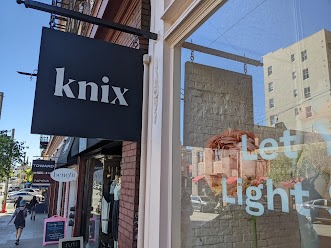
One of the Knickey knick-knacks is the Knickey hanky, illustrated with abstract renderings of bodies viewed from the rear. I discovered the other knickers-esque brand name during a stroll down San Francisco’s Fillmore Street….
Knixwas founded in Toronto in 2013; the San Francisco store opened in November 2021. The company sells its own line of seamless bras, underwear—nope, not “knickers” … yet—and leakproof underwear (a growing category of its own). The parent company, Knix Wear, began registering U.S. trademarks in 2012; its applications don’t include a clarification of the name, but again—pretty clearly derived from “knickers.”
We shall see if “knickers” moves from the retail space to the real people actually using it space. I have my doubts, but my prognostication is worth the money you have paid for it.
This originated as (and still is) a tennis expression. If your opponent is running or moving, say to their right, to “wrong-foot” them is to hit the ball to their left, also known as “behind” them. The OED‘s first citation is from the Daily Telegraph in 1928, and it uses an odd-sounding gerund form: “His ground strokes had not the same speed and polish as Austin’s, nor could he steer all his volleys into the same wrong-footing area.”
The first OED citation in a more standard form doesn’t come till a 1959 book on rugby: “You could pick up the ball as though to go one side, and then, having picked up the ball, swing to the other side… It will wrong-foot the attackers, thereby giving you more time for your kick.”
However, using Google Books, I found an example from 1935:
The source is American Lawn Tennis, a periodical that, to state the obvious, was American. The quotation marks around “wrong-footed” suggest that the phrase was a relatively new borrowing from British tennis discourse. I am an avid tennis player, and my sense is that the term has long been used by people from all countries, yet it retains a British feel. In fact, when I say something like, “You properly wrong-footed me!” I always do so in a mock-British accent, aspirating the “t” in “footed” instead of using the flapping American “foodded.”
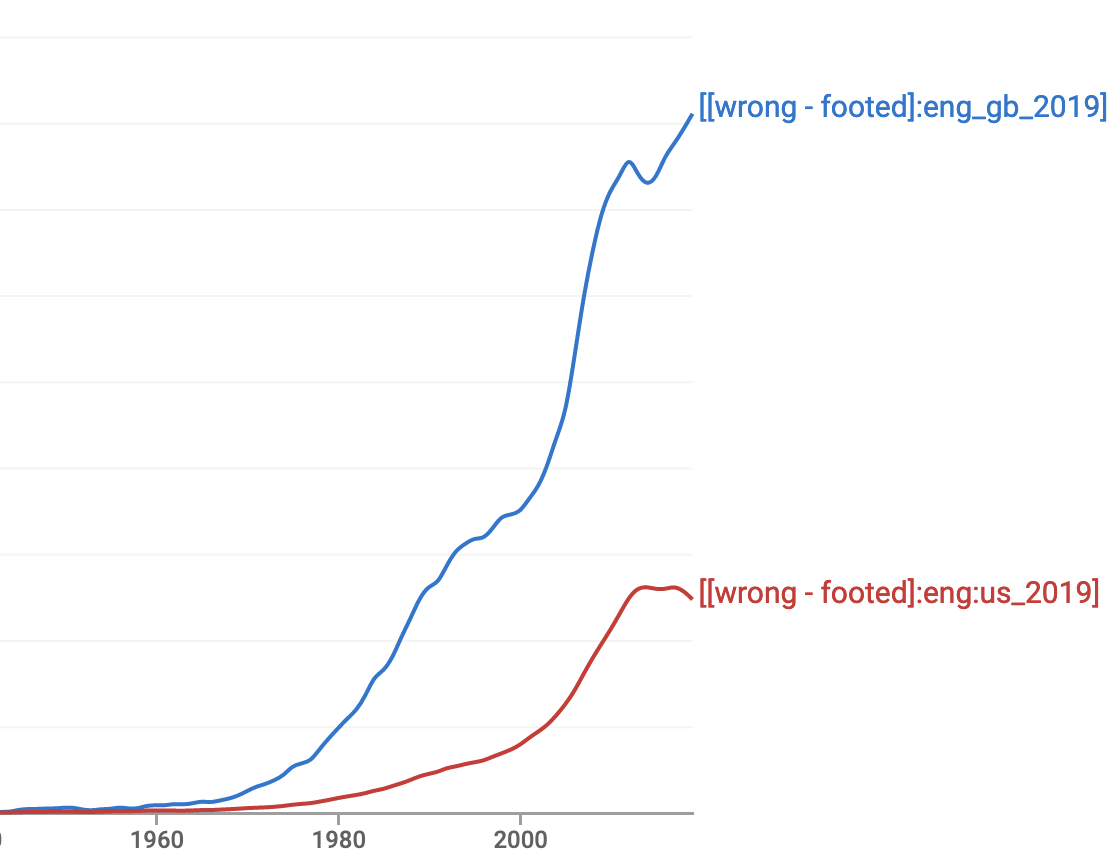
Here’s what Ngram Viewer has to say:
My read of the graph is the uptick in both Britain and the U.S. is due to non-sporting, metaphorical uses of the term. The OED defines this as “To disconcert by an unexpected move; to catch unprepared.” Its first example is from a 1957 book: “‘Let me tell you..that the Government has made enquiries and we are not at all satisfied with the accuracy of your report.’ Kingsley was wrong-footed.”
Neither this nor any of the other citations are from American sources, but it has become a popular NOOB, to the point of cliche. The first eight uses of the term in the New York Times were published between 1964 and 1977, and all concerned tennis. (There were also two references in music reviews to “wrong-footed rhythms” but I consider that unrelated.) Then a 1982 article had this line: “the Japanese are now busy making many of their cars bigger, not smaller, and could catch Detroit wrong-footed once again if fuel economy becomes less important to consumers.”
The trickle has become a flood. The Times used the phrase thirteen times between 2019 and 2021, and only three concerned sports (two soccer and one tennis). For example, from a June 2020 article about the Trump Administration’s approach the pandemic: “Vice President Mike Pence, having been wrong-footed after taking the no-mask custom to the Mayo Clinic, now seemed to be making it up as he went along.”
For a related foot-centered sporting expression, see “on the back foot.“






 notoneoffbritishisms.com