I Was So Wrong About “Harry”

Over the years, when I’ve been asked about the NOOBs phenomenon, part of my standard answer (along with the arrival in America of British journos like Andrew Sullivan, Christopher Hitchens and Tina Brown, and the rise of global internet culture) has been that the Harry Potter books introduced and popularized a lot of British words. The one example I always gave was “ginger,” in reference to Ron Weasley’s hair.

It finally occurred to me to check this assertion out. My local library had on offer a digital version of the first book in the series, Harry Potter and the Sorcerer’s Stone (… and the Philosopher’s Stone in the U.K). I checked it out and searched for “ginger.” Nothing. On the other hand, there were multiple references to Ron having “red hair” and one calling him “redheaded.”

My world was rocked.

Apparently, “ginger” becoming “red-haired” was one of the numerous changes from the British versions of the books to the American. Wondering if any Britishisms remained, I found an article called “Six British Words from Harry Potter That I Never Understood.” The author doesn’t specify, but I assume she’s referring to words found in American editions. The words are:

  • “Budgerigar” or “budgie” (American: “parakeet”).
  • “Wotcher!” (“An old informal greeting, possibly Cockney in origin, possibly a contraction of “what cheer.”)
  • “Tea cozy.”
  • Fug.”
  • “Candyfloss” (American: “cotton candy”).
  • “Treacle” and “trifle.”

The only ones of these that showed up in my digital edition were “tea cozy,” “treacle,” and “trifle”–an item and two foods that don’t have American equivalents. The foods appeared in the same sentence, an interesting one, describing the desserts at Hogwarts:

“Blocks of ice cream in every flavor you could think of, apple pies, treacle tarts, chocolate éclairs and jam doughnuts, trifle, strawberries, Jell-O, rice pudding . . .”

Here’s my take on the list. “Blocks of ice cream” and “jam doughnuts” are Britishisms that somehow made it through. (We would be more likely to refer to “scoops” of ice cream and much more likely to say “jelly donut.”) “Jell-O” (U.K.: “jelly”) was probably and “apple pies” (“apple tarts”) possibly changed for the American market. And chocolate éclairs, strawberries, and rice pudding work equally well in both countries.

“Easy Peasy,” Updated

Since I first wrote about the expression, I’ve learned that “easy peasy” and its origins are shrouded in mystery, or, at least, uncertainty. Start with most British people’s Mandela effect notion that it came from an advertising slogan for Sqezy [sic] dish-washing liquid, “Easy Peasy, Lemon Sqezy.” It is flat-out wrong. The language historian Barry Popik and Pascal Tréguer, who runs the WordHistories.net blog, have both established that there was never such a slogan. Rather, from 1957 until 1962, it was, “It’s Easy With Sqezy.”

A 1957 advert.

Shortly after that, the brand was discontinued. However, a commenter on my 2012 post noted that Star Brands, which had (temporarily) reintroduced Sqezy, had a message on its website which bought into the folk/faux/fake etymology: “From its origins in 1958 when Sqezy was launched as the world’s first washing up liquid in a plastic squeezy bottle, we’ve now brought it bang up to date. Although when you consider that 99.9% of people can complete the line ‘Easy peasy ..’ you’d hardly believe that it had ever been away!”

In fact, the first documented (by Tréguer) instance of the full phrase is in a 1983 article in The Guardian: “Chap comes in, sits down, says, ’I want to be a marine biologist.’ Easy peezy lemon squeezy.”

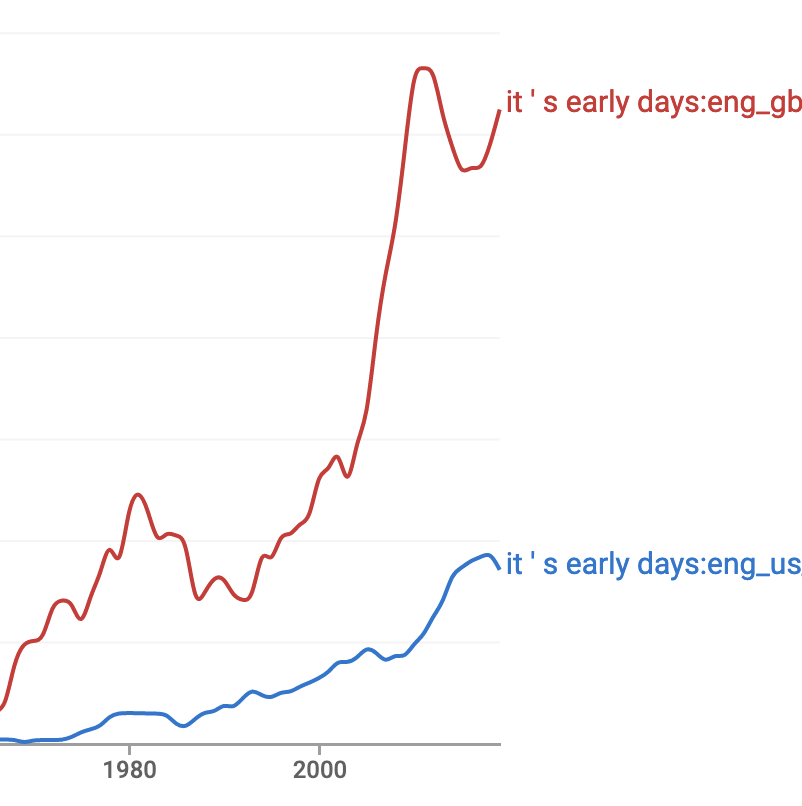
Another odd thing about the short version of the phrase is its nationality. Ngram Viewer confirms it’s a NOOB (and that widespread use began in the late ‘70s):

Yet two of the three early uses of it cited by the OED come from American sources. The first is very early and not American: in a 1923 article about traditional mummers’ plays, there is a reference to “The Berkshire Doctor’s cure of the ‘easy-peasy, palsy, and the gout.’” In the 1940 American film Long Voyage Home, the character played by John Wayne says, “Easy-peasy. Take it easy, Drisc!” And a 1953 article in the Cincinnati Enquirer noted, “There’s a brief air travelogue of highlights of a jet trip from London to Cairo… The flight is such an easy-peasy affair for the air travellers, they seem to be motionless in a fantastic and lovely, sun-drenched cloudland.”

My guess would be that in all three cases, the phrase was used not because it was in circulation but because the rhyme came easily to the tongue. The same is true of the other popular variant, “Easy peasy, Japanesey,” which Popik has spotted in 1982 (that is, a year earlier than the “Lemon Sqezy/Squeezy” version). The character played by James Whitmore uses the phrase in the 1994 film The Shawshank Redemption, which is set decades earlier and is therefore anachronistic.

“Easy peasy” has been used in the New York Times sixty-five times from its first appearance, in 2001, through 2021. That includes a 2012 article about a New York City burglar: “The following morning, he was awakened by police officers in his bedroom. One of them said, ‘Easy, peasy, lemon squeezy,’ first handcuffing, then dressing” him. The comma after “Easy” is the doing of the Times reporter and should not be there.

While the phrase is popular here, it hasn’t yet become a cliché and ripe for parody. It has in Britain, where in the 2009 satire In the Loop (Nancy Friedman has pointed out), a character says, “Difficult difficult lemon difficult.”

Did Le Guin write “worst bits”?

Here’s my most recent bit on “bit” — probably the word I’ve written the most about over the years. You can follow the link and go backwards through all the posts, but the basic deal is that British people commonly use “bits” where American would traditionally use “parts” — as in the good bits, the best bits, fiddly bits, lady bits and so on.

I’m inspired to write again because of a 1976 quote by the American science fiction writer Ursula Le Guin, originally published in the Times Literary Supplement and posted on Facebook by Benjamin Friedman:

[H.P.] Lovecraft was an exceptionally, almost Impeccably, bad writer. He was not even originally bad. He Imitated the worst bits of Poe quite accurately, but his efforts to catch [Lord] Dunsany’s sonorous rhythms show an ear of solid tin. Derivative, inept, and callow, his tales can satisfy only those who believe that a capital letter, some words, and a full stop make a sentence.

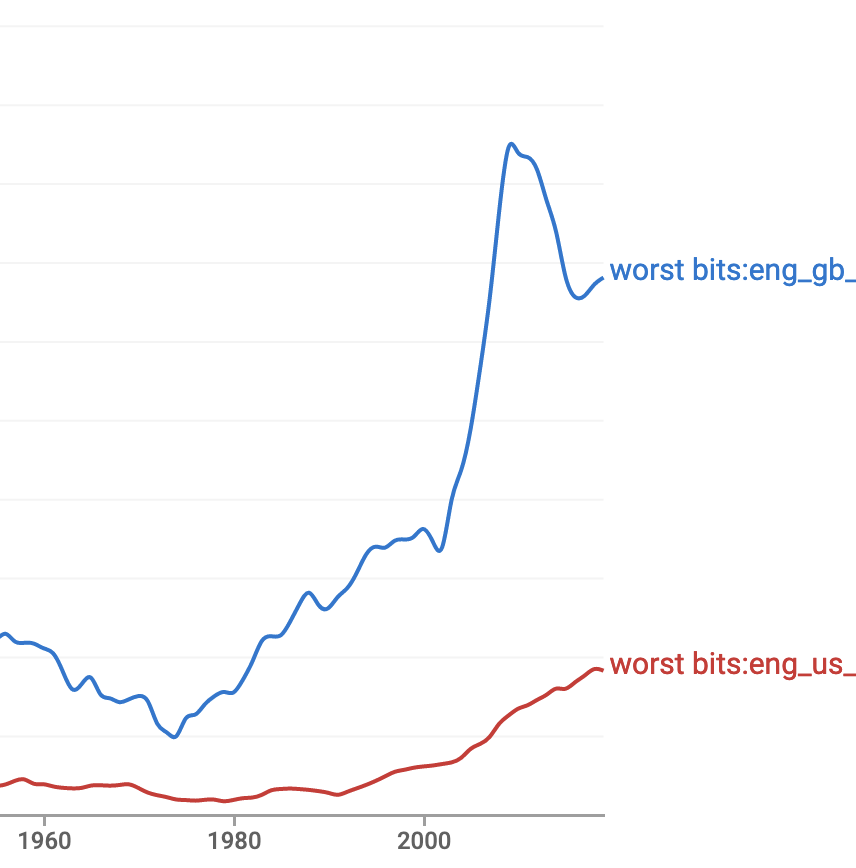
I was immediately suspicious that Le Guin would have written “worst bits” (or, for that matter, “full stop” rather than “period”). And indeed, Ngram Viewer shows 1976 to be pretty much the nadir of American “worst bits”:

I commented about this on Facebook and Friedman replied: “It’s quite possible that her TLS editor amended the piece to accord with British usage. That certainly happened to me more than once back when I used to occasionally write proper reviews for them. The revisions would part of the back-and-forth as the editor and I arrived at a final draft, so if that was the case with Le Guin, she would have agreed to them.”

We’ll probably never know the truth. But my bet is on editorial suggestion.

“No worries” proceeds apace

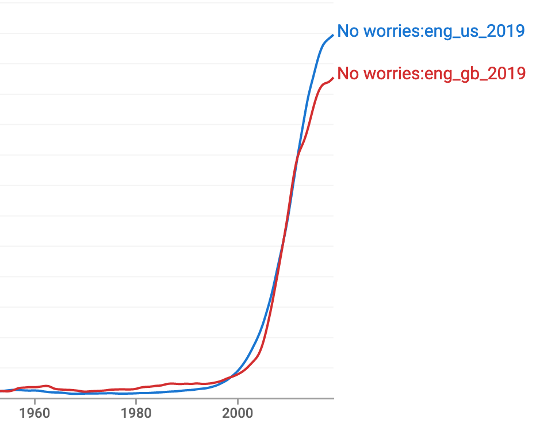
I wrote about the originally Australian “no worries” — as a response to “thank you” or an apology — in the first year of this blog, 2011. Since then it has continued a sharp increase in popularity, especially in the U.S., which has outpaced British use, as this Ngram Viewer graph shows.

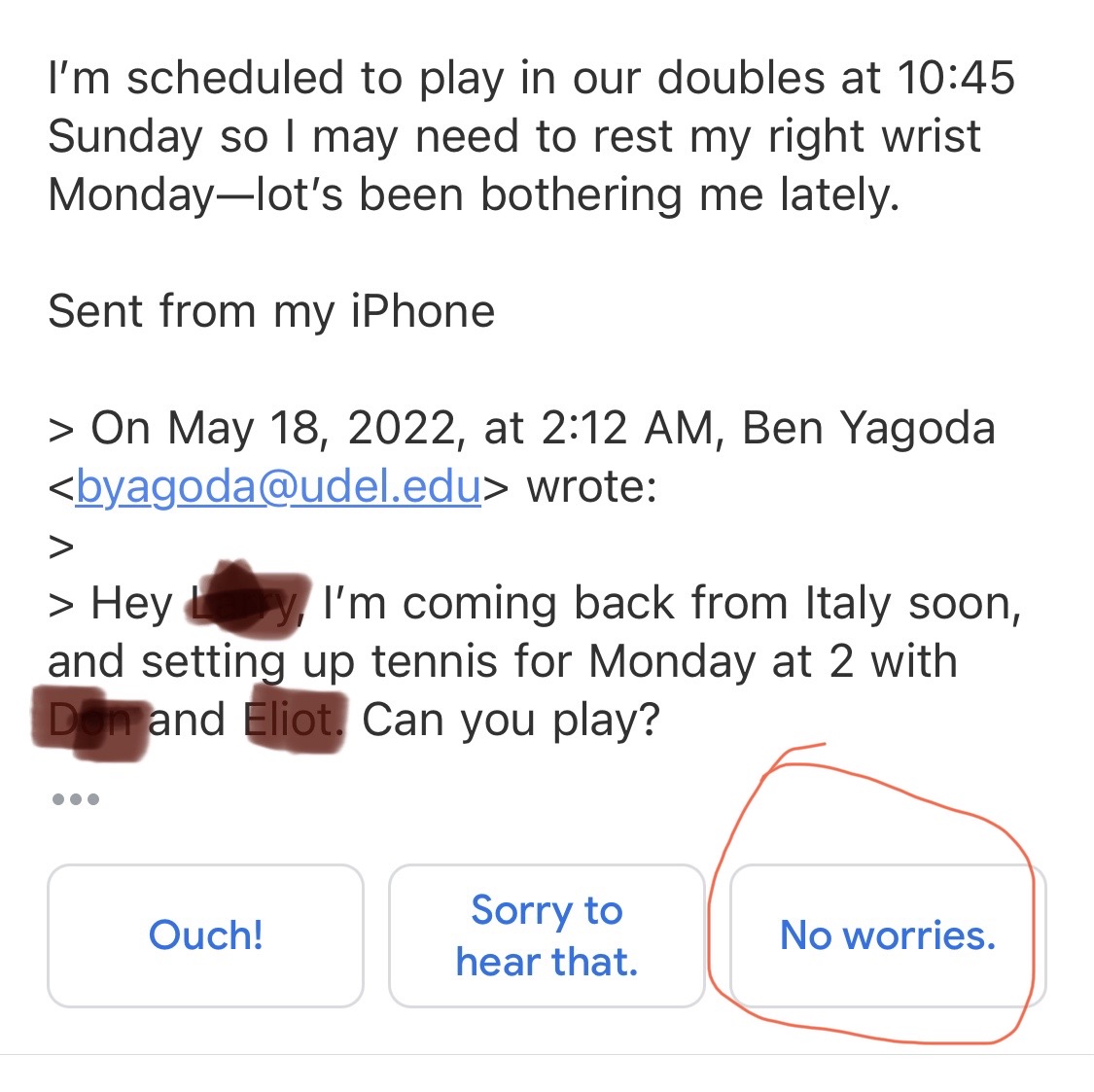
Apple’s iOS artificial intelligence has jumped on the bandwagon. For some time now, when I start to respond on my phone to an email, there are three options on the bottom of the screen for what to say. Here’s a screenshot of what appeared on my phone when I was about to respond to a friend who said he couldn’t play tennis because of an injury.

FYI, I chose “Ouch!”

“Full marks”

The phrase originates in education, specifically the custom of indicating every correct answer in an examination with a mark. Hence, “full marks” would be getting everything right. The phrase appears as early as 1852, according to the OED, with a figurative use in 1889: “I was once fifteen hours on the road… By rail I have done it in an hour and three-quarters. Full marks for steam, it may be thought…”

Though “full marks” shows up in an anonymous 1924 New York Times movie review — “the film version of ‘Monsleur Beaucaire’ is entitled to full marks for the splendor of the settings and the extraordinary beauty of the costimes” — I ascribe that to an Anglophile reviewer. Or, at least, the phrase fell out of favor after that and became unfamiliar here. In the U.S., “marks” is a more general term: one can talk of getting good or not-so-good marks, meaning grades. And I judge the modern American equivalent of “full marks” to be “full credit.”

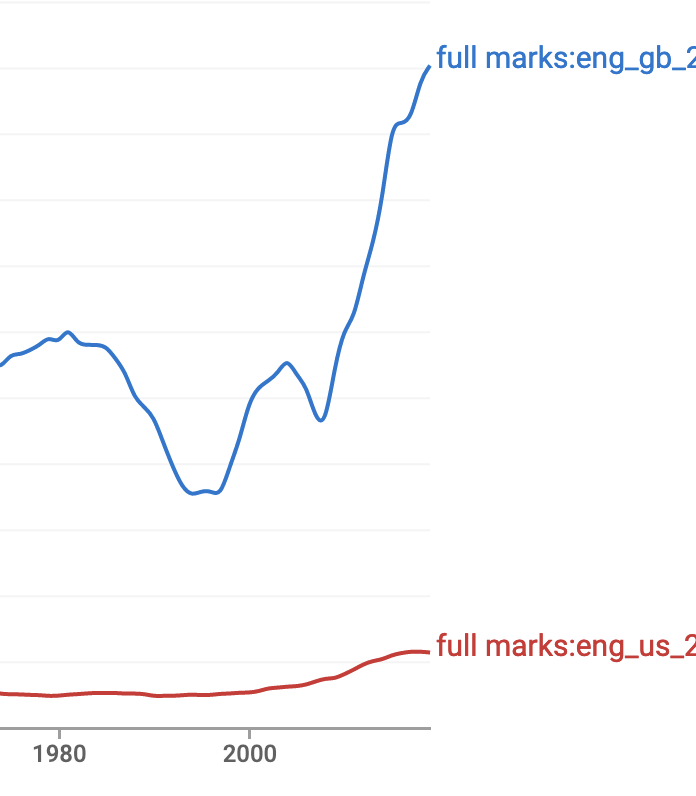
When I wrote about it in 2019, I categorized “full marks” as “On the Radar.” But it has started to get more popular here. Here’s the Ngram Viewer chart.

It actually showed up a week ago in the Times (as I write), from Bret Stephens in an exchange with fellow columnist Gail Collins: “[President Biden has] done a much better job standing up for Ukraine than I had expected he might, and I’ll give him and his national-security team full marks for that.”

Expect to see it pretty widely, pretty soon.

Confused Caption Writer?

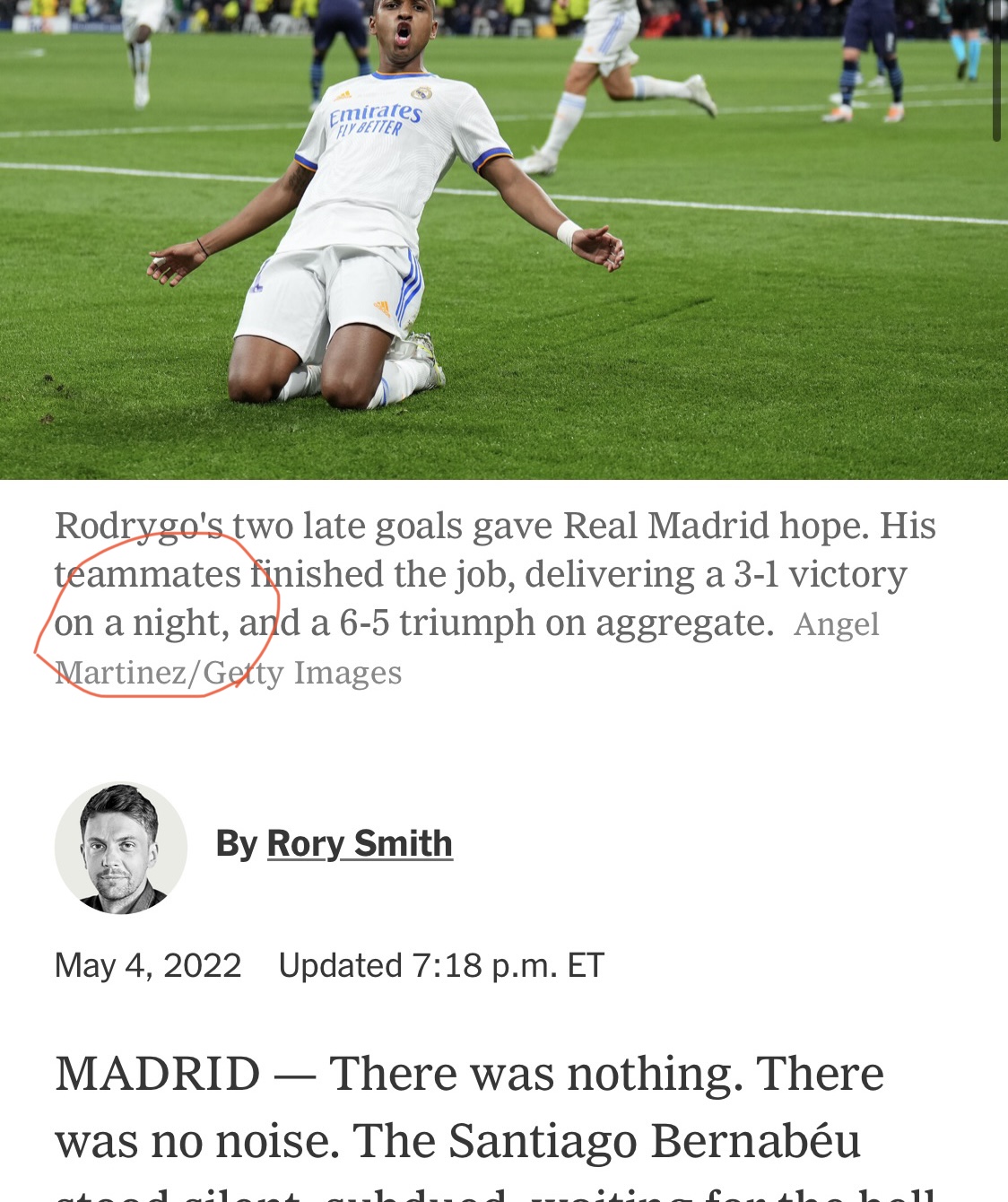
I recently discussed the expression “on the night,” meaning “on the night in question,” “night of the game/event/performance,” etc; that post has a link to the similar “on the day.” The phrase came to mind yesterday, when I was saw the online New York Times coverage of an epic Manchester City-Real Madrid Champions League match.

For those not versed in Champions League soccer/football (and for those who are, correct me if I botch this), it’s a tournament where, once the field gets down to sixteen teams, each contest consists of two games, and the team with the highest aggregate score advances. In this case, Manchester City won the first leg 4-3, but Real Madrid advanced on aggregate because they won the second leg 3-1.

Thus the caption should have read “on the night”; “on a night” is meaningless, to my ears. My theory is that a British person (perhaps Rory Smith, the author of the article) or someone well-versed in NOOBs originally wrote “on the night,” but some well-meaning but ill-informed person changed it.

Any other theories?

“Awfully”

In the course of putting together a book based on this blog (you heard it here first!), I found that I am standing on the shoulders of Richard Grant White. White, a nineteenth-century American literary critic (and father of the architect Stanford White), coined the word “Briticism” in 1868, to mean words and usages that had sprung up in Britain (but not America) in the century or so since the countries had been apart. White didn’t look kindly on this phenomenon. Among the instances he cited was a peculiar British use of the word “directly”:

Directly.—The radical meaning of this word is, in a right line, and hence, as a right line is the shortest distance between two points, it means at once, immediately. Its synonyme in both senses is a good English word, now, unhappily, somewhat obsolete, straightway—our equivalent of which, right away, is laughed at by brother Bull as an Americanism. But John Bull himself uses directly in a way which is quite insufferable—to wit, in the sense of when, as soon as. This use of the word is a widespread Briticism, and prevails even among the most cultivated writers. For instance, in the London “Spectator” of May 2, 1867, it is said that “Directly Mr. Disraeli finished speaking, Mr. Lowe rose to oppose,” etc. Anglice, As soon as Mr. Disraeli finished speaking, etc. It is difficult to trace by continuous steps the course of this strange perversion, for which there is neither justification nor palliation.

He also complained about a supposed British insistence on saying “ill” instead of “sick” to describe someone who was under the weather.

They sneer at us for not joining in the robbery and the imposition. I was present once when a British merchant receiving in his own house a Yankee youth at a little party, said, “Good evening! We haven’t seen you for a long while. Have you been seeck” (the sneer prolonged the word), “as you say in your country?” “No, thank you,” said the other, frankly and promptly, “I’ve been hill, as they say in yours.”

He went on, “For the use of ill—an adverb—as an adjective, thus: an ill man, there is no defence and no excuse, except the contamination of bad example.” Like many language peevers through the ages, he was on shaky ground. In fact there was nothing new about adjectival “ill”: “By my troth I am exceeding ill” is a line from Much Ado About Nothing).

Another complaint was “awfully” to mean “very,” instead of its early meaning of “in a manner that inspires awe or terror.” White wrote, “The misuse is a Briticism; but it has been spreading rapidly here during the last few years.” And here he was on the mark. In fact, I put forth this intensifier “awfully” as the very first Not One-Off-Britishism.

The early citations in the OED (which labels it “colloquial”) are all British, starting with one from The Times in 1820: “Let any one..say whether the illustrious defendant [sic]..has not awfully strong grounds for protesting against the tribunal.” I happen to be reading Thackeray’s Vanity Fair—published in 1847-48 and set in the 1810s—and came upon a line where Becky Sharp thinks, “I suppose he will be awfully proud, and that I shall be treated most contemptuously.”

Ngram Viewer also confirms White’s impression.

It’s an interesting chart, showing significantly more frequent use in Britain in the second half of the nineteenth century (White’s era), and American topping Britain in about 1920.

Since then, the two countries’ use of the word have been awfully similar.

“Expiry Date”?

My heart quickened when I saw this headline — for an article about women runners in their 40s who are still running — in yesterday’s New York Times:

In the early days of the blog, I had written about “sell-by date,” a British term roughly equivalent to what Americans call “expiration date.” A bit later, I noted one American use of the similar term “expiry date.”

I hadn’t encountered it again till the Times headline. Unfortunately, the quote in it is from one of the runners, and she turns out to be from British Columbia, so it doesn’t properly count as a NOOB. On the plus side, this spurred me to create a new category and put “expiry date” in it: “false alarms.”

“Wodge”

Faithful correspondent Nanette Tobin alerted me to a line which appeared in a New York Times Book Review column by romance reviewer Olivia Waite on Sunday, April 10. The book under discussion is a novel in which characters are “contestants on a high-concept reality show, where for a wodge of cash they have to convince their families that they’re getting married in a matter of weeks.”

Nanette wasn’t familiar with “wodge” but thought it sounded British; I had the same reaction. We were both right. The OED identifies it as originally a Midlands (the first citation is from 1847) but now broadly British colloquial term meaning “A bulky mass; a chunk or lump; a wad of paper, banknotes, etc. Hence also: a huge amount, a lot.” All the citations are British with the interesting exception of the American poet Ezra Pound, who wrote in a 1913 letter “I don’t want a great wadge of prose, but about double what we have at present.” (“Wadge” was originally a common alternate spelling.) The dictionary does not mention that Wodge Wodge Boodley Oodle Poo was considered as a title for the television show that eventually became Monty Python’s Flying Circus.

Looking up “wodge” in the New York Times archives, I find that, until now, every use of it had been by a British person or, in one case, an American who had spent more than half his life in England. (Charles Marowitz.) That led me to wonder whether Waite is British. I found her on Twitter (@O_Waite) and asked her. Her reply:

“Not British, just watched too much Blackadder! And ‘wodge’ as a sound has the heft and awkwardness of a fat roll of bills, so it stuck with me.”

“On the q.t.”

This expression means “in confidence” or “just between us” and is originally British. To expand on that a bit, the first citation in the OED is from the Irish writer George Moore’s 1885 novel A Mummer’s Wife: “It will be possible to have one spree on the strict q.t.” And the first citation in Green’s Dictionary of Slang, also from 1885, is some lines of verse from a Sydney, Australia, newspaper: “Oh, my! what a pious world it is, / And how very good they all seem to be – / But what a ’duffing’ lot you’d find / If you would only raise the blind, / And see ’em on the strict Q.T.” (Green’s also has a citation supposedly from an 1870 song, but that is pretty clearly inaccurate.)

In both the OED and Green’s, all the citations through 1904 except one use the formulation “on the strict q.t.” and are from British, Irish, or Commonwealth sources. The one exception (in Green’s) is from a Provo, Utah, newspaper in 1894: “We got this on the dead Q-T —and will ask you readers, please don’t give it away.” And incidentally, the expression gets some literary pedigree via James Joyce’s Ulysses (1922): “Sailing under false colours after having boxed the compass on the strict q.t. somewhere.”

All sources that I’ve found say that “q.t.” is short for “quiet,” and that’s convincing, especially since the phrase “on the quiet,” meaning the same thing, can be found pre-1874. However, I was intrigued by an alternate theory offered by a contributor to the Stack Exchange English Language and Usage bulletin board:

“Q.T.” is an odd abbreviation for “quiet.” Since it is of British origin, I would think it would derive from schoolboys’ abbreviations, often derived from Latin. The Latin taceo means “not to speak” and has solemn meaning sometimes, referring to “passing over in silence.” Thus quae tacenda, or q.t., would refer to “things about which one should not speak.” Cf. Horace, Epodes, 5.49, where Horace speaks of Canidia and quid dixit et quid tacuit, what she said and what she left unsaid.

Another Stack Exchange contributor, who goes by “Callithumpian,” antedated the OED and Green’s initial citations by more than ten years, unearthing a passage from a British play called My Husband’s Secret that debuted no later than 1874:

It quickly became a catchphrase: a Google Books search for “on the strict q.t.” yields about a dozen examples from 1877 to 1880, including these:

The phrase had fully arrived in the U.S. in the early 1900s. Green’s has fourteen citations between 1906 and 1999, and nine of them are American, including this lyric from a song by Merle Travis: “You thought your little romance was on the strict Q.T. / So if you want your freedom P.D.Q., / Divorce me C.O.D.”

The song came out in 1946, and indeed the phrase has a mid-century feel. The 1997 film L.A. Confidential was set in the early ’50s and the gossip monger played by Danny DeVito’s trademark line is “Off the record, on the QT, and very hush-hush.”

Nowadays, “on the q.t.” has been replaced by “on the downlow” or “on the d.l.”–though that phrase also has a very particular meaning of its own.