“A proper …”

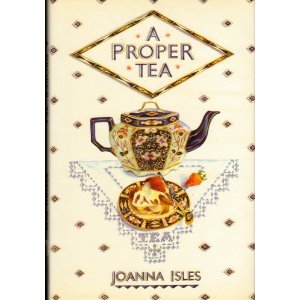
Adjectival phrase. It does not indicate “characterized by propriety” (as in proper behavior) but rather fits this subsidiary OED definition of proper: “Strictly or accurately so called; in the strict use of the word; genuine, real.” The OED has surprisingly few citations, the first notable one coming from Ann Thwaite’s 1984 biography of Edmund Gosse:  “He had worked with magnifying slides but he had never had a proper microscope.” Three years later, more to the point of Britishisms, came a book called A Proper Tea: An English Collection of Recipes.

Help me out here. I can’t put my finger on it, but there is something very British about thinking about or referring to this quality. Americans don’t generally care about whether a particular thing satisfies all the attributes of its category, only whether or not it works or is a good buy. They didn’t used to, that is. Now they are all over “a proper.”

Our distant ancestors probably did not have a proper breakfast when they woke up in their caves, so they gorged whenever they made a kill. (Marian Burros, New York Times, December 18, 2002)/Now that Anderson Cooper has come out of the closet about his admiration for Nicole “Snooki” Polizzi, it’s only fitting that they go out on a proper date. (TVGuide.com, September 15, 2011)

” … years on”

Preceded by a number and indicating, roughly,  “… years later.” More so than “later,” “on” provides a retrospective feel, and thus is useful in titles, as in Alan Bennett’s first produced play, the 1968 “Forty Years On.” The two-letter word makes the expression especially tempting for headline writers, and as the tenth anniversary of 9/11/01 approaches, it is ubiquitous. A Google News search for the phrase in headlines yields 424 hits for just the two days Sept. 3 and 4, 2011, from “Bin Laden Wanted a Second Hit, Ten Years On” (Sydney Herald) to “10 Years On: Finally, Smarter Airport Security Screening?” (Wall Street Journal).

A Consummate Teacher: Coach Robinson 50 Years On. (New York Times headline, August 4, 1991)/Though we’ve felt the impact of 9/11, more will yet unfold. Ten years on, it still might be “too soon to tell.” (Sacramento Bee, September 4, 2011)

“Dodgy”

(Thanks to Nancy Friedman.) Evasive, tricky, artful; dubious, unreliable. OED’s first citation is 1861. Google Ngrams show British use taking off in about 1940 and American, characteristically for NOOBs, circa 1990.

To heighten the fun of the chase, she gives Grace a road buddy in Darcy Kohler, a dodgy market analyst who stands to lose her condo if her missing boyfriend can’t be found to make good on the bond she co-signed. (Marilyn Stasio, New York Times, September 18, 1988)/ I see that the administration is pressing New York’s attorney general to drop its investigation into dodgy foreclosure practices and settle with the banks. (Megan McArdle, TheAtlantic.com, August 25, 2011)

“Shambolic”

Adjective indicating the state of being in shambles. The OED’s first cite is from 1970 (The Times) but curiously notes in small print: “Reported to be ‘in common use’ in 1958.”
To which I say, Hah! A Google Books search reveals a few dozen pre-1958 uses, the earliest being this from a 1939 issue of The Journal of Land & Public Utility Economics (and the telltale quotation marks indicate it’s a very early use indeed):

If judges are hesitant to adopt the findings made by a commission, and instead substitute their own inclinations, the administrative agency becomes not symbolic of legal progress but “shambolic.”

That is an American journal (don’t know the nationality of the author), but shambolic is nonetheless definitely a Britishism. Google Ngram data suggests it is currently used about five times more frequently in British than American English. But it is also a Not One-Off-Britishism: that same Ngram chart indicates frequency of use in American English has increased some 400 percent since the early ’90s.

Despite its shambolic start, the euro is not going to vanish. (Paul Krugman, New York Times, September 20, 2000.)/Taken together these albums hopefully represent the first unified volley in a new Philly sound — shambolic, shamanistic and completely cool. (Associated Press, August 15, 2011)

“Cheeky”

Mike Myers as Simon

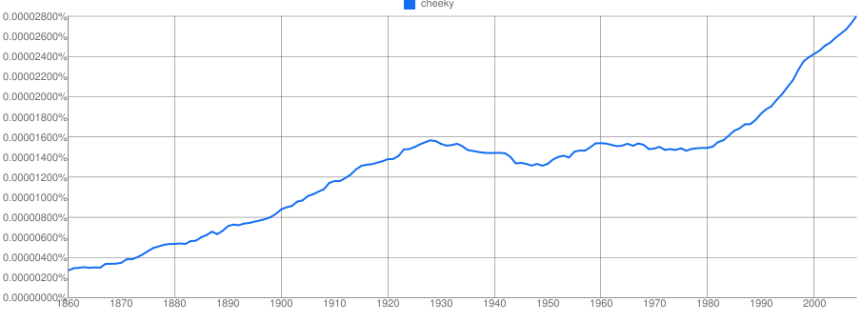
OED defines cheeky as “insolent or audacious in address; coolly impudent or presuming” and cites a first appearance in 1859. It was not unknown in the U.S. in subsequent years; a New York Times headline from 1885 read, HOW HILL HELPED PATRICK.; A CHEEKY CIRCULAR SENT THROUGH CHEMUNG COUNTY BY PONY EXPRESS. In 1943, the American writer Max Shulman published a comic novel with the amusing title “Barefoot Boy with Cheek.”

But the Google Ngram below shows that, as with  many Britishisms, American only increased significantly in the 1980s.

American use of "cheeky," 1860-2008

Presumably, its popularity was helped along by Mike Myers’ late-80s Saturday Night Live character Simon, one of whose catchphrases was “Cheeky monkey!”

Years after retiring, she became friendly with a 37-year-old cheeky chap who had the habit of forging her name on big checks. (New York Times, March 4, 1990). My man Mark Thompson puts up a cheeky post yesterday that I most heartily approved of. (Thomas P.M Barnett, Time.com, August 9, 2011)

“Crap” as adjective

The specific British use is of this word as an adjective, equivalent to the American crappy or crummy, as when a laddish U.K. online magazine called The Sabotage Times, recently referring to a new soccer video game,  commented: “…we now have access to an alternate world where supporting a crap, shambolic and skint club is no barrier to success.(And by the way, shambolic and skint are now officially on my radar.)

…the Senate bill retains a finance committee provision allowing some employees to purchase health insurance on the exchange, even if their employers already offer health coverage, if it’s a crap plan (i.e., one that requires the employee to pay more than 10 percent of his income in premiums or fails to meet a minimum coverage standard). (Timothy Noah, Slate, November 22, 2009)/I mean, I’ve seen a lot of mediocre films, even at major fests, but let’s assume for the sake of argument that most people who set out to make an indie film are not aiming to make a crap movie. (Movie City News, website, July 27, 2011)

On the radar: “Mad,” “Nutter”

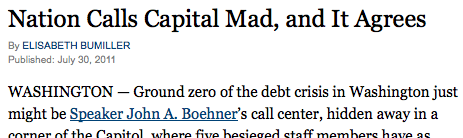
From the New York Times, July 31, 2011

For some reason, adjectives indicating mental instability have always been a key marker of difference between American and British English. We have crazy  and insane; they have mad and daft. Does the New York Times article above indicate a meeting of the minds on mad, or merely that headline writers really like short words? Only time will tell.

Moving on to nouns, I’ve always felt the U.K. nutter is more expressive than our nut, and in recent years have wondered what U.K. visitors to Philadelphia (near which I live) think when they discover that it’s governed by a Mayor Nutter. Predictably, I enjoyed this quote from a recent Reuters article on the Murdoch scandals:

“We used to talk to career criminals all the time. They were our sources,” says another former reporter from the paper who also worked for Murdoch’s daily tabloid, the Sun. “It was a macho thing: ‘My contact is scummier than your contact.’ It was a case of: ‘Mine’s a murderer!’ On the plus side, we always had a resident pet nutter around in case anything went wrong.”

My pulse quickened some months ago when the PBS program “Frontline” posted Wikileaks leaker Bradley Manning’s Facebook status updates, including this from September 4, 2009: “Thinks Cambridge, Massachusetts is full of crazy (but fun) nutters.” But it turns out that Manning’s mother is from Wales and he spent much of his adolescence in that country.

However, I haven’t given up hope on the nutter front and was very pleased to read this yesterday in John Nichols’ blog at The Nation:

But it is becoming all too clear that the “right-wing nutter” fantasy that the debt-ceiling debate could be gamed for political points is crashing into the prospect of a “crunching global recession.”

So far, no sightings of daft.

“Journo”

The OED reports that this diminutive for journalist originated in Australia in the 1960s, migrating to the UK no later than 1984, when this ominously prescient quote appeared in The Listener: “Rupert Murdoch once said, if the journos don’t like it they can always get out; there are plenty more journos on the street.”

The atmosphere was animated and perhaps a little self-satisfied—the New Hampshire primary is tremendous fun, and journos and politicos alike are always tickled to be part of it—but of boisterousness there was none. (Hendrik Hertzberg, The New Yorker, blog, January 8, 2008)/It’s been nearly a year since the release of UFOs: Generals, Pilots and Government Officials Go on the Record, journo Leslie Kean’s attempt to steer The Great Taboo into the arena of mainstream debate. (Sarasota Herald-Tribune, blog, July 29, 2011)

Delicious kerfuffle

Something that originally got me interested in NOOBs was its contrarianness: the way it balanced the conventional notion of Americanisms flooding into British English. Indeed, complaints about creeping Americanisms have been aired in Britain for at least two hundred years. The events of the last week have shown that resentment has not diminished in the slightest.

It started with an article in the BBC’s online magazine by journalist Matthew Engel, which opened this way:

I have had a lengthy career in journalism. I hope that’s because editors have found me reliable. I have worked with many talented colleagues. Sometimes I get invited to parties and meet influential people. Overall, I’ve had a tremendous time.

Lengthy. Reliable. Talented. Influential. Tremendous.

All of these words we use without a second thought were never part of the English language until the establishment of the United States.

This was right in the wheelhouse of University of Pennsylvania linguist Mark Liberman, who summarily demonstrated in a post for Language Log–the invaluable blog he curates–that four of the five words were not Americanisms at all. (The exception is lengthy.) Liberman:

The Oxford English Dictionary cites reliable as in regular British use for more than two centuries before the establishment of the United States. The first citation for talented, in the relevant sense, is from Edward Bulwer-Lytton, a quintessentially and even parodically British writer. The relevant sense of influential was first used by Roger North, who spent all of his 83 years in England, and died more than 40 years before the American revolution. The OED’s first citation for tremendous in the “extraordinarily great” sense is from the English poet Robert Southey.

It gets better. The BBC invited readers to send in their choice for the most objectionable “Americanism,” and in just one day got 1295 responses: so many, and so filled with fury, that the Beeb stopped taking new ones. They then created an article from “50 of your most noted examples,” and even now, two and a half days after the post, it is the most e-mailed story on the BBC site. The top 50 make for diverting reading. One reader nominated eaterie (which I always thought was spelled eatery) and commented, only, “Oh my gaad!” Another noted, “The one that always gets me is the American need to use the word bi-weekly when fortnightly would suffice just fine.” I guess. Ross from London shared, “I hear more and more people pronouncing the letter Z as “zee”. Not happy about it!” Predictably, my favorite comment was: “What kind of word is “gotten”? It makes me shudder.”

This time, it was The Economist’s pseudonymous “Johnson” blogger that had the rejoinder, pointing out that many of these so-called Americanisms, too, were as British as steak and kidney pie: including oftentimes, wait on (to mean “wait for”) and physicality. Johnson wisely noted that a remarkable number of the entries “share one or more of these features”:

1) selective hyper-literalism: refusal to understand idioms as such

2) amnesia, or else the ” recency illusion“: A belief that something quite old is new

3) simple anti-Americanism: the belief that if something is ugly, it must have come from the States

To which I would add the idea that if you don’t like something, it is vile, evil, and/or a mistake.