
Where else? Meanwhile, the mind boggles as to what the store will eventually sell.

Where else? Meanwhile, the mind boggles as to what the store will eventually sell.
A couple of days ago, I invited readers to vote on what they thought were the search terms (after the decisive winner, ginger) that most often led readers to Not One-Off-Britishisms in 2011.
Hoo boy, were you wrong. Here’s what you said:
And here are the actual most commonly searched terms:
I had pledged to send a signed copy of my book The Sound on the Page to anyone who correctly chose the three most commonly searched terms (From boot to bonnet, Thank you very much indeed and Sit for an exam). The offer holds–though how such a claim could be substantiated, short of a screen shot of your ballot, is beyond me.
… another Hollywood movie based on a European source, a movie in which characters speak in Britishisms. Yesterday it was The Girl with the Dragon Tattoo, where reference is apparently made to a coffee. Today it’s Steven Spielberg’s animated Tintin, in which (again according to Steven Rea of the Philadelphia Inquirer), Haddock says:
I’ll not be doubted by some pip-squeak tuft of ginger and his irritating dog.
And speaking of which, WordPress provides a running list of the most common search terms that led people to this blog, and I have just been taking a look at it. By my informal count, the winner was various combinations of ginger, including ginger person, ginger prejudice and ginger commits suicide.
Now for some end-of-the-year fun. In the poll below, the other top ten searches are listed in random order. Your task is to choose the top three. I will report the correct order in a couple of days. If anyone attests to me that you got all three right, I will mail you, as my special holiday present, a copy of my book The Sound on the Page: Style and Voice in Writing.
In Steven Rea’s Philadelphia Inquirer review today of some film based on an obscure novel by Stieg Larrson, he writes:
One of the most important questions to be asked in the late Swedish author’s mega-selling mystery The Girl With the Dragon Tattoo– the line “Do you want a coffee?” – makes it into David Fincher’s movie.
My questions are, 1, why is this so important? and, 2, accepting the convention that these Swedish characters are speaking English, why, since this is an American movie with an American director and American screenwriter, do they express themselves in Britishisms?
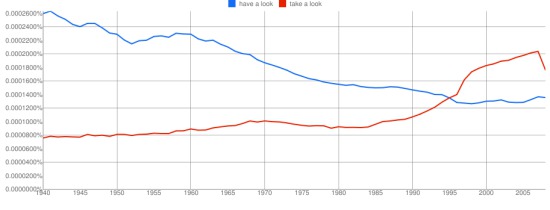
Cast your eyes upon something, figuratively or literally. Synonymous with take a look. Both forms are found in both British and U.S. English throughout the twentieth century but the charts below, from Google Ngram, showing frequency of use of have (blue line) and take (red) between 1940 and 2008, suggest some of the nuances. In Britain, below, have started the period way in front, then steadily declined until it was overtaken by take in the mid-90s.
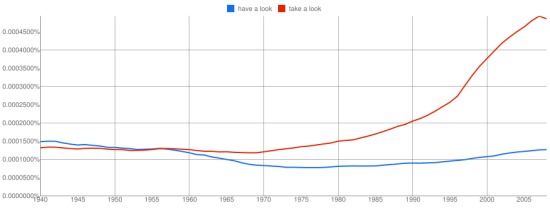
In the U.S., the two were roughly equal until about 1960, when take took off and have went into a tailspin, only to revive recently as a NOOB:
Are these clothes worth it? Go have a look. If ever there was a season to explore the mind of high fashion, this is it. (William Norwich, New York Times, January 18, 2004)/Mitt Romney has turned black, at least according to a graphic that appeared on a Fox News program today. Have a look — this is strange even by the standards of this Republican race. (Erik Wemple, Washingtonpost.com, December 14, 2011)
Headline on Slate.com (owned by the Washington Post Corporation), December 14, 2011:

The exact equivalent, I would say, of the U.S. get along with; used by Dickens in Bleak House: “They get on together delightfully.”
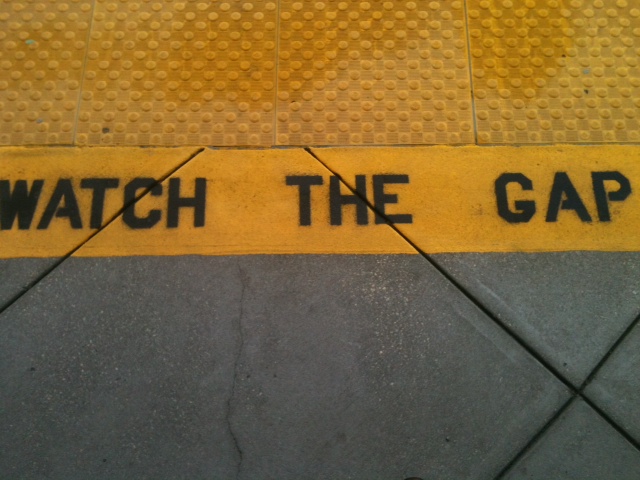
Today I took the above photo of the platform at at the University City, Philadelphia, train station. For some time, I have been noticing “Watch the gap” announcements and signage not only in the Philadelphia commuter train system, but also Amtrak and Metro North, which serves the New York metropolitan area.
The phrase “Mind the gap” is, of course, intimately connected with the London Underground and has been since 1969, when it was adopted to caution passengers not to step into the space between the train and the platform. Gap isn’t a proper Britishism, I don’t think; it’s just that there isn’t any American counterpart, so the association with the Underground slogan makes it sound British.
Mind very much is a Britishism, so much so that I don’t expect to see it catch on in New York or Philly. However, Seattle–the home of the Bumbershoot Festival–has, according to this Flickr photo, put the slogan on public buses. I don’t exactly understand what the gap is on a bus, so if any Seattle-ites could fill me in, I would appreciate it.
In a wonderful essay, “In Praise of Crap Technology,” Thomas Hayden extols the virtues of his $19.99 Coby mp3 player, bottom-of-the line Samsung cellphone, 1995 mountain bike, and other devices that aren’t fancy but work. He says of the Coby:
it’s worth next to nothing so I’m virtually assured never to lose it—unlike apparently every iPhone prototype ever—and I don’t cringe at all when my toddler flings it across the room. And because the next Coby is sure to be just as mediocre, I’ll never need to upgrade—I’ve stepped off the escalators of feature creep and planned obsolescence, and all the expense and toxic e-waste that come with them. Crap technology, it turns out, is green technology.
Much food for thought there. However, the thing that caught my attention, of course, was the use of the NOOB crap as an adjective. In an interview last night on public radio’s “Marketplace,” Hayden expanded on the distinction between crap and crappy:
Crap technology is basically stuff that doesn’t have cachet, you know? It’s not slick, it’s not cool, but it works. Crappy technology, on the other hand, is stuff that simply doesn’t work. That’s the sweet spot of crap technology: no cachet but all the functionality you’ll need.
 I first became aware of massive as a Britishism about ten years ago, when I interviewed the English tennis player Tim Henman and he used the word roughly every third sentence. The Britishism, I should point out, is not the adjective in the traditional meaning of very big but its use, in the OED’s words, “in weakened senses: far-reaching, very intense, highly influential.” The OED cites the periodical “Sound” in 1984: “Personally, I’m convinced the Immaculate Fools are going to be massive.” Massive Attack (I quote from Wikipedia because I am not conversant with the terminology and because of plural verb for a collective noun makes me weak in the knees) “are an English DJ and trip hop duo” that began operations in 1988.
Weakened-massive got on my radar as an NOOB when I read an October 2, 2011, article by David Hiltbrand in the Philadelphia Inquirer. Hiltbrand was interviewing the British actor Damian Lewis, who said of a character he played, “Brody is treated as a war hero but he’s carrying a massive secret.” Then, just two paragraphs later, Hiltbrand himself picks up the word, referring to a “massive cattle call for [the miniseries] Band of Brothers.”
Here’s a relatively early American use: The series [“Survivor: All Stars”] made its debut immediately after the game, and minutes after the first contestant was bounced from paradise, an anonymous gremlin posted a massive ”spoiler” on the entertainment Web site Ain’t It Cool News — a detailed list of upcoming plot twists. (Emily Nussbaum, New York Times, May 9, 2004)

