A Newt Gingrich soundbite caught my ear the other day. Complaining about his rival, Mitt Romney, he observed that the media “did exactly what Obama would do this fall, and kept replaying [Romney’s quote] ‘Oh, I don’t really care about the poor.’ Which is not a very clever thing for someone who is very wealthy to say.”
It’s that clever–a very British use of the word, in my experience. The precise American equivalent is smart, or, more formally, intelligent. We actually use clever less to characterize a person then to describe shrewd or ingenious decisions or actions–or, if a person, then one who makes that sort of decision. British people often talk about “clever children,” or a “a clever child.” Americans, never.
Except for Newt Gingrich, who seems to be trying to bring the British usage over here. I found another quote of his, dated January 26: “The message we should give Mitt Romney is you know, ‘We aren’t that stupid and you aren’t that clever.'”
But Newt, as David St. Hubbins so sagely pointed … well, read the caption above.
(Update, 11:59 AM Eastern time: We have not three but five correct answers. Check them in the comments.)
A reader who calls him or herself Avengah made this comment to my post about carry on:
Maybe “spoilt for choice” would be better as it’s the form more often used in England – e.g. spoilt brat / child, since I think you’re trying to give these posts an English flavour…?
I’m not sure that I’m actually trying to give the posts an English flavour, erm, flavor, but Avengah was very perceptive in noting that I find myself increasingly drawn to Britishisms like spoiled for choice, even when they are not NOOBs. Occupational hazard, I suppose.
So here’s a fun little task (you will be grateful that I am not repeating my woeful attempt, in this post’s title, to transliterate glottal stop). Can you find, in yesterday’s post on streets ahead, three Britishisms about which I haven’t already written? (I have indeed done a post on a proper and it was Gareth who said “realising,” so these don’t count.) Hint: one of them is a proper NOOB that I plan to post on, one is nowhere in evidence on these shores, and the third is in between.
Put answers in comments, and please read the comments before commenting yourself: I will indicate correct and incorrect answers.
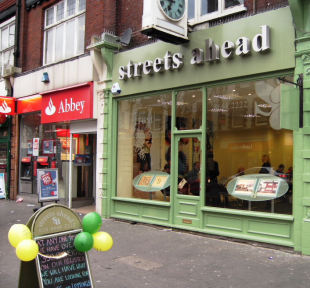
You can find Streets Ahead on the High StreetWow, this is a tricky one. I confess that I was not even aware of the expression until a reader named Gareth commented, “Is ‘streets ahead’ well-established in American sources? Earliest OED reference is 1885 in Ireland. Recently a character in NBC’s ‘Community’ tried to ‘coin the phrase’, without realising it already existed (for the backstory see http://earnthis.net/2010/04/community-is-streets-ahead/.)”
First of all, in answer to Gareth’s question, no. “Streets ahead” (which the OED defines as “far ahead of something or someone, far superior”) has never appeared in the New York Times–as uttered or written by an American–and that means from 1851 to the present. Yet it somehow has the reputation of being a catchphrase. A New Yorker blog post from January 201o revived the venerable character created by Frank Sullivan for the magazine in days of yore, Mr. Arbuthnot, the Cliche Expert, and had him say this about the then-brand-new Apple iPad:
It reflects the company’s commitment to cutting-edge design and elegant technology solutions. They’re the eight-hundred-pound gorilla in the room. They’re streets ahead of their competition and they have both the ground game and air attack to take on anyone.
I believe, as Gareth suggested, that it all goes back to “Community,” which, by the way, is one of the favorite shows of Elizabeth Yagoda. The excllent article to which he linked (on the blog “Earn This”) explains the whole complicated story, but basically it started during an online competition for best TV show in which “Community” was vying with a couple of other series. A supporter of the other shows tweeted: “both Modern Family and Glee are streets ahead of your meta bullshit.” The creator of “Community,” Dan Harmon, got wind of this, and, apparently unaware that streets ahead is an actual British expression, spent the next couple of months mocking it online, going so far as to create this animated video on the Extranormal site.
Art started imitating life, or maybe it’s the other way round, with this Twitter exchange between Harmon and a fan:
@tim_stoltz : @danharmon Your hatred of “Glee” has made its way into “Community;” how long till your new favorite phrase makes it?
@danharmon : @tim_stotz I’m putting it in the current script, so it’ll be a few weeks. But I have to get the world understanding it by then!
And sure enough, in the 22 April 2010 episode, Pierce, the character played by Chevy Chase, made a star-crossed attempt to push streets ahead as a catch phrase.
An interesting sublot is that several people posted comments to the “Earn This” article along the lines of this one:
How is ‘streets ahead’ a British or Irish phrase in any way shape or form? I’ve lived in the UK, to the best of my knowledge, for my whole life and have never heard it used until Community.
So maybe, in addition to not being a true NOOB, streets ahead isn’t even a proper Britishism. I await further enlightenment.
Ironically (as U.S. newsreaders like to say), this past fall, NBC announced it was putting “Community” on hiatus. Dan Harmon posted: “Streets ahold.”
The verb has several distinct meanings, one of which (1)–to misbehave–is American in origin. Distinctly British (2), on the other hand, is the sense it was used in the 1939 propaganda poster “Keep Calm and Carry On”–that is, to persist in the face of obstacles. The Oxford English Dictionary tells us this originated as a nautical variation on “stay the course.” The OED quotes a 1909 newspaper (which was partial to quotation marks): “‘Carry on!’ is a word they have in the Navy. It is the ‘great word’ of the Service.‥ To-morrow the workaday life of the Fleet begins again, and the word will be, ‘Carry on!’” Familiar on both sides of the Atlantic, I reckon, is the notion (3) of carrying on, or maintaining, a legacy or tradition.
The NOOB is a fourth carry on meaning, more or less, to continue: either as an auxiliary verb (Please carry on working) or by itself (Carry on with your work). The American vernacular equivalent is keep on; Bob Dylan sings of a time when “All I knew how to do was to keep on keepin’ on.” British movie comedy Carry On Sergeant (1958) and its twenty-eight sequels cleverly packed meanings 1, 2 and 4 into the title.
In recent years, Americans have grown mighty partial to carry on 4. I’m spoiled for choice for examples and will just cite today’s (Columbia) Missourian, where a columnist writes, “these people have such a high opinion of themselves that I wasn’t certain we would be allowed to carry on with the rest of our lives without their permission.”
I am also picking up intriguing signals that meaning 3, the stiff upper lip deal, is getting some traction on these shores. Yesterday’s Washington Post had the headline: “Occupy DC Protesters Vow to Carry On Despite Camping Regulations.” And in a profile of runner Michael Pistorius in the 18 January 2012 New York Times, Michael Sokolove writes, “Some of the equipment is clamped to an exterior wall of the garage, opposite an uncovered patio; when it rains, athletes just carry on and get soaked.”
The Huffington Post notes: “Brad Pitt was on hand at Saturday night’s Producer’s Guild Awards, in part to support his partner Angelina Jolie…” That partner caught my eye–specifically as a way to denote someone’s opposite-sex, longterm and, all things being equal, permanent love interest. My observation is that this has long been common in the UK–among both unmarried and married couples. The former makes sense because of the lack of suitably dignified terms. (Girlfriend? Lover? Main squeeze?) The latter case is more interesting. I hear it as an implicit disapproval of the traditional husband, wife and spouse, which presumably bring with them whiffs of an oppressive heteronormative (thanks, Elizabeth Yagoda) patriarchy.
The Oxford English Dictionary’s note about partner supports this political interpretation:
Now increasingly used in legal and contractual contexts to refer to a member of a couple in a long-standing relationship of any kind, so as to give equal recognition to marriage, cohabitation, same-sex relationships, etc.
Anyway, opposite-sex amorous partner is on the rise in the U.S. Just in the last few days, there has been:
Denver Post, January 24: “[Jim Jesperson] is preceded in death by his partner, Erin O’Niell…”
Chicago Sun-Times, January 24: “Even in his final days, [Yuri Rasovsky’s] partner, Lorna Raver, could hear him calling out directions to actors in his sleep.”
Tewksbury (Mass.) Patch.com, January 21: “Besides his wife, Angela, Michael Callhan] is survived by his three sons; Michael Callahan and his partner Patricia Lamirande of Lowell…”
You do not need to have sharp eyes to notice that all three examples are from obituaries. That makes sense, because if it’s undignified to refer to the girlfriend of a man in his 60s or 70s in ordinary speech, it’s borderline insulting to do so in a recognition of his passing.
All that said, I have not noticed many–or even any–U.S. uses of married partner, that is, to refer to an opposite-sex husband or wife. Please send on any sightings!
My homegirl Ellen Magenheim (who besides being a NOOBs informant is a distinguished Professor of Economics at Swarthmore College) writes: “another one: easy peasy. I just saw it on the Facebook page for Green Aisles Grocery [a South Philadelphia market]; i.e., ‘Easy Peasy Dinner courtesy of Green Aisle and Severino Pastas!'”
Ellen is spot on. The OED’s first citation for the phrase–whose non-rhyming American equivalent is easy as pie–is from 1976, but it originated some years before that in the expression easy peasy lemon squeezy, which may or may not have originated in an advertising slogan for the “washing-up liquid” (aka dish detergent) Lemon Sqezy [sic].
Whatever, easy peasy is now officially all over the U.S.: a blog, a song from the (Baltimore) band Ponytail, a netbook operating system, and the press, including this three days ago from the Huntsville (Alabama) Times: “You would think the area would be thick with restaurants and operating one successfully would be easy-peasy.”
Previously, Ellen had suggested dead easy, noting this quote from a Nicolas Kristof article in the New York Times:
Along with a no-fly zone, another important step would be to use American military aircraft to jam Libyan state television and radio propaganda and Libyan military communications. General McPeak said such jamming would be “dead easy.”
In his recent book The Psychopath Test: A Journey Through the Madness Industry, the English Welsh journalist Jon Ronson has a set piece in which he encounters the disgraced American corporate executive Al “Chainsaw Al” Dunlop. The book is about psychopaths–whether they exist, what they are–and the issue in this scene is if Dunlop qualifies. Ronson quotes him as saying:
“Listen. The psychopath thing is rubbish. You cannot be successful unless you have certain”–he pointed to his head–“controls.”
Well, no. As everybody knows, American say garbage while the British say rubbish (and whilst). Well, not everybody. Jon Ronson was clearly unaware and put a bogus rubbish in Al Dunlop’s mouth. Good thing NOOBs is on the case!
A couple of days ago, I invited readers to vote on what they thought were the search terms (after the decisive winner, ginger) that most often led readers to Not One-Off-Britishisms in 2011.
Hoo boy, were you wrong. Here’s what you said:
One-off
Whinge
Bespoke
Sit for an exam
Laddish
Suss out
From boot to bonnet
Chattering classes
Charlotte Church having a wee
Thank you very much indeed
And here are the actual most commonly searched terms:
From boot to bonnet
Thank you very much indeed
Sit for an exam
Laddish
Suss out
Chattering classes
Bespoke
One-off
Charlotte Church having a wee
Whinge
I had pledged to send a signed copy of my book The Sound on the Page to anyone who correctly chose the three most commonly searched terms (From boot to bonnet, Thank you very much indeed and Sit for an exam). The offer holds–though how such a claim could be substantiated, short of a screen shot of your ballot, is beyond me.


 The verb has several distinct meanings, one of which (1)–to misbehave–is American in origin. Distinctly British (2), on the other hand, is the sense it was used in the 1939 propaganda poster “Keep Calm and Carry On”–that is, to persist in the face of obstacles. The Oxford English Dictionary tells us this originated as a nautical variation on “stay the course.” The OED quotes a 1909 newspaper (which was partial to quotation marks): “‘Carry on!’ is a word they have in the Navy. It is the ‘great word’ of the Service.‥ To-morrow the workaday life of the Fleet begins again, and the word will be, ‘Carry on!’” Familiar on both sides of the Atlantic, I reckon, is the notion (3) of carrying on, or maintaining, a legacy or tradition.
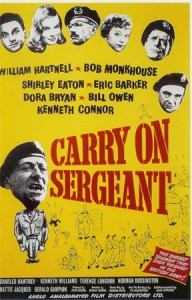 The NOOB is a fourth carry on meaning, more or less, to continue: either as an auxiliary verb (Please carry on working) or by itself (Carry on with your work). The American vernacular equivalent is keep on; Bob Dylan sings of a time when “All I knew how to do was to keep on keepin’ on.” British movie comedy Carry On Sergeant (1958) and its twenty-eight sequels cleverly packed meanings 1, 2 and 4 into the title.


 notoneoffbritishisms.com