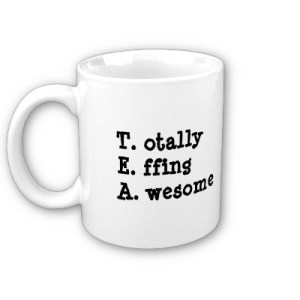
Effing

Funny story: in a previous post written under the influence of jetlag, I wrote “eff” instead of “egg.” Before I had a chance to correct it, reader John Stewart noted that effing–euphemism for fucking–is itself a Britishism.

This surprised me: I have gotten used to effing in these parts and had no sense of a transatlantic origin. But John is correct. The OED’s examples are all British, starting with this from Robert Graves’ 1929 “Goodbye to All That”: “He was charged with..using obscene language to the bandmaster; the bandmaster, who was squeamish, reported it as: ‘Sir, he called me a double effing c—.'”

I have a sense that effing’s U.S. popularity stemmed in large part from radio and later TV personalities seeking to avoid Federal Communication Commission strictures on foul language. A 2004 New York Times piece about shock jock Gregg “Opie” Hughes noted that even after moving to satellite radio (where the FCC has no sway), “Mr. Hughes often carefully and sometimes almost primly avoided expletives, using euphemisms like ‘freakin’ ‘ or ‘effing’ even though he was free to spew the foulest language they could come up with.”

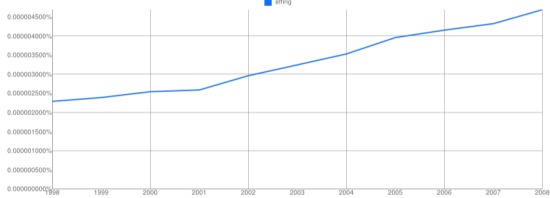
A Google Ngram shows a 100 percent increase in U.S. usage of effing between 1998 and 2008

Relative frequency of “effing” in U.S. books, 1998-2008

British usage is still about 50 percent more common, according to Google Ngram, but at this point, effing has passed its sell-by date on both sides of the Atlantic, with an unappealing naughty little child quality. Take a recent headline in Jezebel (which has used effing an astonishing 71 times in its history): “What’s the Big Effing Deal About Having a Second Baby?”

Nor does British actress Emily Blunt’s quote about her marriage to John Krasinski augur great things for the union: “All I can say is that it’s an effing blast.”

Rendell Roundup

I just got back from vacation (a beautiful tour of the Amalfi Coast) and I did the traditional vacation thing of reading a mystery novel, End in Tears, by the splendid (and English) Ruth Rendell. Three passages struck me as relevant to this blog. The first related to a recent entry on trousers. A character meets an old-fashioned woman and reflects on her garb: “The only name for her trousers, Hannah thought, was one her own mother used, ‘slacks.'” No mention of pants.

The second reminded me that I have been meaning to do an on-the-radar entry on flat, the dwelling unit that Americans have traditionally called apartment. In Rendell’s world, things are moving in the opposite direction, with the American term apparently a sign of pretension. A character refers to “these flats or ‘apartments,’ as the prospectus calls them.”

The final quote relates to the issue of the extent to which Britishisms are Americanized in American editions of books. Here’s a description of a bad guy:

He was sitting in front of the television on a sagging sofa eating a burger with a fried egg on top, a large portion of fries, and a thick slice of fried bread, the lot doused in tomato ketchup.

Surely Rendell wrote chips rather than fries? If so, on the very next page, the translator nodded, leaving unchanged a reference to “the coagulated egg, burger and chips on Prinsip’s plate.”

Not One-Off Footballisms

By JACK BELL

So there is this American television network  that is carrying all 31 games of the European Championship, the continent’s soccer jamboree that starts today in Poland and Ukraine.

On Wednesday, ESPN hosted a telephone conference call with the on air “talent,” as the industry calls its announcers. Both of the guys – Ian Darke and Steve MacManaman – are British. So that means another month of British accents spilling out of TV sets across America. Another month? Make that more, much more.

I love many, many things English: The Beatles, Stones and Clash; Beeston Castle; Mousehole in Cornwall; Stilton cheese; Manchester United; Cockney rhyming slang; and there once was this a girl (another story). But over the years, I’ve come to draw the line at the so-called “language of soccer,” where every chip is “cheeky,” every player on the wing is “nippy,” every field is a “pitch,” every pair of cleats are “boots,” every uniform a “kit” and every big play is “massive, just massive.”

I learned my soccer (sorry, we don’t call it football and even though the Brits like to give us stick for calling it soccer, it’s actually their word, derived from aSOCCiation football) from a collection of British counselors at a summer camp in the Pocono Mountains way back in the 1960s. We got called all kinds of names for wearing strange uniforms (not kits), high socks … you get the idea. But soccer taught me about the world, in a lot of different accents and languages. My travels have been soccer travels. My friends are soccer friends.

But now, as the game is seeping deeper and deeper into the American consciousness, some pooh-bahs somewhere (ESPN, Major League Soccer, Fox Soccer to name three) have come to the conclusion that to sound authentic the game in the United States has to, must to, adopt the Britlingo of the game.

And it’s especially absurd, in my view, for M.L.S. to indulge this soaring perversion. On its own Web site, MLSsoccer.com, the prose is rife with Britishisms that can confuse and mislead the casual reader, me included. Do you know what a “brace” is? I had never heard the word until a Fox Soccer report. Then it popped up again on the MLS Web site. I had to check the dictionary. And I’ve been following the game for longer than I care to remember. I had never, ever heard the term. Why confuse people? Can’t we just say “Francochino scored two goals”? Why make it mysterious.

What’s more the league – remember it’s called Major League SOCCER – has for some reason allowed a handful of teams to append the letters F.C. to their club names. That stands for Football Club. That’s fine if you’re in Burnley or Bristol (England, that is), but it’s patently absurd in the U.S. (maybe more acceptable in Canada for Toronto, a team without a nickname, imagine!, and the Vancouver Whitecaps). But F.C. Dallas? Seattle Sounders F.C. Laughable.

Fox Soccer has been the pre-eminent transgressor for a couple of reasons: The network’s lead soccer producer is a gruff (I’ve been told) Scotsman who insists on the Britlingo and some odd pronunciations of other words and names. Hence we have JuvenTOOS when every one in the world says Juventus. Just to be different? I think not. In addition, an anchor I once exchanged email with told me that the channel was catering to expat viewers who simply would not abide the Americanization of soccer lingo. Really? Next stop is the WC (water closet).

So there I am, watching Fox Soccer’s nightly report and on comes a story about something called a “tapping up” scandal. Sorry, but WTF? Again, I had never, ever heard the British term for a bribery scandal. Ever.  I also broke for the dictionary when another announcer used the word “scupper” to describe something gone wrong. So what’s a scupper? It’s a nautical term for the spaces on deck that allow water to flow back into the sea. Get it? Man overboard.

My latest pep peeve is ESPN’s wholesale plunge into Anglophilia (I know, that sounds really bad). Ian Darke has emerged as the network’s No. 1 play-by-play man. He’s as talkative as some of the worst American offenders, but what’s worse, he insists on using the most obscure British terms during broadcasts. Some players are at “sixs and sevens.” Huh? Wha? Are you kidding me. And the man simply will not allow the game to do its own talking.  Even the network’s M.L.S. broadcasts have a Brit doing the games (the generally benign Adrian Healey) and the newest entry in the national soccer TV landscape, NBC Sports Network, hired one Arlo White, another Brit. (Here I’ll give a pass to the former GolTV color man, Ray Hudson, who is most entertaining, in any language.) I don’t want to start a contROVersy, but it’s getting harder and harder to take.

These terms are not the language of soccer … they are the clichés of soccer and should be recognized for what they are. And they are spreading like Kardashians as more and more people latch on to the world’s sport and think they’re speaking the game’s lingua franca. They are not. Ask an authority as authoritative as the long-time columnist Paul Gardner, an English native who has called New York home for more than 40 years. The only Britishism he’ll use about this topic is “rubbish.” Brilliant, just brilliant.

As I mentioned before, there are many, many things I love about Britain, particularly the facility with the language of so many people. The inventiveness that is often missing in American discourse. But do we say “lorry” for truck? Do we say “loo” for bathroom? Do we say “lift” for elevator. Not bloody likely. We have our words, they have their words. Can’t we just agree to disagree on this? O.K., back to the games on the telly.

 Jack Bell is an editor in the sports department at The New York Times; and also edits and writes for the Times’s Goal blog. He can be reached at (no, not on) bell@nytimes.com

“The long game”

[I wrote this for the Chronicle of Higher Education’s Lingua Franca blog]

All of a sudden, it is impossible to pick up the paper or listen to the news and escape “the long game.” I’m not talking about coverage of golf or other actual games, but to this sort of thing:

  • The example of guitarist Doc Watson should “serve as inspiration to any musician interested in the long game, in making music that endures not because of its shock value or its keen marketplace vision but because within its measured tones lies universal truth.” Los Angeles Times, June 3.
  • “I mean, [Queen Elizabeth] has played the long game better than anyone one can think of. I mean, she has understood from the beginning, for instance, even not to become too celebrated and popular.” Tina Brown, speaking on NPR’s Morning Edition, June 1.
  • “[Lawrence] Summers’s talent was for influencing a particular decision at a particular moment. He was not someone with a flair for the long game—for the week-in, week-out slog of bringing colleagues around to his views.” Noam Scheiber, The Escape Artists: How Obama’s Team Fumbled the Recovery.
  • “And ALEC, even more than other movement-conservative organizations, is clearly playing a long game.” Paul Krugman, The New York Times, March 26.

Speaking of the Times, I charted the newspaper’s nonsporting “long game” uses and came up with this:

1892-2005, inclusive: 6

2006: 3

2007: 1

2008: 0

2009: 5

2010: 8 (including Barack Obama, at a December news conference on his tax plan: “To my Democratic friends, what I’d suggest is, let’s make sure that we understand this is a long game. This is not a short game.”)

2011: 8

Where did this expression come from? Why is it so popular? The second question is relatively easy to answer. It is a vivid metaphor for an idea that frequently comes up in consideration of politics, business, and other human endeavors: to wit, the possession and use of a long-term strategy. (The very phrase long-term,” so flat and overplayed, suggests the need for a replacement.) It sounds British, always a good thing. And catchphrases, no less than videos or memes, have the capacity to go viral: to attain uncanny popularity at the drop of a dime.

But where did the long game” come from? My investigation (admittedly not exhaustive) suggests that it is indeed of British origin. Certainly there are plentiful uses in such sources as The Economist, The Times (of London), and The Times Literary Supplement. The most common contexts have been diplomacy, espionage, and statecraft, as in a 1944 comment in The Times that “ … so well and successfully have conspirators played the long game.” But it’s been used in all sorts of ways. In 1917 an anonymous author in The TLS intriguingly commented, “We are reminded of a pregnant saying of Hart’s that the long game is the Church’s game.” A 2005 episode of the BBC series Dr. Who was titled “The Long Game,” as was a posthumous collection by the Australian poet Bruce Beaver published the same year.

Using Google Books as my Wayback Machine, I came upon this 1860 quote, in the journal The Athenaeum: “… to continue speculations, in the soundness or unsoundness of all who play  ‘the long game’ are interested.” The quotation marks around the phrase were a smoking gun, indicating recent coinage. And sure enough, when I went back just a little farther, I hit pay dirt in Bohn’s New Hand-book of Games, published in 1856. In the section on whist, the book notes, “In playing the long game, when both sides mark five, they are precisely in the same position with those parties who are beginning the short game.”

It turns out that the long game and the short game are variants of whist. Chamber’s Encyclopedia explains: “About 1785 the experiment of dividing the game into half was tried, and short whist was the result. The short game soon came into favour; and in 1864 the supremacy of short whist was acknowledged.”

Apparently, just as the long game was losing its popularity as a game, it came into its own as a metaphor. It took the Yanks a century and a half to catch up. Clearly we don’t like to rush into anything.

“Mewling Quim”

Loki

This comes from reader John Stewart (a Londoner), and deals with a term I was not previously familiar with. Thus any objections should be directed to him, not me.

It deals with a moment in the new film “The Avengers”–written by the Americans Joss Whedon and Zak Penn–when Loki addresses Black Widow with the two-word epithet that’s the title of this post. Loki hails from outer space (John informs me) but, perhaps significantly,  is played by a British actor. John writes:

this is possibly the most offensive line in the film, beyond even Wolverine’s in X-Men: First Class. It is just that some people aren’t too familiar with the derivation. In more modern English, this would be “whining cunt”. In American English, “cunt” is generally used as a misogynistic insult, mostly used against women, insulting their very nature of being female. British English doesn’t use the female-specific aspect of this in an insult, which loses much of the mysogynistic tone. Indeed, it’s more likely to be used against a man, an exaggrated form of “wanker”. But “quim”, though rarely used, is done so in a misogynist fashion. It’s only used about women, and is very much about reducing them to their gender, as if that by definition, reduces their importance. And that’s how Loki uses it in Avengers.

Next, I am going to have to look into mewling.

“Fortnight”

Period of two weeks. This useful word has traditionally been reserved, in the U.S., for tennis commentators referring to the Wimbledon tournament. But that is clearly no longer the case. Consider:

For the rest of us dilettantes, there is the Hallmark aisle and, more precisely, the special section dedicated for a fortnight annually to cards exclusively “For Mom.” (ABCNews.com, May 12, 2012)

Not even a fortnight has passed and now a cloud of uncertainty hangs over the team thicker than at any time since a Ping-Pong ball bounced the Bulls’ way four years ago, bringing forth a Chicago son’s bright rays. (Chicago Daily Herald, May 10, 2012)

‘I have to pinch myself every day,” [hockey player Chris] Kreider said of his storybook fortnight, which began with winning the N.C.A.A. championship with Boston College and has continued with five rapidly improving appearances in the Stanley Cup playoffs. (New York Times, April 27, 2011)

Even the U.S. Conference of Catholic Bishops is planning a “Fortnight for Freedom” this summer (actually mostly coinciding with Wimbledon), the freedom in question apparently being that of employers to prevent their workers from getting free birth control.

The word this brings to mind is stone, as a unit of weight. I somehow don’t think that one is going to happen over here.

“Sorry?”

This is a very British way of saying, “I didn’t hear what you said–please repeat.” The OED dates it to the mid-sixties, and it was still novel enough in 1972 for Tom Stoppard to have sport with it in his play “Jumpers”:

Miss Moore, is there anything you wish to say at this stage?

Dotty (in the sense of “Pardon?”): Sorry?

Bones: My dear, we are all sorry

I’ve felt for a while Sorry? is gaining ground over here. But for a long time I didn’t know any way of finding out. The databases and corpora I usually consult primarily deal with published texts, and Sorry? is, of course, something that’s said far more than it’s written. Moreover, none of my sources pay any heed to punctuation, so any search would bring thousands of leaden I’m sorrys and sorry states for a single piece of gold.

Then Mark Liberman of the University of Pennsylvania advised me that the Corpus of Contemporary American English over at Brigham Young University indeed allows you to include punctuation in searches. Bingo. A search of broadcast transcripts yielded about 150 hits, most recently this from a journalistically hard-hitting ABC Primetime Live segment called DIRTY DINING: WAITER DROPS FOOD, TRIES TO SERVE IT:

GREG-1ACTOR2-# Here you go. And that’s it. (Voiceover) And before they can take that first bite… DINER-1MALE2-# Guys? One of your sandwiches, he just dropped it. ACTRESS-1FEMALE2# I’m sorry? DINER-1MALE2-# He just dropped one of your plates. The sandwich went on the floor, right here.

And this from a 2010 CNN interview:

KING: The mood there must be pretty good, huh? LAVANDERA: I’m sorry? KING: The mood must be pretty good?

The sharp-eyed will notice that in both those cases the speaker said “I’m sorry?” rather than simply “Sorry?” This is the case with a considerable majority of the COLA hits, one exception being this double-sorry from a segment on NPR’s Talk of the Nation. It starts off with the host, Neil Conan, interrupting a long statement by a caller, Eric:

CONAN: Eric – I’m sorry. Eric? ERIC: Sorry? Go ahead. CONAN: I was to ask you if you had any more. ERIC: Oh, no. I’m, you know, the only concern that I have is as far as, you know, I mean, everybody is concerned about their privacy.

Now that I examine the quote, it seems that both Eric and Conan are saying “sorry” to actually apologize. In any case, my hypothesis is that Americans, as is their wont, have subtly altered the British Sorry? into the more literal I’m sorry? Agreement, disagreement, explanation and any other amplification welcome.

“Trousers”

Jagger

A couple of weeks ago, the New Yorker magazine ran an online competition asking readers “to propose a single English word that should be eliminated from the language.” The winner, somewhat puzzlingly, was slacks. This is a rather old-fashioned term for what Americans call “pants” and Brits call “trousers,” which is my subject today.

The term dates from the seventeenth century and virtually all the OED’s citations for it and the many phrases and compounds formed from it (wears the trousers in the family, anything in trousers, not in these trousers) come from Britain, with one of the few exceptions being this 2005 quote from The New York Post: “Lee was game and let his trouser snake loose.”

The word initially forced its way into my consciousness via a moment on the Rolling Stones 1970 live album, “Get Yer Ya-Ya’s Out,” in which Mick Jagger addresses the audience: “Ah think I’ve busted a button [heavy glottal stop on the “buh-un”] on my trousers. I hope they don’t fall down….You don’t want my trousers to fall down, now do ya?”

Pants, dating from the early 1800, is the preferred American term. In the U.K., of course, that word means something completely different.

Trousers has, or have, been making inroads over here for some time, but seemed to have reached a crescendo of late, referring to articles worn by both men and women. In Anne Tyler’s new novel, The Beginner’s Goodbye, a man reflects about his wife: “Her clothes made her figure seem squat — wide, straight trousers and man-tailored shirts, chunky crepe-soled shoes of a type that waitresses favored in diners.”

Writing in the New York Times on May 1 about a new Ferragamo store, Alexandra Jacobs observes, “A fellow wearing cerulean trousers and slicked-back hair sampled driving moccasins while his bored-looking female companion sat on a couch, an amusing inversion of the customary situation.”

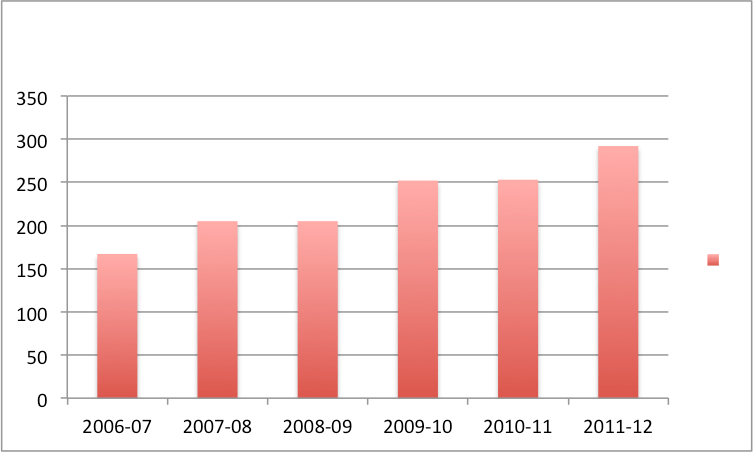
To be sure, the Times is fond of trousers. The chart below shows its frequency in the paper in twelve-month periods (May through April), 2006 to the present.