“Piece of kit”

Nancy Friedman has once again alerted me to to a NOOB of which I was not aware. (If you want to know about the other occasions, just key her name into the search field at right.) I was certainly familiar with the BrE kit, meaning both “uniform” (what football players wear) and “equipment,” and had indeed been keeping my eye out for American uses.

Thanks to Nancy, I now know the latter kit, at least, has established a capacious beachhead on these shores. She sent along a link to a September 14 blog post by John Scalzi, about the new iPhone, which includes this line: “As advertised, it is a very lovely piece of kit.”

I poked around the Web for other uses and found it’s most popular among techies like Scalzi. Thus Zack Whitaker, on ZDNet: “It doesn’t matter where you are in the world: a media on-the-go bag has to have every piece of kit you may or may not need.” And Elizabeth Fish, in PCWorld: “The Sandia Hand by Sandia National Laboratories is an impressive piece of kit for a troop to own.” (Both quotes appeared in the last couple of months.)

Besides spotting this rather annoying piece of pretentiousness, Nancy offers a credible starting point for its U.S. popularity: Lenny Kravitz’s 1999 song “Black Velveteen,” which refers to a “nice piece of kit.”

As if all this weren’t enough, Nancy has identified another new NOOB. Watch this space to learn about it.

“Fingers crossed”

Yes, yes, I know this is a venerable U.S. expression, so hold your fire. Americans say things like “My fingers are crossed” or “Keep your fingers crossed,” to indicate a wish for good luck. The Brits like to use the phrase by itself, as Americans would say, “Good luck!”, or, similarly, to more or less mean, “Here’s hoping for…” An example is this headline from the local newspaper in the West Midlands town of Solihull: “Fingers Crossed for a Sunny Shirley Carnival.”

I have some sense that the expression is in the early stage of incipient NOOB-itude. I offer this from Andy Benoit’s New York Times preview of the NFL Dallas Cowboys: “The budding star receiver (fingers crossed on off-field matters) Dez Bryant is 23.”

And this quote from American Canadian director James Cameron, about the recent release of his most famous film on Blu-Ray: “We’ve been holding back Titanic. So, fingers crossed.”

“Directly”

The British use this adverb, in a time sense, where Americans traditionally use right or immediately or just, most commonly in such phrases as directly after or directly before, but also by itself, to mean straightaway, as in this line from Jane Eyre (1847): “He sat down: but he did not get leave to speak directly.”

It is popping up over here, prominently in a Sam Sifton New York Times Magazine recipe for rosemary-garlic crusted pork butt that I aim to make tomorrow night (I will let you know how it goes):

“These [peaches] you will cut in half and pit, directly before cooking.”

And there is also:

  • “CBS is preparing online specials for directly before and after its television coverage, the latter anchored by Scott Pelley.” (Philadelphia Inquirer, August 25, 2012)
  • “Maj. Gen. Paul Lefebvre retired during a small, private ceremony directly before handing command of Marine Corps special operations to Maj. Gen. Mark Clark…” (Jacksonville Daily News, August 24, 2012)
  • “Littlepage stated that directly after hearing the noise, her steering wheel began to jerk from side to side.” (Surfky.com News, August 25, 2012)

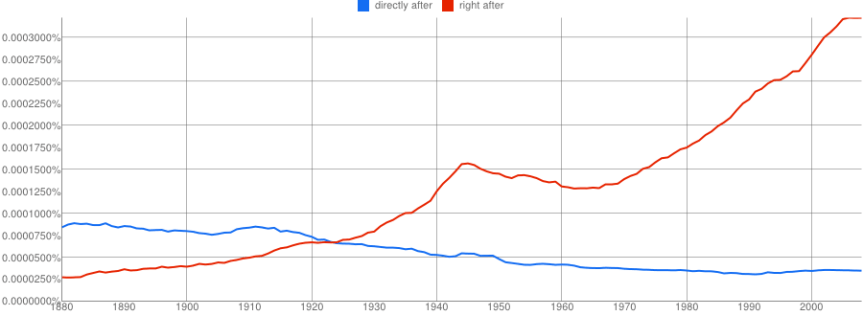
I used Google Ngram to compare relative frequency of right after and directly after in the U.S. because I couldn’t figure out any other way to isolate this meaning from all the (many) other ones directly has. The results in the chart below show that right after (red) overtook directly after (blue) in about 1925, but that d.a. stopped the lexical bleeding in the ’90s and is starting on the road back. (In Britain, directly after didn’t take the lead till the ’50s and even since then has had a respectable showing.)

“Fancy”

An item from Jessica Simpson’s “I Fancy You” Collection at Macy’s

Fancy, a useful verb (deriving from a noun referring to the imagination, as in a young man’s f. lightly turning to thoughts of love in spring), has two main senses. The first, followed by that, is a sort of combination of speculate and imagine with just a hint of improbability. A common idiom is I fancy myself a …

This fancy is more British than American, I would say, but has long been in view on both sides. So James Parker, in a February 24, 2012, New York Times review of a novel called The Technologists, wrote:

“Do you hear a whisper of ”The Da Vinci Code’ in all this? I fancy I do.”

The other fancy means some combination of like and desire, has traditionally been applied to people, and is more British. Thus Walter Raleigh in The History of the World (1616): “Ninus..fancied her so strongly, as (neglecting all Princely respects) he tooke her from her husband.”

It’s sprung up from time to time in the U.S., memorably in Yip Harburg’s lyric  to “When I’m Not Near the Girl I Love,” from the Broadway musical “Finian’s Rainbow” (1947):  “When I’m not facing the face that I fancy,/I fancy the face I face.”

Anne Tyler, who overall is rather fond of British diction, has this line in her new novel The Beginner’s Goodbye: “I decided that our reader in this case was a young woman who had been invited to go birdwatching with a young man she secretly fancied.”

In recent months Americans have shown a marked fancy for fancying not boys or girls but stuff. I first became aware of this when a Facebook friend of mine started posting the objects of his desire through an app called Fancy, which describes itself “part store, blog, magazine and wishlist. It’s a place to discover great stuff, to curate a collection of things you love, to get updates on your favorite brands and stores and to share your discoveries.”

In short order I found a blog called “Things I Fancy,” which I gather to be written by an American because she describes herself as a “stay-at-home mom” (not “mum”), and “Fashion I Fancy,” by “a California native living in NYC.”

And then, of course, there’s The Jessica Simpson “I Fancy You” Fragrance Collection at Macy’s.

Fancy that.

“Cock-up”

Today, the splendid writer James Wolcott (@James Wolcott) tweeted: “Romney’s multi-gaffe cock up: these are the times that try Jennifer Rubin’s soul.” (Ms. Rubin is a conservative blogger.) Naturally, that made me wonder whether cock-up had verged into NOOB territory

The OED defines this expression as meaning “a blunder, a mistake, a confused situation,” and cites it first in a 1948 dictionary of soldiers’ slang compiled by Eric Partridge. It is widely used in the U.K., notably in the phrase, “What a cock-up!” (Jonathan Coe has a novel with the subtitle “What a Carve-Up,” which I always imagined was a bowdlerized version.)

Wolcott notwithstanding, it’s very much still on the radar in these parts, its use mainly limited to hip or pseudo-websites, to wit:

“So yeah, maybe this isn’t Ryan Reynolds’ cock-up.” (Gawker.com, June 20, 2011, on the failure of the film “The Green Lantern”)

“But by any measure, this has been a monstrous cock-up.” (Slate.com, May 27, 2010, on BP’s handling of the Gulf oil spill)

But it’s certainly an evocative expression, and I look for more penetration soon.

“Man with a van”/”White van man”

I originally posted this in the Chronicle of Higher Education’s Lingua Franca blog:

Man in van

The ABC television network has announced that in 2013 it will air a sitcom called Family Tools. Previously, the show was called Comeback Jack; before that it was called Red Van Man, and before that, it was called White Van Man. And therein lies a tale.

Like many American comedies, including All in the Family, Sanford and Son, and The Office, this one took its premise from a British original, White Van Man. If you are American, that phrase probably means nothing to you. And neither does the much older expression from which it sprang, “man with a van.”

I myself first became aware of the latter when I got an e-mail from a BBC correspondent, Michael Wendling, who was interested in Not One-Off Britishisms, the blog I conduct about British expressions that have become popular in the United States. He observed, “I was in Brooklyn recently and I saw signs for ‘rubbish removal’ and ‘man with a van.’ There was a sex shop called ‘Shag.’”

I was aware of rubbish (what we would call garbage or trash) and Austin Powers had universalized shag, but I’d never come across man with a van. I asked Michael what it meant, and he explained:

A ‘man with a van’ is a person who will move your belongings to your new flat, or take them to the rubbish tip, or any other odd jobs that need a large vehicle and an extra pair of hands. Particularly common in London where there are a lot of people moving and fewer people have cars.  Inevitably the man is Australian, and the van is white (you may have come across the related Britishism, ‘white van man’, a working class male usually employed in some sort of manual labour, avid reader of tabloids and connoisseur of full English breakfasts).

When I looked into the expressions (as how could I not?), I encountered some surprises. One would have presumed man with a van to have originated during the time when vans, as we know them, started to be manufactured—maybe the 1940s? In fact, the Oxford English Dictionary has a definition of van as “A covered vehicle chiefly employed for the conveyance of goods, usually resembling a large wooden box with arched roof and opening from behind,” and locates a first citation in 1829. Man with a van was in circulation by 1876, when an article in The Times noted, “The practice of the firm was to send to customers a man with a van.” And an Australian agricultural journal wrote in 1903: “Where the factory is so situated that a man with a van could collect the cans from the different suppliers, deliver them to the factory, and bring back the empty cans at a small charge the factory should lie supported.”

White van man, meanwhile, was apparently coined by a Times writer called Jonathan Leake, who in 1997 published an article headlined “Number Is Up for White Van Man—Scourge of the Road.” It began:

He is known as White Van Man and is the most feared driver on the road. But he is about to be tamed. Transport watchdogs plan to crack down on the young male van driver who looms in your rearview mirror, comes within feet of your bumper and usually makes obscene gestures until he forces his way past. The phenomenon of White Van Man—a tattooed species often with a cigarette in his mouth, who is prone to flashing his lights as he descends on his prey—has been identified in a report by the Freight Transport Association (FTA). It says his bullying antics have now become a threat to all motorists, and it believes the problem is so serious that a nationwide re-education programme is needed, possibly backed by legislation.

Rupert Murdoch’s tabloid The Sun subsequently ran a regular feature in which a white van man, shown through the window of his vehicle, was interviewed about the issues of the day. The BBC ran a documentary about the phenomenon, and  at least two studies have been devoted to it, one comparing the frequency of bicycles being overtaken on the road by cars and white vans, and the other a seemingly half-serious, half-facetious composite portrait of the species.

When ABC started working up its sitcom, White Van Man was a reasonable working title, but even the dimmest suit could see that it would lack any meaning or resonance for American viewers. ABC cleverly put a post on its Facebook page asking people to weigh in on the alternatives it was considering: Red Van Man, Get Back Jack, Comeback Jack, The Family Tools, and Tool Guys. A surprising 118 people replied, the majority of whom actually took the task seriously. (One who didn’t was the woman who noted, “How about canceled after 3 weeks”). And ABC actually took the counsel of Annette Zaripov-Brand, who wrote, “Family Tools … no ‘The’.”

So will this show be worth watching? The plot description doesn’t fill one with hope:

Mixing family with business is never easy, and Jack Shea (Kyle Bornheimer) is about to learn that lesson the hard way. When Jack’s father, Tony (J.K. Simmons), has a heart attack and is forced to hand over the keys to his beloved handyman business, Jack is eager to finally step up and make his father proud. Unfortunately Jack’s past career efforts have been less than stellar, so everyone seems to be waiting for him to fail. …

Moreover, the online trailer suggests the dominant motif of the show will be staple-gun humor. However, a show about a bunch of neurotic New Yorkers who have to figure out what to do when the fascistic owner of a soup restaurant throws them out wouldn’t have sounded so great, either. So I will give Family Tools a shot.

Meanwhile, I have to find out what a “rubbish tip” is.