That Olde-Time Feeling

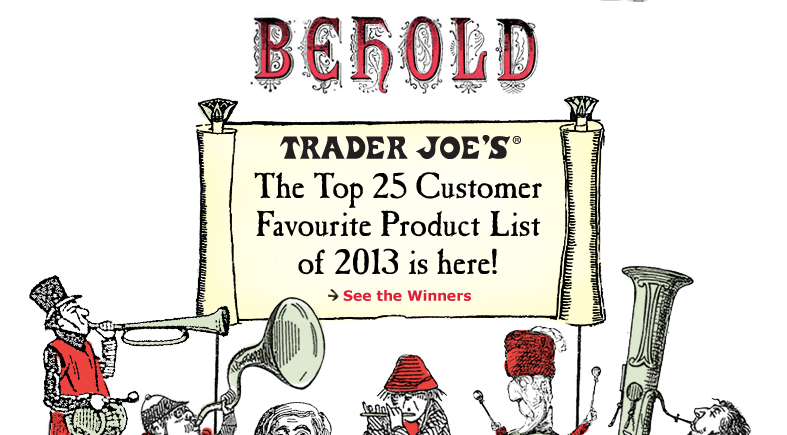
The indispensable Nancy Friedman forwards an e-mail she just got from the American grocery chain Trader Joe’s:

Screen Shot 2014-01-07 at 9.26.24 AM

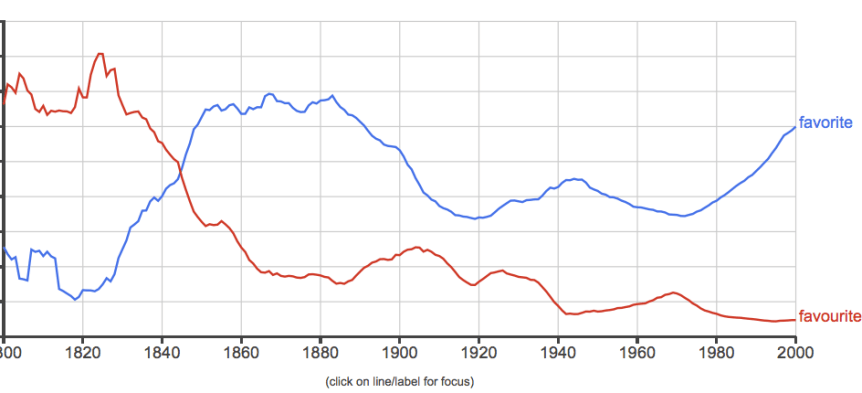
I guess they’re trying to get an old-fashioned feel. And by “old-fashioned” I mean 1842–which was the last time favourite was more common than favorite in American English, according to this Google Ngram Viewer chart:

Screen Shot 2014-01-07 at 9.30.34 AM

“Queue” (verb)

Long ago I wrote a post on queue, meaning what Americans would traditionally call a lineand have returned to the word from time to time. But I have concentrated on the noun form, as I’ve felt that Americans would much more frequently talk about “a queue” than say they “queued up” or “queued.” (I’ll note that I’m specifically talking about a physical line with physical people in it, not the variants of the word in music and computers, in which queue has particular meanings that are found on both sides of the Atlantic.)

Even in Britain, the noun came first, with an 1839 citation (from Thomas Carlyle) compared to this 1920 Times advert for the verb:  “Taxi-Cabs queued up for their supplies of ‘Shell.’” The first up-less verb queue isn’t until a 1978 quote from a Dick Francis novel: “We are damned lucky to have been given the few weeks’ option. They’ve got other buyers practically queueing for it.”

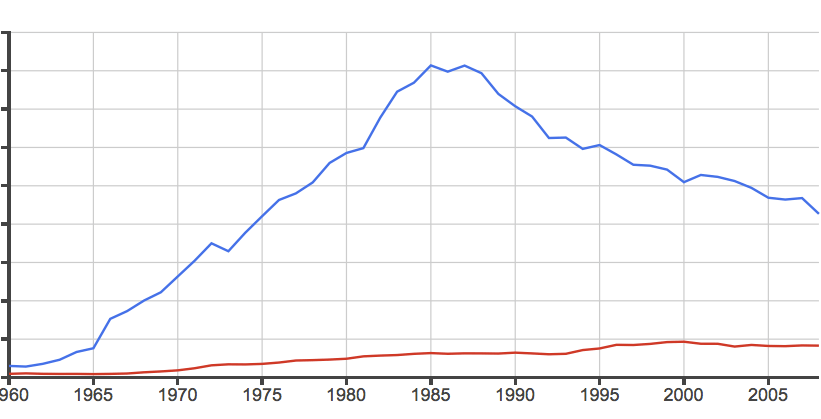
Francis chooses one of the two variants for the gerund, the other being queuing. They have duked it out over the years, with the streamlined form surging ahead since the 1990s, according to Google Ngram Viewer chart of British usage since 1930:

Screen Shot 2014-01-05 at 10.29.23 AM

At this point, American queue (noun) is quite common, one reason being that line has so many meanings that it’s not always clear which one is intended. Queue up has developed a strong presence as well, for the same reason. Yesterday this was in the Los Angeles Times–“The union hall closest to Boeing Co.‘s biggest manufacturing operation swarmed with activity Friday afternoon, as hundreds of machinist union members queued up to vote on the aerospace giant’s latest contract”–and this in the Kansas City Star: “Chappell is the first, but a few others are queued up to receive the implant, including one surgery planned for next month.”

But the up-less verb form is much less common, similar to how Americans will ring someone up, but rarely just “ring” someone. It is making inroads, however, and what a surprise that evidence should come from what could be considered the very epicenter of hipness, a Whole Foods store in San Francisco. Nancy Friedman sends in this photographic proof:

Whole Foods queue

And what a surprise: they stuck in that second “e.”

“Roll-neck sweater”

Reader Jeanne Nelson comments, simply:

“From the New York Times, 12 December 2103:

“But if Mr. [Colin] Wilson was no Angry Young Man, with his lush Romantic hair and roll-neck sweaters he more than looked the part.”

I gather she is suggesting as a NOOB roll-neck sweater,  a phrase with which I’m not really familiar, though having read it I get the idea.The Oxford English Dictionart defines roll-neck as “A high loosely turned-over collar on a garment; a garment which has such a collar.” The first citation (from 1897) is from the Washington Post, but everything after 1950 is from Great Britain, including this from a 1977 “Time Out” advert: “Former male model—but more the jeans and rollneck type.”

The New York Times obituary of Colin Wilson helpfully provides this cozy photo of the author in roll-neck, with his wife, Joy:

WILSON-2-obit-web-popup

I am familiar with “turtle-neck,” which the OED defines identifies as “orig.” American and defines as: “A close-fitting roll or band collar, now usu. one intermediate in height between a crew-neck and a polo-neck.” The first citation is an 1895 Montgomery Ward Catalog:  “The Turtle Neck Shirt or Sweater, double from waist up, one of the most desirable garments ever invented for cold-weather shooting.” Two years later, 15-year-old Franklin Delano Roosevelt writes home from Groton School:  “I should very much like a red turtle neck sweater for skating and coasting.”

P.G. Wodehouse, who spent many years in the U.S., may have carried the term to Britain, writing in 1946, “He dresses like a tramp-cyclist, affecting turtle-neck sweaters and grey flannel bags.”

The New York Times has used the expression “roll-neck” or “rollneck” (the hyphen comes and goes) about fifty times in its history, including this from a fashion piece in 2009: “Remember when the cast of ‘Dawson’s Creek’ modeled in the J. Crew catalog and suddenly everyone was wearing those rollneck sweaters?”

By contrast, “turtle neck” or “turtleneck” have appeared some 4,000 times, including this sentence, just a couple of weeks ago, from an interview with Will Ferrell’s anchorman character, Ron Burgundy: “Dapper in a glen plaid polyester suit, brown ribbed turtleneck and dark-green leather jacket, Mr. Burgundy strode into the store, stopping to hold aloft some merchandise.”

Here’s the Times’ photo of Burgundy:

01ANCHORMAN-articleLarge

To me, this looks awfully close to Colin Wilson’s roll-neck. My sense is that originally, turtleneck referred to collars that were folded-over snugly and more or less low, and roll-neck to those that were folded over loosely and more or less high. I sense, further, that in the U.S., that roll-neck is a subset of the larger category turtleneck, and that roll-neck is in fairly wide use in the U.K., but is common in the U.S. only in fashion circles.

But I await the judgment of those who know better.


“Purpose-built”

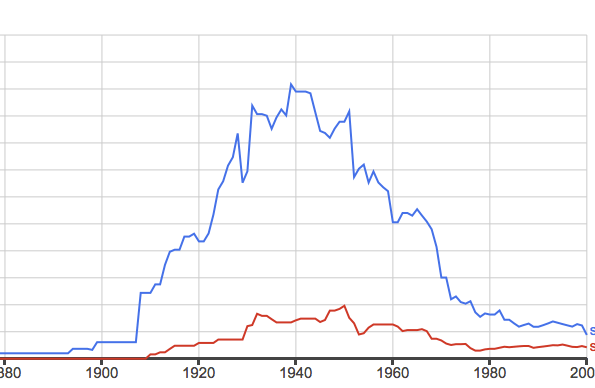
When Jan Freeman noted on Twitter that she had heard an NPR correspondent use purpose-built, I was momentarily befuddled. Not only did I not know the phrase was a Britishism, I also kind of didn’t know what it meant. Merriam-Webster informed me that the phrase is an adjective meaning “designed and built for a particular use,” adding “chiefly British.” A Google Ngram chart confirmed this, and also that American use is on the rise. (The blue line represents British use, the red line American.)

Screen Shot 2013-12-05 at 10.00.14 AM

The New York Times has used purpose-built about 300 times in its history, first in 1929 in a reference to “purpose-built taxicabs.” But things have picked up lately: there have been 49 purpose-builts in the Times in 2012 and 2013 alone. Most of them, interestingly, refer to cars or some car-related things, as in the most recent reference, on November 15, 2013: “After an absence of half a decade from the United States, Formula One returned last year with a Grand Prix at the first purpose-built circuit in the country.” But art critic Michael Kimmelman this year described a Tuscan vineyard as “purpose-built nature  on a very large scale” and columnist Paul Krugman, a serial NOOBer, argued against gerrymandering, writing, “Let’s stop allowing the parties to pick their voters (and put them into purpose-built districts).”

I’m still a little befuddled by purpose-built. One commenter on the Merriam-Webster definition (and since when have definitions had commenters?) said the phrase was frequently superfluous, noting, “One uses ‘purpose-built’ as an adjective to differentiate between items that were built for a reason and items that were built for no reason at all”–the implication being that very few things are built for no reason at all. (Another commenter noted, “Marketing buzzward.” I like the way they think, though not necessarily their spelling.)

But on reflection, and on examination of the Times items above, I can see that the phrase is occasionally useful and apt, especially when you consider the alternative. That’s right, I’m talking about bespoke.

“Keep Calm and…”: A slideshow of a meme

This slideshow requires JavaScript.

(Note: To start the slideshow, click the image at left or the words “Continue reading,” below. If it moves too fast, you can click the “pause” button at the bottom and advance it one slide at a time with the right-facing arrow.)

If by some chance all this excites you, you can create your own “Keep Calm and” online poster at keepcalmandposters.com or keepcalm-o-matic.co.uk. Both sites let you order actual paper versions of your work; at keep-calm-o-matic, you can also get a t-shirt, a mug, a keychain, or an iPhone 5 case.

At this point, “Keep Calm and” is everywhere. It cannot be escaped. That is all. Carry on.

“Rump”

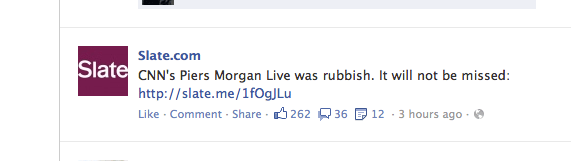
Joshua Keating’s recent Slate article had a brilliant conceit: how would the U.S. media report on the current U.S. political crisis if it were happening in another country? The piece started:

WASHINGTON, United States—The typical signs of state failure aren’t evident on the streets of this sleepy capital city. Beret-wearing colonels have not yet taken to the airwaves to declare martial law. Money-changers are not yet buying stacks of useless greenbacks on the street.

I recommend you read the whole thing, but the line that’s relevant to this blog is: “…the president’s efforts to govern domestically have been stymied in the legislature by an extremist rump faction of the main opposition party.”

The Oxford English Dictionary’s defines rump (in this context) as “A small, unimportant, or contemptible remnant or remainder of an (official) body of people, esp. a parliament,” and explains that it’s derived from rump Parliament, that is, “the remaining part of the Long Parliament, esp. in its second formation of 1659–60.” As befitting its origin, every citation for rump in the political sense is of British origin.

But it has occasionally been hauled out by Americans. One of the first to use it to refer to the Republican Tea Partyers who have been holding things up in the current mess was Senate Majority Leader Harry Reid (a Democrat). He was quoted as saying on Sept. 27, “The middle class, working men and women in this country, are the ones we were elected to serve. That’s who we should be thinking about. They’re the ones who are going to pay the price if these rump Republicans force a government shutdown.”

A few days later, Mother Jones magazine wrote, “Once again, a rump group of Republican radicals in the House are throwing the US government into chaos.” The day after that, a Baltimore Sun columnist opined, “fault for the current government shutdown lies with the rump, radicalized, tea party-beholden congressional Republicans who have no regard for the legislative process, the country’s credit rating, political traditions, or the U.S. Constitution they supposedly revere.”

Haven’t seen any beret-wearing colonels on the streets of Washington yet, but give it time.

TGIF

Founder Alan Stillman in front of the original TGI Friday's in New York City.
Founder Alan Stillman in front of the original TGI Friday’s in New York City.

Reader Rosalind Mitchell commented on the recent ta-ta post that the 1940s radio serial “ITMA” (or, “It’s that Man Again”) “also gave us TGIF (‘Thank Goodness It’s Friday’), and since this is now a US-based global restaurant chain this is surely also a NOOB.”

That intrigued me, as how could it not?

The initialism is best known, at least to me, from the restaurant chain mentioned by Ms. Mitchell, which is officially known as “TGI Friday’s” and sometimes called merely as “Friday’s.” Wikipedia reports that in 1965, a young New Yorker named Alan Stillman “purchased a bar he often visited, The Good Tavern at the corner of 63rd Street and First Avenue, and renamed it T.G.I. Friday’s after the expression “Thank God! It’s Friday!” from his years at Bucknell University.” (There are now about 920 restaurants in the chain, around the world.)

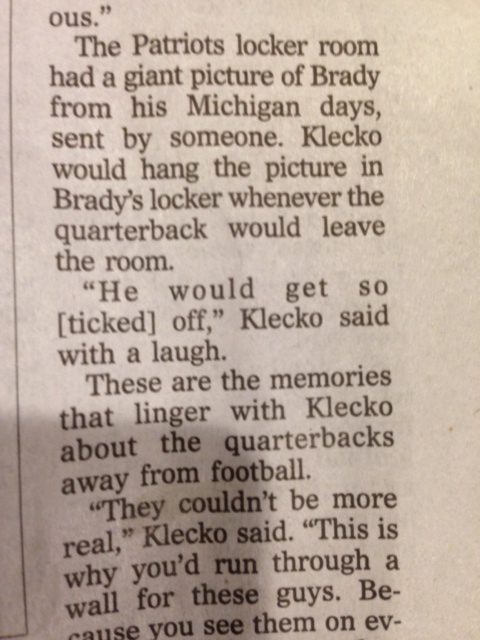
The first time TGIF appeared in the New York Times was in a 1959 article about the U.S. Air Force missile- and rocket-testing site in Cocoa Beach, Florida, which had this sidebar:

Screen Shot 2013-09-26 at 10.31.51 AM

Then came Stillman’s popular joint–one of the first of the “singles bars” on Manhattan’s Upper East Side. The next time the initials appeared in the Times was in a 1969 cartoon (and I’m still not sure how this happened, given that the newspaper is famous for not publishing cartoons). The spot, by Henry Martin, shows Robinson Crusoe spotting a native through some bushes. The inevitable caption: “TGIF!”

A Times reader wrote in to say he wasn’t familiar with the expression, and an editors’ note defined it and explained it was a favorite of–get this–the “Now Generation.” That occasioned a slew of other letters purporting to explain that “TGIF” was much older. One asserted that TGIF went back “at least 30 years–when I first started working in an office, and every stenographer and file clerk intoned those magic initials on Friday afternoons, while combing her hair in the ladies’ room.” Another claimed the initialism was invented by one Richard Amper during a “beer bout” near the University of Missouri in 1934.

It’s hard to verify those claims. But Jonathon Green’s authoritative Encyclopedia of Slang provides an authoritative 1941 quote, from the [Marion, Ohio] Star:

I thought I’d heard of everything in the way of booster clubs, alumni organization and the like, but this city, home of the Ohio State university Buckeyes […] has come up with one that tops them all. It’s the “Thank God It’s Friday” Club, composed entirely of undergraduates here at State. […] A typical meeting of the TGIF club foes something like this….

Now, “ITMA” ran from 1939 to 1949, and it’s possible that someone on the show uttered TGIF before the Ohio State club adopted it, but I’m dubious. For now, I’m going to label TGIF not only not a Not One-Off Britishism, but not a Britishism at all.