
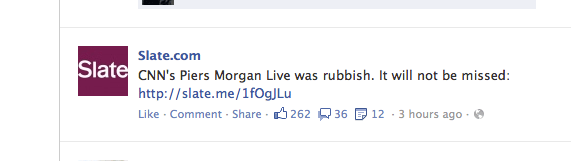
(That is, the person who wrote Slate’s Facebook feed did a nice job of pointedly using the Britishism rubbish in reference to the British Piers Morgan [whose chat show was just cancelled by CNN.])

A few years back, a friend of mine was watching a horror movie with his precocious ten-year-old son. A couple of characters were out rowing on a lake, and then there was some sort of horrible sound. My friend’s son turned to him and whispered, “Hmmm. Implied off-screen suicide.”
That came to mind the other day when I read a Philadelphia Inquirer article in which Brett Brown, the coach of the 76ers basketball team, made some comments about a young player, Nerlens Noel:

It was clear to me that Brown used the words tick and ticking, and the reporter supplied the American equivalent, check, in brackets. The backstory is that while Brown is a native American, he spent many years playing and coaching in Australia, which is presumably where he learned about ticking boxes.
Coincidentally, just a couple of days later, this appeared in the very same Inquirer:
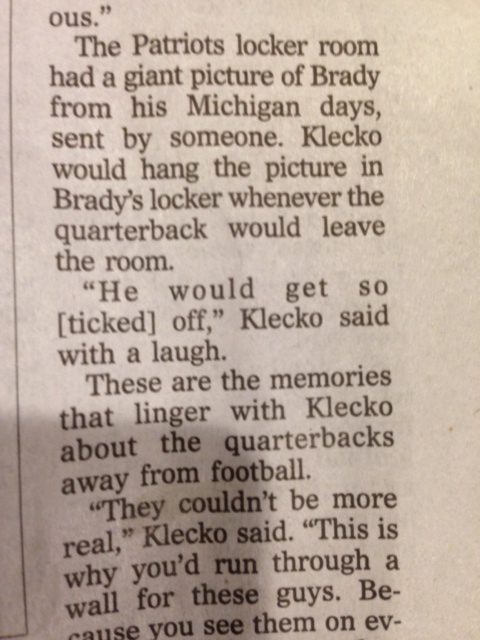
I would bet dollars to donuts that the word Dan Klecko used to refer to Tom Brady was pissed, which, of course, means something very different in the U.K.
When I started Not One-Off Britishisms, nearly three years ago, it was a sort of experiment. In retrospect, I see that I was testing the commonly voiced proposition that the best blogs tend to be about the narrowest topics.
Well, narrow I have been. And while I won’t make any judgments about “best,” NOOBs recently passed the 750,000 page view mark, which is not nothing. (273,894 have come from the U.S. and 257,247 from the U.K.) Beyond the numbers, it’s been greatly rewarding for me. I’ve been able to explore a fun hobby and add infinitesimally to the fount of knowledge, all while never (knowingly) harming anybody. Best of all for me have been the comments, which continually delight and instruct. There are too many examples to name, but just in the past week, in the discussion of Titbits, I learned about the venerable magazine of that name and even heard from someone who’d worked as an editor there in its last days.
In this general air of self-congratulation, I thought I’d pass along some statistics, To start with comments, there have been 3,981 of them, and the most prolific recent commenters are:
Thanks, mates.
The most commented entry has been “Arse” with 99 of them, followed by:
European Date Format is the most-read single post, followed by
All that must mean something, but for the life of my I can’t think of what it is. Anyway, thanks again for stopping by. Talk to you again when we reach a million.
The indispensable Nancy Friedman forwards an e-mail she just got from the American grocery chain Trader Joe’s:
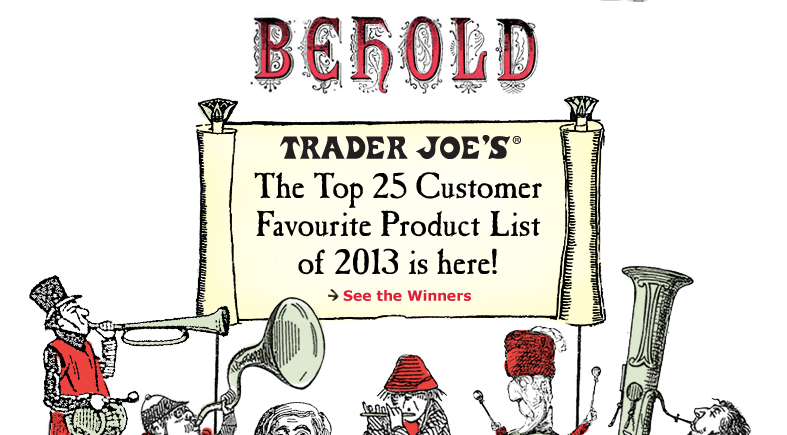
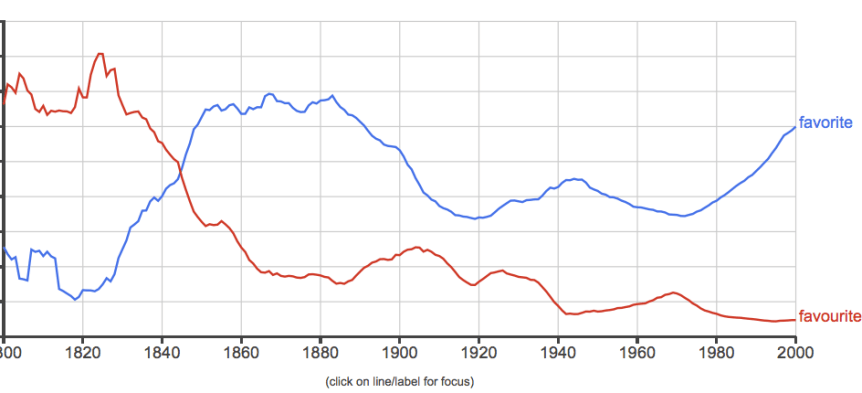
I guess they’re trying to get an old-fashioned feel. And by “old-fashioned” I mean 1842–which was the last time favourite was more common than favorite in American English, according to this Google Ngram Viewer chart:
Long ago I wrote a post on queue, meaning what Americans would traditionally call a line, and have returned to the word from time to time. But I have concentrated on the noun form, as I’ve felt that Americans would much more frequently talk about “a queue” than say they “queued up” or “queued.” (I’ll note that I’m specifically talking about a physical line with physical people in it, not the variants of the word in music and computers, in which queue has particular meanings that are found on both sides of the Atlantic.)
Even in Britain, the noun came first, with an 1839 citation (from Thomas Carlyle) compared to this 1920 Times advert for the verb: “Taxi-Cabs queued up for their supplies of ‘Shell.’” The first up-less verb queue isn’t until a 1978 quote from a Dick Francis novel: “We are damned lucky to have been given the few weeks’ option. They’ve got other buyers practically queueing for it.”
Francis chooses one of the two variants for the gerund, the other being queuing. They have duked it out over the years, with the streamlined form surging ahead since the 1990s, according to Google Ngram Viewer chart of British usage since 1930:
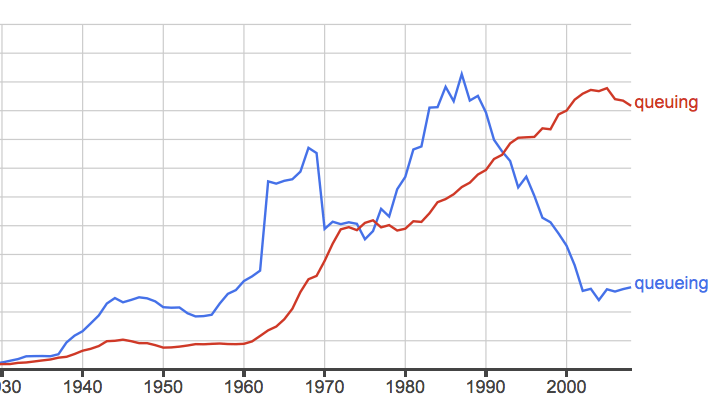
At this point, American queue (noun) is quite common, one reason being that line has so many meanings that it’s not always clear which one is intended. Queue up has developed a strong presence as well, for the same reason. Yesterday this was in the Los Angeles Times–“The union hall closest to Boeing Co.‘s biggest manufacturing operation swarmed with activity Friday afternoon, as hundreds of machinist union members queued up to vote on the aerospace giant’s latest contract”–and this in the Kansas City Star: “Chappell is the first, but a few others are queued up to receive the implant, including one surgery planned for next month.”
But the up-less verb form is much less common, similar to how Americans will ring someone up, but rarely just “ring” someone. It is making inroads, however, and what a surprise that evidence should come from what could be considered the very epicenter of hipness, a Whole Foods store in San Francisco. Nancy Friedman sends in this photographic proof:

And what a surprise: they stuck in that second “e.”
Reader Jeanne Nelson comments, simply:
“From the New York Times, 12 December 2103:
“But if Mr. [Colin] Wilson was no Angry Young Man, with his lush Romantic hair and roll-neck sweaters he more than looked the part.”
I gather she is suggesting as a NOOB roll-neck sweater, a phrase with which I’m not really familiar, though having read it I get the idea.The Oxford English Dictionart defines roll-neck as “A high loosely turned-over collar on a garment; a garment which has such a collar.” The first citation (from 1897) is from the Washington Post, but everything after 1950 is from Great Britain, including this from a 1977 “Time Out” advert: “Former male model—but more the jeans and rollneck type.”
The New York Times obituary of Colin Wilson helpfully provides this cozy photo of the author in roll-neck, with his wife, Joy:

I am familiar with “turtle-neck,” which the OED defines identifies as “orig.” American and defines as: “A close-fitting roll or band collar, now usu. one intermediate in height between a crew-neck and a polo-neck.” The first citation is an 1895 Montgomery Ward Catalog: “The Turtle Neck Shirt or Sweater, double from waist up, one of the most desirable garments ever invented for cold-weather shooting.” Two years later, 15-year-old Franklin Delano Roosevelt writes home from Groton School: “I should very much like a red turtle neck sweater for skating and coasting.”
P.G. Wodehouse, who spent many years in the U.S., may have carried the term to Britain, writing in 1946, “He dresses like a tramp-cyclist, affecting turtle-neck sweaters and grey flannel bags.”
The New York Times has used the expression “roll-neck” or “rollneck” (the hyphen comes and goes) about fifty times in its history, including this from a fashion piece in 2009: “Remember when the cast of ‘Dawson’s Creek’ modeled in the J. Crew catalog and suddenly everyone was wearing those rollneck sweaters?”
By contrast, “turtle neck” or “turtleneck” have appeared some 4,000 times, including this sentence, just a couple of weeks ago, from an interview with Will Ferrell’s anchorman character, Ron Burgundy: “Dapper in a glen plaid polyester suit, brown ribbed turtleneck and dark-green leather jacket, Mr. Burgundy strode into the store, stopping to hold aloft some merchandise.”
Here’s the Times’ photo of Burgundy:

To me, this looks awfully close to Colin Wilson’s roll-neck. My sense is that originally, turtleneck referred to collars that were folded-over snugly and more or less low, and roll-neck to those that were folded over loosely and more or less high. I sense, further, that in the U.S., that roll-neck is a subset of the larger category turtleneck, and that roll-neck is in fairly wide use in the U.K., but is common in the U.S. only in fashion circles.
But I await the judgment of those who know better.
When Jan Freeman noted on Twitter that she had heard an NPR correspondent use purpose-built, I was momentarily befuddled. Not only did I not know the phrase was a Britishism, I also kind of didn’t know what it meant. Merriam-Webster informed me that the phrase is an adjective meaning “designed and built for a particular use,” adding “chiefly British.” A Google Ngram chart confirmed this, and also that American use is on the rise. (The blue line represents British use, the red line American.)
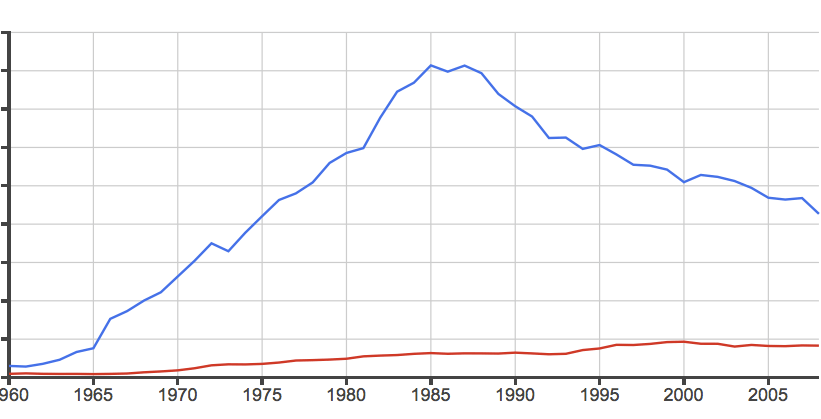
The New York Times has used purpose-built about 300 times in its history, first in 1929 in a reference to “purpose-built taxicabs.” But things have picked up lately: there have been 49 purpose-builts in the Times in 2012 and 2013 alone. Most of them, interestingly, refer to cars or some car-related things, as in the most recent reference, on November 15, 2013: “After an absence of half a decade from the United States, returned last year with a Grand Prix at the first purpose-built circuit in the country.” But art critic Michael Kimmelman this year described a Tuscan vineyard as “purpose-built nature on a very large scale” and columnist Paul Krugman, a serial NOOBer, argued against gerrymandering, writing, “Let’s stop allowing the parties to pick their voters (and put them into purpose-built districts).”
I’m still a little befuddled by purpose-built. One commenter on the Merriam-Webster definition (and since when have definitions had commenters?) said the phrase was frequently superfluous, noting, “One uses ‘purpose-built’ as an adjective to differentiate between items that were built for a reason and items that were built for no reason at all”–the implication being that very few things are built for no reason at all. (Another commenter noted, “Marketing buzzward.” I like the way they think, though not necessarily their spelling.)
But on reflection, and on examination of the Times items above, I can see that the phrase is occasionally useful and apt, especially when you consider the alternative. That’s right, I’m talking about bespoke.
(Note: To start the slideshow, click the image at left or the words “Continue reading,” below. If it moves too fast, you can click the “pause” button at the bottom and advance it one slide at a time with the right-facing arrow.)
If by some chance all this excites you, you can create your own “Keep Calm and” online poster at keepcalmandposters.com or keepcalm-o-matic.co.uk. Both sites let you order actual paper versions of your work; at keep-calm-o-matic, you can also get a t-shirt, a mug, a keychain, or an iPhone 5 case.
At this point, “Keep Calm and” is everywhere. It cannot be escaped. That is all. Carry on.
 notoneoffbritishisms.com