
Nancy Friedman wonders, “Is Facebook trying to make ‘advert‘ happen?” and sends along this screenshot.

My answer to her question would have to be:


Nancy Friedman wonders, “Is Facebook trying to make ‘advert‘ happen?” and sends along this screenshot.
My answer to her question would have to be:
I just read Emma Donoghue’s excellent novel Room–the film version of which is up for a slew of Academy Awards Sunday night. The book’s about a five-year-old named Jack, whose entire life has taken place in an 11-by-11 foot room, where he is confined with his mother. (That situation becomes apparent in the first few pages of the book, so this is not a spoiler.)
Before starting the book and even as I was reading the early pages, I had the feeling that it took place in a completely unspecified location — or, if anywhere, somewhere in Britain, where I had the sense Donoghue lives. It turned out I was wrong on that last point — she is a native of Ireland now based in Canada. And as I read on in Room, I found I was wrong on the first point, too: We eventually learn that Jack and Ma and Room are in the United States.
I was gobsmacked to learn it, because Jack and Ma both talk like they’ve spent their whole lives hard by the North Sea. I’m reasonably certain that wasn’t intentional on Donoghue’s part. She and/or her editors have scrubbed away most of the obvious Britishisms. Jack says elevator instead of lift, trash instead of rubbish, sweater instead of jumper. Spelling-wise, it’s favorite instead of favourite and program instead of programme
But when it comes to the subtle things that separate the two varieties of English, Jack and Ma almost always come down on the British side. Consider:
An important moment in the book, referred to frequently later on, happens when Ma points to Jack’s reflection in Mirror and says,
“The dead spit of me.”
“Why I’m your dead spit?”…
“It just means you look like me. I guess because you’re made of me, like my spit is.”
When I encountered it, I thought “dead spit” was a bit of poetic invention. But I looked it up and it turns out it’s a common British expression for what Americans call “spit and image” or “spitting image.”
I don’t blame Donoghue for all of this. Only someone as neurotically obsessed with the differences between American and British English as I am would be expected to be aware of the trans-Atlantic register of every word or phrase. But the personnel who see a manuscript to publication are expected to attend to such matters. And Donoghue’s editors let her down.
[Note: a version of this article previously appeared in the Chronicle of Higher Education’s Lingua Franca blog.]
Below is a portion of a photo that appeared in today’s New York Times, taken at the Westminster Kennel Club Dog Show, in New York.

My eye was immediately drawn to the sign saying “DOGS ON LEAD ONLY.” I only became aware of the expression “on lead” during a trip to England two years ago, when I encountered it as the equivalent to what Americans would call “on a leash.” My guess is that it’s been used in American dog circles for a long time; I’m sure readers can fill me in on that score.
You may have caught this Budweiser ad during the Super Bowl. Dame Helen Mirren sits before a burger, is served a Bud (not bloody likely), and counsels, in strong language, against driving drunk. Anyone who does so, she avers, is a “shortsighted, utterly useless, oxygen-wasting human form of pollution.” Then, at about the 41-second mark, she says, “Don’t be a pillock.”
My guess is that somewhere north of 99 percent of the people who saw the spot had no idea what a pillock is — though they could clearly tell by context clues that it isn’t a good thing. I certainly wasn’t familiar with the term and went straight to the Oxford English Dictionary, whose first definition is: “orig. Sc[ottish]. The penis. Now Eng. regional (north.) and rare.” The copywriter for the Mirren commercial was clearly going for definition No. 2, which is “Chiefly Brit. colloq. (mildly derogatory). A stupid person; a fool, an idiot.” The first OED citation for the figurative use is from 1967, the most recent from a rugby magazine in 2004: “Those mindless pillocks in New Zealand who slated England for the way they played in Wellington in June.”
Pillock may have rung a faint bell in the minds of English majors. It is likely a shortening of another word for penis that turns up in King Lear. Edgar, in his guise as the mad beggar Poor Tom, pipes up at one point with a line from a perverse ditty: “Pillicock sat on Pillicock hill. La, la, la, la!” (Use your imagination for the meaning of “Pillicock hill.”)
Salty British insults seem to be in the air at the moment. Returning from Australia, I caught up on some Simpsons that had piled up in my absence. In “The Girl Code,” which aired January 3, Lisa creates an avatar with a British accent (voiced by Stephen Merchant), who ultimately comes to life and, à la Mirren, delivers some hard truths, including: “Your species is on the precipice of turning into complete and utter wankers.” Wanker, of course, is an epithet whose literal meaning is habitual masturbator. One hears and reads it occasionally from Americans, who do not seem to be aware that it’s considered a fairly coarse term in the U.K., certainly more so than pillock. Indeed, a British website that provides transcripts of Simpsons episodes could not bring itself to print the word, rendering it “w*nk*rs.”
Yet another British derogatory term attracted attention in January, when — after a petition advocating banning Donald Trump from the United Kingdom attracted some 600,000 signatures — the House of Commons actually considered the question. They ended up not taking a vote, but in the course of debate, MP Victoria Atkins said Trump was a “wazzock.” Surprisingly, wazzock seems never to have meant penis. It sprang up as slang in the North of England in the 1970s as an all-purpose insult. If you would like to learn quite a bit about its origin and use, listen to this Lexicon Valley podcast with Ben Zimmer.
It has been little remarked that Trump’s name itself is a British term for a bodily function. An American friend of mine with British relatives emailed me, “When I was in England over the holidays, my 6-year-old grandnephew said, ‘I trumped!’
“The adults from America wondered why no one at home had pointed out that our leading Republican candidate’s name means to fart.“
In the U.K., “brilliant” has many meanings, of which my favorite displays a sort of free-floating irony.
“I’m going to see ‘The Revenant.'”
“Brilliant.”
The travel-resource application TripIt has a nice use of the word in its upgrade protocol (seen in the screenshot below). Sometime in the mists of time, it was established that, in anything having to do with computers, you click the word “OK” to indicate comprehension or agreement or just “go to the next screen.” TripIt has come up with an alternative to “OK.” Brilliant.

The blog has previously covered “kit,” meaning equipment or gear, often used in the phrase “piece of kit.” A variation that seems to be gaining popularity in the U.S. is “kitted out,” more or less meaning “equipped” or “decked out,”sometimes with the implication that the decking is excessive. Thus this from the New York Times:
A 23,500-square-foot behemoth at the corner of Sunset and Vine, the store is kitted out to the point of preposterousness with, among other things, a sushi bar, a supermarket, a florist, a warren of frozen-yogurt kiosks and a sidewalk cafe.
And Vanity Fair (0n a mock documentary on Donald Trump):
The 50-minute film, supposedly unearthed at a yard sale by Ron Howard, is kitted out perfectly as a 1980s relic, with a VHS hiss in the background and even an original theme song written by Kenny Loggins.
And the Times again, on the London antiquarian bookshop Heywood Hill:
Requests are as varied as the world of books is wide. [Manager Nicky] Dunne has kitted out a hotel, at least one cruise ship and a fleet of private jets.
In my world, three qualifies as a trend-let.
(By the way, some readers have expressed irritation that I refer to the New York Times as the Times. For the record, I do that only on second reference, and refer to the London newspaper as The Times, with two capital “T”s.)
Former Florida Governor Jeb Bush’s campaign for the Republican nomination for president is ailing, badly. Before yesterday’s Iowa caucuses he could not but acknowledge that he had no chance of finishing near the top. He said of the presumed front-runner, Donald Trump, “It’s all about him and insulting his way to the presidency is the organizing principle.”
Then he said of the other leaders in the polls, Senators Ted Cruz and Marco Rubio: “The two other candidates that are likely to emerge in Iowa are two people that are backbenchers who have never done anything of consequence in their lives.”
Bush has a fondness for the term (an explanation of which you can find by following the above link), having used it in a Republican debate, after a skirmish between Rubio and Cruz: “this last back and forth between two senators–back bench senators, you know–explains why we have the mess in Washington, D.C.”
Unfortunately for Bush, his efforts to dismiss the senators not only as participants in the mess in Washington, but as junior participants, with no experience at actually running anything, doesn’t appear to have much traction. Cruz won the Iowa caucuses with 28 percent and Rubio was a strong third at 23. Bush’s showing? 2.8 percent.
In its first season, the extremely popular American podcast “Serial” released one episode a week. However, in the middle of the second season, currently under way, the producers have changed to a once-every-two-weeks schedule. But what should they call it?
There were two obvious options, the American “biweekly” and the British “fortnightly,” a word that had heretofore been confined on these shores mainly to coverage of Grand Slam tennis tournaments. Serial decided to ask the public to choose, via a Twitter poll. If “fortnightly” were to win, it would truly be a red-letter day for Not One-Off Britishisms.
The final tally was close indeed.

“Fortnightly,” as the saying goes, will have to wait till next year.
Astute reader John Wall points to a sentence in today’s New York Times: “The Guardian said on Monday that it intended to cut its costs sharply in an effort to reduce its losses and break even at an operating level in three years’ time.”
He notes, “I think of the phrase with ‘time’ preceded by the possessive form of a measure of time as a very British expression, as in ‘two hours’ time’ or, in this case ‘three years’ time.’ … A native USA speaker/writer of English would, I think, write ‘in three years,’ without the possessive apostrophe or the word ‘time.'”
I was not aware of the Britishness of the formulation, but John is correct, according to this Google Ngrams Viewer graph showing the relative frequency of the phrase “years time” in British and U.S. sources. (Ngram viewer doesn’t recognize apostrophes, so I left it out; and I didn’t include the number of years, so as to include a wider range of citations.)
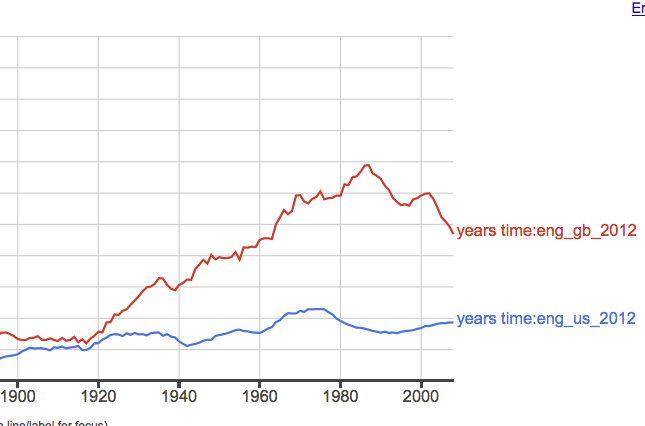
Like a number of other NOOBs, “___ years’ time” wasn’t especially British until fairly recently–in this case, the 1920s. It steadily increased in popularity till the late 1980s–the moment when the modest American revival commenced.
As the end of the year approaches, it’s a good time to thank readers, commentators, and tipsters for another good one. Statistically speaking, 197,444 people visited the blog in 2015, leaving 768 comments. Counting this one, I filed 52 posts–an even one a week. The most-viewed posts were the usual golden oldies: number one was European Date Format, followed by “Mewling quim,” “xx,” “ta-ta,” and “easy peasy.”
Right after the New Year, I am off to Melbourne for a month, where I will be teaching a group of University of Delaware students, soaking up the sunshine, and–not last–on the lookout for not one-off Australianisms.
I’ll be reporting in this space on what I find. Until then, have the merriest of happies.
 notoneoffbritishisms.com