Anthimeria (also known as “functional shifting”) is a linguistics term that refers to a word being used as an unaccustomed part of speech. It happens a lot, as when people started to say, “I’m going for a run,” or the first advert(isement) that proclaimed something like “Welcome to extraordinary!”
Two NOOB-y examples recently popped up. My friend Hillard Pouncy sent me this quote from Josh Marshall at the Talking Points Memo blog: “We start with a piece in this morning’s Punchbowl which is simultaneously encouraging and gobsmack disheartening.” That is, he is using “gobsmack” as an adverb. I’ve searched around a bit and, having found no other examples, conclude that this is a one-off. Hopefully it will stay that way.
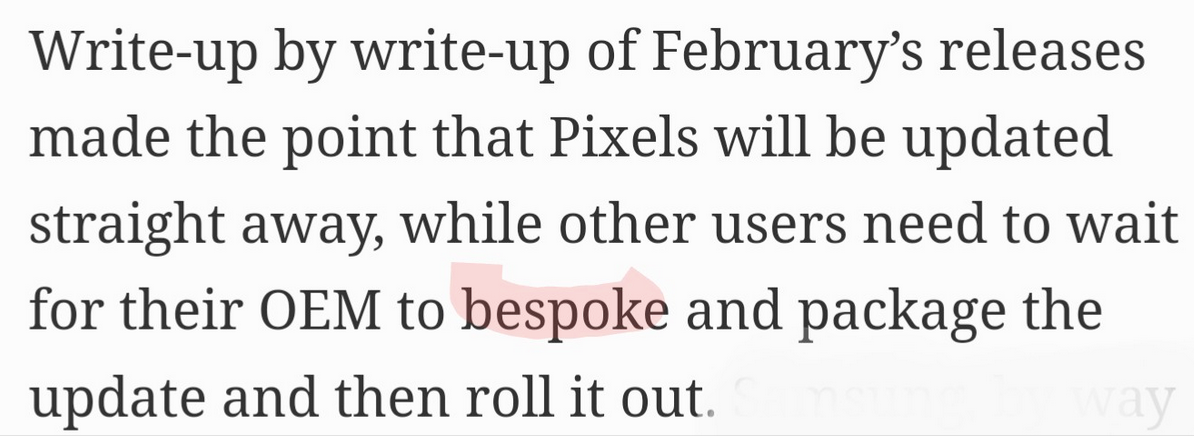
Next is a quote that NOOBs-friend Mike Pope posted on Facebook (he didn’t name the source, but “straight away” suggests the writer is British):
That is. “bespoke” as a verb meaning, as one commenter on Mike’s post pointed out, “tailor.” (That of course is itself an anthimeria, albeit a venerable one; the OED reports that “tailor” was used as a noun by 1297, and a verb by 1662,)
The OED doesn’t recognize “bespoke” as a verb but it’s out there. To separate it out from the noun I searched for “bespoked” in Google Books and got a non-negligible number of hits, including:
and
Meaning that this one, alas, appears to be no one-off.
Longtime reader David Ballard emailed yesterday to alert me to a sentence he read in the Washington Post:
“….and fired him two years later, after he declared that Trump’s loss in the 2020 election wasn’t down to fraud.”
He was interested in the two-word phrase in italics, which he (correctly) felt was British.
Now, “down to” can mean awfully many things. Merriam-Webster’s online dictionary has trawled the internet and come up with a couple of dozen examples, of which this is a selection:
–Then, scroll down to find the Passkeys section and tap on it. — It’s marked down to just $145 right now—a third of the price of the Dyson Animal. — The game was down to a one-point margin, 70-69 with Iowa in the lead, in the last few seconds of the game. — Lambert joined in on singing the chorus, and the pair rocked along while jumping up and down to the beat. — Today, the plates have slowed back down to their normal speed. — But this one will get the temp down to 64 degrees at its coolest setting. — But now that things were down to the wire, Bowser’s team returned to Lee’s staff to try once again. — Chaz is a friend, and Jimmy is always down to help out his friends. — The man then kneels down to allow the older dog to get a closer look at the puppy. — Their third choice receives eight points, fourth choice seven points — and so on, all the way down to one. — One day Botting headed down to the quarry to search for more sponges. — Joshua Estrada had a sack on fourth down to frustrate the Pirates.
That doesn’t even include a least a couple of other uses. One I think of in connection with the 1974 Joni Mitchell song “Down to You,” which has these lyrics:
Lost or changing as the days come down to you Down to you Constant stranger You’re a kind person You’re a cold person too It’s down to you.
Then there’s the idiom in a sentence like, “I put his mistake down to carelessness”–that is, meaning “attribute.”
I think the British expression actually came from that. The OED lists two closely related meanings, and has only British citations for both. The first is defined as “to be attributable to” and the first quote is from The Times in 1955: “Wattam said: ‘It’s down to me, the stamps and postal orders belong to me. They are nothing to do with the wife. I’ve done all the jobs.’” The second means “To be the responsibility of” and seems to have originated in police jargon; the first citation is from a 1970 study of Scotland Yard. This 1986 quote is from City Limits: “The clothes are by Jean-Paul Gaultier, the basslines are by Blackmon, and the dancing is down to you.”
Besides the Washington Post quote, Merriam-Webster provides these examples from American publications, though I can’t vouch for the nationality of the authors:
“This is all down to memory-bandwidth limitations on the Nvidia cards, due to their 128-bit interface. ” PCMAG, 25 Jan. 2025
“The reason for such fulsome praise is down to the warm but detailed sound that the GO link produces.” Travel+Leisure, July 2024
Is it not still the case that Americans say “in the hospital”? Perhaps Post editors could grab a style guide from the boot of their saloon car and have a butcher’s (pronounced: shufti) to confirm how to characterize the location of sick people for an American audience. Correct this usage, and I’ll be right chuffed.
This popped up the other day, as I was buying tickets to see David Doucet perform at Buffa’s in New Orleans.
The NOOB in question is “tick,” where Americans would historically say “check.” (The “should you wish to receive” sounds off as well, perhaps more formal than British. The U.S. norm would be “if you want to…”)
I see that I wrote about “tick” in the very first year of the blog, 2011. I’ve seen it from time to time here over the years, often in the expression “ticks [as opposed to “checks”] all the boxes.”
Some of the commenters on the original post seemed to differ on whether British “tick” and and American “check” indicated the same mark. Some said both meant a single diagonal lower-left-to-upper right line, while others said no, an American checkmark starts with a short diagonal, upper left to lower right, like this:
Back to H.L. Mencken and his book The American Language, he says in Supplement One (1945) that one of the Britishisms “that deserve American adoption” is “‘pub-crawl’ (a tour of saloons).” I’m pretty sure my readers don’t need that definition, so familiar has the phrase become on this side of the Atlantic. But it definitely had British origins.
It sprang from more more specific sorts of alcoholic “crawls.” The OED‘s first citations (Bird o’ Freedom is Australian; the other publications are English):
The familiar modern form first appears in a quote from Thomas Burke’s 1915 book Nights in Town, the quotation marks suggesting recent coinage: “We did a ‘pub-crawl’ in Commercial Road and East India Dock Road.” All subsequent OED citations are British.
Google Ngram Viewer shows modest U.S. use from the 1930s through the ’70s–so modest that many if not most of the hits probably came from British books published in the U.S., travel books about Britian or Australia, or dialogue in novels from the mouths of British speakers. The rise from the ’80s through the present is real, though. (And the decline in Britain post-2000 could reflect awareness of American appropriation.)
The first use I could find in the New York Times by an American came in a 1975 column by the great Russell Baker–who had been a foreign correspondent in London early in his career. He’s talking about the world of different magazines, and says that in Esquire, “Dante Gabriel Rossetti always seems to be jogging with Muhammad Ali while Norman Mailer is on a pub crawl with Vergil.” (Elsewhere, Baker writes, “Not that the world of People isn’t a pretty gosh‐dam wonderful place, too. Life may not be very exhilarating in the world of People, but it is beautiful. There I meet Prince Charles, who has no problems, and Erica Jong, who has fame, beauty and success. And J. Paul Getty, the richest man in the world! I learn that Catherine Deneuve is beautiful and Liza Minnelli is talented and Mikhail Baryshnikov is happy. What a sweet world. It is what the world of F. Scott Fitzgerald would have been if Fitzgerald had been ghostwritten by Dr. Norman Vincent Peale.” Here’s a gift-link to the rest of the pretty gosh-darn wonderful column.)
However, in the 21st century, “pub crawl” has appeared 280 times in the Times, including in an article last year about the (American) football-playing brothers Travis and Jason Kelce, Billy Witz writes that Jason, “who plays for the Philadelphia Eagles, has followed his brother’s team on what has looked like a bare-chested pub crawl through the playoffs.”
And any doubt I might have had that “pub crawl” has achieved “adoption” as well as commercialization in America is removed when I Google it on my phone (which of course knows I live near Philadelphia) and this pops up:
It’s always instructive to look at H.L. Mencken’s The American Language,, which was originally published in 1919 and went through many editions before Mencken released the second and final “Supplement” in 1948. In his chapter “Briticisms in the United States” (I have before me the 1936 edition), he writes, “It is most unusual for an English neologism to be taken up in this country, and when it is, it is only by a small class, mainly made up of conscious Anglomaniacs… To the average red-blooded he-American [the stage Englishman’s] tea-drinking is evidence of racial decay, and so are the cut of his clothes, his broad a, and his occasional use of such highly un-American locutions as jolly, awfully and ripping.”
He mention a number of words that have managed to “seep in” among certain classes, some of which I’ve considered in the past, including “mummy” and “smog“; on the other hand, he says, “wowser” and “wangle” “have never got a foothold.”
Wangle eventually did, though it took some time. Over thee next couple of weeks, I’m going to consider some of the other “Briticisms” mentioned by Mencken that took a while to catch on here, starting with one that will probably surprise you. Mencken writes,
When certain advertisers in New York sought to appeal to snobs by using such Briticisms as swagger and topping in their advertisements, the town wits, led by the watchful Franklin P. Adams …, fell upon them and quickly routed them.
The surprising one, of course, is “swagger,” which is now common enough in the U.S. to have been used 272 times in the New York Times over the past year, including in these headlines:
These are all “swagger” as a noun, deriving from the OED‘s definition 1 a.: “The action of swaggering; external conduct or personal behaviour marked by an air of superiority or defiant or insolent disregard of others.” The dictionary’s citations, all British and all dating from the 18th and 19th centuries, include this from King Solomon’s Mines (1885): “He was an impudent fellow, and..his swagger was outrageous.”
The noun comes from the verb, defined by the OED as: “To behave with an air of superiority, in a blustering, insolent, or defiant manner; now esp. to walk or carry oneself as if among inferiors, with an obtrusively superior or insolent air.” The dictionary has some interesting quotes, starting with Shakespeare’s Midsummer Night’s Dream: “What hempen homespunnes haue we swaggring here, So neere the Cradle of the Fairy Queene?” Then this from Gulliver’s Travels in 1726: “He..became so insolent..that he would always affect to swagger and look big as he passed by me.” And, showing at least some adoption in America, from Washington Irving’s Tales of Traveller (1824): “He took complete possession of the house, swaggering all over it.”
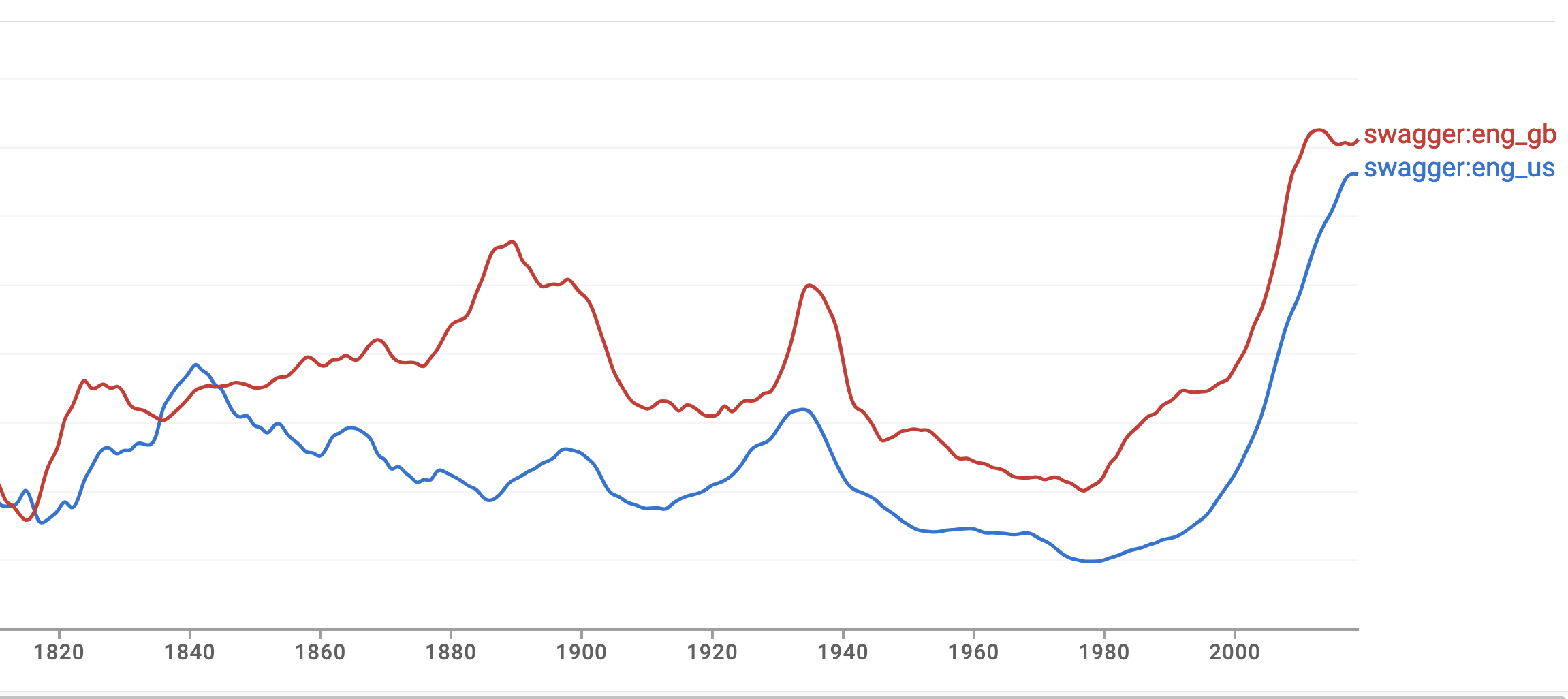
Google Ngram Viewer shows that except for a few years in the 1840s, “swagger” has always been more common in Britain than in the U.S.
The most common current form, I would say, is the shortened form “swag,” an incredibly rich word that has seven separate entries in Green’s Dictionary of Slang–four nouns (including the word for promotional freebies), two adjectives, and one verb. The one that comes from “swagger” has this OED definition: “Bold self-assurance in style or manner; an air of great self-confidence or superiority.” It came out of hip-hop where one of the first uses was in a 2003 Jay-Z song: “My self-esteem went through the roof, man. I got my swag.”
It started when I sent an article from the sports news site New York Times sports site The Athletic to my tennis buddy Don Lessem, who occasionally uncorks an underarm serve. The article was about the top professional Sara Errani, who uses the same dare I say underhanded tactic. Don wrote back: “What’s ‘nous’?”
I was pretty sure he wasn’t misspelling “new,” but otherwise I didn’t know what he was talking about. But when I read the article all the way through, I found this sentence:
“Instead of letting her serve become a complete albatross, Errani has used her ground skills, tactical nous and the shock factor of a serve that regularly registers around 60mph (96.5kph) on the speed gun to reach the very top of tennis in singles and doubles.”
Looking up “nous” in Green’s Dictionary of Slang, I find that it means “instinct or common sense, as opposed to actual learning”; that it rhymes with “mouse”; and that there are more than two dozen citations for it in British and Australian sources, going back to 1704, but only one American one, from an 1878 book.
The explanation for its appearance in the Athletic article is simple. Here’s the bio of the author of the article:
“Charlie Eccleshare is a tennis writer for The Athletic, having previously covered soccer as the Tottenham Hotspur correspondent for five years. He joined in 2019 after five years writing about football and tennis at The Telegraph.” The Telegraph being a British newspaper.
And in fact there are more Britishisms in this one particular piece:
He gives the speed of Errani’s serve as quoted above, and lists Errani’s her as “5ft 5in (164cm).” An American publication would never give the centimeter or kilometers per hour figures. (Eccleshare also leaves out the spaces that normal Times style requires, but that’s too nerdy a topic to get into, even for me.)
He talks about her being “broken to love,” meaning a game in which she was serving but didn’t win a point. I’m not sure, but I think the American version is “broken at love.”
He uses logical punctuation when he quotes someone as saying Errani is “the brain of the team”.
He uses single quotation marks, or inverted commas, when he refers to Errani of being one of the ‘Fab Four’ of Italian women’s tennis.
He uses British spelling when he writes about a player who “practised,” rather than “practiced,” a particular shot.
Now, I don’t really have a problem with any of this. Arguably, it makes the writing more colorful. But it does point to a new and robust conduit for NOOBs. Other than that the Times owns the Athletic and their staffs are separate, I’m not exactly sure of the precise relationship between the two entities, but I got to the Errani piece and all other Athletic articles via the Times home page, and Athletic content is in the searchable Times database.. However, it’s clear that that Athletic pieces aren’t subject to Times style rules or editing. As a result, in the coverage not only of international sports but also of Premier League and European football, the Athletic is poised to be a massive source of NOOBs.
This caught my eye in the New York Times the other day:
That word, “cleaner,” wasn’t familiar–I imagined it meant what Americans would call a cleaning lady, a cleaning person, a custodian, a janitor, basically, something that sounded a bit fancier than what the job really is. “Cleaner” felt British to me, along the lines of “carer,” also not found in the U.S. (We would say “companion,” “care-giver,” or, wordiest yet, “home health aide.”)
I asked Lynne Murphy about it and she confirmed that “cleaner” is widely used in the U.K.–as did the OED, with citations as early as 1816. (“A tribe of cleaners, keepers, and porters.’)
Lynne mentioned a British sitcom called “The Cleaner,” about a someone who tidies up crime scenes, but that’s a special case, similar to (but on the other side of the law from) Harvey Keitel’s character in Pulp Fiction, who as I recall was also referred to as a cleaner.
Incidentally, the IMDB description also calls the “High Potential” character a cleaner, but on Wikipedia she’s a “cleaning woman.”
I’ve seen one other U.S. use of the word, making it barely not a one-off. It was in a TV commercial for a company called Homeaglow, which advertised that for an absurdly low price, it would send a “cleaner” to my home.
I’ve got my ears open for more, but I’m not optimistic, as “cleaner” may be just too straightforward and plain to catch on in America.
My book Gobsmacked: The British Invasion of American of American English–which is of course based on this blog–has gotten a lot of nice attention in the couple of weeks since it’s been out. I plan to do a post with some of the links to articles, reviews, and podcasts soon. But the piece by The Economist‘s “Johnson” columnist–Lane Greene–deserves a post of its own. The title is “Americans Are Chuffed as Chips at British English.” But I’m the one who’s chuffed, especially because it’s being so widely read.
This link will take you to the piece. There’s a paywall but also a free trial subscription offer, plus seemingly you can read it for free if you register. But if you can’t be arsed (or asked) to do that, here it is.
British intellectuals enjoy bewailing the influx of Americanisms into the language of the mother country. The BBC once asked British readers to send in the Americanisms that annoyed them most and was flooded with thousands of entries, including “24/7”, “deplane” and “touch base”. Matthew Engel, a writer who had kicked off the conversation with an article on unwanted Americanisms, even turned the idea into a book, “That’s the Way It Crumbles”, in 2017.
The furore—which Americans would call a furor—seemed to die down. But in September Simon Heffer of the Daily Telegraph revived it with a column and book exploring Americanisms, a trend he situates “in the past 15 years”. His language evokes violence, bemoaning American words’ “poisoning”, “linguistic assault”, “conquest” and “penetration”. In the end, though, even the hyperbolic Mr Heffer concedes that Brits are, in fact, “willingly adopting” these words, especially via two channels associated with America: digital technology and “corporatespeak”. He just wishes his countrymen would stop.
But linguistic exchange can also be seen in a more upbeat way. This is the approach of Ben Yagoda, emeritus professor of English at the University of Delaware, in “Gobsmacked!” The trend is older and more extensive than many think. Mr Yagoda describes Britishisms like “it’s early days” and “gone missing” taking hold in America almost entirely below the radar in the 1980s and 2000s, respectively.
Mr Yagoda identifies the intensifier “awfully” (as in “awfully tired”) as the first Britishism, having been noticed (disapprovingly) by an American commentator in the 19th century. The early 20th century saw many more Britishisms take hold, especially via military contact: “gadget”, “cushy”, “scrounge”, “bonkers”, “dicey” and “shambolic” all made their way from the British Tommy to G.I. Joe, and thence to the wider American public.
The internet has spread English in both directions. Being able to read the Guardian and to binge “The Crown” on Netflix has probably speeded up the passage of British terms into American speech. Mr Yagoda has compiled a “top 40”, including “brilliant” (merely “OK, good”), “chat up” and “ginger”. Each term gets a rating on a five-notch adoption scale, from “outpacing” (signifying Americans now use the term more than its coiners in Britain do) to merely “on the radar”, meaning only a few newspaper columnists are using it.
American Anglophiles tend to be part of a media elite who holiday in Europe (and might even use “holiday” as a verb), whereas American slang is seen as passing to Britain through less rarefied channels. Lynne Murphy, a linguist at the University of Sussex, notes that “Friends”, an American comedy show, is often blamed wrongly for the rise of “Can I get…?” at coffee shops in Britain. In her study of online lists explaining British terms to Americans and vice versa, she found the ones about Britishisms for Americans were often framed positively (for example, “a guide to the best Britishisms”), whereas for Brits Americanisms were more often negative (“41 things the Americans say wrong”).
Which Britishisms tickle American fancies? A few sounds recur, such as adjectives ending in “y”, from “cushy” and “smarmy”—Britishisms but no longer seen as such in America—to more recent ones like “cheeky” and “dodgy”. B- and p-sounds also feature, including in made-up words (“bumbershoot” is not, as some Americans believe, a British word for an umbrella). The Oatmeal, a web comic, summed up how British English sounds to Americans: “I remember my days at Oxford, we’d often dabble in a little rumpy-pumpy before dingbangling a fresh todger, haha!” That hints at another source of Britishisms making their way west: insults and “naughty bits” like “shag” and “wanker”. A spirit of playfulness pervades Americans’ use of these British words; they may even tend to overuse them and underestimate their rudeness, because the sounds are so silly.
It is possible that the British need “Gobsmacked!” more than their American cousins. The Americanisation of British English is well known; the Britishisation of American English, not so much (as a Californian teen might say). A country not sure what influence it still has in the world might like to know that the superpower across the ocean still fancies the mother country and its culture. ■
Nancy Friedman is one of my favorite writers on language, so I was over the moon to read her write-up of my book Gobsmacked!I can’t imagine a better appreciation of what I’ve tried to do with the blog and the book.
Her piece also reminded me that, some months back, Nancy had suggested I write about “pap”–a noun for paparazzi photographers, and a verb for what they do, as in these examples she provided.
“The street looks I papped in Paris” (Blackbird Spyplane, a Substack written by two Oakland, California, residents)
“I met up with my pal of over a decade, Sarah Isenberg, who got papped out the wazoo (what a horrible phrase I’ve just reified) for her extremely cute cotton frock and gingham sailor cap” (Esque, whose author lives in New York)
“I guess Van’s slip-ons are having a moment? Morgan Stewart sporting the checkered pair sent the IG girls into a tizzy, and now Jennifer Lawrence has been papped in a black pair” (The Love List by Jess Graves, “New York by way of Atlanta”)
To give a bit of history, the verb and the noun–“pap” to refer to a paparazzo, which is the singular of paparazzi–both popped up in the U.K. in the early 1990s, according to the OED, which has these early citations for the verb:
“The Queen, it has been said, doesn’t like being ‘papped’ on her own estate… Certain over-zealous royal flunkeys were sounding off about pictures of HM taking her corgis for a walk in the snow at Windsor Castle.” Daily Mirror, 1991
“Night is a good time for ‘papping’ celebrities and I’m often called from my bed to follow up a tip-off.” Independent, 1994.
The dictionary has an American use of the noun from the New York Daily News in 1998: “The duo recently noshed at Kobe Club, giving paps ample opportunity to get some shots of them.”
As Nancy’s examples suggest, the verb is pretty common here now. I can offer one example of the noun, from an episode of the sitcom Abbott Elementary last season. Bradley Cooper (as himself) has just unexpectedly shown up at the eponymous primary school, and one of the teachers, busy on his phone, defensively says: “I’m just texting the other teachers, not the paps.”