

I mentioned in the previous post that in his book The American Language, H.L. Mencken listed “pub-crawl” as a “Briticism” that had not caught on in America. Another one he mentions is “wowser.” In the 1936 edition, Mencken calls this “an excellent noun” of Australian origin and provides a definition: “a fellow who is too niggardly of joy to allow the other fellow any time to do anything but pray.” Mencken goes on: “I tried to introduce it in the United States after World War I, but without any success.”
That surprised me. I would have thought “wowser” had indeed found success in America. And in fact it did, but only after 1936, and with a different meaning.
But first, as to the Miss Grundy-type “wowser,” Mencken was correct, though incomplete. The OED confirms Australian origin and has a citation from a Sydney newspaper in 1900: “That old Y.M.C.A. wowser, whose journalistic virtue is of such transparent Sir Galahad-like purity.”
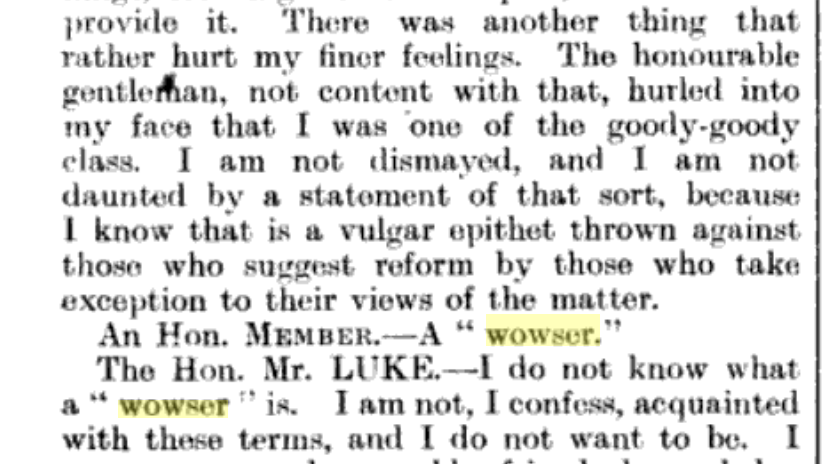
The word has traveled to New Zealand by 1910 as witness this parliamentary exchange:
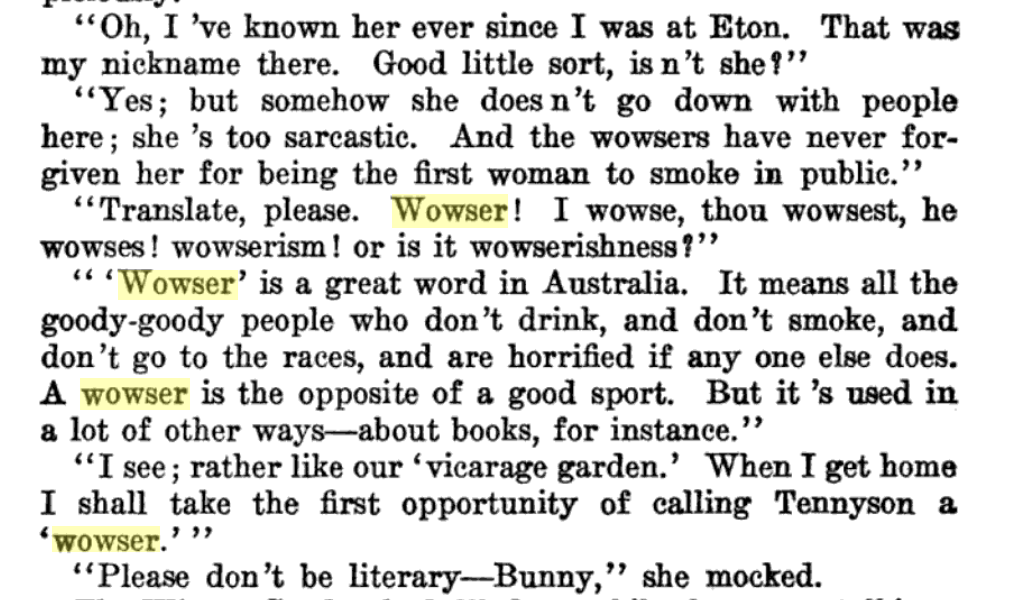
It had spread to Britain by 1917, appearing in The Woman of the Horizon by Gilbert Frankau, the passage containing a helpful explanation of its meaning:
Mencken did not seem to be aware that the word had another, seemingly earlier, meaning, found strictly in Australia. In the OED‘s words, “A person, esp. a man, who behaves in an antisocial or disruptive way; a lout; a yob.” This appeared as early as 1898 but seems to have died out by the 1930s (even as the puritanical “wowser” persisted in Australia and Britain into the 21st century).
As for the American “wowser,” it derives from the exclamation “Wow!,” which originated in Scotland but flourished in America starting around the turn of the 20th century, as in this exchange from a book by George Ade, a virtuoso of slang: “‘The girls—wow!’ ‘Beauties, eh?’ ‘Lollypaloozers!’” Green’s Dictionary of Slang defines this “wowser” as “something, or somebody, impressive, sensational, successful.” The dictionary has citations from 1917 and 1924, which I’m a bit dubious about, and a solid one from a 1951 novel: “[She] Certainly was a wowser on that Gay Nineties stuff.”
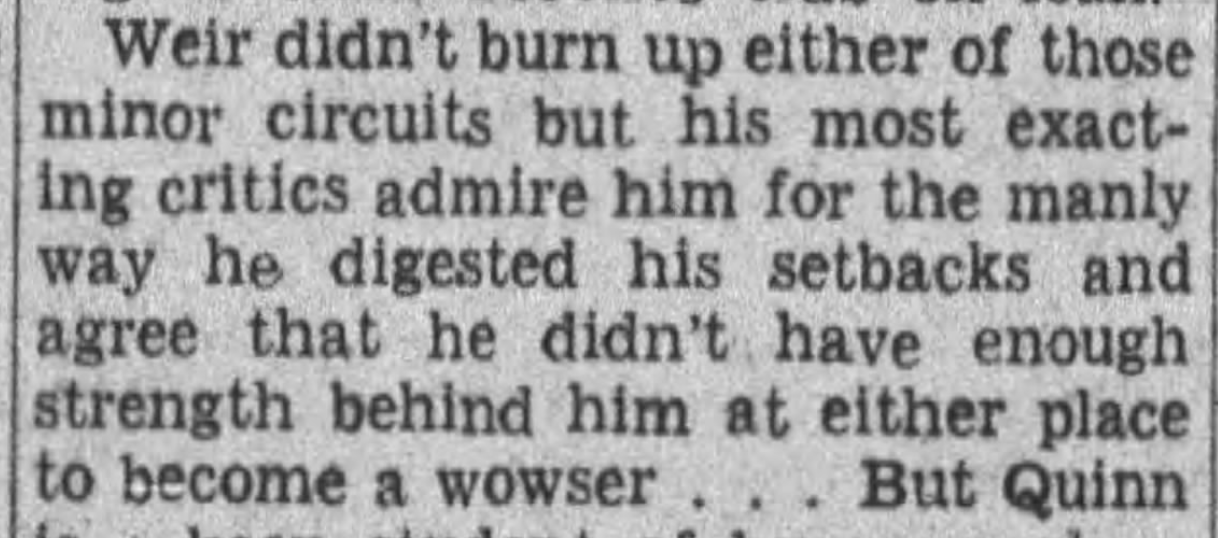
I found an earlier example, using newspapers.com, in a 1940 sports article in the North Adams [Massachusetts] Transcript. It’s about a baseball pitcher who had been playing in the minor leagues, or “circuits”:
An interesting thing about American “wowser” (sometimes spelled “wowzer”) is that even though it probably didn’t exist before the 1936 (else Mencken would have noted it), very soon it acquired an old-fashioned sound. Consider that 1951 quote, referring to the 1890s. And its second appearance in the New York Times (following a 1964 book review) was in a fanciful article that purported to be about the 1927 New York Yankees season and to be written in the style of the time. The owner of the team “had a wowser of a promotional idea, which he plastered on billboards all over the city: Babe Ruth promising to break his 1921 record of 59 homers ‘or apologize in person to each and every disappointed Yankee rooter!'”
I believe the sense of “wowser” as coming from the Jazz Age derives from its sounding like another word, which did. Green’s categorizes “yowza” as “US teen” argot and defines it as “a general excl., either of approval or of vaguely non-committal agreement.” The first citation, which seems to be either a definition or a repetition, is from the Philadelphia Daily Bulletin in 1933: “Yowza–Yes sir!”
The word, repeated three times, became associated with the bandleader Ben Bernie, who had a nationally syndicated radio show in the ’30s. It was adopted by the malevolent bandleader played by Gig Young in the 1969 film They Shoot Horses, Don’t They?, which is where I first encountered it. Wikipedia notes that the word was also picked up by “Richie Cunningham in a 1976 episode of Happy Days, ‘They Shoot Fonzies, Don’t They?’, by the band Chic with their 1977 hit ‘Dance, Dance, Dance (Yowsah, Yowsah, Yowsah),’ Frank Zappa in his 1979 single ‘Dancin’ Fool‘ and Ritch Brinkley as Cappy in 1994’s comedy Cabin Boy.”
Did American “wowser” spring from “yowza”? My guess would be yes, but more research is clearly called for.


Thanks, Ben, and have a post-’36 wowser of a year.
Best regards,
Phil Kann
I have a paper sampler put out by the Potlatch Paper Company in 1998 to celebrate the coming end of the century. Each decade had a page with words and phrases, the 1930s had Yowzer, Natch!, Good ship lollipop, No dice and Leapin’ lizards.
I am not sure about it persisting in Britain into this century – as a 64 year old Briton from the Midlands I can honestly say I have never heard of the word. I am familiar with the record by Chic though!
You’re probably right. The OED has citations from the Times in 1977 and 1982:
“This country’s pattern of..licensing hours..is the work of wowzers of every description.”
“These authoritarian wowsers would like to see a law forbidding anybody to watch any programme they disapprove of.”
Seems to have died out in UK not long after that. But it is still robust in Australia and New Zealand.
the guess that American “wowser” derives from “yowza” seems right to me.
“yowza” itself, along with “yassuh” and other eye-dialect variants of “yes sir” has the reek of the minstrel show about it.
English East Midlands: I thought “wowser” was American, one of those rarely encountered words the meaning of which I never bothered to scratch my head over.
By the by, it took almost 50 years from my first hearing “talking trash / trash-talking” in the 1960s for me to begin to understand the meanings. I thought every variant meant “talking rubbish”, or what we used to call “drivelling” when I was at school.
Oh, and have a Happy New Year, Ben and all.
Our new year: there is just one “Severe Flood Warning – Danger to Life” anywhere in the UK; and yes, it’s on our stretch of the River Nene, including the bridge we use most. We heard the evacuation siren yesterday afternoon. https://check-for-flooding.service.gov.uk/target-area/055FWFPUNE07
I’ve read (heard?) e.g. the Thames River instead of the River Thames several times recently from supposedly British sources. Is this an Americanism which has arrived over here?
Thames River had bumps in Britain around 1880 and 1910, but none from then till 2019 (the last date for which Google Ngram Viewer has data). https://books.google.com/ngrams/graph?content=River+Thames%2CThames+River&year_start=1800&year_end=2019&corpus=en-GB-2019&smoothing=3
It’s not just ‘the Thames River’ (‘Thames river’ with a small R? I can’t think of your convention offhand).
I’ve since heard ‘the Mersey River’ (on BBC radio 4) instead of the River Mersey. And others, on British TV as well, certainly on a weather forecast. It always sounds odd, artificial, affected.
Sam Neill, playing the Australian artist Norman Lindsay, says this word a few times in the film ‘Sirens’ (1994)
Wowser was explained by the late Barry Humphries as an acronym of ‘We Only Want Social Evils Remedied’ that was used on placards by people wanting social reform. e.g. ‘ a blue- nosed wonder ‘ He was Australian and used it a lot in a cartoon strip called Bazza Mackenzie, that was published in the satirical magazine Private Eye in the 1960’s.