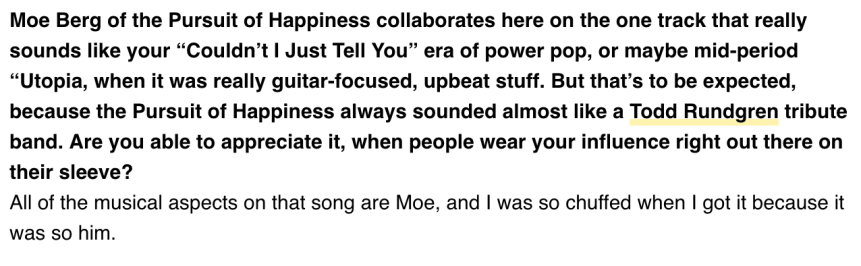
A few days ago, Philadelphia-born musician Todd Rundgren inducted his fellow rockers The Hooters into the Philadelphia Music Alliance Walk of Fame. Here’s a little of what he had to say, as recorded by Dan DeLuca of the Philadelphia Inquirer.
Explanatory note 1: Jerry Blavat, aka The Geator, aka The Boss with the Hot Sauce, is a legendary Philadelphia DJ whose career has spanned from 1960 till the present day.
Explanatory note 2: “chuffed” is a NOOB meaning, basically, pleased as punch.
The magic of the Internet reveals that Rundgren–who’s had lots of collaborations and contact with British musicians, notably Ringo Starr–has used the word at least once before, in this 2017 interview with Variety.
I was recently talking with a professor at an American university who regularly brought students to London for study-abroad programs. (He’s now retired.) He said that by the end of the semester, his male students had always incorporated into their vocabulary three insults: wanker, tosser, and poser. I’ve covered the first here (and touched on it several other times: plug it into the “Search” field at right to see). As for “tosser,” the OED defines it as “A term of contempt or abuse for a person; a ‘jerk,'” and etymologically originates it in the same activity as “wanker.” But it seems to be used rarely if at all in the U.S.
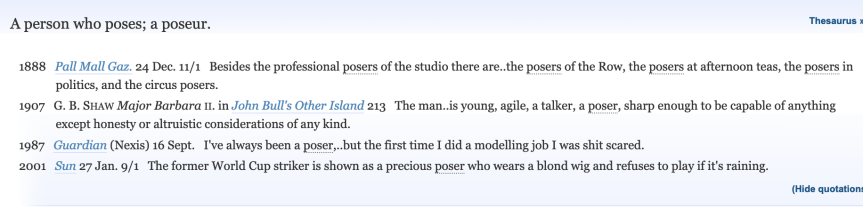
However, “poser” is worth looking into. Here’s what the OED has to say:
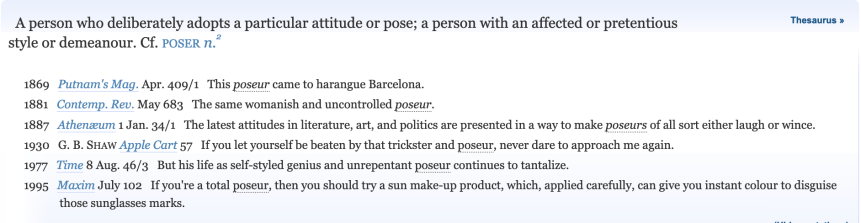
Since “poseur,” from the French, is an almost identically-spelled synonym, it’s worth looking at the OED deets:
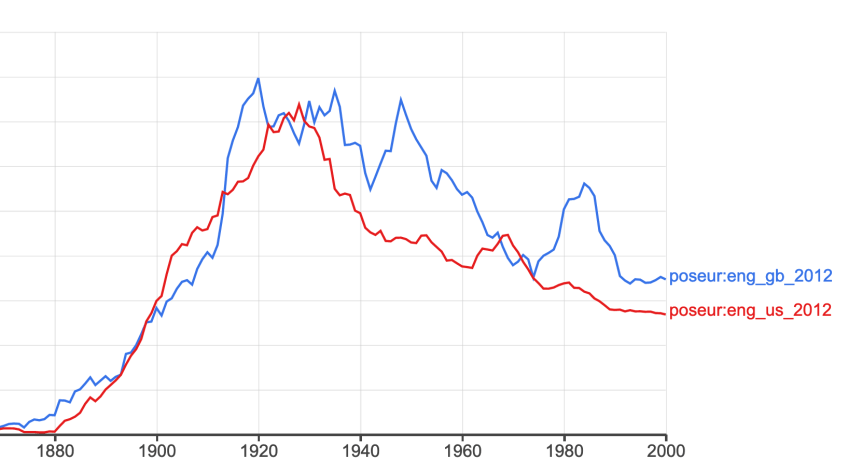
This suggests to me that “poseur” has been out and about since circa 1870; the Time and Maxim (American lad magazine) citations and a Google Ngram Viewer chart suggest it’s been used with relatively equal frequency in the U.S. and Britain.
The Anglicized “poser” is trickier. First, note all the citations are British. Second, I suggest that the Pall Mall Gazette and Shaw (” The man..is young, agile, a talker, a poser, sharp enough to be capable of anything except honesty or altruistic considerations of any kind”) quotes are interesting outliers, in which the straightforward noun “poser,” one who poses, is extended to the derogatory meaning the word would later come to adopt. Even the 1987 Guardian quote (“I’ve always been a poser,..but the first time I did a modelling job I was shit scared”) seems to refer to literal posing. Only the final quote, from The Sun, sounds like the “poser” one is used to today: “The former World Cup striker is shown as a precious poser who wears a blond wig and refuses to play if it’s raining.”
It’s a little hard to be definitive with “poser,” since in database searches I’ve found it impossible to separate out two other meanings of the word: a hard-to-answer question (“that’s a real poser”) and a French verb meaning to put or to place. But assuming that “poser”=”poseur” had taken hold in the 1980s (by which time “poser”=tough question had fallen out of fashion), Ngram Viewer shows almost twice as frequent use in U.K. as in U.S. (As I’m fond of saying, reliable data for Ngram Viewer only goes up to 2000.)
But the word has caught on on this side of the pond. The main character in a new Broadway play by Tracey Letts says Radiohead’s Thom Yorke is nothing but a “scrubby little poser.” (I know Yorke is English, but Letts is a Yank.) The headline of an ad in the New York Times reads
Getting Digital Right: Posers, Players and Profits
And last month Forbes had:
Peak Performer Vs. Professional Poser: Creating The Right Team
Earlier this year, Times columnist Maureen Dowd wrote that Democratic presidential candidate Beto O’Rourke has been compared to “a middle-school poser who ‘went to Zumiez and spent $27 on stickers.'”
Don’t ask me to explain that. I only come up with the quotes, not what they mean.
This post marks a Not One-Off Britishisms first. I don’t believe it’s ever previously happened that, while researching American use of a British word or phrase, I came upon an example written by me. The phrase is “full marks.” Merriam-Webster’s online dictionary has these definitions and examples:
1 chiefly British : the highest possible grade on an exam or in a course. “She got full marks for the coursework”… — Lancashire Telegraph
2 chiefly British : due credit or commendation. “Regarding the question of aircraft nomenclature, my pet peeve is commercial airline aircraft. I give the Europeans full marks in this department: Comets, Caravelles and Concordes are above reproach.”— John Ryan
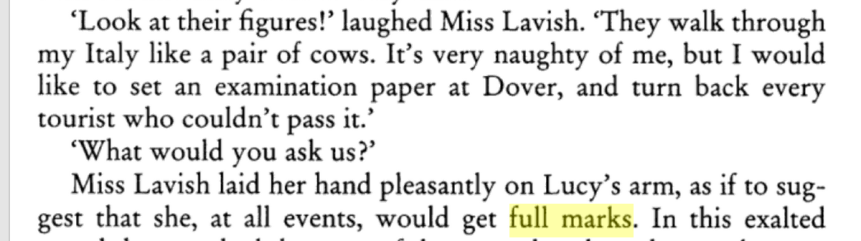
There’s a nice used of the term, sort of half-literal and half-metaphorical, in E.M Forster’s A Room with a View:
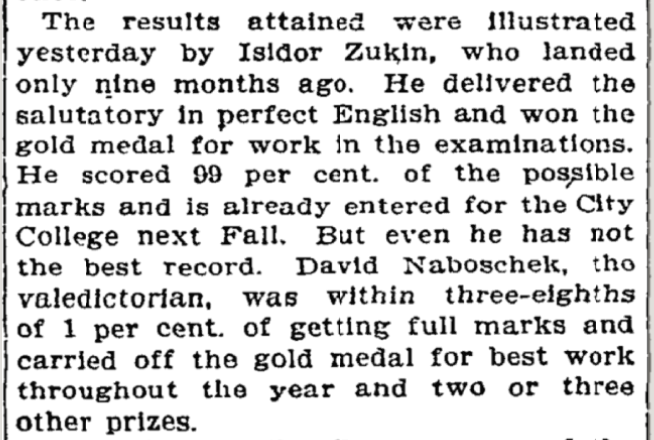
In my many years as a student and teacher, starting in 1960, I don’t believe I’ve ever encountered Merriam-Webster’s first meaning. The American equivalent would be “got 100” or “got straight As” or “aced it.” But I found that in years past, it was used here. This is from a 1908 New York Times article about a graduation ceremony at a school “for Immigrant Children”:
The literal meaning fell out of favor in American education but the figurative use shows up in the prose of mid-20th century belle-lettristic sorts, including Times writers like Orville Prescott, Arthur Krock, and Brooks Atkinson, who in a 1947 pan of a Molnar play wrote of the author, “Possibly he should be given full marks for attempting a sublime theme.”
But the phrase was used considerably more commonly in Britain, especially in the ’30s through the ’60s, as this Google Ngram Viewer graph shows. (Reliable data for Google Ngram Viewer only goes up to 2000.)
Nowadays, the metaphorical meaning pops up quite a lot in the U.S., including two in sports contexts in just the past few days: The (American) football website Fansided on October 1: “If [Josh] Rosen ever becomes a legitimate starter in the NFL, full marks to him.” And ESPN’s National Hockey League preview on September 30: “Full marks to Niklas Hjalmarsson and Brad Richardson” of the Arizona Coyotes.
There have been twenty-one uses in the Times since 2012, including:
Recap of the TV series Outlander: “Full marks to Sam Heughan and Caitriona Balfe for doing a scene on actual horseback instead of on barrels with hair.”
Theater critic Charles Isherwood: “I’d grant [playwright Adititi] Kapil full marks for invention.”
Sports column quoting Ron Katz, the chairman of the Institute of Sports Law and Ethics at Santa Clara University, on a National Football League report on “deflate-gate”: “I thought the N.F.L. was going to brush it under the carpet. I give them full marks for coming out with this report.
Theater critic Ben Brantley in a review of The King and I: “give full marks to the first-rate Ruthie Ann Miles”
And including an article about comma use listing various mistakes and saying that if the reader spotted them, “give yourself full marks.” The author, I was interested to note, was Ben Yagoda.
I was informed via Lynne Murphy of this map for an event held yesterday in Portland, Oregon.
The key at the bottom says that WC (British term for public lavatory, short for “water closet”) indicates “restrooms” (an American term for same), thus effecting a nice trans-Atlantic hybrid.
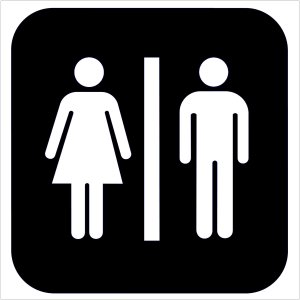
American WC tends to turn up in special circumstances, as in the Portland map, where the customary symbol for such facilities, a version of this–
–might end up too small to be legible. (Or maybe, Portland being Portland, the binary imagery was viewed as politically incorrect.)
The American company Kontextur uses the term for their range of bathroom-cleaning tools:
And it’s helpful in headlines, where space is at a premium. This 2004 New York Times article is about being stuck on a bathroom-less corporate jet:
WC is useful term, not only in being concise but in having a Goldilocksean just-right level of euphemism, not explicit about its function but, being willing to acknowledge “water,” nowhere near as opaque as “rest room” or “facilities.” I hope it catches on.
You often hear people say things along the lines of, “Never read the comments!” Well, that’s definitely not true for NOOBs, whose comments and commenters are frequently brilliant. Just a few days ago, “oldyellr” commented on the “petrol” entry: “Sadly, Britishisms are infiltrating North American language because somebody thinks they’re ‘cool’. Examples are ‘mobile’ for cellphone and ‘CCTV’ for surveillance video.” The brilliant bit wasn’t oldyellr’s comment but “Michael M”‘s response: “They are? If only there was some website that pointed these out.”
oldyellr, missing the humor, carried on: “You don’t need a website or Google. Just listen to the news and how people talk today. But if you like, here is just one link.” The link was to a BBC article that cited Not One-Off Britishisms and quoted me.
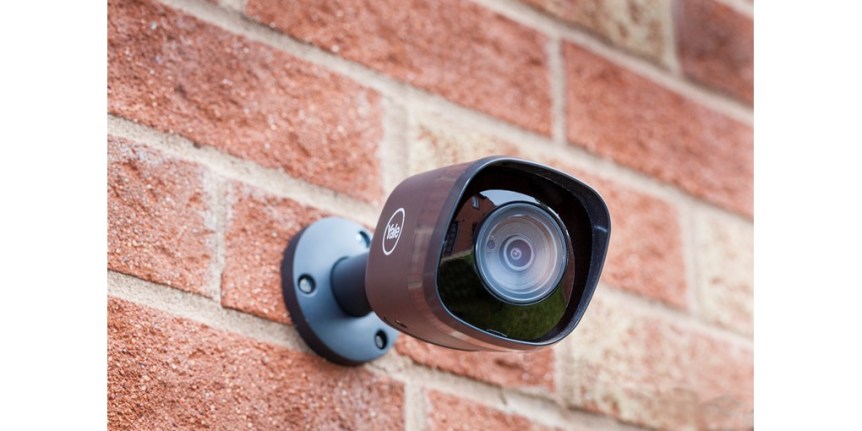
I bring this up, actually, not to have sport at oldyellr’s expense but to thank him (I think he’s a he) for an idea for a post. Not “mobile,” which I covered years ago and continues apace, but his other example. When I started visiting London regularly, in the mid-1990s, I noticed many references in the press to CCTV, an initialism for closed-circuit TV, in this case specifically referring to surveillance cameras. The OED’s first two citations for the term, from 1959 and ’60, are from American publications. I believe I can antedate that by one year with a quote from Radio & TV News, also American:
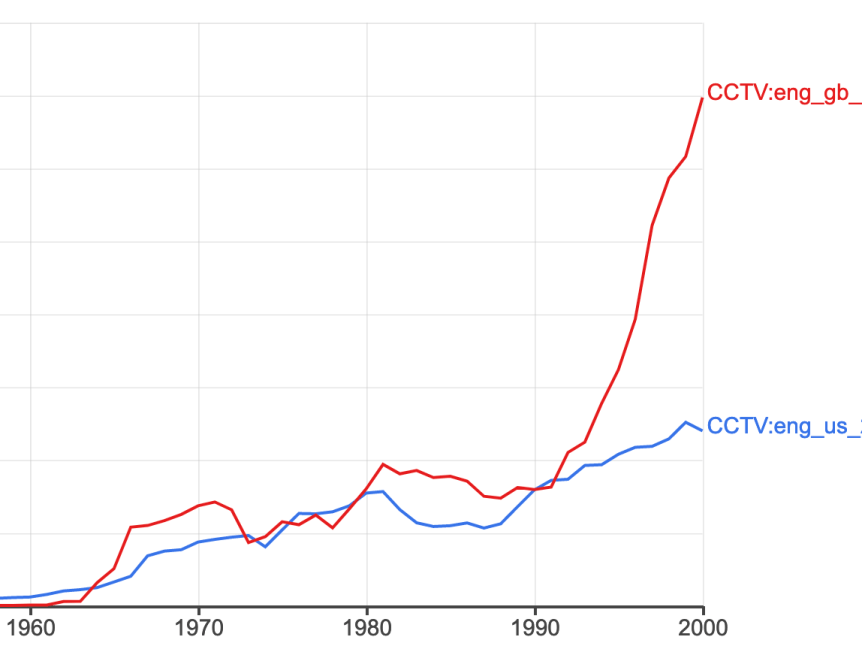
According to Google Books Ngram Viewer (whose reliability goes up only to 2000), the term was used with roughly equal frequency on both sides of the Atlantic through the early ’90s, when, consistent with my experience, it shot up in Britain:
I don’t know why that happened and would be curious about any ideas. It doesn’t appear to be because of a preponderance of CCTV use in the U.K. According to Wikipedia, estimates of the number of such cameras in operation there are between 1.85 million and 4.2. million, while the figure cited for American is 30 million.
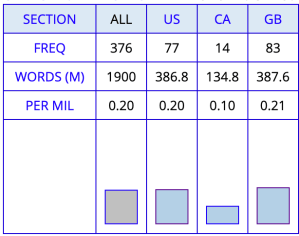
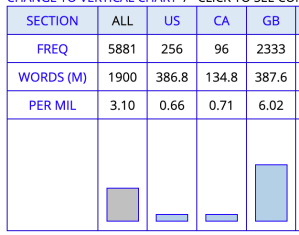
The terminological discrepancy was still present in the early 2010s, when “CCTV” was used about ten times more frequently in Britain than in the U.S. (and Canada), according to another database, the Corpus of Global Web-Based English.
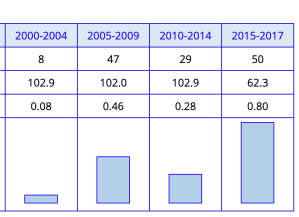
But as oldyellr perceived, things seem to be changing just a bit. According to yet another database, the Corpus of Contemporary American English (COCA), the use of the term in the U.S. rose roughly tenfold between 2000 and 2017, from .08 uses per million words to .80:
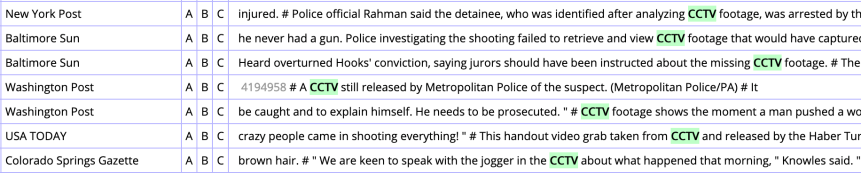
Here are some examples from COCA, all from 2017:
So “CCTV” appears to be established in America, and on the rise.
If only there were a website that pointed such things out.
This phrase, “the fullness of time,” meaning, more or less, the appropriate time, was originally confined to Christian contexts. For example, in the King James Bible, Galatians 4:4 reads, “But when the fulness of the time was come, God sent forth his Son, made of a woman, made under the law.”
In due course — or in the fullness of time — the expression began to universally take the form “in the fullness of time,” meaning at the appropriate time, or after a certain amount of time, usually lengthy, has passed. The first secular use cited by the OED unsurprisingly is from Charles Dickens (Barnaby Rudge, 1841), who, as he did, brought the high-flown rhetoric down to earth: “Nor was she quite certain that she saw and heard with her own proper senses, even when the coach, in the fullness of time, stopped at the Black Lion.”
As far as transatlantic patterns go, Google Ngram Viewer shows much more frequent use in the U.S. than in Great Britain in the late nineteenth-century; I’d venture that the reason is America’s greater degree of public piety.
The phrase’s popularity shot up in Britain between 1900 and about 1945, corresponding, I’d say, to its adoption there in non-religious contexts, especially favored by windbag politicians, and those making fun of them.
But in the fullness of time (sorry, can’t help myself), America caught up. Reliable figures for Ngram Viewer only go up to 2000, but the Corpus of Global Web-Based English — a snapshot or nearly 2 billion words on online text in 2012-13 — shows nearly equal use of the phrase in the U.S. and U.K.
Since it began publishing in 1865, the New York Times has used the phrase 210 times, but 17 percent of them have been since 2010. For example, in reference to astronomical shifting, science writer Dennis Overbye observed in 2018, “In the fullness of time, everything gets everywhere.” And that same year, in a review of George Bernard Shaw’s St. Joan, theater critic Jesse Green wrote:
“What other judgment can I judge by but by my own?” Joan asks, casually assuming supremacy over churchmen and kings. From this idea comes not only the necessary sentence of a perfectly fair proceeding but also, in the fullness of time, Protestantism, nationalism, individualism and, as Shaw would have it, the Great War, which had recently concluded as he started writing the play.
New York Times book critic Dwight Garner has the usual high number of good lines in his review today of former New Jersey governor Chris Christie’s new memoir. Here’s the one that especially interested me:
“Let Me Finish” is a superficial and ungainly book that tries to cover so many bases at once — it’s a series of attacks and justifications, it’s a master class in sucking up and kicking down, it’s a potted memoir, it’s a stab at political rehabilitation — that reading it is like watching an octopus try to play the bagpipes.
The reason for my interest is a NOOB–“potted.” The OED‘s definition is: “Of a piece of information, work of literature, historical or descriptive account, etc.: put into a short and easily assimilable form; condensed, summarized, abridged.” The first citation is from the magazine The Galaxy in 1873: “If I skip the lad’s measures and tidbits of potted history, yet these letters from Augustus are none the less welcome, revealing the traveller in a new light.” Subsequent citations, all from British sources, refer to “potted” abridgments, prose, abstracts, and, again history. That seems to be the word that most commonly follows this adjective, so I used the whole phrase for a Google Ngrams Viewer search to compare frequency of use in Britain and the United States through 2000, the last date for which the application supplies reliable data. (I couldn’t very well search “potted” alone, because that would give me American references to drunkenness, British references to what we would call canned laughter and to food preserved by the process we call “canning,” and reference in both countries to plants in their planters.)
I’m pretty sure American use jumped not long after that, because of the Harry Potter theatrical satirical abridgment Potted Potter, which has been playing in the U.S. for more than a decade. In any case, I found a number of American uses, including one from Times drama critic Jesse Green in November 2018. Some skits within The Thanksgiving Play, he wrote, “are selections from actual lesson plans and Pinterest boards posted by teachers to share ideas for classroom Thanksgiving activities. They include potted history and offensive ditties and, in one case, a suggestion to split the pupils into Pilgrims and Indians ‘so the Indians can practice sharing.”’
And the previous year, book critic Laura Miller wrote in The New Yorker that “newsreel-like interludes of potted history … are constantly interjected” into Paul Auster’s novel 4 3 2 1.
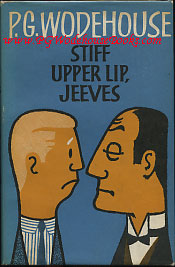
A 1963 novel by a quintessentially British author.
I was directed to the (British, as you can tell from “mum“) Mumsnet.com website because, in a discussion of Americanisms, someone nicely posted a link to NOOBs. Looking around on the discussion, I noted one person who listed the expression “stiff upper lip” as an Americanism. Another commenter responded: “I beg to differ. That’s really quite Brit.”
The first person was right.
Learning that surprised me, because the expression, suggesting stoic keeping calm and carrying on, is so strongly associated with the British national character and lexicon. But so is “bumbershoot,” and that word is as American as a McDonald’s apple pie.
The OED confirms that with these early citations (Thomas Haliburton was Canadian):
1815 Massachusetts Spy 14 June I kept a stiff upper lip, and bought [a] license to sell my goods.
1837 T. C. HaliburtonClockmaker 1st Ser. (ed. 2) x. 77 Its a proper pity sich a clever woman should carry such a stiff upper lip.
1852 H. B. StoweUncle Tom’s Cabin I. x. 152 ‘Well, good-by, Uncle Tom; keep a stiff upper lip,’ said George.
The popularity of the phrase was boosted by a oft-reprinted poem by the Ohioan Phoebe Cary (1822-1871), “Keep a Stiff Upper Lip,” whose last stanza is:
Through childhood, through manhood,
Through life to the end,
Struggle bravely and stand
By your colors, my friend.
Only yield when you must;
Never “give up the ship,”
But fight on to the last
“With a stiff upper lip.”
Not until 1887 does a British example appear, from The Spectator: “The Financial Secretary, who, it is supposed, will have a stiff upper lip and tightly buttoned pockets.”
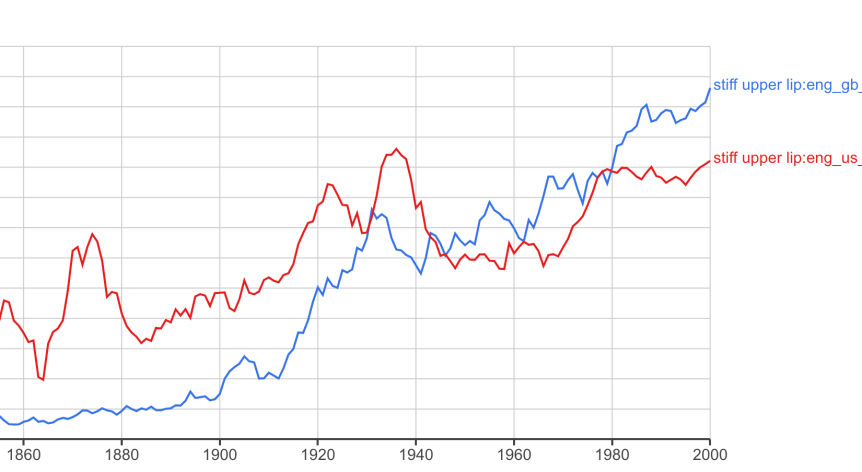
As this Ngam Viewer chart shows, the phrase continued to be more popular in the U.S. through the early 1940s:
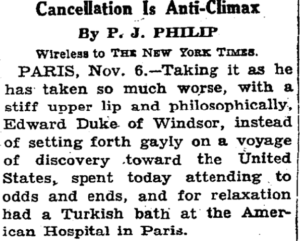
In the fall of 1937, something–I don’t know what–seemed to happen to establish the phrase’s connection to British people. On November 7, the New York Times used it in reference to the Duke of Windsor.
More important, on November 19 Damsel in Distress opened. The movie featured a number, lyrics by Ira Gershwin and music by his brother George, and sung by Gracie Allen, George Burns and Fred Astaire, that took the expression’s Britishness as a matter of course. It starts off:
What made good queen Bess
Such a great success?
What made Wellington
Do what he did at Waterloo?
What makes every Englishman
A fighter through and through?
It isn’t roast beef, or ale, or home, or mother,
It’s just a little thing they sing to one another.
Stiff upper lip, stout fellow,
Carry on, old fluff.
Chin up, keep muddling through.
Stiff upper lip, stout fella
When the goings rough
Pip pip to old man trouble
And a toodly-oo too
And, in case you could use some delight in your life (who couldn’t?), here it is:
From then on, upper-lip stiffness was more and more thought of as a British thing. In 1940, the New York Times, reporting on English children coming to America to escape the war, “In the face of a barrage of questions and attentions from the curious, the English children trickling into this country in the past few months have maintained a solid front of poise, courtesy and the traditional stiff upper lip.”
In 1944, The New Yorker ran a Talk of the Town item with the title “Stiff Upper Lip,” summarized this way in the magazine’s internal filing system:
An American officer stationed in a remote English village writes us that he didn’t have much to do during the cold winter evenings while waiting for the invasion except read the books in the local lending library. He says that they served beautifully as reminders of certain quirks and crotchets of the native soul, and he gives an example. This is the opening sentence of an autobiographical volume he found: “In 1928 my foot was hurting all the time, so they took it off and gave me an aluminum one.”
(I learned through a Google search that the book in question was a 1943 novel, The Small Back Room, by Nigel Balchin, and that the actual first sentence was longer than the New Yorker quote. The whole thing: “In 1928 my foot was hurting all the time, so they took it off and gave me an aluminum aluminium one that only hurt about three-quarters of the time.”)
The difference between “bumbershoot” and “stiff upper lip” is that the former was never adopted by the British, while the latter has been. You can tell that by series of citations in the OED, all from British sources.
1961 A. O. J. CockshutImagination of Charles Dickens viii. 116 He oscillated between indignation, self-pity, and reticence of the stiff-upper-lip English school.
1961 John o’ London’s 19 Oct. 447/2 The second film contains a firmly disciplined..undercurrent of Miniverish stiff-upper-lippery.
1963 Listener 3 Jan. 42/1 It was all very improbable and too stiff-upper-lippish to have been written by anybody but an anglophile Frenchman.
1973 New Society 31 May 483/2 MPs, in praising stiffupperlippishness, used sex as a stalking horse.
1977 Broadcast 14 Nov. 10/3 The British are stiff upper-lipping through power cuts.
I suppose it caught on in the U.K. because of the lesson in the expression, “if the shoe fits…”–the British version of which, I just learned, is “if the cap fits…”
I was initially going to write about “betwixt,” as the third item in a trilogy started by “whilst” and “unbeknownst.” It is true that this synonym for “between” has traditionally been more popular in Britain than the U.S.
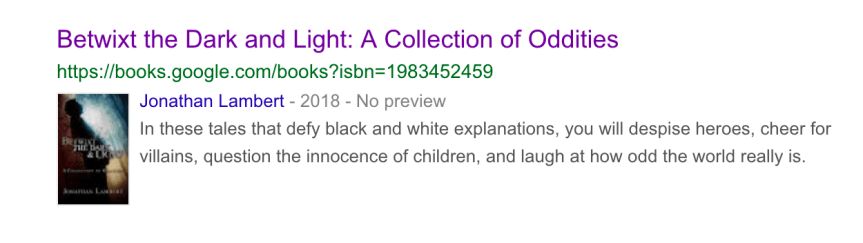
And it’s true that it seems to be popping up in America a bit more frequently as a cute and old-timey variation, especially in a mystical or fantastical context, as in the title of this book by a Maryland-born author.
The most common use, in my experience, remains the phrase “betwixt and between,” which, of course, means “between and between.” Google Ngram Viewer shows that after it came into prominence in the mid-1800s, Britain and the U.S. alternated in liking it more, with a long period in the mid-20th century with Britain in the lead, followed by equality since about 1980.
But “betwixt” ultimately isn’t popular or interesting enough for me to say anything more about it. So I’m just going to leave it there.
I always look forward to this time of year because, among other things, Lynne Murphy announces two Words of the Year at her Separated by a Common Language blog: U.S. to U.K. and U.K. to U.S. For 2018, the former is “Mainstream Media,” or MSM.
More to the interest of this blog, the U.K.-to-U.S. word is “whilst.” She graciously mentions that I wrote about the word (which is, of course, a substitute for the traditionally American “while”) in a NOOBs post back in 2011, shortly after I started the blog. But there have been significant developments since then. Lynne quotes an email from another friend of NOOBs, Nancy Friedman:
While standard dictionaries still mark it as “chiefly British,” it’s on the rise among Smart Young Things here in the U.S. who think it sounds “cool” or “refined.” Here’s an example from The Baffler (published in New York), April 6, 2018: “You see, while the violence of financial capitalism and the ever-widening chasm of economic inequality might have something to do with why poor folks get themselves into a tizzy and take to the streets, the true catalyst is that they don’t feel respected whilst being systematically eliminated by the police state, they don’t feel respected whilst performing wage slavery.” This humor piece in McSweeney’s (based in San Francisco), from April 2017, is egalitarian: it uses “while” and “whilst” twice each. And here’s the singer Lana Del Rey— born in Los Angeles, residing in Lake Placid, New York — writing on Instagram in May 2017: “I had complex feelings about spending the weekend dancing whilst watching tensions w North Korea mount.” (Quoted in Rolling Stone)
Halle Kiefer, “comedy writer out of Astoria, New York”: a surreally long, minutely detailed anecdote about a young Madonna auditioning with the Queen of Soul’s “(You Make Me Feel Like) A Natural Woman” whilst living in a crack den”
I’ll add that it’s not just the elite who are saying “whilst.” I used my new favorite TweetDeck tool, the location search, to find “whilst” users within 200 kilometers of a randomly selected U.S. city, St. Louis, and found plenty, who appear to be young things, though not necessarily notably smart (for British readers: clever).
Interestingly, Lynne is interested in the pronunciation of the word. She writes:
Before I started hearing it in British English, I would have read it aloud as ‘willst’. (Dictionaries would have told me otherwise, but I don’t tend to look up pronunciations when I’m reading.) It is pronounced like while with a st on the end. In the US, it seems to mostly have a life in print (does anyone have any nice clips of audio clips of it in American mouths?), whereas in the UK, you hear it too.
I have the sense that I have heard it a fair amount here, always pronounced in the proper, long-“i” way. But I may be kidding myself. I searched the archives of National Public Radio for on-air utterances of the word, and found 246 of them. But they were all spoken by British people going back through 2015, at which point I gave up. Does anyone have evidence that an American has ever said “whilst,” and if so how she or he pronounced it?
Update: On the pronunciation issue, Ben Zimmer has directed me to a remarkable site called Youglish; it allows you to search YouTube videos for specific words or phrases, and narrow them down to U.S., U.K., or Australian speakers. He sent me a link for U.S. “whilst,” which has 364 videos. The categorizing isn’t perfect–the first clip is from a Canadian, and the second and third appear to be from an Australian and a Brit, respectively–but the speaker in the fourth video is from Minnesota, and I listened to enough true-blue Americans to establish that we do indeed say “whilst,” and that we pronounce it the same way the British do.








 You often hear people say things along the lines of, “Never read the comments!” Well, that’s definitely not true for NOOBs, whose comments and commenters are frequently brilliant. Just a few days ago, “oldyellr” commented on the “
 So “CCTV” appears to be established in America, and on the rise.