Kerfuffle This

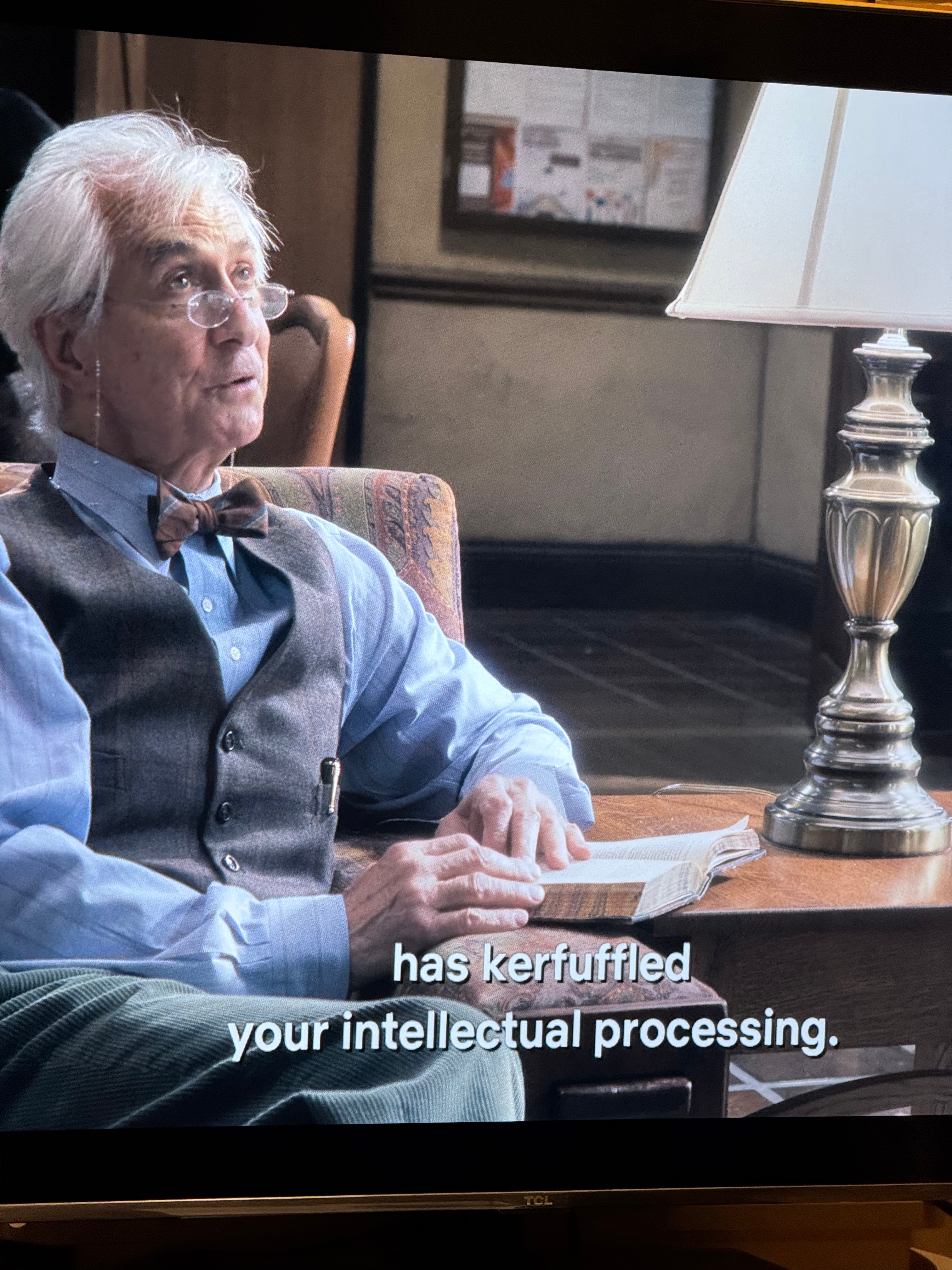
I was watching the Ted Danson Netflix series Man on the Inside when an English professor (the subject, not the nationality) played by David Strathairn says this to Danson:

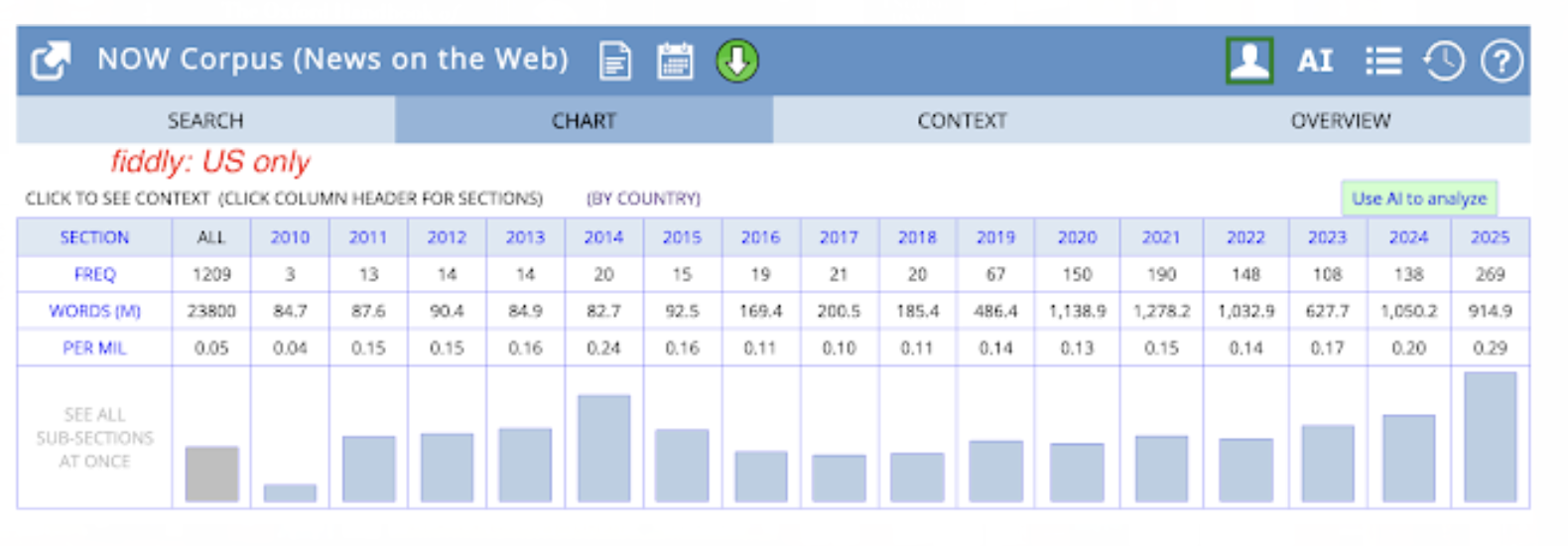
I (of course) have written about “kerfuffle” but only as a noun. When I heard the verb on TV, I initially thought it was an American invention, but it in fact, the first use I’ve been able to find (I’ve searched for the past tense, to avoid getting false positives) was from David Cunliffe Lister in the House of Lords in 1985: “The Earl of Swinton, My Lords, he could if the noble Earl would give him time: He is absolutely kerfuffled with figures here.”

And, talking of America, the great political columnist Molly Ivins used the word in Mother Jones in 1991, referring to George H.W. Bush:

The New York Times has used “kerfuffled” once, in 2014.

But one syntactical thing is different about the Man on the Inside example. The others are in the passive voice, talking about people who are kerfuffled. But in Man on the Inside, the riddle has kerfuffled Danson. I’ll be monitoring whether that’s a one-off.

“I’ll leave you to it”

I knew a tipping point of sorts had been reached last week, when I was at the gym of the small liberal arts college in my town. (I have gym privileges because my wife works at the college.) Two undergrads, one of them sitting at a weight machine, were chatting. There was a pause, then the other said, “I’ll leave you to it,” and walked away.

That phrase, “I’ll leave you to it,” had been on my NOOB-dar for a while. I had a sense of it as a British thing, yet characters recently used it on the American sitcoms Midcentury Modern and Abbott Elementary. A 2023 New York Times cooking column (unsigned but undoubtedly written by NOOBs favorite Sam Sifton) closed with the paragraph:

“Or maybe you’d like something decidedly soupy? Yotam Ottolenghi’s herby sweet potato soup with peanuts is also substitute friendly, like the sancocho, with added carby comfort from bulgur or short pasta. Yotam calls it a soup for when you just want to be left alone,’ so we’ll leave you to it.”

As for British origin, some research backed my hunch up. The OED actually has a definition for the phrase, which, I learned, doesn’t necessarily have to begin with the word “I’ll”:

“to leave (a person) to it: to leave (a person) alone to proceed with a task in hand; to allow to get on with something without interference.”

The dictionary’s citations–which go back a surprisingly long time–are all British:

(BTW, the “S. Mather” in the 1671 quote isn’t one of the American preaching Mathers, but Samuel, an English minister.)

Google Ngram viewer adds a little more nuance.

That is to say, the expression has always been more common in Britain the the U.S., but it shot up in popularity in both countries in the decade of the 2000s, to the point of becoming a catch phrase.

Thanks for reading. Now, I’ll leave you to it.

“Snarky”; “Snark”

Of the words at the top of this post, Merriam-Webster defines the adjective, “snarky,” as “sarcastic, impertinent, or irreverent in tone or manner.” “Snark,” meanwhile, can be either a noun (“an attitude or expression of mocking irreverence and sarcasm”) or verb (“to say something snarky”).

Google Ngram Viewer shows both words shooting up in popularity over the past twenty-five years or so, in both the U.S. and the U.K. They apparently felt somewhat fresh in 1997 when Spy magazine took the trouble to point out numerous recent uses: “people on SNL made ‘snarky portrayals.’ VHI’s Pop-Up Videos had ‘snarky comments.’ Tennis players used ‘snarky, talk.’ Chris Rock’s HBO show ‘got off to a snarky start,’ The Dandy Warhols’ hit single had a ‘snarky title,’ (‘Not if You Were the Last Junkie on Earth’). Gen Xers were reading ‘snarky free weeklies.’ … The New York Observer had ‘snarky commentators.'”

The etymology does not go back to Lewis Carroll’s 1876 poem about an imaginary creature, “The Hunting of the Snark” (as some have assumed). Instead, the word has multiple roots, An 1866 glossary of “Shetland and Orkney Words” lists “snark” as a verb meaning “to make a snoring noise.” Sixteen years later, the OED reports, Jamieson’s Etymological Dictionary of the Scottish Language included the verb as meaning, “To fret, grumble, or find fault with one.” The OED also suggests a connection with “nark,” meaning “An annoying, unpleasant, obstructive, or quarrelsome person.” The dictionary has a citation from 1846: “They are the rankest narks vot ever God put guts into, or ever farted in a kickses case.” Most of the later examples of “nark” are from Australia or New Zealand. Another antipodean connection is that Digger Smith, a 1917 Australian book-length poem by C.J. Dennis, has a glossary at the end defining “snarky” as “angry.”

The first OED citation for “snark” as a verb comes from a 1904 novel, The Phoenix and the Carpet, by the English children’s book author E. (Evelyn) Nesbit: “He remembered how Anthea had refrained from snarking him about tearing the carpet.

Remarkably, the dictionary’s first example of “snarky” is a line of dialogue from another Nesbit book, the well-known The Railway Children, from 1906: “Don’t be snarky, Peter. It isn’t our fault.” But I can antedate that by a year, with this quote (with telltale quotation marks) from Law Notes, published in London in May 1905:

For the purposes of this blog, it’s relevant that all the other examples from the next decade I’ve found either in the OED or through Google Books are from Britain. Nesbit’s niece, Dorothea Deakin, seemed to have caught her aunt’s enthusiasm for the word, and put this line in a 1908 short story: “Martin isn’t often snarky, but he remarked then in a cold voice, that he objected to backstairs gleanings about any one…” And the following appeared in Punch in 1913: “It didn’t matter a bit if I left my new bat out all night or had to sing a solo in chapel or was bottom of the form and got snarky letters from home or broke rules or anything.”

By 1915, “snarky” had appeared in a U.S. book, Ruggles of Red Gap: “I had received a rather snarky letter from him demanding to know how long I meant to remain in North America.”

“Snark” the noun, meanwhile, doesn’t show up till the very late 1980s. Relevant to the recent popularity of all forms of the word, on both sides of the pond, is the way “snarky” sounds like a portmanteau word, combining “sarcastic” and “snarl.” That, plus the fact that we live in extremely snarky times.

What’s Got Into Stephen King?

The title of this post is a reference that will be understood by one person, at most, my former University of Delaware colleague McKay Jenkins. A few years ago, McKay wrote a prescient book about the plastic and other bad stuff that has entered human beings’ bodies, and I suggested What’s Gotten Into Us? as a title. His publisher liked that, except they wanted to change it to What’s Got Into Us? I remonstrated loudly when McKay informed me of this, exclaiming that no American would say “got.” Reason prevailed and the book was published under my suggested title.

The Stephen King reference comes from the fact that I have just finished and enjoyed his latest book, Never Flinch, and for some reason it is chock full of Britishisms, some from the narrator, some spoken by characters. I’ve read a number of other King books–including the entire series featuring the protagonist of this one, the detective Holly Gibney–and don’t recall this being a feature of any of them. (And I would notice.) I’m not sure what’s gotten or got into the master of horror. The internet tells me he spent three months in England in 1977 but doesn’t reveal any more recent contact. Maybe he’s been watching a whole bunch of British crime shows.

Anyhoo, the Britishisms in the book break down into four categories, as follows.

Common NOOBs

These are words or expressions that I’ve covered on the blog and are widespread in the U.S.

Less Common NOOBs

I find it unlikely that King’s American characters would use these, and when the narrator does, it strikes a discordant note.

  • “’I don’t know what you’re on about,’ Roxanne said.”
  • “We have a valuable lead and that’s down to [attributable to] you.”
  • “Stewart’s gone to ground.”
  • “Her anxiety has been replaced by a kind of nervy [nervous] anticipation.”

Words and Phrases I’ve Heard in America but Haven’t Yet Covered on the Blog

  • “I’ll leave you to it.”
  • “He needs four more days. Until then, he’ll stand down. No more killing.” [Definition of “stand down”: “to withdraw from a contest, a position of leadership, or a state of alert or readiness. Chiefly British.]

What Was He Thinking?–Things I Can’t Imagine an American Saying

Definitions of italicized words (as of “stand down) are from Merriam-Webster.

  • “They split a strawberry shortcake for afters,” [“British: Dessert.”]
  • “She left us, buddy. Went walkabout.” [“To go on a walkabout (a long walking journey on land that is far from towns and cities.”]
  • “Midday custom is slow.” [“Business patronage.”]

“Raspberry”

I had the good fortune a couple of weeks ago to give a talk about Not One-Off Britishisms in Washington, D.C., under the auspices of the admirable organization Profs and Pints. The fact that about a hundred people turned out on a hot Monday evening to hear me talk about an obscure language topic did my heart good.

It was a rousing group, who laughed in all the right places and had brilliant questions afterwards. I subsequently got an email from one member of the audience, “Dru,” as follows:

“I’ve heard on the Internet (so of course it’s true /s) that the word ‘raspberry,’ as in using your mouth to make a fart sound, comes from Cockney rhyming slang. The rhyme being ‘raspberry tart.'”

What Dru heard was in fact correct, at least according to the OED, which cites a 1902 slang dictionary as giving the rhyming-slang etymology. Green’s Dictionary of Slang provides an earlier explanation (dated circa 1880) of the term from the Sporting Times:

“The tongue is inserted in the left cheek and forced through the lips, producing a peculiarly squashy noise that is extremely irritating. It is termed, I believe, a raspberry, and […] is regarded rather as an expression of contempt than of admiration”

All this was news to me, not only the rhyming-slang etymology, but the British origin, as I had always thought of giving the raspberry as an American thing. But all subsequent citations in Green’s are British or Australian until this rather opaque headline from the New York Evening World in 1918:

“When the Hohenzollerns Stepped Out to Slip the World the Old Razzberry They Forgot That There Is Many a Skid Between the Chinaware and the Chin.”

Note that spelling, “razzberry.” It calls to mind another familiar-word, “razz.” This is both a noun (give someone the razz) and verb (to razz someone), and Green’s and the OED agree that it derives from “raspberry” and that it is very American. It also quickly expanded in meaning from making the “raspberry tart” sound to teasing or verbally abusing someone. Green’s first citation for the verb is from New York State in 1914: “It is not long before you have all of the fun of a baseball game, with one side razzing the players of the opposing side as well as the umpire.” And the noun from Washington, D.C., in 1919: “A fresh cake-eater […] tried to tell Monahan this and got an awful raz.” (All subsequent citations have the double “z.”) In the 1938 edition of The American Language, H.L. Mencken treats both “razz” and ‘raspberry” as strictly American slang.

The concept was so quickly embraced in the U.S. that it acquired a geographically precise synonym. The indefatigable researcher Bonnie Taylor-Blake has found an early example from Damon Runyon, writing in a New York newspaper in 1921. The reference is to Georgia-born baseball player Ty Cobb: and a game against the New York Yankees, who of course played in the New York City borough of the Bronx: “The Jewel of Georgia got the old familiar Bronx cheer when he came to bat for the first time in the first inning. Tyrus would probably be sadly disappointed were he not so greeted in New York.”

In any case, the rapidity with which “razz” was adopted in America suggests to me at least that it may have come from something other than “raspberry.” One possibility is “razoo,” which the OED has found in a Wisconsin newspaper as early as 1888: “Mayor Lawson’s veto of the police service bill..has a strong resemblance to what the political toughs would call ‘giving a man the razoo’.” That’s suspiciously chronologically close to the “raspberry” coining. .No dictionary I have access to gives a helpful etymology for “razoo,” but I found this in a 1945 New York Times book review: “A certain newspaper man is likely to say, come make-up time: ‘I hate to tell you, but I think we’ve got to razoo that back page. I’ll give you a new layout.’ It’s doubtful he knows where the ‘razoo’ comes from. Almost surely it is from razee, a shipbuilder’s term for drastically cutting down the rig of a ship.”

Clearly, further research is called for.

Let’s Do “Brunch”

If you google something like “origin of the word brunch,” you will get a bunch of articles that make the same claim. Here’s how Google’s AI puts it:

“The word ‘brunch’ is a combination of ‘breakfast”‘ and ‘lunch’. It was first used in 1895 by Guy Beringer in an article for Hunter’s Weekly. Beringer suggested it as an alternative to the traditional heavy post-church Sunday meal, proposing a lighter, more sociable meal eaten around noon.”

(And by the way, I saw that logical punctuation, AI.)

My friend “Dino” Don Lessem sent me one of those articles, with a comment along the lines of “You probably know this, but…”

I had to respond that I didn’t know it. I had written a post on the word, but my first example is an article from the U.S. newspaper The Independent, also from 1895: “Breakfast is ‘brekker’ in the Oxford tongue; when a man makes lunch his first meal of the day it becomes ‘brunch’.”

At this point I didn’t know when in 1895 each quote appeared, but the OED supplied the receipts, bless its heart:

In AI and the internet’s defense, it turns out the mistaken attribution has a long history. In August 1896, Punch reported,

“To be fashionable nowadays we must ‘brunch’. Truly an excellent portmanteau word, introduced, by the way, last year, by Mr. Guy Beringer, in the now defunct Hunter’s Weekly, and indicating a combined breakfast and lunch.”

But the story isn’t over. I spent a little time on Google Books, and found another 1895 citation, this one in a book called Giddy Oxon. An Eight Weeks Dialogue, and Other Pieces. The quote comes from an arch (the whole thing is arch) dramatic piece called “Men’s Badgerings.” A character called Strurt is being addressed, then speaks

The book itself doesn’t indicate the month of publication, and I have not been able to find any record of or reference to Giddy Oxon. in any other source, including Google and the British Library.

Can anyone help me find the date it was published? Until you do, The Independent can still claim the first use of “brunch” in print.

Update: Not surprisingly, a NOOBs reader came swiftly the rescue. Not long after the above was published, Hugh Waterhouse posted a comment that he had found an article in the May 28, 1895, edition of the Western Morning News concerning happenings at Oxford, which included this quote : “Eights’ week literature is well to the fore this year, and is evidenced in two short-lived publications, “Giddy Oxon” and the “Octopus”. They are both well up to the standard of such evanoescent [sic] literature,…” Hugh was kind enough not to point out that in my post I mangled “eights week,” which, as he explained, is “the week in the year when student rowing eights compete in races to be crowned ‘Head of the River’.” (Dave Lull independently emailed me with another mention of Giddy Oxon in May 1895.)

Bottom line, “brunch” was used as early as May 1895, three months before the OED‘s first citation.

“Eye-watering”

William Grimes is a New York Times writer, Facebook friend, and language curmudgeon. A while back, combining the last two identities, he complained about Americans’ use of the adjectival “eye-watering.” I was unfamiliar with the expression and, needless to say, looked into it.

The story is a bit complicated. The OED has three separate definitions for “eye-watering” and (in my opinion) misses out on a fourth meaning. The first is, simply, “Having eyes which are watering,” and it doesn’t seem to favor a specific nationality. The dictionary’s first citation is from the North Wales Chronicle in 1874 (“A few days ago I left Edinburgh, a shaky, wheezing, snivelling, eye-watering, bronchial body”) and the second is from the New York Times in 1933 (“Dr. Gay had not found out more than any sneezing, eye-watering victim of hay fever already knows”).

The second meaning, also literal and agnostic as to nationality, describes something that causes the eyes to water, to wit:

The third and last sense is figurative. The OED defines it as, “That inspires a strong emotional response; astonishing, exciting, shocking, etc. Now: esp. (of a figure or amount) extremely high or large; staggering,” and says it is “originally U.S.” That’s presumably because of its first citation, from an Ohio newspaper in 1950: “Are you looking for a new refrigerator..? We’ve got eyewatering prices. Wow!”

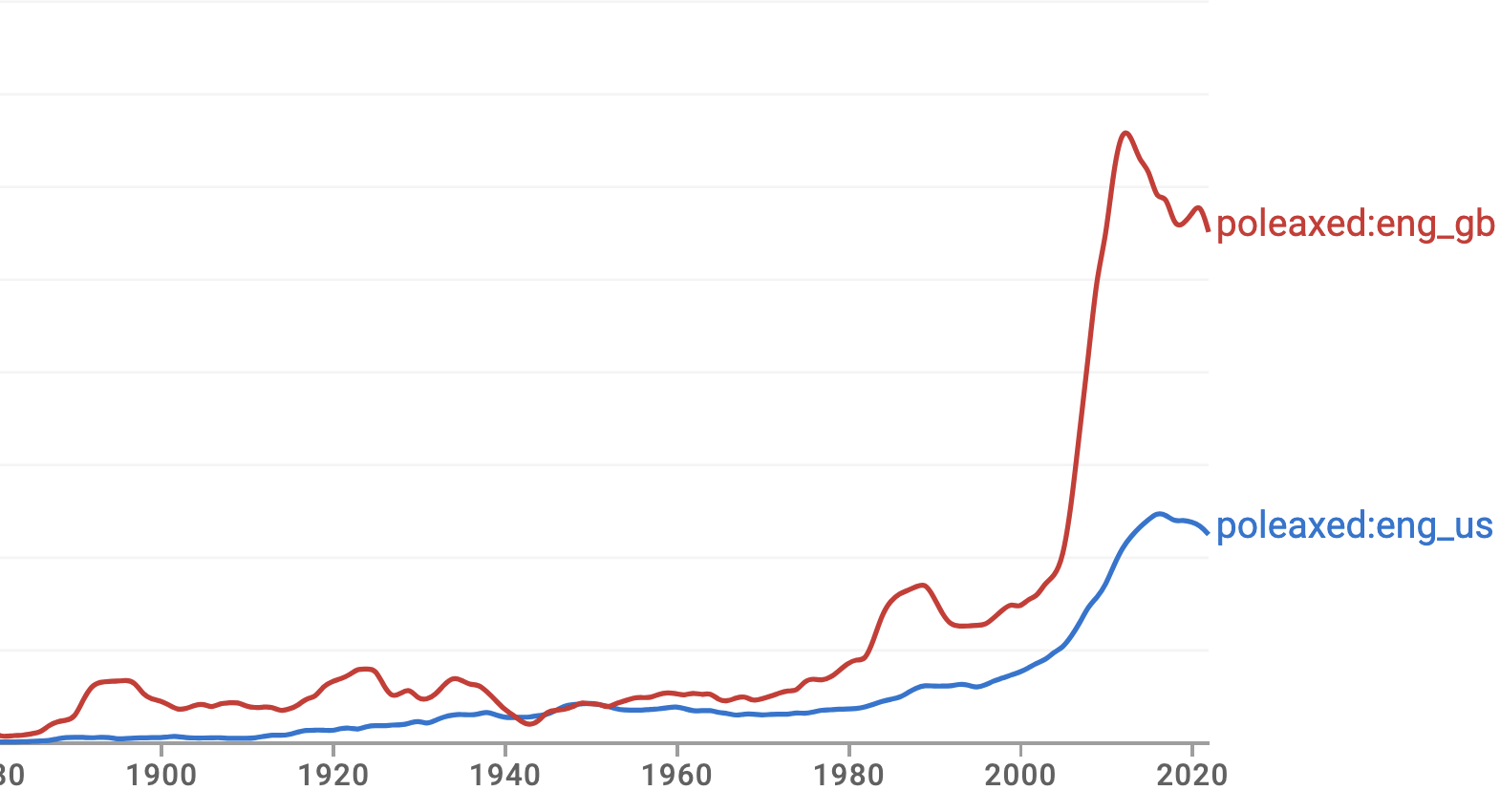
But I’ve got to think that is an outlying one-off. As evidence, I offer this graph from Google Ngram Viewer:

That is, it really developed as a catch-phrase in Britain in the late 2000s, then slowly started taking hold in America. But William Grimes’s former employer is ahead of the curve. Just two days ago (April 14, 2025), the phrase appeared twice in the Times. One article noted, “Amid a spat with China, Mr. Trump raised tariffs on Chinese imports last week to an eye-watering minimum of 145 percent,” and another referred similarly to “eye-watering tariffs.” All told, “eye-watering” has been used used sixty-four times in the Times since the start of 2024 (admittedly a good number in English football/soccer coverage from The Athletic).

Two other examples from 2024:

  • “Behind the dearth of elevators in the country that birthed the skyscraper are eye-watering costs.”
  • “I have more than 50,000 pictures stored in Google Photos—over 700 of them taken in the first three months of this year alone. These photos, which take up an eye-watering 44 GB of storage space…”

I mentioned my opinion that the OED has neglected a fourth meaning. It’s an extension of “mouth-watering,” as in something imagined to be delicious; thus, “eye-watering” can mean very pleasing to the eye. I would say this applies to the 1950 refrigerator ad, as well as these two quotes from Times ballet and theater reviews, from 1973 and 2005, respectively.

  • “[Patricia] McBride provided one of the very few memorable moments of 1973 when, radiating delicious and seductive opulence in an eye‐watering red gown, she was the center of attention in Jerome Robbins’ “An Evening’s Waltzes.”
  • “This peculiar news serves as an apposite coda to a season in which much of the dancing on Broadway was probably more fun to do than to watch, those eye-watering splits from the acrobatic beauties in ‘La Cage aux Folles’ definitely excepted.”

But I don’t expect the OED to recognize this, so established has the staggeringly high figure or price meaning become–in Britain and now, America.

“Orientate”

On a recent trip to New York City, I saw this sign at a worksite:

Of course, it was the word “orientated” that caught my eye. “Orientate” and its fraternal twin, “orient,” are part of an interesting history. They derive from the noun “orient,” referring to an easterly direction or region. A verb form arrived in the early 1700s, according to the OED, with the meaning, “To place or arrange (a thing or a person) so as to face the east; spec.(a) To build (a church) with the longer axis running due east and west, and the chancel or chief altar at the eastern end;(b) to bury (a person) with the feet towards the east.”

A hundred or so years later, the meaning was broadened: “To bring into a defined relationship with known facts, circumstances, etc.;” The OED‘s first quotation with this sense is from 1850: “It seems to me you might, in this way, orient yourself before the public.”

Along the way, a new noun, “orientation,” appeared–in the 1830s referring to churches facing east and in the 1870s to more general or metaphorical positioning. The next step, which came relatively quickly, was the back-formation of the verb “orientate,” meaning essentially the same thing as “orient.”

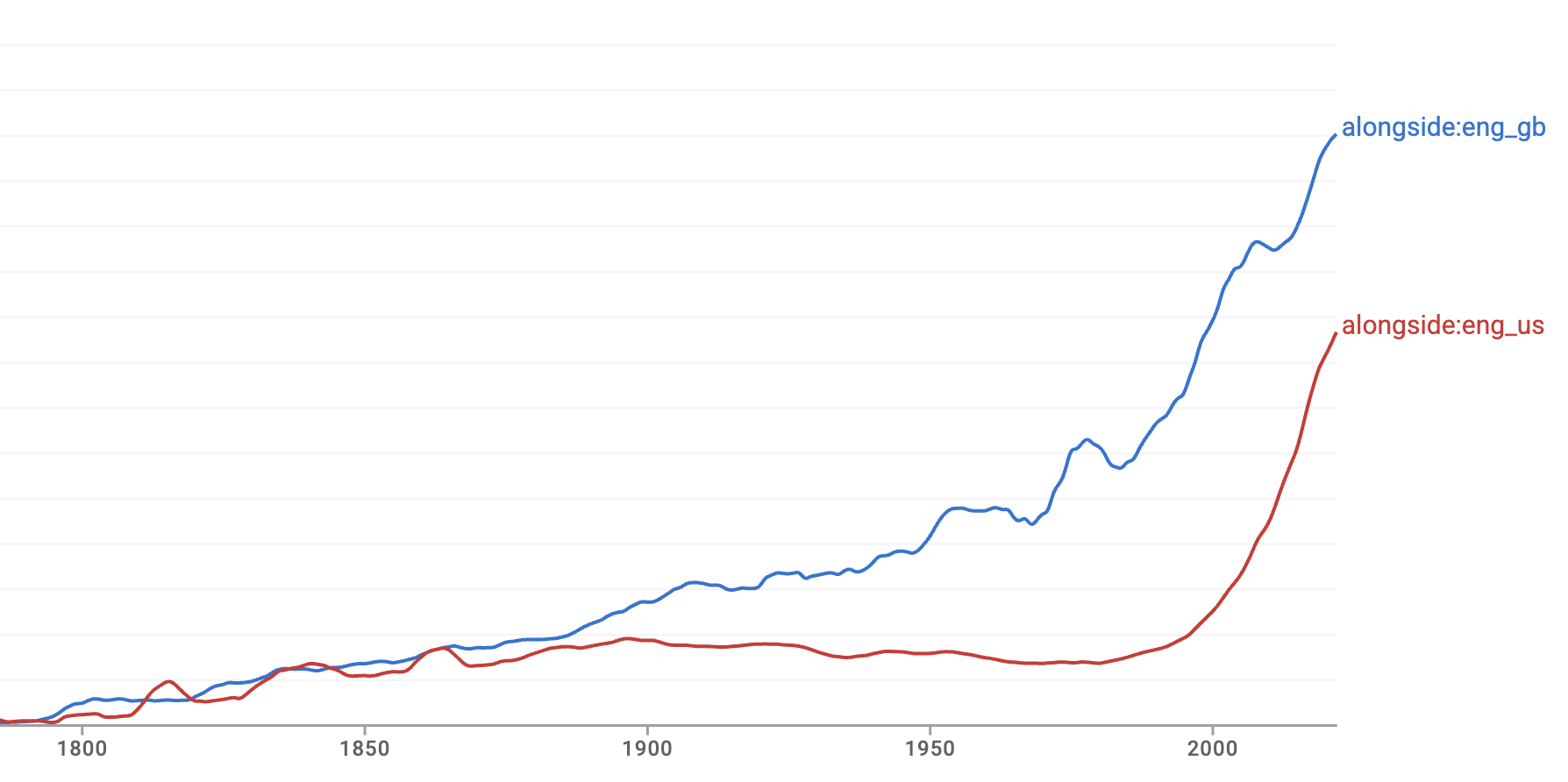
For some reason, “orientate” has been and is much more common in Britain than in the United States. Here’s the Ngram viewer chart showing the frequency with which the word is used in books from the two countries..

A sign of the word’s unusualness in the U.S. is the fact that the thirty-one most recent appearances in the New York Times are all from articles in its sporting division, The Athletic, about international, mostly English, football. For example, on February 25 of this year, Conor O’Neil writes, “Since his £51.4million ($65.5m) move to Chelsea, however, there’s a sense that Neto is still adapting to Maresca’s structured, methodical and possession-orientated approach.” I had to go back to 2021 to find a home-grown example, and that was in a quotation, all of which leads me to conclude that Times style prohibits “orientate.”

The Ngram Viewer chart indicates the word is used here, sparingly, but I confess that I’ve only been able to find one example, in a Merriam-Webster article about “orient” and “orientate.” It’s a line from a 1950 novel by Tennessee Williams, The Roman Spring of Mrs. Stone: “She was only standing there to catch her nervous balance, to orientate herself.”

For the record, Merriam Webster also quotes a 1940 W.H. Auden poem

What parting gifts could give that friend protection,
So orientated, his salvation needs,
The Bad Lands and the sinister direction?

(“Orientate” was apparently so entrenched in Britain that Auden used it even though “orient,” which would have better fit the poem’s iambic pentameter.)

The M-W article points out that “orientate” is only one of several words that over the years have acquired an extra, seemingly unnecessary, syllable, like “irregardless,” “conversate,” and “preventative.” (I would say the first two are uttered or written most often when people mock them, as oppose to actually use them.) Other examples of rather clunky back-formed verbs would be “commentate” (for comment) and “ambulate” (for walk).

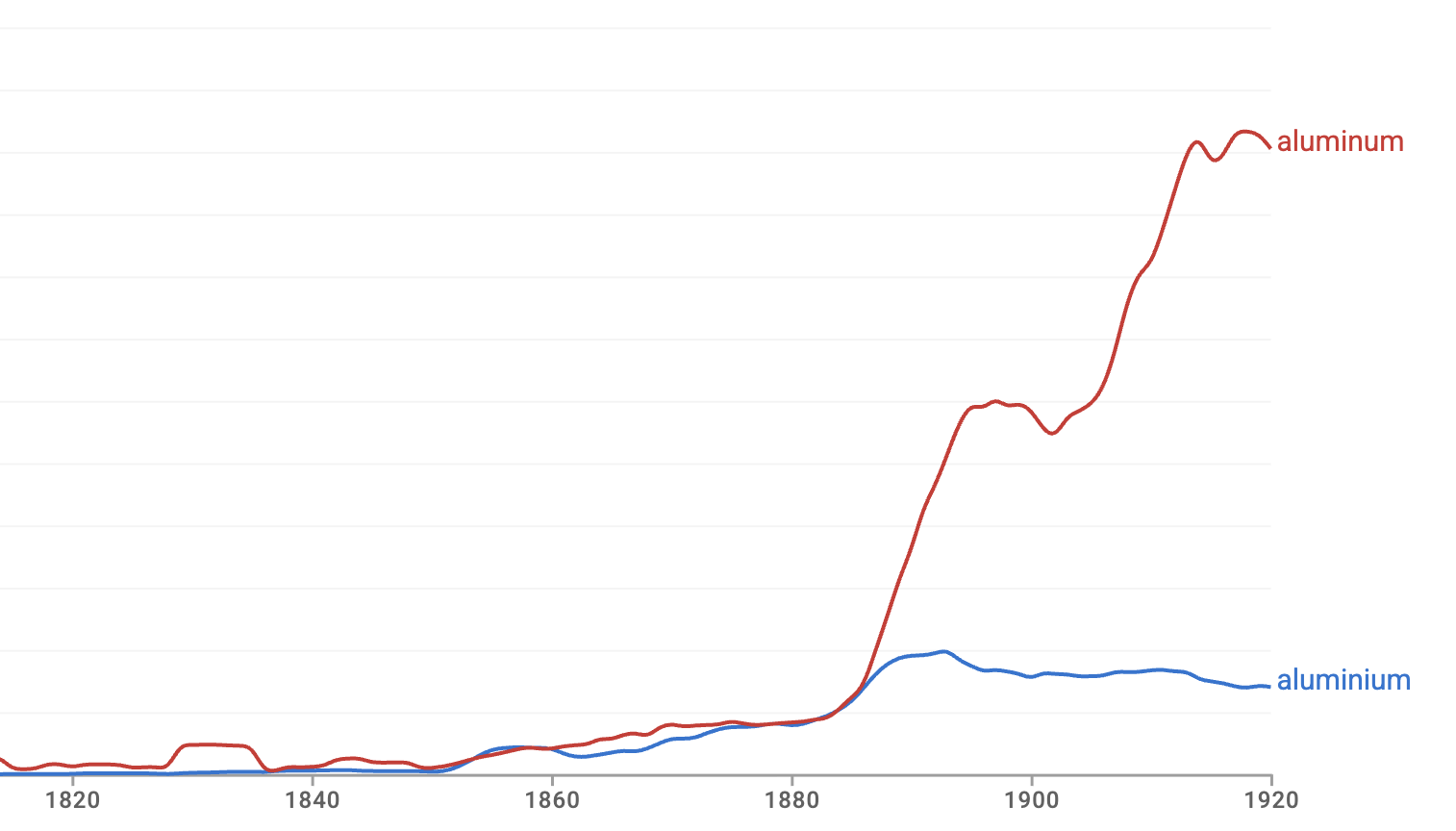
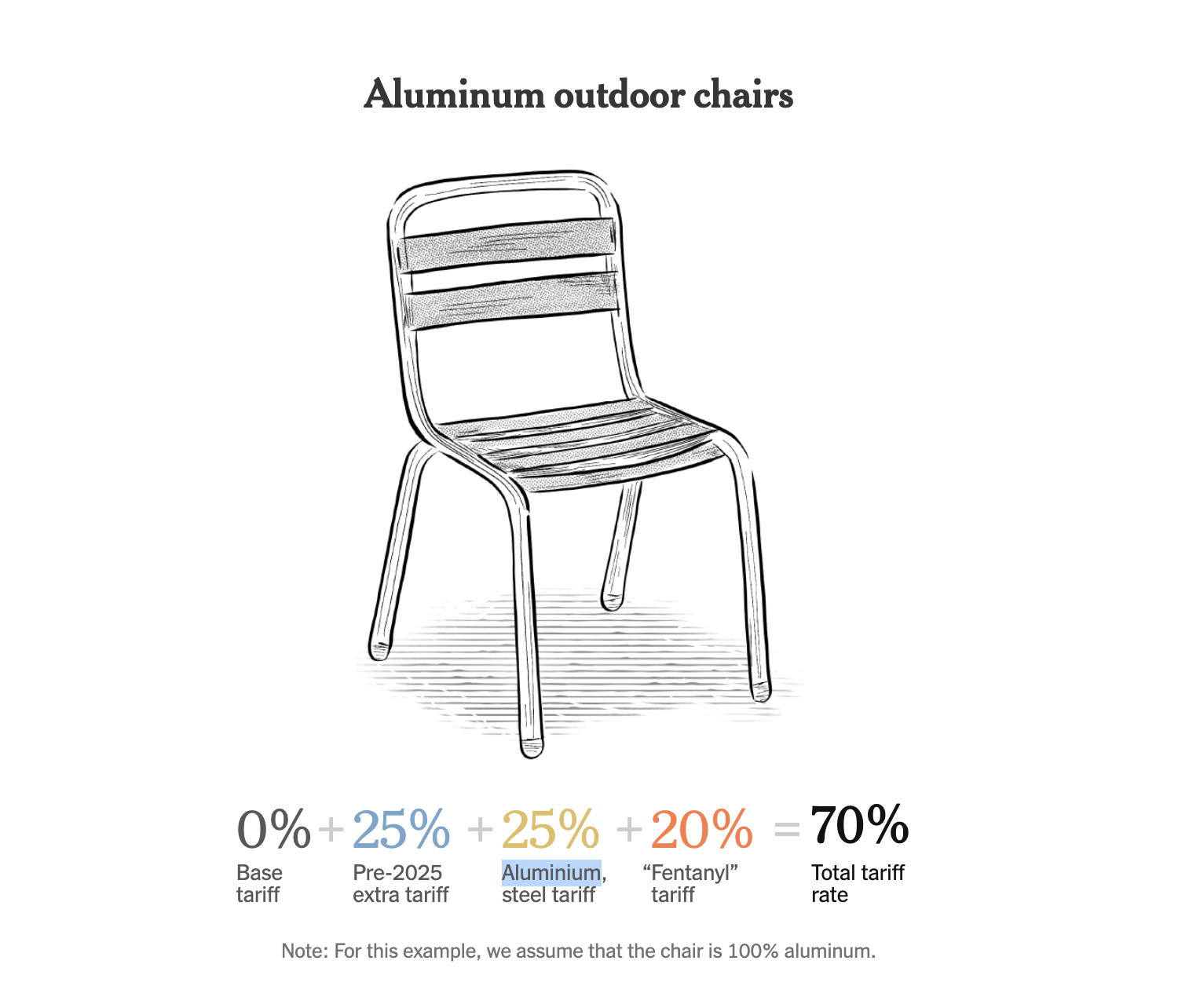
In any case, the British fondness for “orientate” puts me in mind of a British person who recently complained to me about American English being too wordy, questioning why we say “elevator” when “lift” is much more efficient. I replied that they were barking up the wrong tree if they expected language to be either logical or consistent. If I could remember who the person was, I would have them chew on “orientate” and “aluminium.”

Getting back to the photo at the top, I’m pretty confident it’s not an example of British “orientate.” Rather it’s a back-formation from a predominantly American noun, “orientation,” referring to a training session or period for new employees, students, etc. “Orientate,” meaning to undergo orientation, doesn’t appear in any dictionaries I’ve found. But give it time.