“Hard man”

This is an as near as I can tell exact British equivalent of U.S. “tough guy,” usually used in a sporting or criminal context. The quintessential hard man is footballer-turned-actor Vinnie Jones. The OED gives no definition or etymology, but the phrase appeared as early as 1984, in this capsule movie review in The Guradian.

“Sequel again features Gene Hackman as maverick, hard-man cop Popeye Doyle, back on the trail of his old drugs-czar adversary Fernando Rey.” (The Guardian, 1984)

Some other examples (taken from OED citations in other words’ definitions):

“There was no room to express love and only space for one kind of man: the hard man, the man’s man.” (Face, 1995)

“To his prison mates Archie was a swaggering hard man who never let a sliver of emotion through the tough exterior he had built against the world.” (Evening News [Edinburgh], 1998)

“Self-styled Hampstead hard man..is actually just a big-mouthed wet.” (Q, February 2003)

Historically, to the extent the the phrase could be found in the U.S., it was in phrases like “You’re a hard man to track down” or in the off-color Mae West chiasmus “A hard man is good to find.” I had assumed I would never encounter the tough-guy meaning here. But I assumed wrong. In a column about (American) footballer Jim Brown in yesterday’s New York Times, sports columnist George Vecsey wrote, “His aging high school teammates still shudder from the dreaded Tuesday tackling drills and know him as a hard man in public life.”

Figures it would be Vecsey, a soccer fan and a man of the world. I don’t expect to come across it again.

“Local”

I was listening to the public radio show “The Takeaway” today. They had an interview with Thomas Kershaw, who for many years has owned the Boston bar after which the one in the TV show “Cheers” was modeled. Talking about the atmosphere in the city after the recent bombings, he said, “People have places they frequent, that they call their local.”

My ears perked up. This sounded like local in a very British sense, the one usually referred to as the local and defined by the OED as “the public house in the immediate neighborhood.” The dictionary quotes Germaine Greer: “Women don’t nip down to the local.”

After some looking around, I am going to label local as On the Radar. The only possible U.S. use I was able find about wasn’t about a bar at all. It was a March 2012 New York Times article that talked about how a man “came to own his local: the Mud, Sweat and Tears Pottery studio.”

But I bet local will eventually come into its own as a full-fledged NOOB. Probably in Brooklyn.


“Nervy”

I was reading The New Yorker the other night (the March 25 edition–I’m always a few weeks behind) and came across this description of 1970s punk rock: it was “spare, nervy music created in reaction to the embarrassing excesses of arena rock.”

It reminded my that my friend David Friedman, a massive West Ham supporter, had for years been telling me about the British use of nervy, especially in a sporting context, to mean something similar to what Americans call nervous.  I found this example, which is British in every possible way, in a headline on a website called “This Is Staffordhire”: “It’s getting nervy for all as Stoke City enter relegation battle.”

We use nervy, too, but here it’s traditionally meant something between audacious and impudent. The OED cites a 1991 short story by Joyce Carol Oates: “I was nervy enough to ask Joan how she’d gotten the little scar beside her mouth.”

Is nervy=nervous happening as a NOOB? The difficulty in answering is that in many quotes you have to study context clues to figure out how the word is being used. In the New Yorker quote, based on my sense of punk as a pretty twitchy affair, I think the British sense is being used. Same with these from the New York Times:

  • “Ms. Rebeck has created a noisy roomful of sharp-tongued characters who are uncomfortable in their own skin — none more so than the self-conscious Lorna, who is preoccupied with dieting, and her nervy brother Jack, who is elusive about his sudden return from New York.” (November 2012)
  • “Federer earned game point a point later with a 1-2 punch of serve and forehand winner that he followed with a deep bark of ‘come on!’, only to send another forehand well wide on the next point. Federer closed out the nervy hold two points later, however…” (July 2012, and note the logical punctuation)

I found another Times quote, from September 2012, interesting: “Those who followed [Rory] McIlroy’s final round will say he won the tournament with three birdies on the closing nine and two nervy par putts, at Nos. 14 and 17.”

It seems to me that the writer, Karen Crouse, was using nervy to mean something else, sort of the opposite of the British usage. It’s basically the OED’s definition 2a, “courageous, bold,” which the dictionary says is “now rare.” Its most recent citation is a 1942 Stevie Smith poem:  “What man will spoil the brick walls of their yellow brim? Such a one as is nervy bold and grim.” U.S. sportswriters may be bringing it back.

“Pulling”

The New York Times yesterday had an article about four UK television series (“Gavin & Stacey,” “Pulling,” “Second Sight,” and “Spy”) and one Australian one (“Rake”) that are being remade in the U.S. It interested me that ABC appears not to be giving a new title to “Pulling,” the original version of which the Times’ Mike Hale describes this way: “Featuring three unrepentantly randy women, it’s brutally frank about sex, booze and lowered expectations, while also being smart and raucously funny.”

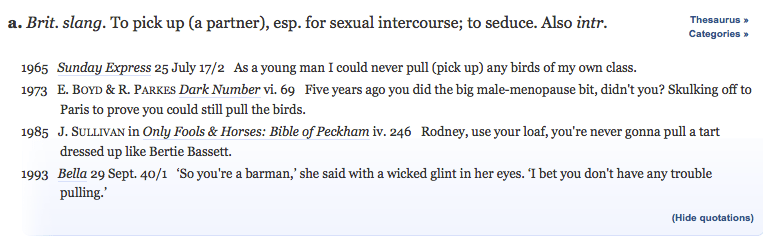
The title thing intrigued me because I have never encountered that meaning of pull in the U.S. For the benefit of American readers, here’s the OED definition and citations:

Screen Shot 2013-04-02 at 9.23.24 AM

I predict that if the show (which stars the excellent Kristen Schaal) ever makes it to air in the U.S., it will be with a new title.

Incidentally, Hale seems to have been inspired by his subject here to use not only randy but another NOOB, in this description of “Rake”: “The protagonist, now called Keegan Joye, will be played by one of American’s most gifted portrayers of kindhearted sleazeballs, Greg Kinnear.”

“Yoghurt”

Screen Shot 2013-03-23 at 12.52.59 PM

I recently became aware of the product featured above. The thing that struck me as odd (as I believe it would most Americans) is the unusual spelling of what we know as yogurt. I suspected it was a Britishism because of Alan Rickman. To be more precise, there’s a scene in the movie “Love, Actually” in which Rickman is trying to buy some jewelry for a woman not his wife, and the sales clerk (played by Rowan Atkinson) won’t let him just get on with it. Rickman finally says in exasperation: “Dip it in yogurt, cover it with chocolate buttons!” He pronounces yogurt with a short in the first syllable–that is, to rhyme with hog–and that’s consistent with the yoghurt spelling.

(If you want to hear Rickman say this line, check out this hilarious YouTube mashup:


)

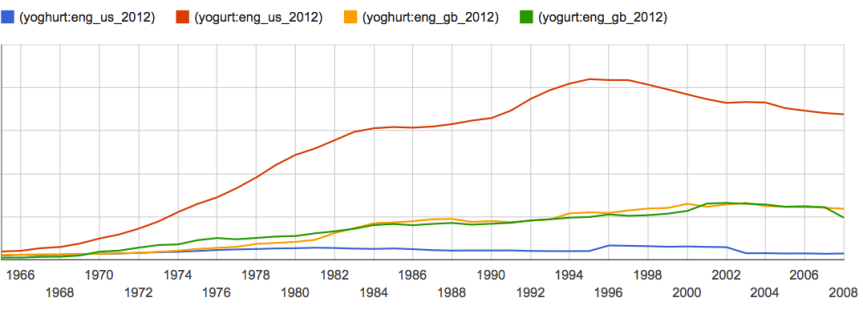
According to the OED, up until the mid-twentieth century, various spellings for the word (derived from Turkish) abounded, including yoghurd, yogourt,yahourt, yaghourt, yogurd, yoghourt, yooghort, and yughard. Subsequently, according to this Google Ngram chart, yogurt (red line) has prevailed in the U.S., and has roughly tied in the U.K. with yoghurt (yellow and green lines).

Screen Shot 2013-03-23 at 1.47.36 PM

Google Ngrams only goes up till 2008, and when more recent data come in, I’m sure that as a result of companies like the Minnesota-based Mountain High, U.S. yoghurt (blue line) will be on the upswing.

“On About”

The British say someone is on about something; Americans say going on, or going on and on. The first citation in the OED is from Rosamund Lehmann’s 1936 novel, Weather in Streets: “Marda’s always asking me why I don’t get a divorce… Last year she was always on about it.”

Welcome to NOOB-hood, bro.

  • Kathryn Schulz (@kathrynschulz) writes on Twitter: “While I’m on about etymology (I’m always on about etymology): ‘adamant’ gets its root from ‘diamond’ — hard, unbreakable.”
  • Kelly Dwyer on Yahoo Sports a couple of weeks ago: “I didn’t see a second of TNT’s Thursday night package, and didn’t hear what [basketball commentator Chris] Webber was on about.”
  • “G. Funk”‘s comment on an article about professional wrestling on The Bleacher Report: “That’s why [the Ultimate Warrior] was the best. No one had a clue what he was on about, but everyone loved it.”

An early U.S. use came from the Rev. Al Sharpton, quoted in a 2002 New York Times article about a taped conversation he had with an undercover agent posing as a drug dealer: ”The guy had come to me. In the middle of conversation he started talking about how he could cut me in on a cocaine deal. I didn’t know what this guy was on about. I didn’t know if he was armed. I was scared, so I just nodded my head to everything he said and then he left.”

Always a groundbreaker, the Rev. is.