“Punter’s Chance”; “Punch Above One’s Weight”

If [the Oklahoma City Thunder are] clicking on all cylinders, I give them a punter’s chance obviously to put the kind of firepower out on the floor to go head to head with the [Golden State] Warriors four quarters.

—Jalen Rose, quoted in The New York Times, April 15, 2016

When I read that quote by Rose (a native of Detroit and famously a member of the University of Michigan’s Fab Five basketball team in the early 1990s), referring to two top National Basketball Association teams, my NOOBs antennae went up.

I had never encountered punter’s chance, but I knew that in Britain, punter is a common word that has not yet achieved NOOBs status. According to the Oxford English Dictionary, it originated in the 18th century to mean “A person who plays against the bank at baccarat, faro, etc.” In Lynne Murphy’s discussion of the term in her blog, Separated by a Common Language, she says it was then generalized “to mean any type of gambler and from there to mean someone who pays for something, and particularly a man who pays for a prostitute’s services.” (This has no relation to the kicking play called the punt in American football and resulting metaphorical verb meaning to put off or delay a decision or action.)

From that, one can deduce that a punter’s chance means a small but not nonexistent chance, such as a bettor against long odds would have. One needs to deduce because the phrase isn’t defined in the OED or any other dictionary I’ve found. Indeed, it is a rarely used expression, on either side of the Atlantic, with scarcely more than 1,000 Google hits. The Rose quote represents the only time it has ever been used in The New York Times. The earliest use I’ve found is this tantalizing one apparently from an Australian financial publication called The Bulletin in 1973:  “At their present price of $2.30 the shares look good value in this market and it’s a punter’s chance that another free issue could be in the wind.” More solid is a quote from a 1986 article in The Hispanic American Historical Review —”He made promises he had only a punter’s chance of keeping.” A 2006 headline from The Times–“Vengeful Ponting Has Given England a Punter’s Chance”–made clever use of the nickname of Ricky Ponting, Australia’s  cricket captain at the time: “Punter.” Four years later, The Daily Mail noted: “It is not just the weather that might give an outsider a punter’s chance in Japan, but the fact the circuit presents a challenge unique in modern motor sport.”

My hypothesis is that punter’s chance is a rather brilliant eggcorn stemming from a more established (and more American than British) expression, puncher’s chance. This one comes from boxing and refers to the fact that even if you’re an outclassed underdog, you can win a match with one knockout punch. The first use I’ve found is from The New York Times in 1961: “Gene Fullmer today remained the favorite to defeat Florentino Fernandez, but the Cuban was given a puncher’s chance to score an upset.” It has been used 68 times in the Times since then, and it now shows up in all sorts of nonboxing and nonsports contexts, such as this from Nick Paumgarten, writing about the novelist James Salter in The New Yorker in 2013: “Among many writers, and some literary people, he is venerated for his sentence-making, his observational powers, his depictions of sex and valor, and a pair of novels that, in spite of thin sales and obscure subject matter, have more than a puncher’s chance at permanence.” Another former NBA player and current analyst, Vinny Del Negro, said last week, referring to the Dallas Mavericks’ playoff series against Oklahoma City, “You always have a puncher’s chance when Dirk [Nowitzki] is on the court.”

Talking of punching, to punch above [or more than] one’s weight is, according to the OED, a “chiefly British” metaphorical phrase derived from boxing and meaning to have more “power or influence [than] one’s status or significance allows or implies.” The first citation is from The Economist in 1986: “Though only some 12 percent of Nevadans are Mormons, they punch more than their weight.” It’s in full cliché mode now, with 5,340 hits in a Google News search. It is also a proper NOOB, with roughly as many of the hits from U.S. as from U.K. sources: e.g., “Russia, too weak to confront NATO directly, relies on two methods to punch above its weight, military analysts say” (The Boston Globe, April 16, 2016).

The phrase apparently really took off in the 1990s due to a widely quoted comment by Foreign Secretary Douglas Hurd of Britain that the country punched above its weight in foreign affairs. Hurd subsequently denied “ever having expressed so crude a sentiment,” according to an Economist article in 1995. “He has ordered searches of electronic databases, defying anyone to find an authoritative attribution of the quote to him.”

No word on the results of the search.

Nice use of “chuffed”

The singer and musician Van Dyke Parks posted this on Twitter today:

Screen Shot 2016-04-06 at 1.14.34 PM

Translation: In 1973, apparently Parks alerted Bonnie Raitt to the song “Wah She Go Do,” which was written by Calypso Rose and opens with the line “I can understand why a woman must have an outside man.” The song appeared on Raitt’s album, “Takin’ My Time,” with backup vocals by Parks. It apparently did well enough to earn Calypso Rose a royalty check in at least the four figures, by which she was understandably pleased.

Here’s the song.

“Gormless”

Friend of NOOBs Lucy Berrington alerted me to a piece posted yesterday in Slate’s women’s-issues blog, XX Factor. Writer Michelle Goldberg discussed how Susan Sarandon, in an MSNBC interview, “posited that a Trump presidency might be preferable to a Clinton one, because it would hasten the revolution. ‘Some people feel that Donald Trump will bring the revolution immediately if he gets in, things will really explode,’ she said.”

Goldberg excoriated Sarandon for–among many other things–“the gormless unreality of her idea of revolution.”

The OED defines “gormless” as “wanting sense, or discernment,” and dates it to 18th-century Lancashire dialect. There’s a citation from Wuthering Heights (1846): “Did I ever look so stupid, so ‘gaumless’, as Joseph calls it.” (Joseph being from Yorkshire, the next county over from Lancashire.)

This Google Ngram Viewer chart suggests that the word didn’t really become widely popular in the U.K. till the 20th century,:

Screen Shot 2016-03-30 at 10.00.09 AM

The low U.S. usage is reflected in the archives of the New York Times, where “gormless” has appeared a mere seventeen times. Many of them are quotations from people from Britain or Ireland, as in the earliest use, from a 1957 column by Drew Middleton: “They’re a poor, gormless [feckless] lot down there,” a Belfast building worker said over the bar at the Great Eastern pub.”  The eleven 21st-century uses tend to be from the mouths of the Times writers, as in the most recent one, a 2015 capsule movie review of “Escobar: Paradise Lost,” where  “Benicio Del Toro’s drug kingpin Pablo Escobar is elbowed aside by this fact-studded fiction’s near-ruinous focus on a gormless surfer played by the chronically inexpressive Josh Hutcherson.”

I expect to see more U.S. uses of “gormless,” as the amount of gormlessness in the world appears to be on the rise.


Is “Called” a Kiddy Thing?

One of the downsides of watching the NCAA basketball tournament (aka March Madness®) is seeing the same commercials over and over (and over) again. Occasionally, there’ll be an ad repeat showings of which I actually enjoy. There’s at least one such this year, for the chain restaurant Buffalo Wild Wings:

I post it here because of what the manchild on the phone says at the beginning: “I have a new friend! He’s called Jeff. I can’t wait to have him over.”

So, “called,” the American equivalent of which is “named.” The question is whether the “called” in the commercial is a NOOB, or if an actual American little kids would tend to say “called” instead of “named.” I await your collective intelligence.

“Can’t Be Arsed”

Online comments sections have a bad reputation, but sometimes you can learn a lot there. The first version of my post on Britishisms in the novel Room (below) appeared in the Lingua Franca blog of the Chronicle of Higher Education, to which I contribute one post a week. A commenter who calls herself “englishwlu” noted:

imagine my surprise when my kid (Virginia born and bred) started saying “I can’t be asked. . .” and “go on about” and “sweet f. a.”–all with the right intonation! It turns out that for many years some of the kids he hangs out with inside games like Minecraft on X-Box Live are British. Evidently their idioms of teenaged ennui have transferred and stuck.

Englishwlu mentioned three expressions. “Go on about” is more precisely “on about,” and I wrote about it here. The other two mystified me. I learned about the meaning and origin of  “sweet f.a.” here. As for “can’t be asked,” NOOB friend Nancy Friedman commented on the comment: “I believe you or your child mis-heard ‘can’t be arsed.'” The top definition for “can’t be arsed” at Urban Dictionary is “To be seriously demotivated; To be disinclined to get off one’s arse; To be unwilling to do something.”

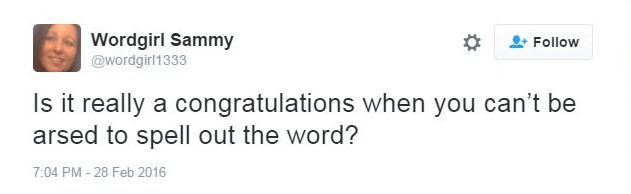
All well and good, but I couldn’t very well claim “can’t be arsed” as a NOOB based on one Virginia teen’s use, or misuse, of it. Again, Nancy Friedman to the rescue. Today, she told me on Twitter that last night, an American had used the phrase in a tweet. Sure enough, she had, and here’s the tweet:

Screen Shot 2016-02-29 at 5.04.24 PM

Which Side of the Atlantic Is This “Room” On?

I just read Emma Donoghue’s excellent novel Room–the film version of which is up for a slew of Academy Awards Sunday night. The book’s about a five-year-old named Jack, whose entire life has taken place in an 11-by-11 foot room, where he is confined with his mother. (That situation becomes apparent in the first few pages of the book, so this is not a spoiler.)

Before starting the book and even as I was reading the early pages, I had the feeling that it took place in a completely unspecified location — or, if anywhere, somewhere in Britain, where I had the sense Donoghue lives. It turned out I was wrong on that last point — she is a native of Ireland now based in Canada. And as I read on in Room, I found I was wrong on the first point, too: We eventually learn that Jack and Ma and Room are in the United States.

I was gobsmacked to learn it, because Jack and Ma both talk like they’ve spent their whole lives hard by the North Sea. I’m reasonably certain that wasn’t intentional on Donoghue’s part. She and/or her editors have scrubbed away most of the obvious Britishisms. Jack says elevator instead of lift, trash instead of rubbish, sweater instead of jumper. Spelling-wise, it’s favorite instead of favourite and program instead of programme

But when it comes to the subtle things that separate the two varieties of English, Jack and Ma almost always come down on the British side. Consider:

  1. At one point, Jack says, “Now I’m 5, I have to choose.” An American kid (or adult) would say “Now that I’m 5.”
  2. He writes, “Ma’s washing up real slow.” American English: “washing the dishes” or “doing the dishes.” (Numbers 2 and 1 are so uncommon in the U.S. that they’ve never been written about in this blog.)
  3. Ma tells Jack, “And I also had — I have — a big brother called Paul.” An American would say “named Paul.”
  4. Jack says poo instead of poop. Enough said on that subject.
  5. He uses the very British proper, as in “if I put on my proper shoes” and “I’m not doing proper pictures, just splotches and stripes and spirals.”
  6. Probably the most common Britishism is bits, used to mean “pieces” or “parts.” The word appears 62 times in Room (having a book on Kindle is great for this kind of investigation), and most are pure British, including: “She doesn’t have many soft bits but they’re super soft”; “she’s putting the hem back up on her brown dress with pink bits”; and “For dessert we have a tub of mandarins between us, I get the big bits because she prefers the little ones.”

An important moment in the book, referred to frequently later on, happens when Ma points to Jack’s reflection in Mirror and says,

“The dead spit of me.”

“Why I’m your dead spit?”…

“It just means you look like me. I guess because you’re made of me, like my spit is.”

When I encountered it, I thought “dead spit” was a bit of poetic invention. But I looked it up and it turns out it’s a common British expression for what Americans call “spit and image” or “spitting image.”

I don’t blame Donoghue for all of this. Only someone as neurotically obsessed with the differences between American and British English as I am would be expected to be aware of the trans-Atlantic register of every word or phrase. But the personnel who see a manuscript to publication are expected to attend to such matters. And Donoghue’s editors let her down.

[Note: a version of this article previously appeared in the Chronicle of Higher Education’s Lingua Franca blog.]

“On Lead”

Below is a portion of a photo that appeared in today’s New York Times, taken at the Westminster Kennel Club Dog Show, in New York.

Screen Shot 2016-02-17 at 9.25.39 AM

My eye was immediately drawn to the sign saying “DOGS ON LEAD ONLY.” I only became aware of the expression “on lead” during a trip to England two years ago, when I encountered it as the equivalent to what Americans would call “on a leash.” My guess is that it’s been used in American dog circles for a long time; I’m sure readers can fill me in on that score.

Wassup, Wazzock?

You may have caught this Budweiser ad during the Super Bowl. Dame Helen Mirren sits before a burger, is served a Bud (not bloody likely), and counsels, in strong language, against driving drunk. Anyone who does so, she avers, is a “shortsighted, utterly useless, oxygen-wasting human form of pollution.” Then, at about the 41-second mark, she says, “Don’t be a pillock.”

My guess is that somewhere north of 99 percent of the people who saw the spot had no idea what a pillock is — though they could clearly tell by context clues that it isn’t a good thing. I certainly wasn’t familiar with the term and went straight to the Oxford English Dictionary, whose first definition is: “orig. Sc[ottish]. The penis. Now Eng. regional (north.) and rare.” The copywriter for the Mirren commercial was clearly going for definition No. 2, which is “Chiefly Brit. colloq. (mildly derogatory). A stupid person; a fool, an idiot.” The first OED citation for the figurative use is from 1967, the most recent from a rugby magazine in 2004: “Those mindless pillocks in New Zealand who slated England for the way they played in Wellington in June.”

Pillock may have rung a faint bell in the minds of English majors. It is likely a shortening of another word for penis that turns up in King Lear. Edgar, in his guise as the mad beggar Poor Tom, pipes up at one point with a line from a perverse ditty: “Pillicock sat on Pillicock hill. La, la, la, la!” (Use your imagination for the meaning of “Pillicock hill.”)

Salty British insults seem to be in the air at the moment. Returning from Australia, I caught up on some Simpsons that had piled up in my absence. In “The Girl Code,” which aired January 3, Lisa creates an avatar with a British accent (voiced by Stephen Merchant), who ultimately comes to life and, à la Mirren, delivers some hard truths, including: “Your species is on the precipice of turning into complete and utter wankers.” Wanker, of course, is an epithet whose literal meaning is habitual masturbator. One hears and reads it occasionally from Americans, who do not seem to be aware that it’s considered a fairly coarse term in the U.K., certainly more so than pillock. Indeed, a British website that provides transcripts of Simpsons episodes could not bring itself to print the word, rendering it “w*nk*rs.”

Yet another British derogatory term attracted attention in January, when — after a petition advocating banning Donald Trump from the United Kingdom attracted some 600,000 signatures — the House of Commons actually considered the question. They ended up not taking a vote, but in the course of debate, MP Victoria Atkins said Trump was a “wazzock.” Surprisingly, wazzock seems never to have meant penis. It sprang up as slang in the North of England in the 1970s as an all-purpose insult. If you would like to learn quite a bit about its origin and use, listen to this Lexicon Valley podcast with Ben Zimmer.

It has been little remarked that Trump’s name itself is a British term for a bodily function. An American friend of mine with British relatives emailed me, “When I was in England over the holidays, my 6-year-old grandnephew said, ‘I trumped!’

“The adults from America wondered why no one at home had pointed out that our leading Republican candidate’s name means to fart.