“Orientate”

On a recent trip to New York City, I saw this sign at a worksite:

Of course, it was the word “orientated” that caught my eye. “Orientate” and its fraternal twin, “orient,” are part of an interesting history. They derive from the noun “orient,” referring to an easterly direction or region. A verb form arrived in the early 1700s, according to the OED, with the meaning, “To place or arrange (a thing or a person) so as to face the east; spec.(a) To build (a church) with the longer axis running due east and west, and the chancel or chief altar at the eastern end;(b) to bury (a person) with the feet towards the east.”

A hundred or so years later, the meaning was broadened: “To bring into a defined relationship with known facts, circumstances, etc.;” The OED‘s first quotation with this sense is from 1850: “It seems to me you might, in this way, orient yourself before the public.”

Along the way, a new noun, “orientation,” appeared–in the 1830s referring to churches facing east and in the 1870s to more general or metaphorical positioning. The next step, which came relatively quickly, was the back-formation of the verb “orientate,” meaning essentially the same thing as “orient.”

For some reason, “orientate” has been and is much more common in Britain than in the United States. Here’s the Ngram viewer chart showing the frequency with which the word is used in books from the two countries..

A sign of the word’s unusualness in the U.S. is the fact that the thirty-one most recent appearances in the New York Times are all from articles in its sporting division, The Athletic, about international, mostly English, football. For example, on February 25 of this year, Conor O’Neil writes, “Since his £51.4million ($65.5m) move to Chelsea, however, there’s a sense that Neto is still adapting to Maresca’s structured, methodical and possession-orientated approach.” I had to go back to 2021 to find a home-grown example, and that was in a quotation, all of which leads me to conclude that Times style prohibits “orientate.”

The Ngram Viewer chart indicates the word is used here, sparingly, but I confess that I’ve only been able to find one example, in a Merriam-Webster article about “orient” and “orientate.” It’s a line from a 1950 novel by Tennessee Williams, The Roman Spring of Mrs. Stone: “She was only standing there to catch her nervous balance, to orientate herself.”

For the record, Merriam Webster also quotes a 1940 W.H. Auden poem

What parting gifts could give that friend protection,
So orientated, his salvation needs,
The Bad Lands and the sinister direction?

(“Orientate” was apparently so entrenched in Britain that Auden used it even though “orient,” which would have better fit the poem’s iambic pentameter.)

The M-W article points out that “orientate” is only one of several words that over the years have acquired an extra, seemingly unnecessary, syllable, like “irregardless,” “conversate,” and “preventative.” (I would say the first two are uttered or written most often when people mock them, as oppose to actually use them.) Other examples of rather clunky back-formed verbs would be “commentate” (for comment) and “ambulate” (for walk).

In any case, the British fondness for “orientate” puts me in mind of a British person who recently complained to me about American English being too wordy, questioning why we say “elevator” when “lift” is much more efficient. I replied that they were barking up the wrong tree if they expected language to be either logical or consistent. If I could remember who the person was, I would have them chew on “orientate” and “aluminium.”

Getting back to the photo at the top, I’m pretty confident it’s not an example of British “orientate.” Rather it’s a back-formation from a predominantly American noun, “orientation,” referring to a training session or period for new employees, students, etc. “Orientate,” meaning to undergo orientation, doesn’t appear in any dictionaries I’ve found. But give it time.

Anthimeria Update

Anthimeria (also known as “functional shifting”) is a linguistics term that refers to a word being used as an unaccustomed part of speech. It happens a lot, as when people started to say, “I’m going for a run,” or the first advert(isement) that proclaimed something like “Welcome to extraordinary!”

Two NOOB-y examples recently popped up. My friend Hillard Pouncy sent me this quote from Josh Marshall at the Talking Points Memo blog: “We start with a piece in this morning’s Punchbowl which is simultaneously encouraging and gobsmack disheartening.” That is, he is using “gobsmack” as an adverb. I’ve searched around a bit and, having found no other examples, conclude that this is a one-off. Hopefully it will stay that way.

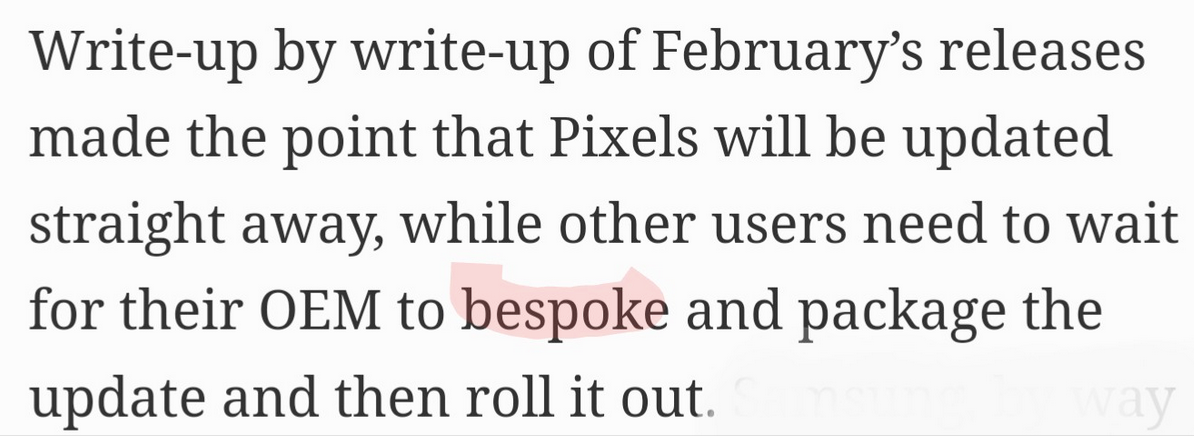
Next is a quote that NOOBs-friend Mike Pope posted on Facebook (he didn’t name the source, but “straight away” suggests the writer is British):

That is. “bespoke” as a verb meaning, as one commenter on Mike’s post pointed out, “tailor.” (That of course is itself an anthimeria, albeit a venerable one; the OED reports that “tailor” was used as a noun by 1297, and a verb by 1662,)

The OED doesn’t recognize “bespoke” as a verb but it’s out there. To separate it out from the noun I searched for “bespoked” in Google Books and got a non-negligible number of hits, including:

and

Meaning that this one, alas, appears to be no one-off.

“Down to”

Longtime reader David Ballard emailed yesterday to alert me to a sentence he read in the Washington Post:

“….and fired him two years later, after he declared that Trump’s loss in the 2020 election wasn’t down to fraud.”

He was interested in the two-word phrase in italics, which he (correctly) felt was British.

Now, “down to” can mean awfully many things. Merriam-Webster’s online dictionary has trawled the internet and come up with a couple of dozen examples, of which this is a selection:

–Then, scroll down to find the Passkeys section and tap on it.
— It’s marked down to just $145 right now—a third of the price of the Dyson Animal.
— The game was down to a one-point margin, 70-69 with Iowa in the lead, in the last few seconds of the game.
— Lambert joined in on singing the chorus, and the pair rocked along while jumping up and down to the beat.
— Today, the plates have slowed back down to their normal speed.
— But this one will get the temp down to 64 degrees at its coolest setting.
— But now that things were down to the wire, Bowser’s team returned to Lee’s staff to try once again.
— Chaz is a friend, and Jimmy is always down to help out his friends.
— The man then kneels down to allow the older dog to get a closer look at the puppy.
— Their third choice receives eight points, fourth choice seven points — and so on, all the way down to one.
— One day Botting headed down to the quarry to search for more sponges.
— Joshua Estrada had a sack on fourth down to frustrate the Pirates.

That doesn’t even include a least a couple of other uses. One I think of in connection with the 1974 Joni Mitchell song “Down to You,” which has these lyrics:

Lost or changing as the days come down to you
Down to you
Constant stranger
You’re a kind person
You’re a cold person too
It’s down to you.

Then there’s the idiom in a sentence like, “I put his mistake down to carelessness”–that is, meaning “attribute.”

I think the British expression actually came from that. The OED lists two closely related meanings, and has only British citations for both. The first is defined as “to be attributable to” and the first quote is from The Times in 1955: “Wattam said: ‘It’s down to me, the stamps and postal orders belong to me. They are nothing to do with the wife. I’ve done all the jobs.’” The second means “To be the responsibility of” and seems to have originated in police jargon; the first citation is from a 1970 study of Scotland Yard. This 1986 quote is from City Limits: “The clothes are by Jean-Paul Gaultier, the basslines are by Blackmon, and the dancing is down to you.”

Besides the Washington Post quote, Merriam-Webster provides these examples from American publications, though I can’t vouch for the nationality of the authors:

  • “This is all down to memory-bandwidth limitations on the Nvidia cards, due to their 128-bit interface. ” PCMAG, 25 Jan. 2025
  • “The reason for such fulsome praise is down to the warm but detailed sound that the GO link produces.” Travel+Leisure, July 2024

Other U.S. examples? That’s down to you, readers.

“In hospital” in Washington Post

My friend Kevin Kerrane forwarded me this letter to the editor, which appeared today in the Washington Post.

We learned this at university

Twice recently, The Post has published the Britishism “in hospital,” and not when quoting sources. The Jan. 10 AP article “Key motorway in Serbian capital blocked during student-led protest over train station crash” reported that “one more person later died while in hospital.” The Jan. 19 Business article “As they age, more women are taking the roommate route” stated, “A friend took care of her cat while she was in hospital.”

Is it not still the case that Americans say “in the hospital”? Perhaps Post editors could grab a style guide from the boot of their saloon car and have a butcher’s (pronounced: shufti) to confirm how to characterize the location of sick people for an American audience. Correct this usage, and I’ll be right chuffed.

Art Stern, Falls Church

“Tick,” Revisited

This popped up the other day, as I was buying tickets to see David Doucet perform at Buffa’s in New Orleans.

The NOOB in question is “tick,” where Americans would historically say “check.” (The “should you wish to receive” sounds off as well, perhaps more formal than British. The U.S. norm would be “if you want to…”)

I see that I wrote about “tick” in the very first year of the blog, 2011. I’ve seen it from time to time here over the years, often in the expression “ticks [as opposed to “checks”] all the boxes.”

Some of the commenters on the original post seemed to differ on whether British “tick” and and American “check” indicated the same mark. Some said both meant a single diagonal lower-left-to-upper right line, while others said no, an American checkmark starts with a short diagonal, upper left to lower right, like this:

I would tend to agree with them. Your thoughts?

“Opposite number”

Back to H.L. Mencken and his The American Language. In a supplemental volume published in 1945, he writes:

The English opposite number, signifying a person in corresponding office or position, e.g., the American Secretary of State with respect to the English Foreign Secretary, has made some progress in the United States in recent years, but only on relatively lofty levels: the common people know nothing of it.

Mencken also says, “It has come in England since World War I, and probably had a military origin.” The first part of that sentence is wrong, and for the second, I would replace “military” with “naval or nautical.” The first citation in the OED is from 1874: “The next time the fish rose it was close to one of our boats, in which was Jemmy Gray, a sure and successful harpooneer, who, unlike his opposite number in the other boats, quickly fired and got fast.” (A.H. Markham, Whaling Cruise to Baffin’s Bay.

Using Google Books, I was able to antedate that by two years, with a quote from The Medical Press and Circular, from October 2, 1872:

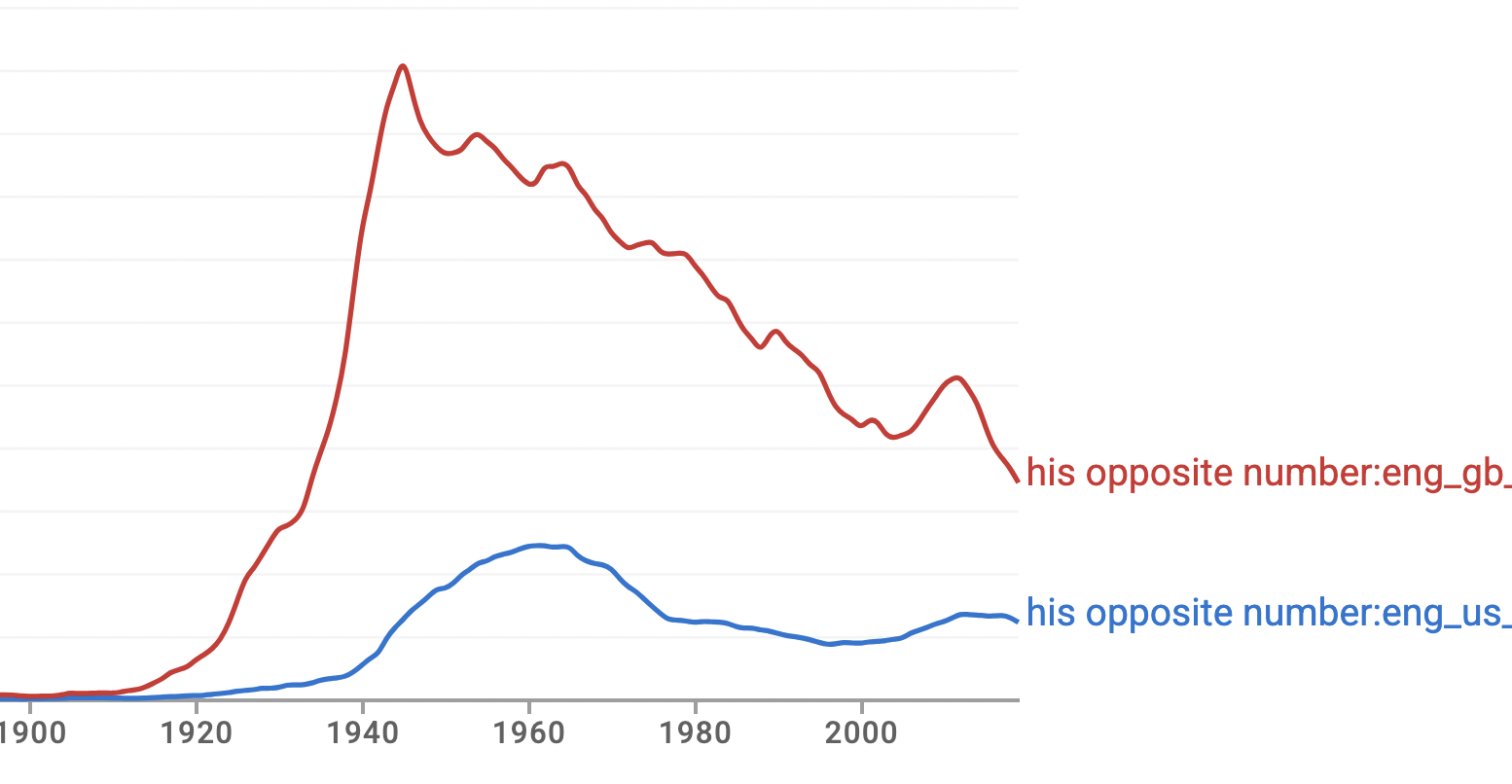
Google Ngram Viewer shows a sharp increase in British use of the phrase in the 1910s and ’20s, followed by an American uptick just about the time Mencken was writing.


“Opposite number” is quite familiar to my American ears, albeit a little old-fashioned; I was surprised to learn of its British origin and, especially, that it currently seems to be more than twice as common in the U.K. as in the U.S.

The New York Times first used the phrase in a 1940 movie review, and it’s been in the paper about 700 times since then. But the figure is misleading. The most recent forty-six uses, dating back to the summer of 2024, have all been in coverage of football/soccer, mostly concerning English or European teams, in the Times’ sports site, The Athletic. For example, “Over 30 minutes had passed after [Manchester City manager Pep] Guardiola left the room and, still, his opposite number was nowhere to be seen.”

Which suggests to me that “opposite number” currently lives most robustly as a British sportswriting cliché. Or at the very least as elegant variation for “counterpart.”

“Pub-crawl”

Back to H.L. Mencken and his book The American Language, he says in Supplement One (1945) that one of the Britishisms “that deserve American adoption” is “‘pub-crawl’ (a tour of saloons).” I’m pretty sure my readers don’t need that definition, so familiar has the phrase become on this side of the Atlantic. But it definitely had British origins.

It sprang from more more specific sorts of alcoholic “crawls.” The OED‘s first citations (Bird o’ Freedom is Australian; the other publications are English):

The familiar modern form first appears in a quote from Thomas Burke’s 1915 book Nights in Town, the quotation marks suggesting recent coinage: “We did a ‘pub-crawl’ in Commercial Road and East India Dock Road.” All subsequent OED citations are British.

Google Ngram Viewer shows modest U.S. use from the 1930s through the ’70s–so modest that many if not most of the hits probably came from British books published in the U.S., travel books about Britian or Australia, or dialogue in novels from the mouths of British speakers. The rise from the ’80s through the present is real, though. (And the decline in Britain post-2000 could reflect awareness of American appropriation.)

The first use I could find in the New York Times by an American came in a 1975 column by the great Russell Baker–who had been a foreign correspondent in London early in his career. He’s talking about the world of different magazines, and says that in Esquire, “Dante Gabriel Rossetti always seems to be jogging with Muhammad Ali while Norman Mailer is on a pub crawl with Vergil.” (Elsewhere, Baker writes, “Not that the world of People isn’t a pretty gosh‐dam wonderful place, too. Life may not be very exhilarating in the world of People, but it is beautiful. There I meet Prince Charles, who has no problems, and Erica Jong, who has fame, beauty and success. And J. Paul Getty, the richest man in the world! I learn that Catherine Deneuve is beautiful and Liza Minnelli is talented and Mikhail Baryshnikov is happy. What a sweet world. It is what the world of F. Scott Fitzgerald would have been if Fitzgerald had been ghostwritten by Dr. Norman Vincent Peale.” Here’s a gift-link to the rest of the pretty gosh-darn wonderful column.)

However, in the 21st century, “pub crawl” has appeared 280 times in the Times, including in an article last year about the (American) football-playing brothers Travis and Jason Kelce, Billy Witz writes that Jason, “who plays for the Philadelphia Eagles, has followed his brother’s team on what has looked like a bare-chested pub crawl through the playoffs.”

And any doubt I might have had that “pub crawl” has achieved “adoption” as well as commercialization in America is removed when I Google it on my phone (which of course knows I live near Philadelphia) and this pops up:

“Swagger”

It’s always instructive to look at H.L. Mencken’s The American Language,, which was originally published in 1919 and went through many editions before Mencken released the second and final “Supplement” in 1948. In his chapter “Briticisms in the United States” (I have before me the 1936 edition), he writes, “It is most unusual for an English neologism to be taken up in this country, and when it is, it is only by a small class, mainly made up of conscious Anglomaniacs… To the average red-blooded he-American [the stage Englishman’s] tea-drinking is evidence of racial decay, and so are the cut of his clothes, his broad a, and his occasional use of such highly un-American locutions as jolly, awfully and ripping.”

He mention a number of words that have managed to “seep in” among certain classes, some of which I’ve considered in the past, including “mummy” and “smog“; on the other hand, he says, “wowser” and “wangle” “have never got a foothold.”

Wangle eventually did, though it took some time. Over thee next couple of weeks, I’m going to consider some of the other “Briticisms” mentioned by Mencken that took a while to catch on here, starting with one that will probably surprise you. Mencken writes,

When certain advertisers in New York sought to appeal to snobs by using such Briticisms as swagger and topping in their advertisements, the town wits, led by the watchful Franklin P. Adams …, fell upon them and quickly routed them.

The surprising one, of course, is “swagger,” which is now common enough in the U.S. to have been used 272 times in the New York Times over the past year, including in these headlines:

These are all “swagger” as a noun, deriving from the OED‘s definition 1 a.: “The action of swaggering; external conduct or personal behaviour marked by an air of superiority or defiant or insolent disregard of others.” The dictionary’s citations, all British and all dating from the 18th and 19th centuries, include this from King Solomon’s Mines (1885): “He was an impudent fellow, and..his swagger was outrageous.”

The noun comes from the verb, defined by the OED as: “To behave with an air of superiority, in a blustering, insolent, or defiant manner; now esp. to walk or carry oneself as if among inferiors, with an obtrusively superior or insolent air.” The dictionary has some interesting quotes, starting with Shakespeare’s Midsummer Night’s Dream: “What hempen homespunnes haue we swaggring here, So neere the Cradle of the Fairy Queene?” Then this from Gulliver’s Travels in 1726: “He..became so insolent..that he would always affect to swagger and look big as he passed by me.” And, showing at least some adoption in America, from Washington Irving’s Tales of Traveller (1824): “He took complete possession of the house, swaggering all over it.”

Google Ngram Viewer shows that except for a few years in the 1840s, “swagger” has always been more common in Britain than in the U.S.

The most common current form, I would say, is the shortened form “swag,” an incredibly rich word that has seven separate entries in Green’s Dictionary of Slang–four nouns (including the word for promotional freebies), two adjectives, and one verb. The one that comes from “swagger” has this OED definition: “Bold self-assurance in style or manner; an air of great self-confidence or superiority.” It came out of hip-hop where one of the first uses was in a 2003 Jay-Z song: “My self-esteem went through the roof, man. I got my swag.”

I wonder what Mencken would have made of that.