Correspondent David Griggs sent from England a note saying “you may be interested” in an example of the word “clobbered” in the New York Times. He was clearly implying it was a NOOB, but the word — meaning “to badly beat or defeat” — didn’t strike my ears as such. I checked the Times archive and found that “clobbered” or “clobber” have been used in the paper 1,720 times since 1990, frequently in a sports context. (“Carmelo Anthony returned to Madison Square Garden, but his Trail Blazers got clobbered by the Knicks, 117-93.”)
Google Books’s newly beefed-up Ngram Viewer told an interesting story:
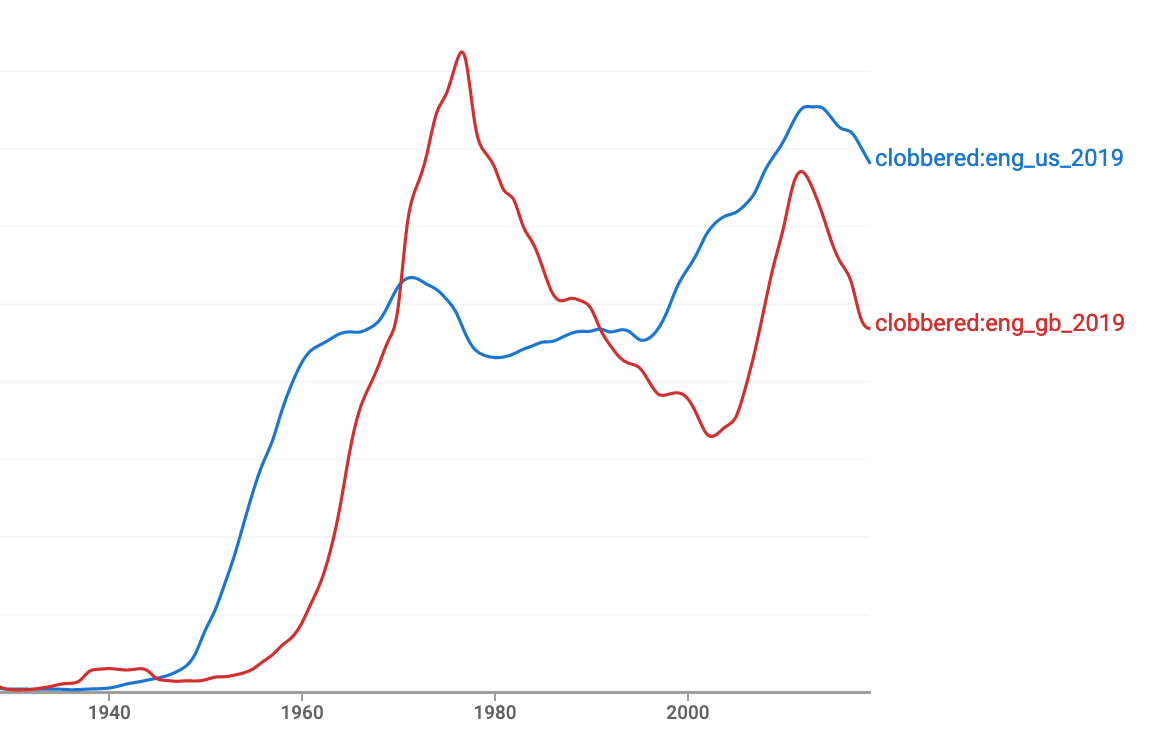
That is, more use in the U.S. from the ’40s through about 1970, then a big spike in Britain over the next twenty years or so — which may account for David Griggs’ sense of it as a British word — followed by a period of slightly greater U.S. use.
But then David sent along a couple of sources asserting that “clobber” originated in British R.A.F. slang. The Online Etymology Dictionary dates it to 1941, but doesn’t give any citations or sources. And a Merriam-Webster article says, “Pilots of the British air force during the 1940s were supposedly the first to throw around the punchy verb ‘clobber” (emphasis added): again, no evidence.
The OED does offer some, though from 1944 rather than 1941. Its first citation is from the R.A.F. magazine Gen, which had the line “Did anyone clobber any?” (The “any” apparently referred to flying bombs.)
The next two citations are from American sources, the first, reflecting a move in meaning from bombing to beating, from a 1949 reference to the University of Michigan football team: “The Wolverines clobbered their opponents 42 to 3.” And the second comes from Max Shulman’s 1951 novel The Many Loves of Dobie Gillis: “‘Poor loser!’ they kept yelling as they clobbered me.”
And on my own I found a 1946 use by an American writer, Percy Knauth: “Bayreuth was clobbered badly.”
Green’s Dictionary of Slang adds some interesting bits to the story, starting with some lines from a poem in an 1894 issue of the Australian magazine Truth: “The larrikin / So full of sin, / has now no fear of getting clobbert.”
Then two citations that illuminate the word’s move to America.
From 1000 Destroyed, 1946, by Grover Cleveland Hall: “It didn’t appear the war was going to last long enough to clobber them.”
And from the 1948 novel Twelve O’Clock High: “‘Hit it?’ Savage asked. ‘Clobbered it, I think, sir.'”
Hall was a public relations officer for the 4th Fighter Group of the U.S. Army Air Force — which was headquartered at the former R.A.F. base at Debden, England, starting in 1942. And Twelve O’Clock High was modeled on activities of the 306th Bomb Group, based at another R.A.F. facility, at Thurleigh.
As David Griggs said to me in an email, “Interesting just when Ngram says ‘clobber’ took off in the US: the late 1940s; all those American servicemen returning from WW2 Europe…” Exactly. The remarkable thing is just how fast it took hold in the U.S. For reasons I won’t speculate on, “clobber” and America were made for each other.
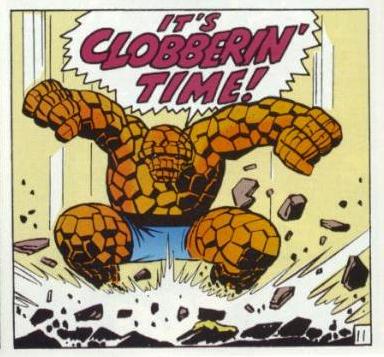
Update: The comments to this post and some additional investigation revealed several additional points of interest. First, the slogan of the comic book character The Thing has been, at least since 1964, what you see in the image below.
Second, I should have pointed out a second, apparently unrelated British use of “clobber,” as a slang term for clothing (dating from the 1870s) or equipment or gear (1890s). They’re still in use today but have not penetrated America.
And finally, “the clobber passages” is a term that refers to the six or seven biblical verses that have traditionally been used to support the idea that the Bible condemns homosexuality.






 notoneoffbritishisms.com