I know Michael Sokolove. Michael Sokolove is a friend of mine. I have not served in the Senate with Michael Sokolove, but I have broken bread with him and played basketball with him and happen to know he hails from Lower Bucks County, Pennsylvania. And so I was surprised to read him say–in a Q and A at the New York Times website regarding his excellent recent article about Oscar Pistorius:
One of the great things about sport is that it is in some ways primitive, or we want to imagine it is.
The surprising thing was that he said sport, a Britishism, rather than the American sports. (We do, however, refer to baseball as a sport and to a person asa good sport.)I asked him about it and he blamed it on his English son-in-law.
But Sokolove is not alone. Times columnist David Brooks, theorizing on the Jeremy Lin phenomenon, recently wrote:
The moral ethos of sport is in tension with the moral ethos of faith, whether Jewish, Christian or Muslim. The moral universe of modern sport is oriented around victory and supremacy.
A headline in the Philadelphia Inquirer late last year read: “Money, not sport, the name of the game.” And a while back, Slate had this one: “Politics and sport: a dangerous mix.”
The next thing you know, we’ll be talking about maths.
What is going on where we are suddenly calling redheads “gingers”? People, we won the Revolutionary War, we don’t have to put up with this.
Hey, Ken, you may be the king of all trivia but you have to brush up your NOOBs: Ginger is the second most all-time most popular entry on this blog. (FYI, bits is first and wankeris third.) You and any other interested party can sort out what’s going on with ginger here.
The phrasal verb has assorted meanings, most of them common to both British and American English: retain (“he hung on to his mother’s jewelry”), refrain from telephonically hanging up (Blondie’s “hanging on the tel-e-phone”), and remain clinging (the Supremes’ “you keep me hangin’ on”).
That leaves hang on is an imperative verb, metaphorically requesting or demanding a time out. The American equivalents are wait (a minute) or hold on (a minute); the OED quotes an 1841 dictionary of Americanisms describing the latter as “originally a sea phrase.” The OED’s first citation for this hang on is a surprisingly late definition in a 1941 dictionary of Australian (!) slang. But now it is so much a Britishism that I can’t even say it in my head other than in my lame British accent (believe me, you don’t want to hear).
All the more reason why the American chattering classes seem to be lapping it up:
... spelling out that members of Congress shouldn’t use non-public information gained through their jobs to line their pockets? As Financial Services Committee Chairman Spencer Bachus allegedly did, according to a 60 Minutes investigation? That’s more in the category of hang on, I can’t believe this is not already against the rules. (Andrew Rosenthal, New York Times, January 27, 2012)
Scientology appears to be giving you the promise of a better knowledge of God, perhaps an attractive prospect for youngsters who might be feeling that more mainstream organized religion leaves them cold. But hang on a minute. What “god” do Scientologists believe in? (Villagevoice.com, February 7, 2012)
Not One-Off Britishisms is one year and one day old, so happy belated birthday to me!
The very first post (on advert) has been followed by 142 more; there have been 686 comments and 79,492 page views. Massive attention has been paid, to which I say, “Cheers!” (a word that so far on these shores is seen only as a drinks salutation and e-mail closing, not as a substitute for thank you. Give it time).
Unaccountably, new NOOBs keep turning up, so I will carry on for a while. Talking of that, my next post will be on turn up (as a substitute for show up) and the one after that on talking of (speaking of).
Immediately. The OED cites a use as early as 1662; the subsequent examples given suggest that in roughly 1900, the predominant form changed from two words (straight away) to one (straightaway), though both versions are still found.
Since straightaway has a 100 percent precise and unobjectionable American equivalent, to wit, right away, its quite frequent use nowadays by U.S. writers is an excellent gauge of their unwavering fondness for NOOBs.
“I knew straightaway what had gone wrong—caps lock was depressed by accident—but instead of simply taking my lumps and re-entering my password, I vented: ‘Is there anything on the computer keyboard more annoying than the caps lock key?'” (Mathew X.J. Malady [“a writer and editor living in Manhattan”], Slate.com. February 1, 2012)
“A comedy about business consultants? Get them to a strip club straight away (‘House of Lies’ pilot, last month).(Neil Genzlinger, New York Times, February 4, 2012)
In a short New York Times essay about his personal art collection some time back, Steve Martin wrote, “There are great pictures mixed in with good pictures, mixed in with oddballs, but I endorse and have found something worthwhile in every one of them.” In all he used the word picture or picture fifteen times, always as a synonym for painting.
This is a distinctly British, U (in the sense of U vs. non-U) and old-fashioned sense of the word. John Ruskin wrote in 1852, “Every noble picture is a manuscript book, of which only one copy exists or ever can exist.”
Wilde didn’t call his novel The Painting of Dorian Gray, after all. In that book, Lord Henry Wotton, after seeing the title portrait for the first time, tells the man who painted it, Basil Hallward: “You must certainly send it next year to the Grosvenor. The [Royal] Academy is too large and too vulgar. Whenever I have gone there, there have been either so many people that I have not been able to see the pictures, which was dreadful, or so many pictures that I have not been able to see the people, which was worse.”
Most Americans tend to use painting for paintings, reserving picture for photographs, drawings or what children produce at nursery school. But the Ruskin-Wilde-Martin picture crops up now and again, for example in the title of Richard Wollheim’s 1988 book Looking at Pictures the Old-Fashioned Way: Painting as an Art.
And then, as is often the case with NOOBs, there is The New Yorker, which is quite fond of pictures, as in a 1935 Talk of the Town piece: “A cold cop wandered into one of the most elegant art galleries in town the other day and asked the lady in charge if he could stay until his hands got warm. He walked around for a while, blowing on his hands, and looking at the pictures.”
A Newt Gingrich soundbite caught my ear the other day. Complaining about his rival, Mitt Romney, he observed that the media “did exactly what Obama would do this fall, and kept replaying [Romney’s quote] ‘Oh, I don’t really care about the poor.’ Which is not a very clever thing for someone who is very wealthy to say.”
It’s that clever–a very British use of the word, in my experience. The precise American equivalent is smart, or, more formally, intelligent. We actually use clever less to characterize a person then to describe shrewd or ingenious decisions or actions–or, if a person, then one who makes that sort of decision. British people often talk about “clever children,” or a “a clever child.” Americans, never.
Except for Newt Gingrich, who seems to be trying to bring the British usage over here. I found another quote of his, dated January 26: “The message we should give Mitt Romney is you know, ‘We aren’t that stupid and you aren’t that clever.'”
But Newt, as David St. Hubbins so sagely pointed … well, read the caption above.
(Update, 11:59 AM Eastern time: We have not three but five correct answers. Check them in the comments.)
A reader who calls him or herself Avengah made this comment to my post about carry on:
Maybe “spoilt for choice” would be better as it’s the form more often used in England – e.g. spoilt brat / child, since I think you’re trying to give these posts an English flavour…?
I’m not sure that I’m actually trying to give the posts an English flavour, erm, flavor, but Avengah was very perceptive in noting that I find myself increasingly drawn to Britishisms like spoiled for choice, even when they are not NOOBs. Occupational hazard, I suppose.
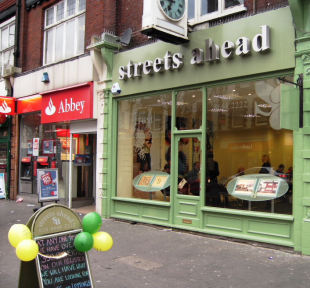
So here’s a fun little task (you will be grateful that I am not repeating my woeful attempt, in this post’s title, to transliterate glottal stop). Can you find, in yesterday’s post on streets ahead, three Britishisms about which I haven’t already written? (I have indeed done a post on a proper and it was Gareth who said “realising,” so these don’t count.) Hint: one of them is a proper NOOB that I plan to post on, one is nowhere in evidence on these shores, and the third is in between.
Put answers in comments, and please read the comments before commenting yourself: I will indicate correct and incorrect answers.
You can find Streets Ahead on the High StreetWow, this is a tricky one. I confess that I was not even aware of the expression until a reader named Gareth commented, “Is ‘streets ahead’ well-established in American sources? Earliest OED reference is 1885 in Ireland. Recently a character in NBC’s ‘Community’ tried to ‘coin the phrase’, without realising it already existed (for the backstory see http://earnthis.net/2010/04/community-is-streets-ahead/.)”
First of all, in answer to Gareth’s question, no. “Streets ahead” (which the OED defines as “far ahead of something or someone, far superior”) has never appeared in the New York Times–as uttered or written by an American–and that means from 1851 to the present. Yet it somehow has the reputation of being a catchphrase. A New Yorker blog post from January 201o revived the venerable character created by Frank Sullivan for the magazine in days of yore, Mr. Arbuthnot, the Cliche Expert, and had him say this about the then-brand-new Apple iPad:
It reflects the company’s commitment to cutting-edge design and elegant technology solutions. They’re the eight-hundred-pound gorilla in the room. They’re streets ahead of their competition and they have both the ground game and air attack to take on anyone.
I believe, as Gareth suggested, that it all goes back to “Community,” which, by the way, is one of the favorite shows of Elizabeth Yagoda. The excllent article to which he linked (on the blog “Earn This”) explains the whole complicated story, but basically it started during an online competition for best TV show in which “Community” was vying with a couple of other series. A supporter of the other shows tweeted: “both Modern Family and Glee are streets ahead of your meta bullshit.” The creator of “Community,” Dan Harmon, got wind of this, and, apparently unaware that streets ahead is an actual British expression, spent the next couple of months mocking it online, going so far as to create this animated video on the Extranormal site.
Art started imitating life, or maybe it’s the other way round, with this Twitter exchange between Harmon and a fan:
@tim_stoltz : @danharmon Your hatred of “Glee” has made its way into “Community;” how long till your new favorite phrase makes it?
@danharmon : @tim_stotz I’m putting it in the current script, so it’ll be a few weeks. But I have to get the world understanding it by then!
And sure enough, in the 22 April 2010 episode, Pierce, the character played by Chevy Chase, made a star-crossed attempt to push streets ahead as a catch phrase.
An interesting sublot is that several people posted comments to the “Earn This” article along the lines of this one:
How is ‘streets ahead’ a British or Irish phrase in any way shape or form? I’ve lived in the UK, to the best of my knowledge, for my whole life and have never heard it used until Community.
So maybe, in addition to not being a true NOOB, streets ahead isn’t even a proper Britishism. I await further enlightenment.
Ironically (as U.S. newsreaders like to say), this past fall, NBC announced it was putting “Community” on hiatus. Dan Harmon posted: “Streets ahold.”
The verb has several distinct meanings, one of which (1)–to misbehave–is American in origin. Distinctly British (2), on the other hand, is the sense it was used in the 1939 propaganda poster “Keep Calm and Carry On”–that is, to persist in the face of obstacles. The Oxford English Dictionary tells us this originated as a nautical variation on “stay the course.” The OED quotes a 1909 newspaper (which was partial to quotation marks): “‘Carry on!’ is a word they have in the Navy. It is the ‘great word’ of the Service.‥ To-morrow the workaday life of the Fleet begins again, and the word will be, ‘Carry on!’” Familiar on both sides of the Atlantic, I reckon, is the notion (3) of carrying on, or maintaining, a legacy or tradition.
The NOOB is a fourth carry on meaning, more or less, to continue: either as an auxiliary verb (Please carry on working) or by itself (Carry on with your work). The American vernacular equivalent is keep on; Bob Dylan sings of a time when “All I knew how to do was to keep on keepin’ on.” British movie comedy Carry On Sergeant (1958) and its twenty-eight sequels cleverly packed meanings 1, 2 and 4 into the title.
In recent years, Americans have grown mighty partial to carry on 4. I’m spoiled for choice for examples and will just cite today’s (Columbia) Missourian, where a columnist writes, “these people have such a high opinion of themselves that I wasn’t certain we would be allowed to carry on with the rest of our lives without their permission.”
I am also picking up intriguing signals that meaning 3, the stiff upper lip deal, is getting some traction on these shores. Yesterday’s Washington Post had the headline: “Occupy DC Protesters Vow to Carry On Despite Camping Regulations.” And in a profile of runner Michael Pistorius in the 18 January 2012 New York Times, Michael Sokolove writes, “Some of the equipment is clamped to an exterior wall of the garage, opposite an uncovered patio; when it rains, athletes just carry on and get soaked.”





 The verb has several distinct meanings, one of which (1)–to misbehave–is American in origin. Distinctly British (2), on the other hand, is the sense it was used in the 1939 propaganda poster “Keep Calm and Carry On”–that is, to persist in the face of obstacles. The Oxford English Dictionary tells us this originated as a nautical variation on “stay the course.” The OED quotes a 1909 newspaper (which was partial to quotation marks): “‘Carry on!’ is a word they have in the Navy. It is the ‘great word’ of the Service.‥ To-morrow the workaday life of the Fleet begins again, and the word will be, ‘Carry on!’” Familiar on both sides of the Atlantic, I reckon, is the notion (3) of carrying on, or maintaining, a legacy or tradition.
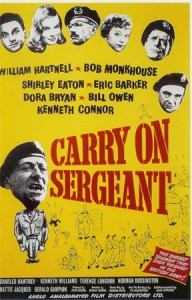 The NOOB is a fourth carry on meaning, more or less, to continue: either as an auxiliary verb (Please carry on working) or by itself (Carry on with your work). The American vernacular equivalent is keep on; Bob Dylan sings of a time when “All I knew how to do was to keep on keepin’ on.” British movie comedy Carry On Sergeant (1958) and its twenty-eight sequels cleverly packed meanings 1, 2 and 4 into the title.
 notoneoffbritishisms.com