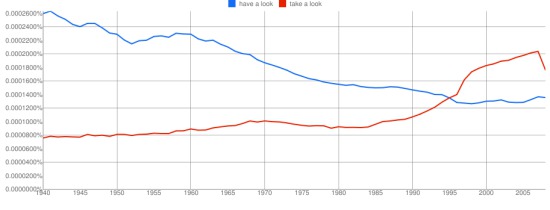
Cast your eyes upon something, figuratively or literally. Synonymous with take a look. Both forms are found in both British and U.S. English throughout the twentieth century but the charts below, from Google Ngram, showing frequency of use of have (blue line) and take (red) between 1940 and 2008, suggest some of the nuances. In Britain, below, have started the period way in front, then steadily declined until it was overtaken by take in the mid-90s.
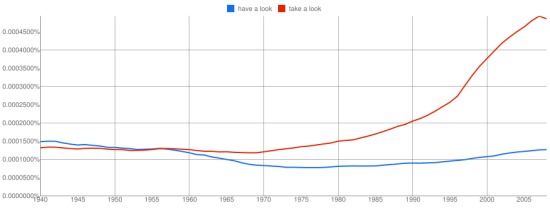
In the U.S., the two were roughly equal until about 1960, when take took off and have went into a tailspin, only to revive recently as a NOOB:
Are these clothes worth it? Go have a look. If ever there was a season to explore the mind of high fashion, this is it. (William Norwich, New York Times, January 18, 2004)/Mitt Romney has turned black, at least according to a graphic that appeared on a Fox News program today. Have a look — this is strange even by the standards of this Republican race. (Erik Wemple, Washingtonpost.com, December 14, 2011)
Expression of congratulations or approval. The precise U.S. equivalent is Good for, as in Good for you!, Good for him!, Good for us!, etc. It’s an Australianism and (in the manner to No worriesand kerfuffle) appears to have been taken up first by the Brits and then by the Yanks. The ur-form is Good on ya, mate!
Another scene, the Elton John party, held in Taj Mahal-size tents outside Pacific Design Center off Melrose. Ever the pessimists, we gird ourselves for letdown. It’s the 16th year Sir Elton has done this, and good on him. (William Booth and Hank Stuever, Washington Post, February 26, 2008)/We all contain multitudes, so if Mr.[Anderson] Cooper — who likes to work all the time and has another job on the side doing occasional stories for “60 Minutes”— wanted to take on another assignment, good on him. (David Carr, New York Times, November 7, 2011)
The exact equivalent, I would say, of the U.S. get along with; used by Dickens in Bleak House: “They get on together delightfully.”
It’s an example of the sort of Britishism that was popular with mid-(twentieth-)century intellectual Americans, such as
Novelist Diane Johnson: “Depending on how you get on with her–she is the most important figure in the book (as we will see)–you will learn about how Constance Philippa escaped on her wedding night.” (1982)
New York Times columnist Flora Lewis: “Nothing different is to be expected from Mr. Qaddafi. If anything is surprising, it is that countries that have been subjected to his cruel wiles still imagine they can get on with him, do business with him, appease him.” (1986)
and editor Robert Giroux: “I had to get on with him and I made sure that I did. ( 2000)
It is now emerging as a NOOB, for example in a December 4, 2011, lifehack.org post by Paul Sloane, which asked: “What should you do if you really cannot get on with your boss at work?”
This is, of course, distinct from the verb phrase to get on with it, which goes to the very heart of the British character, which was used by Lisa Simpson in an episode a couple of weeks ago, and which will be the subject of a future post.
Two separate meanings are in play here. The first, defined by the Oxford English Dictionary as “A cause of laughter; a joke,” was emblazoned onto my brain by the very sharp HBO-BBC comedy series “Extras.” In it Ricky Gervais plays a mediocre actor who finds himself starring in a witless sitcom, wearing a curly black wig and oversized glasses; his signature catchphrase, endlessly derided, is “Are you ‘avin’ a laff?”
The OED (characteristically, IMHO) makes no distinction, as it probably should do, between the plural and singular forms. That is, it is a standard Americanism to refer to “(having) some laughs,” while the singular, “a laugh,” is rare here. But not unheard of: a New York Times headline on November 27 was “Schmekel, a Band Born as a Laugh.”
The other meaning–“an amusing or entertaining person”–presents a more interesting case. The OED says this is “now chiefly Brit.” That means it’s an unusual example of an Americanism that became a Britishism and is now on the verge of NOOB-dom. For the American origin, the OED cites Kodak Magazine from 1921 (“Eight finished acts were presented, including‥Sam Kellman, Hebrew comedian, who was a laugh from start to finish”) and Of Mice and Men, 1937: “Old Susy’s a laugh—always crackin’ jokes.” It might also have mentioned Lorenz Hart’s 1940 lyric to “Bewitched, Bothered and Bewildered,” which notes with a characteristic double entendre, “he’s a laugh, but I like it, because the laugh’s on me.”
Fast forward to the 2000s, and the word has a strongly British identity. In the film “Shaun of the Dead,” Shaun says of Ed, “I like having him around, he’s a laugh.” And in Sue Townsend’s 2006 novel Queen Camilla, a character refers to “Prince Harry, who were a right laugh but were a proper ginga.”
The phrases laugh riot and laugh a minute have, of course, long been popular in the U.S., and they make searching for a-person-as-a-laugh challenging. However, my college daughter Maria reports that in her circles, it’s a comer. And I’ve found a few outcroppings on the internet, for example, this September 28, 2011, post from the blog thepartywhip.com:
But I just don’t see that friendly banter working with some of the goons who occupy the Tea Party wing of the GOP. “Hey guys, this is Ted. He’s convinced that the president was born in Kenya and is waging a steady effort to take away his gun, but believe me, he’s a laugh!”
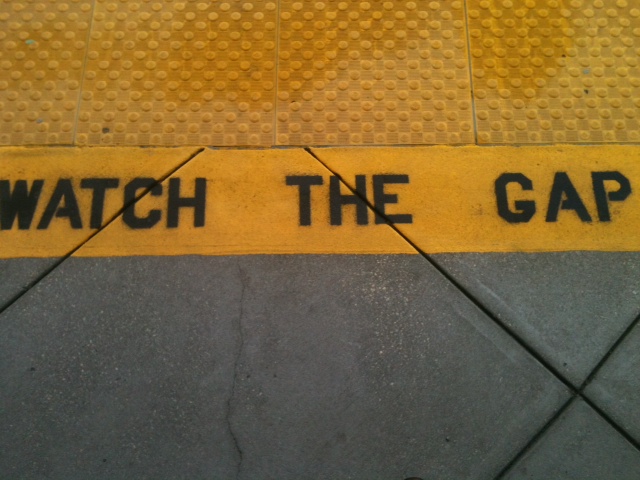
Today I took the above photo of the platform at at the University City, Philadelphia, train station. For some time, I have been noticing “Watch the gap” announcements and signage not only in the Philadelphia commuter train system, but also Amtrak and Metro North, which serves the New York metropolitan area.
The phrase “Mind the gap” is, of course, intimately connected with the London Underground and has been since 1969, when it was adopted to caution passengers not to step into the space between the train and the platform. Gap isn’t a proper Britishism, I don’t think; it’s just that there isn’t any American counterpart, so the association with the Underground slogan makes it sound British.
Mind very much is a Britishism, so much so that I don’t expect to see it catch on in New York or Philly. However, Seattle–the home of the Bumbershoot Festival–has, according to this Flickr photo, put the slogan on public buses. I don’t exactly understand what the gap is on a bus, so if any Seattle-ites could fill me in, I would appreciate it.
In a wonderful essay, “In Praise of Crap Technology,” Thomas Hayden extols the virtues of his $19.99 Coby mp3 player, bottom-of-the line Samsung cellphone, 1995 mountain bike, and other devices that aren’t fancy but work. He says of the Coby:
it’s worth next to nothing so I’m virtually assured never to lose it—unlike apparently every iPhone prototype ever—and I don’t cringe at all when my toddler flings it across the room. And because the next Coby is sure to be just as mediocre, I’ll never need to upgrade—I’ve stepped off the escalators of feature creep and planned obsolescence, and all the expense and toxic e-waste that come with them. Crap technology, it turns out, is green technology.
Much food for thought there. However, the thing that caught my attention, of course, was the use of the NOOB crap as an adjective. In an interview last night on public radio’s “Marketplace,” Hayden expanded on the distinction between crap and crappy:
Crap technology is basically stuff that doesn’t have cachet, you know? It’s not slick, it’s not cool, but it works. Crappy technology, on the other hand, is stuff that simply doesn’t work. That’s the sweet spot of crap technology: no cachet but all the functionality you’ll need.
In last week’s run-up to Thanksgiving, I wrote a post for the Chronicle of Higher Education’s Lingua Franca blog about the proliferating ways of saying you’re welcome. I focused on the eminently annoying Not a problem! and No worries!, the latter of which has periodically been suggested as an NOOB.
I have always resisted. Not because it isn’t popular in the U.S.; indeed, it is nearly inescapable. Rather, because it’s not a Britishism but an Australianism. According to Wikipedia: “‘No worries’ was referred to as ‘the national motto’ of Australia in 1978, and in their 2006 work, Diving the World, Beth and Shaun Tierney call ‘no worries, mate’ the national motto of the country.“
But looking into the matter I see that the the phrase itself has deep British roots. The Times used it 463 times between 1785 and 1985–for example, in the 1970 headline NO WORRIES FOR CELTIC. The Aussie innovation–now picked up in the U.S., with a vengeance–may have been to isolate the two words as a response to thank you or I’m sorry.
My college-student daughter Maria informs me that in Facebook birthday greetings, the normal salutation is xoxo, meaning, “hugs and kisses.” But she says that every one of her friends who has studied in England–as well as all their English friends, and increasing number of people who seem to want to sound English–merely write xx, meaning, presumably, “kisses.”
This bears further study. I wonder if it relates to the hugging epidemic that reached American shores a decade and a half ago. Has it not gotten to the U.K–do acquaintances merely kiss there on greeting each other, and eschew body-on-body content?
In any case, I fancy–and note the writer’s use of the word fancy, suggesting English origin–the definition of xx on urbandictionary.com:
Something every girl says. If she says it to you, you’re not special, she doesn’t fancy you, shut up.
Tom : Hiiiiiiiii :D:D HI
Mel: hi do i know u…
Tom: HOW ARE U !
Mel: Im ok soz g2g bye xx
(Mel signs out, or blocks tom)
Tom (to other friend) HIIII MAN MEL JUST SAID “xx” TO ME!
friend: And?
Tom: SHE LIKES ME
friend: No she doesnt shut youre mouth.





 notoneoffbritishisms.com