“Grotty”

The OED’s first citation for this adjective comes from the 1964 movie tie-in The Beatles in A Hard Day’s Night, by John Burke, and helpfully includes an etymology and partial definition: “‘I wouldn’t be seen dead in them. They’re dead grotty.’ Marshall stared. ‘Grotty?’ ‘Yeah—grotesque.’” The OED’s full definition: “Unpleasant, dirty, nasty, ugly, etc.: a general term of disapproval.”

A Google Ngram graph shows that grotty is a dead Britishism, with steadily increasing U.S. use. That appears to have picked up in recent years, including in a piece about the HBO series “Girls” in today’s Philadelphia Inquirer: “Hannah is still waiting hand in foot on Adam (Adam Driver) in his grotty apartment.”

An April 2012 New York Times theater review by Eric Grode says the play’s setting, in “a wood-paneled living room in Paterson, N.J., is more strip mall than Vegas Strip. (Mimi Lien contributed the suitably grotty set.)”

The reviewer’s name reminds me that there is more or less exact American equivalent, spelled, variously, grody, groaty, groady, and groddy, with all but the last rhyming with toady. The OED’s first cite for this is a 1965 Houston Chronicle but it gained immortality in the early ’80s, via Valley Girl Moon Unit Zappa and her immortal phrase “grody to the max.”

Is there any difference between grotty and grody? I leave a definite answer to wiser heads than mine, but I will note that all the OED definitions of grody refer to people and all but one of grotty refer to places.

“Car park”

A letter to the editor to my local weekly newspaper, The [Swarthmore, Pennsylvania] Swarthmorean, starts off this way:

Why is the college not using all the available space on the campus for a new car park?

If the present car park were expanded, it could accommodate many cars.

It was signed “Dorothy Moffett.”

I do not know if Ms. Moffett is British, but I suspect she is, because I have never  encountered an American who uses car park instead of one of our two alternatives, parking lot and parking garage.

But I found that the term at one time has some currency in the U.S.–at least among headline writers, who are always looking for ways to trim words and phrases. A 1953 New York Times headline reads “City Set to Start Metered Car Park.”

The only recent U.S.-datelined use in the Times came in a 2011 style-section piece about the Art Basel Miami Beach festival: “The event was originally scheduled to take place at a mansion on Indian Creek Island but ended up, more conveniently and also more appropriately, at the Herzog & de Meuron car park at 1111 Lincoln Road.”

1111 Lincoln Road
1111 Lincoln Road

And in that case, parking garage is hardly sufficient. Here is how Wikipedia’s description of the seven-story, $65 million Miami Beach facility begins:

The design has been characterized as resembling a house of cards. It is an open-air structure with no exterior walls constructed around buttresses and cantilevers that features floor heights varying from 8 to 34 feet.Some of the internal ramps are quite steep in order to accommodate the wider height intervals. Elevators and a central, winding staircase take drivers to and from their cars.A glassed-in high-fashion boutique sits on an edge of the fifth floor.The parking garage features retail space at the street level, with tenants such as Maxposure Media Group, and is joined to another structure at the same address that serves as an office for SunTrust Banks.[Developer Robert] Wennett has built a penthouse apartment for himself as part of a 18,000-square-foot (1,700 m2) space on the structure’s roof that also features a pool and gardens with hanging vines.

Now that is a proper car park!

“Omnishambles”

This word–meaning, basically, a really bad, pervasive cock-up–was invented in 2009 by the writers of the British TV series “The Thick of It.” Then it caught on. As the Financial Times has noted:

Tearing into the UK government’s budget, opposition Labour leader [Ed Miliband] detailed a list of fiscal shambles – an admittedly impressive array of gaffes from the taxes applied to hot pasties to caravans, from donations to charities and churches – before concluding that the end result was, you guessed it, an omnishambles.

The barb was well timed. The charge of omnishambles was quickly extended to pretty much all aspects of a government that had been granted the benefit of the doubt as it stuck with unpopular austerity policies but whose competence was now in question. The neologism even spawned neo-neologisms. A dispute about whether an independent Scotland could be an EU member became Scomnishambles; a row about badger culls became omnivoreshambles. A flip across the Atlantic to a series of gaffes by the Republican presidential contender gave us Romneyshambles.

In late 2012, omnishambles solidified its triumph by being chosen Word of the Year by the Oxford English Dictionary.

It has still not had much traction in the U.S., however. Other than reporting on the OED’s selection, the New York Times has used it only one time, in a December 24, 2012, blog post.

Shambolic, meanwhile, proceeds apace. Reader Peter Hirsch notes: “Two mentions by Jon Meacham on ‘Meet the Press’ this weekend had even the moderator puzzled.”

“Year on year”

The expression is a compound adjective that, according to the OED, is “used with reference to a comparison of figures with corresponding ones for a date twelve months earlier.” The dictionary’s first citation is from a 1976 article in the Daily Telegraph: “It is hoped this will show a year on year rise in average earnings of between 14 and 15 per cent.”

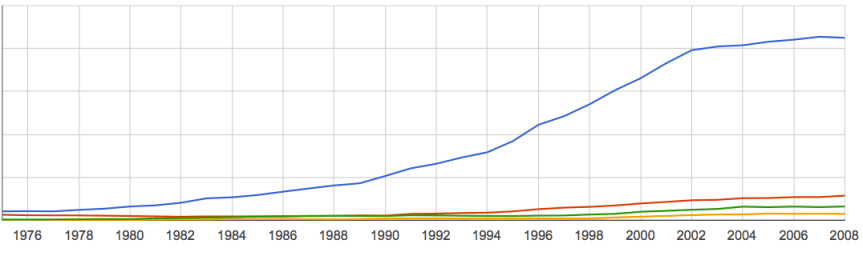
The Google Ngram chart below showing use of year on year between 1975 and 2008 suggests it is both a Britishism (the blue line represents British use) and a NOOB (the red line, showing U.S. use, climbs steadily starting in the mid-1990s).

Screen Shot 2013-01-02 at 2.27.57 PM

Certainly, it’s often been seen in U.S. financial pages in recent months, for example:

  • “Consumer spending suffered its sharpest year-on-year drop since World War II, according to Italy’s leading business association.” New York Times, December 12, 2012
  •  “Home values in San Francisco have been growing on a year-on-year basis for four consecutive months.” San Francisco Chronicle, November 2012:

Interestingly, year on year has an (as far as I can tell) exact synonym: year over year. This one is an American speciality (to use a Britishism which has not yet appeared here). U.S. use of year over year is the green line in the chart, British use the yellow line. An example from the Associated Press, December 26, 2012: “October was the fifth straight month of year-over-year gains, after nearly two years of declines.” And the New York Times, December 28, 2012: “The pace of rental growth year over year has also slowed.”

The two expressions seem to be battling it out on these shores. I predict over will ultimately prevail. We like our literalisms even more than our Britishisms.

“Turn up” keeps turning up

In a mere five paragraphs in yesterday’s New York Times, Neil Genzlinger writes that on January 21, the actor Kevin Bacon “turns up as the star of a new series on Fox, ‘The Following’”; that the villain of the series has  “a knack for bewitching attractive women, who would later turn up dead, their eyes gouged out”; and that the series is similar to “Alcatraz,” a Fox series “in which investigators had to track down scores of inmates and guards who vanished from Alcatraz in 1963 and began turning up in the present.”

Genzlinger also writes that the bad guy “seems always to be one bloody step ahead,” but he’s probably being literal.

Th-fronting

Rapper Chief Keef
Rapper Chief Keef

I have remarked on the fondness of young Americans–especially African-American rappers and/or people from the New York metropolitan area–for the glottal stop. Now it appears that another of Cockney characteristic, th-fronting, is ready for its U.S. closeup.

Th-fronting is a feature of Cockney–and now, apparently, of Estuary English–in which a th sound is pronounced like an f (as in I fink instead of I think) or v (as in the way the TV show “Big Brother” is commonly referred to in U.K. red-top tabloid headlines: “Big Bruvva”). Sacha Baron Cohen’s Ali G is a heavy user, and it’s been prominent recently in hip U.S. references to the Rolling Stones guitarist Keith Richards as “Keef.”

That same word actually represents the only indigenous U.S. use I’m aware of. It’s in the name of a teenage rapper from Chicago: Chief Keef. His website reports that he was born Keith Cozart but is silent on how Keith became Keef.

NOOB readers are a clever lot, and among them are probably one or two hip-hop fans. If so, I would be grateful for any enlightenment on the phenomenon of th-fronting among the rappers.

“From strength to strength”

This turned up in a New York Times article a couple of months ago:

Susan Kamil, the editor-in-chief and publisher of Random House, confirmed the acquisition on Monday, saying in a statement, “We’re thrilled to welcome Lena [Dunham] to Random House. Her skill on the page as a writer is remarkable — fresh, wise, so assured. She is that rare literary talent that will only grow from strength to strength and we look forward to helping her build a long career as an author.”

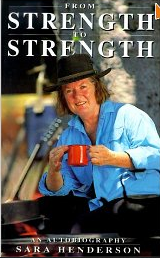
I was surprised, because I’d always thought of from strength to strength–meaning, basically, that something is already doing well and is expected to do even better–as one of those British expressions, such as spoiled for choice, that would probably never make it over here.

Screen Shot 2012-12-26 at 11.45.36 AMBut I found that the Susan Kamil quote wasn’t a one-off, as witness this from the Yale Daily News: “After winning every Ivy game this season, the women’s volleyball team is going from strength to strength.” (October 17, 2012) And this February 2102 quote from the Times’ David “Think British, Act Yiddish” Brooks: “Without real opposition, the wingers go from strength to strength.”
It turns out that the expression has a long history, on both sides of the Atlantic. Forgive me for stating what may be obvious to some, but it appears first to have been used in Myles Coverdale’s 1535 translation of the Bible, where Psalms 84:7 is rendered “They go from strength to strength and so the God of Gods apeareth unto them in Zion.” The phrase was used in the King James and other subsequent versions, as well as by religious writers, including Julian Hare in an 1849 sermon: “Mounting from strength to strength, from highth, to a higher highth!”

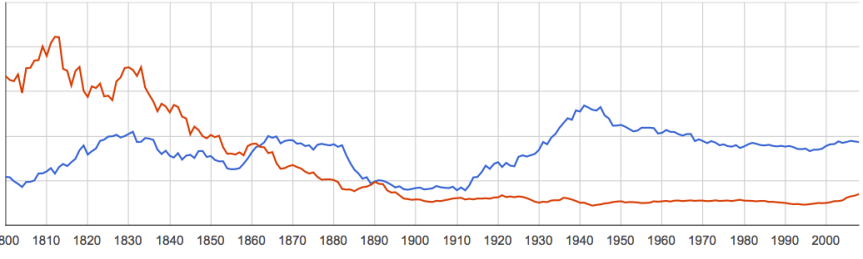
The Google Ngram chart below shows the use of the phrase in Britain (blue line) and the United States (red line) from 1800 through 2008:

Screen Shot 2012-12-26 at 11.37.31 AM

The uses appear predominantly religious until about 1900–and note that in the nineteenth century it was considerably more popular in the U.S. The ascendance of the blue line in the early twentieth reflects its acceptance as a secular metaphor in the U.K.; the (presumably continuing) upturn of the red line starting in about 2000 suggests that from strength to strength is a solid NOOB.

Can spoiled for choice be far behind?

“Poo”

No one can say that we here at NOOBs don’t tackle the profound issues of the day. A Smithsonian Magazine headline, posted just an hour ago (as I write) read: “The Most Exclusive Coffee in the World Is Harvested From Elephant Poo.”

On the other hand, American Republican political operative Grover Norquist notoriously said after our recent election: “The president was elected on the basis that he was not Romney and that Romney was a poopy-head, and you should vote against Romney”

I don’t care much about Grover Norquist or the most exclusive coffee in the world, but I am interested in the possibility that British poo is taking over from good old American poop in the faeces euphemism department.

The question turns out to be a somewhat complicated one, as these questions tend to be. The OED offers two separate sets of entries for these terms, with separate etymologies. One derives from the onomatopoeic interjection “Poo,” dating from the 1600s, when it was more commonly spelled “Puh” or “Pooh,” or, as Fielding rendered it in this quote from Tom Jones: “‘Pugh,’ says she, ‘you have pinked a Man in a Duel, that’s all.’”

It was not until the 1960s, according to the OED, that the word began to be used as a noun or verb for excrement, as The Guardian did in 1981: “That doggy’s doing a poo.”

The second entry derives from a different instance of onomatopoeia. The OED cites this definition from an early eighteenth-century dictionary: “to break Wind backwards softly.” By the 1920s, poop had acquired, in the United States, solidity. The OED quotes Ezra Pound in a 1940 letter: “This federation poop is just the same old..secret committee of shit.”

Complicating manners are at least three additional meanings of poop. One, derived from the term for the rear of a boat, refers to the rear of a person or animal. The second–which Pound may have had in mind–is an American slang term, originating in the military, for inside information. The third, which probably isn’t relevant, is pooped, an Americanism meaning “exhausted” or “worn out.”

Getting back to poo versus poop, here is a Google Ngram chart showing use of dog poo and dog poop n Britain and the U.S. between 2000 and 2008 (the most recent year for which figures are available):

Screen Shot 2012-12-17 at 11.27.58 AM

It confirms that the dominant form is poop in the U.S. (red line) and poo Britain (yellow line), and that poo (green line) is on the rise in the U.S., with a roughly 100 percent increase in the period.

Further research is clearly needed. For the time being, my sense is that my fellow Americans are rather conflicted on the matter, sometimes, as in this Huffington Post piece from March, trying to have it both ways:

“Poop. Is there anything it can’t do? On Wednesday, The Denver Zoo introduced what is believed to be the world’s first poo-powered motorized tuk tuk showcasing The Denver Zoo’s very own patent-pending gasification technology.”

Make up your mind, Huffington Post!

“Sticky wicket”

Two readers have independently alerted me to this recent quote in the New York Times:

“It’s a sticky wicket for Obama,” said Bruce Buchanan, a political science professor at the University of Texas at Austin, saying any aggressive move on such a high-profile question would be seen as “a slap in the face to his base right after they’ve just handed him a chance to realize his presidential dreams.”

I initially resisted investigating sticky wicket, relegating it to the telly-lift-old chap sort of term that in the U.S. is a stereotype of a Britishism, and thus can’t be a proper NOOB. I was wrong. It turns out that the Times has used the phrase six additional times in the past two years, all either by its own reporter or a quote by an American source. For example, Milwaukee Journal-Sentinal sportswriter Tom Haudricourt commented in 2010 about the Hall of Fame prospects of baseball’s Mark McGwire, who had just admitted to using steroids: “Should we be voting guys in who admit to doing it? The sticky wicket just got stickier.”

The original British expression dates from the 1880s, according to the OED, and is (sorry for stating the obvious, to some) is a cricket metaphor. Thus it’s traditionally phrased as (batting) on a sticky wicket. The batting on is always lost in the U.S.

Looking at Google Ngram data (below) makes me think I need a new category for this bad boy. It’s a quintessentially British expression that’s so quintessential, it’s hardly used there anymore. Meanwhile, it has gradually grown in the U.S. from being an exotic novelty item to a solid NOOB–to the point that, in 2004, it was as popular here as it was there! Google’s data only goes up to 2008; I bet that at this point, there are more U.S. sticky wickets than British ones.

Google Ngram showing popularity of the phrase "sticky wicket" in Britain (blue line) and the U.S. (red line), 1915-2008
Google Ngram showing popularity of the phrase “sticky wicket” in Britain (blue line) and the U.S. (red line), 1915-2008