Judging what I’ve been reading in the sports pages and hearing in broadcasts, sports (“sport” if you’re British) has become a fount of Not One-Off Britishisms. Here is a recent headline from the New York Times’ sports division, The Athletic:
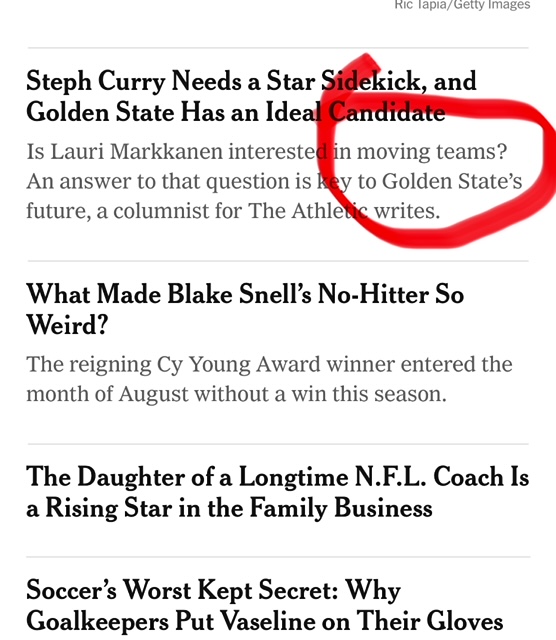
I’m not positive but imagine the circled phrase is a Britishism, as Americans would normally say “changing” or “switching” teams; the British say they are “moving house” or “moving offices.” (I still recall the first time I heard the latter expression from none other than legendary editor Tina Brown.)
And here’s the beginning of an Olympics-related article from an American writer for The Athletic:
As I explained in this post, “athletics” is the British (and international) term for what Americans call track [running] and field [throwing things like discuss and shot put].
But The Athletic is nothing compared to the Tennis Channel, where (American) commentators Jim Courier and, especially, Brett Haber have recently gotten completely jiggy with Britishisms, many of them unfamiliar to most American ears. A sampling:
Courier said a match between Janik Sinner and Alexander Rublev was “a ginger matchup.”
Haber referred to Jacob De Minaur’s “kit,” that is, outfit.
Getting more obscure, Courier said a certain shot “works a treat.”
Haber said player Jack Draper was “well thrashed” online after he didn’t call an infraction on himself.
When I saw in headlines that soccer/football commentator Gary Lineker had called England’s national team “shit” or “s—” (the two main variations I saw), I knew I had to find the exact wording. The quote is beyond the scope of this blog, since Lineker is English, but for some years I have been tracking the adjectival use of “shit” and “crap” — both borderline NOOBs — and in the interest of science, I wanted to find out what Lineker said.
It proved deuced hard, as almost every newspaper and website either used the single word or versions with hyphens, or asterisks. Finally, I found a Daily Mail article that linked to another Daily Mailarticle that had the full quote: “I mean, you can think of all sorts of words or expletives if you like, but it was shit.” (At the risk of stating the obvious, an American would say “shitty,” or “they played like shit.”)
Now, “it” was referring to England’s 1-1 draw with Denmark in the UEFA European Championship on June 24. Since then, the team has advanced to the knockout round, and won three consecutive matches to advance to the championship this Sunday against Spain.
You could argue that Lineker’s criticism motivated England. Or, you could say his commentary was shit.
On May 7 of this year, the New York Times reported the conversation of some Chicago grade-schoolers:
“Some people think cicadas can suck your brains out,” said Willa, a red-haired 8-year-old in a Star Wars T-shirt.
“They’re going to be so loud,” Christopher, 9, said as he colored his cicada intently. “I hate noise.”
“It’s kind of scary,” Madison, 8, said while picking through markers scattered on a green table. “What if they do something to me?”
Not to worry, Madison and Willa: Cicadas don’t actually bite, and they prefer to suck tree sap.
My topic today is the expression in the last paragraph, “Not to worry.” It means, essentially, “Don’t worry” or “There’s nothing to worry about it” or “No worries.” The online Merriam-Webster’s supplies two additional recent examples:
“But not to worry: These eight online subscription gifts can be purchased within seconds to make your last-minute holiday shopping way less hectic.” — Phoebe Sklansky, Parents, 22 Dec. 2023
If a tropical trip is not in your immediate future, not to worry.” — Rebecca Angel Baer, Southern Living, 18 Feb. 2024
As with quite a few words and phrases, I remember precisely where and when I first encountered it. I was in Chicago, on a vacation with my parents in 1965 or so, and it was uttered by a character in a comic book I was reading. Struck me as odd, but then it kept popping up over the years, with increasing frequency.
I never had a sense of its origin, but for me it always had a vaguely Jewish/Yiddish feel, like “I could care less” or “What am I, chopped liver?” But that’s not where it came from. When I finally got around to researching “Not to worry” I found, for one thing, that it’s a Britishism. In his A Dictionary of Catchphrases (1985 edition), Eric Partridge, who was born in New Zealand and lived in England his entire adult life, says of the phrase: “current, since the middle 1930s, in the [military] Services, and then, suddenly, in 1957-8, it began to be generally and very widely used.” Partridge quotes a 1967 informant: “It is old hat. I first heard it, ad nauseum, in the Admiralty about ten or twelve years ago.” And he quotes another informant, John W. Clark, saying in 1977 that the phrase is “never heard in US except from Britons or by sophisticated or affected imitators.”
Google Books’ Ngram Viewer graph of British and American usage confirms Partridge to a rather remarkable degree. (I did a case-sensitive search with a capital “N” to eliminate things like “I told him not to worry.”) It shows the phrase emerging in Britain in the ’40s and rising fairly rapidly in popularity in the late ’50s and ’60s. It turns up in American in the mid-’60s (that is, right around the time I read that comic book) and–pace John W.Clark– just keeps rising, surpassing British use in 1979.
The OED finds the origin of the phrase, with its odd syntax, in an old Scottish custom to elide every word except “please” from sentences that start, “May it [or let it] please you…” There’s a quote from Milton’s Paradise Lost (1667): “Heav’nly stranger, please to taste These bounties which our Nourisher,..To us for food and for delight hath caus’d The Earth to yeild.” And this from a 1757 letter: “Please to send me the following things Vizt. 1 Dozen of Black mitts. 1 piece of Black Durant fine.”
Here are the first two examples the dictionary has found with “not”:
The first “Not to worry” is from The Daily Mail in 1958–just when Partridge said it was reaching catchphrase status.
I’ll note in conclusion that even though I was wrong about Jewish origin, I’m not the only person who thinks the phrase has a Jewish feel. Here’s the cover of a book that came out in 2003.
In the very early days of this blog, I did a post on “erm,” which I took and still take to be the British version of the American “um,” with similar pronunciation. (That is, the “r” is silent, though on some occasions in the U.K. it’s pronounced more like “em.”) At that time, there was no entry for “erm” in the OED, so I constructed my own definition: “Interjection. Self-conscious vocalism, indicating skepticism.” The idea being that people said “erm” or “um” when they were hesitating, and that writers employed in attempting to cleverly call attention to what follows in the sentence. American speakers and writers had been doing the same thing with “um” but in the post I gave two recent U.S. “erm”s.
“Here’s a report on the, erm, incident from CBC’s nightly national newscast.” (Slap Shot blog, New York Times, November 29, 2007)
”Justice Breyer asks a hypothetical question that he will pose several times today: ‘Imagine a well-educated American woman marries a man from a foreign country X. They have a divorce. The judge says the man is completely at fault here, a real rotter. The woman is 100 percent entitled to every possible bit of custody and the man can see the child twice a year on Christmas Day at 4:00 in the morning.’ (Erm. Isn’t that once a year?)” (Dahlia Lithwick, Slate, January 10, 2010)
In March 2023, the OED published an “erm” entry, with this definition: “Used to express uncertainty, embarrassment, a pause to consider one’s next words, etc., or as a conversational filler expressing hesitation or inarticulacy.” Interestingly, the citations, which ranged from 1911 to 2017, had no jokey written uses of “erm,” only lines of dialogue from works of fiction, or journalistic quotes, including this from The Dalesman in 2017: “The new vicar is visiting members of his Wensleydale parish. ‘Erm, could I just ask why you have a bucket of manure in your front room?’ asks the flustered man of the cloth.”
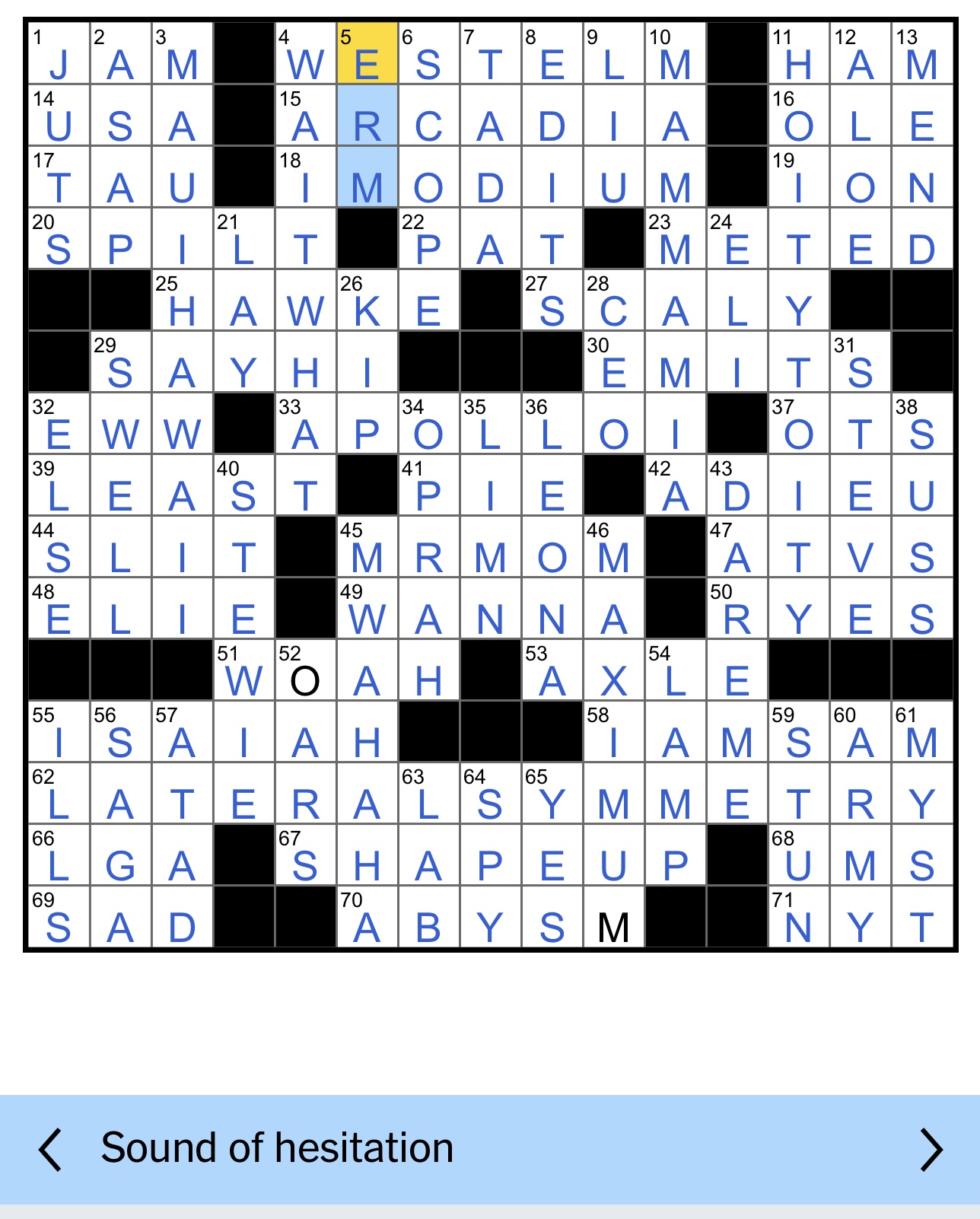
I had occasion to look this up because over the course of the week, I encountered two U.S. examples. The first was in the New York Times crossword puzzle:
And the second was in the captioning to the FX television series The Veil. (The character speaking isn’t British.)
Here’s what Google Books Ngram Viewer has to say about the use of the word in written sources in Britain and America:
Supporting the idea of a mild uptick in the U.S. is that fact that it’s been used four times in the past year in the New York Times, including:
“… obsessing over who Donald Trump will pick as his new pain sponge — erm, running mate …”–Opinion columnist Michelle Cottle
“Every generation, it seems, has a way of ‘discovering’ items of dress that previous generations dismissed in triumph, recontextualizing them and claiming them for its own, like anthropologists unearthing buried treasures. Wide ties? Bell bottoms? So ironically cool! Corsets? Neato! Waistcoats? Funky. Spats? Erm … maybe for a costume party.”–Fashion writer Vanessa Friedman
Such American uses are both cutesy and needlessly British, seeing as we’ve got our homegown “um.” So, erm, maybe give “erm” a rest?
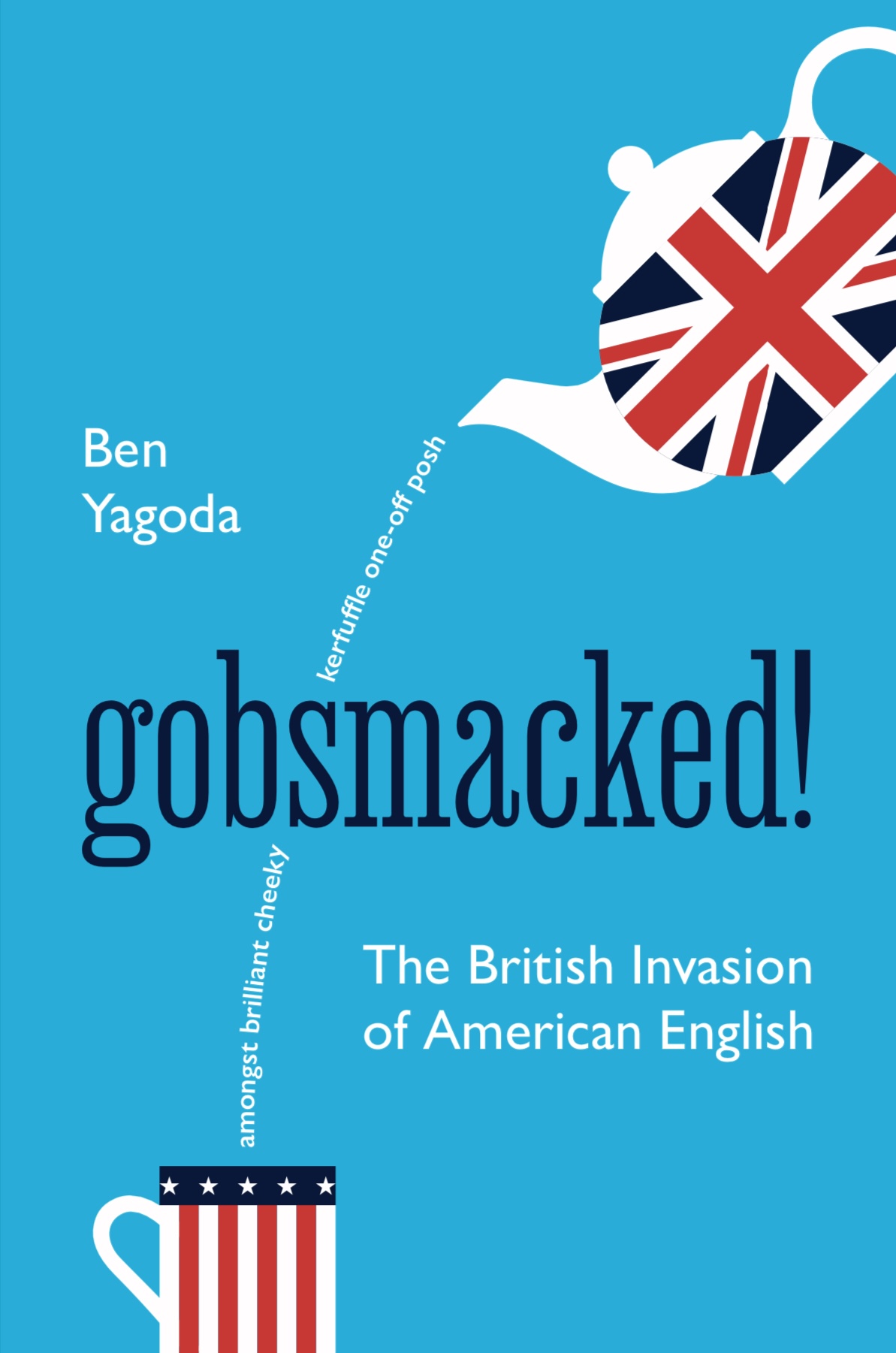
I’ve mentioned here before that I’ve put together a book based on this blog. I’m happy to announce that it has a publisher (Princeton University Press), a publication date (September in the U.S., November in the U.K.), a title, and a brilliant cover (designed by Chris Ferrante):
I’m especially pleased by the use of Gill Sans for the subtitle and my name, as it is in itself a Not One-Off Britishism.
Already, the book has received some great endorsements from really distinguished people:
“The best exploration of British and American lexical variation and change that I’ve ever read. Or, to put it in the terms of this book: it’s brilliant, gobstoppingly spot-on, streets ahead of anything else.”–David Crystal, author of The Cambridge Encyclopedia of the English Language
“One could do worse than to have a lie-in with this valuable and entertaining book, in which Ben Yagoda gets his Britishisms sorted for our benefit. Brilliant, in the best American sense!”—Mary Norris, author of the New York Times bestselling Between You & Me: Confessions of a Comma Queen
“Ben Yagoda is one of our most insightful and entertaining commentators on language and culture. In Godsmacked!, he focuses his formidable talents on an original and fascinating story: Britain’s growing influence on U.S. speech. If you’ve ever wondered why you have suddenly started saying things like cheeky, dodgy, or twee, you’d be bonkers not to devour this wonderful book.”—Fred R. Shapiro, editor of The New Yale Book of Quotations
“Despite my decades of experience with English on both sides of the Atlantic, and all my academic study of its varieties, Ben Yagoda’s delightful book taught me things I had not yet realized about the British influence on American speech. As anyone acquainted with Yagoda’s writing might expect, his book is both fascinating and fun.”—Geoffrey K. Pullum, University of Edinburgh, coauthor, The Cambridge Grammar of the English Language
As I say, the book won’t be available for several months, but pre-orders are always helpful, as they show the publisher that people are interested. If you’re so inclined, you can pre-order here.
When events or interviews are scheduled, I will announce them here.
One one more thing. I could not have written the book, or sustained the blog for so long, without its corps of discerning, clever (in both the British and American senses), and passionate readers and commenters, many of whom are quoted in the book. So a big ta to you all, and TTFN.
One of the first posts I did for this blog was on the expression “the run-up to,” meaning a preliminary period. It was a really short post, as was my custom in those days, so here’s some more about it.
“Run-up” emerged in the nineteenth century in dog racing, to mean the section of the chase up to the first turn. Next, it referred to a preliminary run taken by an athlete before a long jump or—most common in recent years—a cricket bowler’s throw. The figurative use—”A period of time or series of occurrences leading up to some significant event”—arrived no later than 1961, when The Times of London referred to “the run-up to the next general election.”
The term became popular in the U.S. because it filled a need. Early In 2003, it became clear that the United States would invade Iraq. Months passed; we did not invade. Then we did. Journalists again faced a question: what to call that preliminary period? In September 2003, the New York Times’ Thomas Friedman chose a Britishism to offer a collective answer that now appears inevitable, referring to “how France behaved in the run-upto the Iraq war.”
“Run-up” quickly began to be very widely used. Ngram Viewer shows a doubling of frequency in the U.S. between 2000 and 2006. (Note that another meaning of the term is traditionally more common in the U.S.: a rapid rise in price or some other measure. Thus the Times reports that the pandemic years saw “a run up on home prices at a pace never seen before in U.S. history.”)
In America, from 2003 till about 2010, the period-time “run-up”was most commonly used to refer to the months before the Iraq invasion. But then it started to spread to other contexts, the Times writing in 2011, “The Packers’ report is more than a novelty in the run-up to their playing the Pittsburgh Steelers in the Super Bowl on Feb. 6.” The ProQuest Recent Newspapers database shows 1,757 American uses between 2000 and 2022, including references to the Olympics, Christmas, the Capitol riots, and (back to the future), the Russian invasion of Ukraine.
I believe “lead-up” means the same thing as “run-up.” It emerged about the same time (the OED has a 1959 citation), but took longer to establish itself and still lags behind “run-up” in frequency of use. Here’s the Ngram Viewer chart for the two phrases in British books:
An early “lead-up” in the New York Times. came in the 1977 transcript of the interview between (the British) David Frost and Richard Nixon, where Frost refers to “the lead up to the China breakthrough.” The first American to use it in the paper seems to be erstwhile language columnist William Safire in 1984, who didn’t comment on the phrase but merely used it in referring to the “lead up” to a joke’s punchline.
That was then, this is now. “The lead-up to” appeared 154 times in the Times in 2023. My favorite is an article about the sex lives of an insect called Neotrogla, the females of which have a penis-like anatomical feature. The article notes researchers found
“two groups of muscles that help female Neotrogla control their penislike gynosomes. One set of muscles was taut in the copulating pair of barklice when the penislike structure was inflated. The other set of muscles, which hooks the gynosome to the female’s internal organs, was active in the flaccid gynosome of the solo Neotrogla specimen. The researchers concluded that these muscle groups helped the females both to unfurl their gynosomes in the lead-up to their prolonged mating sessions and to retract their engorged gynosomes afterward.”
Ninety percent of the ads I see on Facebook are either for shoes (especially with wide sizes), electric cars, or glasses, especially sunglasses and reading glasses. That’s because I’m interested in those things, and keep clicking on attractive ads. What can I say? It keeps me off the street.
The other day, I clicked on a shoe ad and this appeared:
I’ve been on the elusive trail of “trainers” (BrE for American sneakers, running shoes, or tennis shoes) for quite some time. My most recent post is here, and you can follow the trail back to the first one, or simply put “trainers” into the search bar at right.
The New Balance ad seemed a palpable hit. But then I noticed the spellings “colour” and “grey”–the first completely British, the second still predominantly so. And when I clicked through to the “About” page of the company, Wide Fit Shoes, my fears were confirmed.
Oh well. At least I have a field trip for my next visit to London.
The New York Times had a nice headline the other day:
The word “swans” in the title of the TV series refers to the word author Truman Capote used to refer to the upper-crust New York women he socialized with, and ultimately betrayed. For an article about a party celebrating the series, the clever Times headline writer used the British verb “swan“–meaning (according to the OED), “To move about freely or in an (apparently) aimless way.”
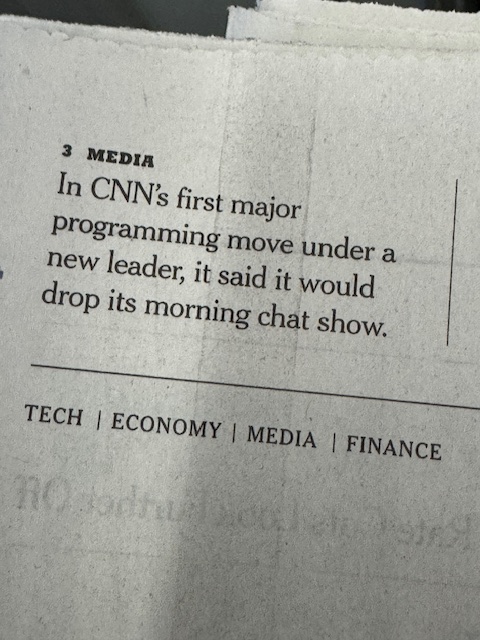
The next one’s from the print edition of the Times.
In this case, substituting the British “chat show” for the American “talk show” isn’t especially clever. It doesn’t even save any space in the headline. Possibly the term was meant as a criticism for the show in question, but as I’ve never watched it or otherwise heard of it, I can’t really say.
in today’s [January 26, 2024] Wall Street Journal article titled “Dimon Again Shakes Up J. P. Morgan’s Leadership,” we find this sentence: “Their remit will also expand from Pinto’s because the bank is consolidating divisions and bringing the commercial bank into the corporate and investment bank.” It’s your remit now.
As Andrew well knew and the OED confirms, the noun “remit,” meaning “A set of instructions, a brief; an area of authority or responsibility,” is “Chiefly British.” The dictionary’s first citation is from 1877: “Mr. Wight does not appear to have considered it within his remit to offer remarks in detail upon the state of the roads.”
The most recent is from 2006: “Even their generous remit wouldn’t allow them to include the dictionary entire.” The source is The New York Review of Books, which led the Grammarphobia blog, in its useful discussion of the word, to surmise it had penetrated to America. But in fact it appeared in an essay by the English critic Frank Kermode.
Still, “remit” has made some appearances here, even before the Wall Street Journal article. Google Books Ngram Viewer shows it popping up, a bit, in the 1990s, and gaining more ground since 2000:
One example, to add to Andrew’s, is from a 2021 column by Michelle Goldberg of the New York Times: “Even if [New York City mayoral candidate Andrew] Yang could, as a political novice, stand up to the N.Y.P.D., he’d have little reason to, since his remit would be safety at almost any cost.”
For now, I’ll tag it “On the Radar,” but, given that there’s no common American word with this precise meaning, I expect “remit” to gain popularity here in years to come.
Update, a week or so later: Andrew Feinberg writes: “But, wait, there’s more. Listening to the most recent New Yorker political podcast now, and Jane Mayer just said that the special counsel on the Biden classified documents case went “way beyond his remit.” Then, a few minutes later, Evan Osnos used “remit,” suggesting that the use may be contagious. At least among New Yorker writers.”
Someone I know has taken to using the word “wee” meaning to urinate, e.g., “Pretty soon I will need to to wee.” I recognized this as a British replacement for “pee,” along the same lines as “poo” substituting for American “poop,” and I thought it would make for a pretty easy post for this blog.
Well, similar to Bogart’s Rick in Casablanca, I misinformed myself. To be sure, “wee” in both the verb form and the noun (“He had a wee”) is indeed British, as well as Irish and Australian. The OED‘s first citation for the verb is a 1934 letter from the Welsh poet Dylan Thomas: “Wee on the sun that he bloody well shines not.” The first noun form is in Richard Clapperton’s 1968 book No News on Monday, with the line, “Wanda is downstairs having a wee.”
The problem was establishing that any American other than my one informant uses it. None of the citations in the OED or in Green’s Dictionary of Slang is American. Nor, as far as I can tell, has “wee” has ever been used to mean urinate in the New York Times. I searched “having a wee” in the News on the Web (NOW) corpus of more than ten million words published online in English-language sources from 2010 to the present. Here’s the geographical spread.
The first number represents the number of times the phrase was used, the second how many words (in thousands) in corpus come from that country. But the measly 13 in the U.S. isn’t even a legit number. Eleven of them are false positives (“having a wee drink”) and the other two are quotes from British people.
Most of the New Zealand hits were real, however:
In 2018 the Australian linguist Lauren Gawne posted an article on the Strong Language blog about the differences in nuance between “a pee” and “a wee.” She didn’t mention anything about America, but several commenters identified themselves as Americans and said they had never used or heard a countryman use “wee.” One wrote: “American-born in 1958. I use pee as the standard polite euphemism for piss, and it is both verb and noun. I don’t say wee; it strikes me as doubly euphemistic and (what can I say?) twee.”
That brings me to “wee-wee,” which actually is an American juvenile form to “urinate.” Green’s Dictionary of Slang has a quote from Sidney Kingsley’s 1934 play Dead End: “Wee-wee! He’s godda go wee-wee!” The duplicated term was used in my own family when I was a kid. To make matters more complicated, “wee-wee” also shows up in Britain and Australia.
But that still left me with no other American instances of “wee.” Desperate, I turned to Facebook and asked my friends if they had ever encountered it. I got more than a few negative responses, but also some positive ones:
“Yes, heard that all my life in Louisiana from family.”
“I’ve heard it all my life. I grew up in Texas and Louisiana. It was common.”
“Here in Kentucky wee-wee and taking a wee were the same thing. When we were littles it was taking a wee or going wee-wee — interchangeable. Starting around sixth grade taking a wee became taking a piss.”
“’Have to go wee’ is something we said as kids (growing up in the Detroit area) and (now) say to grandkids. Mom grew up outside of Pittsburgh, for what that’s worth.”
Ben Zimmer, language columnist for the Wall Street Journal, wrote that “Back in 2007, a Sacramento radio station held a highly misguided promotional contest called ‘Hold Your Wee for a Wii.’ A woman who participated in the contest died of water intoxication and her family won a settlement.”
And the distinguished novelist Richard Bausch wrote:
Bobby and I were five or six and our step grandfather Dick Underwood came by in a shiny new Packard convertible, and took us for a ride. We were riding past an army post—Korean War still going on across the world (I remember wondering why we couldn’t hear it). Dick Underwood looked over at us and said, “I’ve gotta wee.” Bobby and I had never heard an adult say anything like that. We laughed like hell, and we never forgot it.