TGIF

Founder Alan Stillman in front of the original TGI Friday's in New York City.
Founder Alan Stillman in front of the original TGI Friday’s in New York City.

Reader Rosalind Mitchell commented on the recent ta-ta post that the 1940s radio serial “ITMA” (or, “It’s that Man Again”) “also gave us TGIF (‘Thank Goodness It’s Friday’), and since this is now a US-based global restaurant chain this is surely also a NOOB.”

That intrigued me, as how could it not?

The initialism is best known, at least to me, from the restaurant chain mentioned by Ms. Mitchell, which is officially known as “TGI Friday’s” and sometimes called merely as “Friday’s.” Wikipedia reports that in 1965, a young New Yorker named Alan Stillman “purchased a bar he often visited, The Good Tavern at the corner of 63rd Street and First Avenue, and renamed it T.G.I. Friday’s after the expression “Thank God! It’s Friday!” from his years at Bucknell University.” (There are now about 920 restaurants in the chain, around the world.)

The first time TGIF appeared in the New York Times was in a 1959 article about the U.S. Air Force missile- and rocket-testing site in Cocoa Beach, Florida, which had this sidebar:
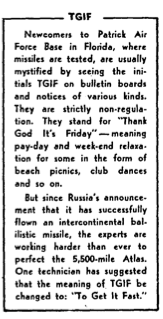
Screen Shot 2013-09-26 at 10.31.51 AM

Then came Stillman’s popular joint–one of the first of the “singles bars” on Manhattan’s Upper East Side. The next time the initials appeared in the Times was in a 1969 cartoon (and I’m still not sure how this happened, given that the newspaper is famous for not publishing cartoons). The spot, by Henry Martin, shows Robinson Crusoe spotting a native through some bushes. The inevitable caption: “TGIF!”

A Times reader wrote in to say he wasn’t familiar with the expression, and an editors’ note defined it and explained it was a favorite of–get this–the “Now Generation.” That occasioned a slew of other letters purporting to explain that “TGIF” was much older. One asserted that TGIF went back “at least 30 years–when I first started working in an office, and every stenographer and file clerk intoned those magic initials on Friday afternoons, while combing her hair in the ladies’ room.” Another claimed the initialism was invented by one Richard Amper during a “beer bout” near the University of Missouri in 1934.

It’s hard to verify those claims. But Jonathon Green’s authoritative Encyclopedia of Slang provides an authoritative 1941 quote, from the [Marion, Ohio] Star:

I thought I’d heard of everything in the way of booster clubs, alumni organization and the like, but this city, home of the Ohio State university Buckeyes […] has come up with one that tops them all. It’s the “Thank God It’s Friday” Club, composed entirely of undergraduates here at State. […] A typical meeting of the TGIF club foes something like this….

Now, “ITMA” ran from 1939 to 1949, and it’s possible that someone on the show uttered TGIF before the Ohio State club adopted it, but I’m dubious. For now, I’m going to label TGIF not only not a Not One-Off Britishism, but not a Britishism at all.

“Ta-Ta”

saveTeeBlackThe New York Times’ Sarah Lyall recently ended eighteen years as a London correspondent. The title of her farewell article, “Ta-Ta London. Hello, Awesome,” made me curious about ta-ta, which I hadn’t  thought of as a Britishism. In fact, my main association with the term is a memory of my mother jokingly saying, “Ta-ta, tatele“–the latter word being a Yiddish diminutive for “father.” A Google search also reminded me of a 1993 “Seinfeld” episode where George quits by saying to his boss, Mr. Tuttle, “Ta ta, Tuttle!”

But ta-ta is indeed of British origin. The OED defines it as ” nursery expression for ‘Good-bye’; now also in gen. colloq. use.” The earliest citation is from 1823, and a notable one can be found in T.S. Eliot’s 1923 “The Wasteland Waste Land”: “Goonight Bill. Goonight Lou. Goonight May. Goonight. Ta ta. Goonight.”

None of the dictionary’s examples come from U.S. sources, but it caught on here fairly early, as is illustrated by this 1889 article from the New York Times:

Screen Shot 2013-09-15 at 9.32.59 AM

During the 1940s, an initialized version of the expression merged via a character on the BBC radio program “Itma.” According to the OED, a “famous saying” of the Cockney Charlady, Mrs. Mopp (played by Dorothy Summers), “were the letters ‘T.T.F.N.’—a contraction of ‘Ta-ta for now’ with which she made her exit.” TTFN emerged decades later as an example of teenage online lingo, presumably on both sides of the Atlantic, peaking sometime in the middle of the decade of the 2000s. I gather that from a comment to a 2012 New York Times review of a play called “Peter and the Starcatcher”: “it tries so hard to be contemporary that it manages to date itself to about five years ago by overusing pop culture references and slang (‘TTFN,’ ‘guuuuuuuurl,’ ‘as if,’ and ‘Oh. My. God.’ to list just a few) from that time.”

A similar sounding word, also with nursery origins, but apparently with no connection to ta-ta, is ta, meaning “thank you.” I believe this is still current in the U.K. (in fact, it just showed up in an English friend’s Facebook feed), but hasn’t made any inroads in the U.S. I had a brief moment of hope when a Google search found it in a line of dialogue in a 2003 William Gibson novel, All Tomorrow’s Parties: “’Cheers,’ Tessa said, ‘ta for the lager.'” But when I looked into it, it turned out that Tessa is Australian, a fact Gibson tried to emphasize by having her use three separate British-Australianisms in one sentence.

I have the sense that a single “ta” is sometimes used in Britain as a shortened version of “ta-ta,” the way one might shorten “goodbye” to “bye.” Any guidance on this point would be appreciated. [Update. Several comments have convinced me that I was mistaken on this point.]

Meanwhile, a more recent term, seemingly American in origin, is ta-tas, or tatas, meaning breasts. It’s been especially prominent since 2004, when an anti-breast-cancer foundation was founded with the name “Save the Ta-tas,” prompting many t-shirts such as the admitted click-bait at the top of this post. I hesitate to speculate on the etymology of the term, but the earliest use I’ve been able to find is from the 1997 book Sexplorations: Journeys to the Erogenous Frontier, by Anka Radakovich: “My own lingerie jones is bras. I like plunging my tatas into lace, satin, and vinyl, and I love shopping at Frederick’s of Hollywood.”

“Run to ground”

The fox-hunting-derived expression go to ground, covered here not long ago, came to mind this morning when I read something President Obama said in an interview with Fox News yesterday:

And, you know, we’ve seen some indications from the Russians as well as the Syrians today, uh, that they may be willing to look at the prospect of getting those weapons under control, perhaps even, uh, international control, and getting them out of there, where they could be vulnerable to use by anybody. And that’s something that we’re going to run to ground over the next couple of days.

(By the way, I assume the Fox intern who transcribed the interview got extra brownie points for ever “uh” he or she could stick in.)According to the OED, “run to ground” is a variant of “go to ground,” both meaning (literally) to burrow into a hole in the earth, or, figuratively, to withdraw from public view or lie low. Something or someone can also be run to the ground, meaning worn out through overuse. Obama seems to have meant something different, more like “explore in every possible way.”

As I noted last week in a post on the Chronicle of Higher Education blog Lingua Franca, one of the distressing aspects the current debate over intervention in Syria is the way it’s led metaphors to run amok, including “red line,” “boots on the ground,” and “shot across the bow.” Now we seem to have come to the stage where metaphors are given new meaning, just because they, uh, sound good.

Lost in translation

Wes Davis sends along this from today’s New York Times real estate section. I believe the bathroom in question would not actually be considered a W.C., owing to its non-closet-like largeness and the presence of a shower, but some journos will do anything to avoid using the same word twice:

wes

“Gyno”

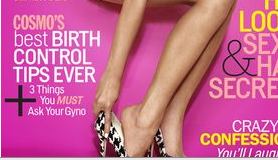
The ever-observant Nancy Friedman notes the viral popularity of a commercial in which a girl dispenses advice about menstruation to the other kids at her summer camp and is  dubbed the “Camp Gyno.” She also sends along the (American) Cosmopolitan cover headline below, and wonders, “is gyno [for “gynecologist”] the latest Britishism to cross the pond?”

Screen Shot 2013-08-29 at 10.39.59 AM

It would appear so, at least a little bit. The word doesn’t appear in the Oxford English Dictionary, and searching for it in Google and other databases is a bit chancey, since it is used in a variety of ways, in addition to the gynecologist abbreviation. That usage does appear to be of longer standing in the U.K. than the U.S., not surprising given the Brits’ fondness for such abbreviations as veg and cuppa.

But it has been gaining traction here for some time, or at least since 2007, the date of these citations:

From “Vibe Vixen” magazine: “At my gyno’s recommendation, I scheduled laser surgery to have the warts removed.”

From Don’t Sleep with a Bubba: Unless Your Eggs Are in Wheelchairs, by Susan Reinhardt: “Never wear C- or D-grade lingerie to the gyno because, chances are, when you wad up your clothes and place them on the chair, they’ll fall to the ground and the nurse will tell everyone in the office how hideous they were.”

Hard to argue with that.

“Different to”

Listening to a report on NPR the other day by the outstanding food correspondent Allison Aubrey, I heard her utter this sentence:

“It’s a high-protein corn that’s really different to what we’re accustomed to.”

That’s right, not different from or even different than, but different to. Years back, my friend David Friedman, a massive West Ham supporter, had told me this usage was prevalent in U.K. football commentary, and I’d been looking out for U.S. users. Aubrey was the first, so I revved up the databases and hunted for more.

Not much luck. There are plenty of different to‘s in the Corpus of Contemporary American English (COCA), but virtually all of them were either uttered by British-born speakers or writers, or were used in expressions like “it’s different to actually go there.” Going back to 2008, the one exception was this from the Denver Post in 2011: “…the roughly $18 billion 2011-12 budget Republicans voted for is more similar than different to those that Democrat-controlled legislatures have written the past several years.” But it seems likely that the writer used to because of the need to work with the earlier word similar, which takes a to.

So I am going to categorize different to as a Doobious NOOB.

By the way, my search informed me that the British usage had been commented on by Americans for at least 140 years. One example among many was an article called “Errors in the Use of Prepositions,” in an 1873 number of American Educational Monthly. The author, identified as “S.W.W.,” wrote:

English people make a sad mistake in saying “different to” for “ different from.” Here is an example from the London Times: “During Swift’s second residence with Sir William Temple, he had become acquainted with an inmate of Moor Park very different to the accomplished man to whose intellectual pleasures he so largely ministered.”

Screen Shot 2013-08-24 at 10.19.56 AM

“Knickers”

There must be something about American movie stars and British lingo. We just witnessed Mark Wahlberg going all NOOB-y. Now Anna Kendrick is quoted in GQ magazine about the horror of being approached for an autograph while shopping for underwear:

“There’s something deeply embarrassing about being approached when you’re holding knickers. And it’s happened TWICE!”

It’s enough to put your you-know-what in a twist.

Bum Steer

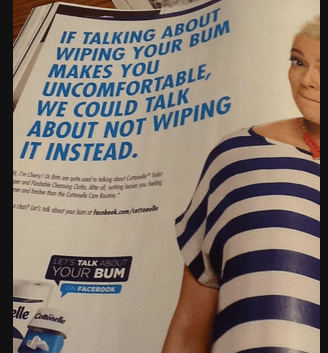
Lynne Murphy, a native American linguistics professor now living in the U.K. (and a good friend of this blog), has been visiting the U.S. and came across a startling magazine ad:

Screen Shot 2013-08-20 at 11.18.36 AM

Wait, what??

I’ve previously noted that bum has certainly made inroads on these shores, but this advert still was a bit surprising. It turns out that the manufacturers of Cottonelle, Kimberly Clark, put out a press release just two weeks ago:

Dallas, August 5, 2013-As bath tissue maker Cottonelle® looks to open the door on bathroom conversation, toilet talk is about to go mainstream. That’s right, Cottonelle wants to get North Americans talking about their bums and on the road to a better way to clean “down there” by using the Cottonelle Clean Routine — combining dry toilet paper and flushable wipes for a cleaner, fresher experience. With the help of London-based immersive journalist, Cherry Healey, Cottonelle is helping consumers to open up about their bathroom behaviors and “makeover” their old toileting routine. And with a sleek, newly designed dispenser for Cottonelle Flushable Cleansing Cloths, Healey is set to start the conversation now.

I had not heard of Cherry Healey, nor of “immersive journalism,” but I learn from Wikipedia that she has done a number of TV documentaries in the U.K,. including the one-offs “Drinking with the Girls, ” “Cherry Gets Pierced,” and “Cherry Goes Drinking,”” and this year had a six-part series: “The Year of Making Love.”

I imagine Kimberly Clark chose the word bum both as a nod to Healey’s nationality and a way of signaling that the ad is a little, well, edgy.

That’s all well and good, but it turns out that there are issues with the “Cottonelle Clean Routine,” specifically the bum-related use of “flushable” wipes. Nancy Friedman informs me that they are one of the prime causes of “fatbergs,” a serious environmental problem. Read her post on the subject … if you have the stomach for it.