Collective plural

ManCity

This appeared a couple of days ago in the Philadelphia Inquirer. The verb an American would normally use, of course, is “is.” My sense is that the Inquirer’s use of “are” is an aberration, even in coverage of English football.

The same day, John F. Burns had an article in the New York Times about the dodgy job prospects of football managers, and he did indeed use the singular verb form in reference to clubs, as in: “After several lean years, Arsenal is at the top of the Premier League standings, followed closely by Liverpool, Chelsea and Manchester City.”

However, Burns is English by birth and neither he nor the Times copyeditors could stop him from using another British custom, forgoing the definite article in referring to teams with plural nicknames, like Glasgow Rangers. An American would no sooner refer to “Yankees,” instead of “the Yankees,” than call a field “the pitch.”

Burns, referring to the Tottenham Hotspur club, wrote, “The admonition was not only for Spurs, who have fired eight managers in the past 12 years.”

Well played, sir.

“High Street”

Solihull High Street

When I first started spending time in England, one new phrase that was completely unfamiliar to me was the High Street, which the OED defines as “very generally, the proper name of that street of a town which is built upon a great highway, and is (or was originally) the principal one in the town.” By the 1950s, metonymic noun and adjective forms had developed, referring to the shops not just on the High Street proper, but on surrounding streets as well, and the goods that could be found in them. From a 2000 article in Elle: “High-street queen Karen Millen launches her first range of spectacles this season, so nab yourself a pair for that librarian-chic look.”

The closest American equivalent, I suppose, would be “Main Street,” but it’s not really the same thing, and besides, to the extent Americans shop in brick-and-mortar stores anymore, they don’t go to High Street or Main Street shops, but instead to big-box stores like Home Depot and Office Depot located in suburban strip malls.

Imagine my surprise, then, to pick up the Philadelphia Inquirer recently and read, “Retail rents on Walnut Street have gone up 33.8 percent in a year, the sharpest annual increase of all ‘high streets’ among U.S. cities…” True, high street was in quotation marks, but it was there.

It turns out the article referred to a report from the real estate company Colliers International. High street is sprinkled all over the Colliers website, but, surprisingly, it’s an American company, based in Seattle. However, a deepish dive into the site reveals that the company originated in Australia,  merged with a Canadian company in 1976, and moved to Seattle only in 1976.

So it would appear that Colliers’ use of high street is something between an appendage and an affectation. I would say its chances of catching on here are low.

“Roll-neck sweater”

Reader Jeanne Nelson comments, simply:

“From the New York Times, 12 December 2103:

“But if Mr. [Colin] Wilson was no Angry Young Man, with his lush Romantic hair and roll-neck sweaters he more than looked the part.”

I gather she is suggesting as a NOOB roll-neck sweater,  a phrase with which I’m not really familiar, though having read it I get the idea.The Oxford English Dictionart defines roll-neck as “A high loosely turned-over collar on a garment; a garment which has such a collar.” The first citation (from 1897) is from the Washington Post, but everything after 1950 is from Great Britain, including this from a 1977 “Time Out” advert: “Former male model—but more the jeans and rollneck type.”

The New York Times obituary of Colin Wilson helpfully provides this cozy photo of the author in roll-neck, with his wife, Joy:

WILSON-2-obit-web-popup

I am familiar with “turtle-neck,” which the OED defines identifies as “orig.” American and defines as: “A close-fitting roll or band collar, now usu. one intermediate in height between a crew-neck and a polo-neck.” The first citation is an 1895 Montgomery Ward Catalog:  “The Turtle Neck Shirt or Sweater, double from waist up, one of the most desirable garments ever invented for cold-weather shooting.” Two years later, 15-year-old Franklin Delano Roosevelt writes home from Groton School:  “I should very much like a red turtle neck sweater for skating and coasting.”

P.G. Wodehouse, who spent many years in the U.S., may have carried the term to Britain, writing in 1946, “He dresses like a tramp-cyclist, affecting turtle-neck sweaters and grey flannel bags.”

The New York Times has used the expression “roll-neck” or “rollneck” (the hyphen comes and goes) about fifty times in its history, including this from a fashion piece in 2009: “Remember when the cast of ‘Dawson’s Creek’ modeled in the J. Crew catalog and suddenly everyone was wearing those rollneck sweaters?”

By contrast, “turtle neck” or “turtleneck” have appeared some 4,000 times, including this sentence, just a couple of weeks ago, from an interview with Will Ferrell’s anchorman character, Ron Burgundy: “Dapper in a glen plaid polyester suit, brown ribbed turtleneck and dark-green leather jacket, Mr. Burgundy strode into the store, stopping to hold aloft some merchandise.”

Here’s the Times’ photo of Burgundy:

01ANCHORMAN-articleLarge

To me, this looks awfully close to Colin Wilson’s roll-neck. My sense is that originally, turtleneck referred to collars that were folded-over snugly and more or less low, and roll-neck to those that were folded over loosely and more or less high. I sense, further, that in the U.S., that roll-neck is a subset of the larger category turtleneck, and that roll-neck is in fairly wide use in the U.K., but is common in the U.S. only in fashion circles.

But I await the judgment of those who know better.


“Pervy”

Reviewing R. Kelly’s new CD, “Black Panties,” in the Philadelphia Inquirer, Dan DeLuca describes the performer as “the most pathologically pervy of pop stars.”

Something about that pervy piqued my NOOB-dar. I scuttled over to the OED, which defines the adjective as “Sexually perverted; pornographic” and locates its origin not in Britain but Australia. First cite is from a 1945 novel by the Australian Lawson Glassop, We Were the Rats: “Listen to this… ‘He buried his head in the warm fragrance of her bosom.’ So-and-so, so-and-so. It gets pervy again here. ‘His hungry kisses were returned with passionate abandon.’” The second is from a 1970 British book, Sir, You Bastard, by G.F. Newman: “Twenty maximum security, the lights never out, pervy screws watching every movement.”

There is also this illuminating exchange from the Australian novelist Jon Cleary’s 1982 book Clearfield’s Daughter: “‘What about Aussie men?’ ‘They’re different. They just think it’s pervy for the girl to be on top. Lie still!”

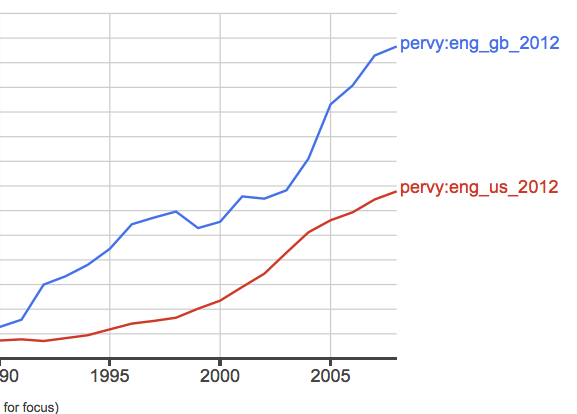
Google Ngram Viewer shows a rapid rise in pervy use in the U.K in the late ’80s, with the U.S. starting to follow suit about a decade later:

Screen Shot 2013-12-09 at 2.48.53 PM

(The word shows up pre-1990, but almost all uses are either of proper names or the Russian word pervy. I believe it means “first” in that language, at least judging by this quote I found on the Internet: “‘How was that as a first try?’ asked Trotsky. [Vladimir] Mayakovsky answered with a devastating pun: ‘The first pancake falls like a People’s Commissar’ (pervy blin lyog narkomom), a play on the saying ‘the first pancake falls like a lump.'”)

The word first appeared in the New York Times in 2000, in an interview with the novelist Edmund White: “Even though people act as though you’re being exhibitionistic in some sort of pervy way by writing about all of this stuff, I actually see it as sort of heroic.” Since then it’s been in the paper about seventy-five times, including this telling quote from a 2004  piece about fashion designer Christopher Bailey, datelined London: “You can’t even say the look is British, although in his latest women’s show, for fall 2004, he did have leather buttons and some see-through rain capes. Very pervy, Bridget Jones would say.”

Since 2009, the word has appeared about forty times in the Times, suggesting that it is now firmly in the American chattering class’s lexicon. One quote earlier this year described a (very) new version of Mozart’s “Le Nozze di Figaro” that was performed earlier this year. “‘Ma’am, I don’t mean to sound twisty or pervy,’ goes one line in his rejiggered ‘Non so più.’ ‘Damn, I just love when a body’s all curvy.’”

“Purpose-built”

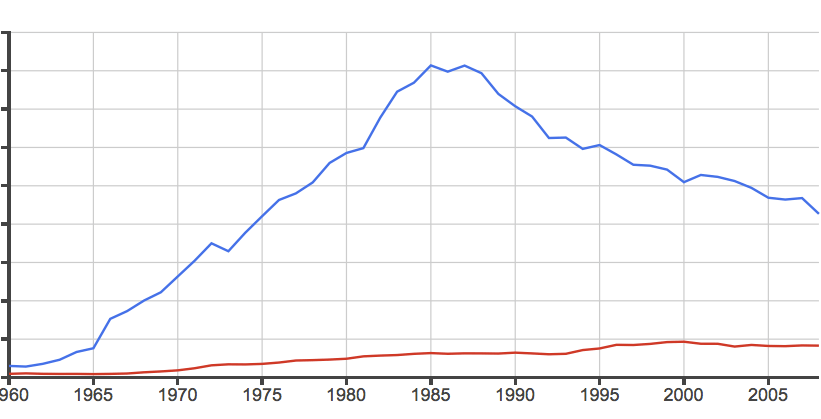
When Jan Freeman noted on Twitter that she had heard an NPR correspondent use purpose-built, I was momentarily befuddled. Not only did I not know the phrase was a Britishism, I also kind of didn’t know what it meant. Merriam-Webster informed me that the phrase is an adjective meaning “designed and built for a particular use,” adding “chiefly British.” A Google Ngram chart confirmed this, and also that American use is on the rise. (The blue line represents British use, the red line American.)

Screen Shot 2013-12-05 at 10.00.14 AM

The New York Times has used purpose-built about 300 times in its history, first in 1929 in a reference to “purpose-built taxicabs.” But things have picked up lately: there have been 49 purpose-builts in the Times in 2012 and 2013 alone. Most of them, interestingly, refer to cars or some car-related things, as in the most recent reference, on November 15, 2013: “After an absence of half a decade from the United States, Formula One returned last year with a Grand Prix at the first purpose-built circuit in the country.” But art critic Michael Kimmelman this year described a Tuscan vineyard as “purpose-built nature  on a very large scale” and columnist Paul Krugman, a serial NOOBer, argued against gerrymandering, writing, “Let’s stop allowing the parties to pick their voters (and put them into purpose-built districts).”

I’m still a little befuddled by purpose-built. One commenter on the Merriam-Webster definition (and since when have definitions had commenters?) said the phrase was frequently superfluous, noting, “One uses ‘purpose-built’ as an adjective to differentiate between items that were built for a reason and items that were built for no reason at all”–the implication being that very few things are built for no reason at all. (Another commenter noted, “Marketing buzzward.” I like the way they think, though not necessarily their spelling.)

But on reflection, and on examination of the Times items above, I can see that the phrase is occasionally useful and apt, especially when you consider the alternative. That’s right, I’m talking about bespoke.

“Keep Calm and…”: A slideshow of a meme

This slideshow requires JavaScript.

(Note: To start the slideshow, click the image at left or the words “Continue reading,” below. If it moves too fast, you can click the “pause” button at the bottom and advance it one slide at a time with the right-facing arrow.)

If by some chance all this excites you, you can create your own “Keep Calm and” online poster at keepcalmandposters.com or keepcalm-o-matic.co.uk. Both sites let you order actual paper versions of your work; at keep-calm-o-matic, you can also get a t-shirt, a mug, a keychain, or an iPhone 5 case.

At this point, “Keep Calm and” is everywhere. It cannot be escaped. That is all. Carry on.

“Rump”

Joshua Keating’s recent Slate article had a brilliant conceit: how would the U.S. media report on the current U.S. political crisis if it were happening in another country? The piece started:

WASHINGTON, United States—The typical signs of state failure aren’t evident on the streets of this sleepy capital city. Beret-wearing colonels have not yet taken to the airwaves to declare martial law. Money-changers are not yet buying stacks of useless greenbacks on the street.

I recommend you read the whole thing, but the line that’s relevant to this blog is: “…the president’s efforts to govern domestically have been stymied in the legislature by an extremist rump faction of the main opposition party.”

The Oxford English Dictionary’s defines rump (in this context) as “A small, unimportant, or contemptible remnant or remainder of an (official) body of people, esp. a parliament,” and explains that it’s derived from rump Parliament, that is, “the remaining part of the Long Parliament, esp. in its second formation of 1659–60.” As befitting its origin, every citation for rump in the political sense is of British origin.

But it has occasionally been hauled out by Americans. One of the first to use it to refer to the Republican Tea Partyers who have been holding things up in the current mess was Senate Majority Leader Harry Reid (a Democrat). He was quoted as saying on Sept. 27, “The middle class, working men and women in this country, are the ones we were elected to serve. That’s who we should be thinking about. They’re the ones who are going to pay the price if these rump Republicans force a government shutdown.”

A few days later, Mother Jones magazine wrote, “Once again, a rump group of Republican radicals in the House are throwing the US government into chaos.” The day after that, a Baltimore Sun columnist opined, “fault for the current government shutdown lies with the rump, radicalized, tea party-beholden congressional Republicans who have no regard for the legislative process, the country’s credit rating, political traditions, or the U.S. Constitution they supposedly revere.”

Haven’t seen any beret-wearing colonels on the streets of Washington yet, but give it time.