

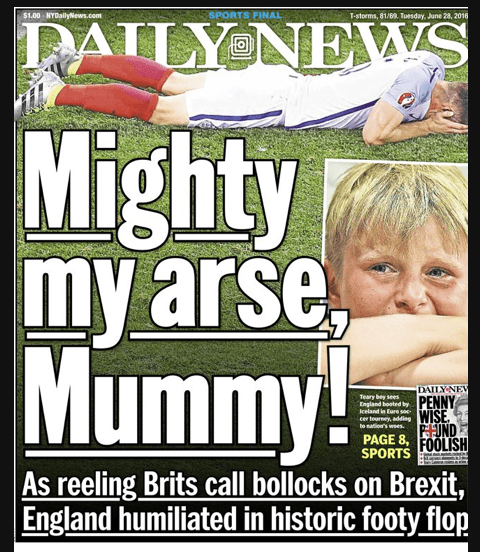
I’ve written before about a trend I first noticed in my students, then observed in the wider world: eschewing the common or standard spelling, pronunciation, or version of a word in favor of one that is or seems more British. Examples include amongst (instead of the traditional among); the British spelling grey (gray) and the faux-British spelling advisor; and pronouncing often as “off-ten” and either as “eye-ther.”
I’m far less certain about the causes for the trend than that it exists. Hypercorrection would seem an obvious explanation, though it’s puzzling why this would present itself especially among the young, or at a moment when formality is otherwise on the decline. Maybe, come to think of it, it’s a reaction to the casualness that’s rampant everywhere else.
In any case, I have a new specimen for the case: the pronunciation of the word for your mother’s sister. In the United States, there are two main alternatives. One is to sound like the insect, “ant” (“ænt” in the International Phonetic Alphabet). Centuries ago, it was pronounced that way throughout the British Isles, but then much of southern England switched to “ahnt” (“ɑnt” in IPA). And that’s the second U.S. pronunciation. In the nationwide dialect survey conducted by Bert Vaux of Harvard around the turn of the 21st century, 75 percent of the respondents reported saying “ant” (shown in blue on the map below) compared with 9.6 percent for “ahnt” (red).

Clearly, the “ahnt” pronunciation — along with an additional 2.5 percent who reported rhyming the word with “caught” (“ɒnt” in IPA) — is concentrated in New England. (It’s how Rosalind Russell–born in Waterbury, Connecticut–says the word in the 1958 film Auntie Mame.) In addition, it is the “typical” pronunciation among African-Americans, according to Algeo and Butcher’s The Origins and Development of the English Language.
Vaux, now at Cambridge University, has continued his investigations under the project title Cambridge Online Survey of World Englishes. The results for aunt would seem to confirm my anecdotal observation and hunch that a change is afoot: A mere 60 percent of respondents now report saying “ant,” and 25 percent either “ahnt” or “awnt.” Hot spots for the latter include (besides New England) Virginia and the Upper Midwest.
I conducted my own semi-scientific test and listened to the 20 most recent times Americans have said the word on National Public Radio’s air. Eleven said “ant,” including Tom Hanks, Joe Biden, Gene Wilder’s nephew, and the hosts Rachel Martin and Terry Gross (the last was overdetermined, since Gross is a Brooklyn native in her 60s whom one would invite to a “cawfee tawk”). Of the nine who said “ahnt,” five were from the traditional African-American group. But there was also an 18-year-old New Yorker whose parents were born in Ecuador, a white drug counselor from Minneapolis, the reporter Hansi Lo Wang (a native of Philadelphia and a fairly recent Swarthmore graduate), and, in the biggest surprise, Weekend Edition host Scott Simon, a 64-year-old Chicagoan.
What’s missing is a generational study, testing the hypothesis that the growth in “ahnt” has been fueled by millennials. To paraphrase Matt Damon in The Martian, can someone please science that up for me?




 notoneoffbritishisms.com