“Flummoxed”

This summary appeared February 3 on the home page of the New York Times:

screen-shot-2017-02-03-at-9-50-48-pm

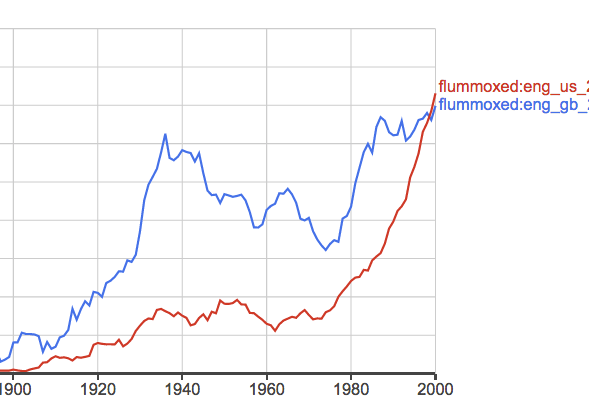
It reminded me that a couple of weeks back, someone suggested “flummoxed” as a NOOB. That sort of flummoxed me, as I had thought of it as a cross-Atlantic word, claimed neither by BrE not AmE. Google Ngram Viewer showed me I was mistaken and my correspondent was correct:screen-shot-2017-02-04-at-11-12-33-amThat is, it started out as a mainly British word, but Americans took a shine to it starting in the 1970s, and finally overtook the British in the late ’90s.

Green’s Dictionary of Slang defines the word as “confused, let down, outwitted” and has as its first citation a 1834 book called Delicious Chatter: “Joe own’d he was flummix’d and diddles at last.” Three years later, in Pickwick Papers, Dickens has Mr. Weller say, “And my ‘pinion is, Sammy, that if your governor don’t prove an alleybi, he’ll be what the Italians call regularly flummoxed, and that’s all about it.”

The OED doesn’t support the Italian etymology but does say the word had a distinct meaning in nineteenth century America. So does Green’s, which quotes Schele De Vere’s Americanisms (1872): “Flummux, to, a slang term used in England in the sense of to hinder, to perplex, denotes in America the giving up of a purpose, and even to die.” It seems to have faded out in the U.S. in the early twentieth century.

The New York Times has used “flummoxed” exclusively in the British sense, first in a dispatch from the 1935 British Open: “there was some confusion regarding ownership of the balls and Smith, being slightly deaf, got so thoroughly “flummoxed” — as the Scots say–over instructions from the marker, his partner and the friendly crowd …” The next use was in 1949, and since then it has appeared in the newspaper 1,434 times–including eight in the first weeks of 2017. Its popularity in this moment isn’t surprising: like “government officials and travelers,” many of us over here feel pretty flummoxed pretty much all the time.

The Ascendance of “Sport”

I wrote here, and again here, about Americans’ use of the typically BrE “sport,” rather than the traditionally American “sports.” I’ve continued to see a lot of examples, most recently from tennis star Venus Williams yesterday at the Australian Open:

I think why people love sport so much is because you see everything in a line. In that moment, there is no do-over. There’s no retake. There is no voice-over. It’s triumph and  disaster witnessed in real time. This is why people live and die for sport, because you can’t fake it.

At this point, AmE “sport” seems sufficiently widespread not to warrant further comment.

“Seconded”

I mentioned that Stuart Semmel had suggested two NOOBs. The first was “liaise” and the second is second. That’s not double-talk: the word he suggested was “second,” usually used in passive-voice participle form: to be “seconded” (accent appropriately on the second syllable).

The term is of military origin. The OED has a first citation from 1802 and offers this definition: “To remove (an officer) temporarily from his regiment or corps, for employment on the staff, or in some other extra-regimental appointment.” It was applied to movements of civilian employees as early as 1920, when this appeared in the Westminster Gazette: “It was finally agreed that Lord Moulton should be seconded to the service of the Corporation and of the dye industry for..one year.”

This Google Ngram Viewer chart indicates that ever since, “seconded” has been a decided Britishism. (The red line indcates British use, the blue line American)

screen-shot-2017-01-20-at-2-19-01-pm


And truth to tell, it still is one. The first five pages (after which I quit looking) of Google News hits for the phrase are all from U.K. or Commonwealth sources. However, Stuart reports hearing it on occasion in academic circles and my friend Nanette Tobin in corporate ones. And it was used three times in the New York Times in 2016, including this by Sarah Lyall (a longtime resident of London), in her coverage of the New York’s Westminster Dog Show: “Andy Das, an assistant sports editor whose responsibilities typically include soccer and college sports, but who was seconded to dog duty this year…”

So “seconded” is definitely On the Radar.


“Go to ground” Gets a Bump

A few years back I wrote about the expression “go to ground,” which originated in fox-hunting and came to mean “disappear”–not in the “go missing” sense but as a deliberate act, a sort up souped-up lying low (or, as it’s nearly universally rendered in the U.S., “laying low”).

The expression has been picked up by U.S. sources in the past week in reference to Christoper Steele, the former British intelligence officer who put together a dossier alleging bad behavior by Donald Trump and, when the news came out, flew the coop. So the New York Times had this headline:

img_3661

While checking out recent uses of the expression, I noticed something I didn’t mention in my original post. In As mentioned in the original post, in British football and rugby coverage, “go to ground” is used more literally–meaning a player who for one reason or another has actually ended up on the ground. As in:

screen-shot-2017-01-14-at-10-23-19-am

As Tara McAllister Byum has pointed out on Twitter, a slang expression long favored by doctors  and used in the 1978 novel “The House of God” is “Gomers go to ground.” (“Gomer”–possibly an acronym for Get Out of My Emergency Room.) According to an article in Phramacy Times, “The gomer was often an elderly patient, and one of the ‘laws] of the book was that ‘gomers go to ground,’ referring to their tendency to fall or fall out of bed.”

“Liaise”

NOOBSian Stuart Semmel of Yale University has passed along two new (to me) NOOBs. The first is the verb “liaise,” a back-formation from the French noun “liaison,” which originally meant a sauce-thickening agent (who knew?) but has since referred to a close (sometimes intimate) connection between two people or organizations. The OED describes “liaise” as “originally Services’ slang” and provides a first citation from 1928: ” [Lord Fisher said in 1916] I want a soldier..to keep in touch with the Navy and so ‘liaise’ or exchange inventions which may be suitable.”

It is certainly a Britishism (which achieved massive gains in popularity in the last four decades of the 20th century), as seen in the Google Ngrams Viewer graph:

screen-shot-2017-01-09-at-11-11-30-am

I had heard it over the years, but mostly in the context of critiques of business jargon and “verbing” nouns. Back in 2005, in a column about back-formations, the great William Safire of the New York Times commented, “I don’t like liaise, a self-important, bureaucratic substitute for ‘work with.'” (He added, interestingly, “I like ‘surveil,’ because ‘surveillance’ has more of a pervasive and sinister quality than ‘watch’ or ‘follow.'”)

As the graph shows, “liaise” has gained some popularity in the U.S., but still is used much less than across the pond. Since Safire’s column, it has been used (by apparently American writers and sources) fifteen times in the Times, ten of them since 2010. This came from a February 2016 article about Libya:

Libyan officials and news media outlets have reported the presence of American, French, British and Italian special forces units in the country in recent weeks, ostensibly on reconnaissance missions and to liaise with local militias.

Next up: Semmel’s second NOOB (and therein lies a clue).

“Hooter”

Writing in the New York Times Book Review yesterday, Woody Allen (invoking the sort of stereotypes that would be offensive from the pen of a Gentile and maybe even from a Jew like Allen) referred to the American playwright George S. Kaufman as having a “standard tribal hooter and the natural blessing of wit common to his people.”

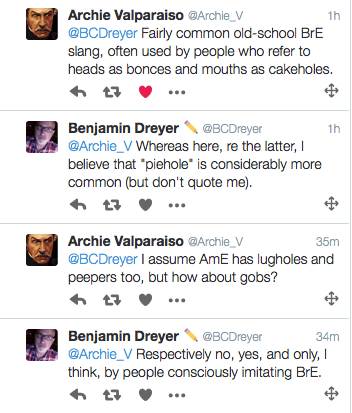
Benjamin Dreyer, an editor at the American publishing firm Random House, remarked on Twitter that he had only recently become aware of “hooter” as a slang term for “nose” and then had this illuminating exchange:

screen-shot-2017-01-02-at-9-21-29-am

Mr. Dreyer’s last assessment is spot-on, in my humble opinion.

“Hooter” for nose isn’t all that old; the Oxford English Dictionary’s first citation is from the 1958 book Bang to rights: an account of prison life, by Frank Norman. It’s clearly derived from another British sense of “hooter”–what Americans would call a car horn. Along the same lines, in Australian Rules Football, the hooter is the horn that sounds at the end of a period or a game. In the U.S., traditionally, the main slang meaning of “hooter” is the female breast, as seen in the chain of fine dining establishments.

Woody Allen (whose review proves–again in my humble opinion–that he’s much better at writing comic essays than movies) was in his high S.J. Perelman mode, which includes a mix not only of Britishisms but of Yiddish, low slang, and polysyllabic archaicisms. Thus his “hooter” doesn’t signal or awkward a widespread U.S. adoption. (We’re good with “honker” and “schnozz.”) The only other recent use in the Times was from book critic Dwight Garner, himself an estimable stylist. Reviewing a collection of Garry Trudeau’s “Doonesebury” cartoons in 2010, Garner referred to “the pencil-shaped hooter that his main character, Mike Doonesbury, has sticking out of his face.”


“Scuppered”

The ever-observant Nancy Friedman has sent along a screenshot of a Wall Street Journal headline: “Tehran officials say accord is now harder to undo, threaten clawbacks if scuppered.”

Never mind about “clawbacks” for the moment–the thing that caught her, and my, interest is “scuppered.” The OED tells us that the verb “scupper” originated in the late nineteenth century as military slang for “to surprise and massacre.” There followed a “colloquial” twentieth-century meaning, “To defeat, ruin, destroy, put an end to.”  By 1957–when a writer for The Economist noted, “The suspicion is still alive that there would have been secret rejoicing in Whitehall if the French Assembly had scuppered the common market”–it had entered (British) journalese, in a sense similar to that seen in the Wall Street Journal headline.

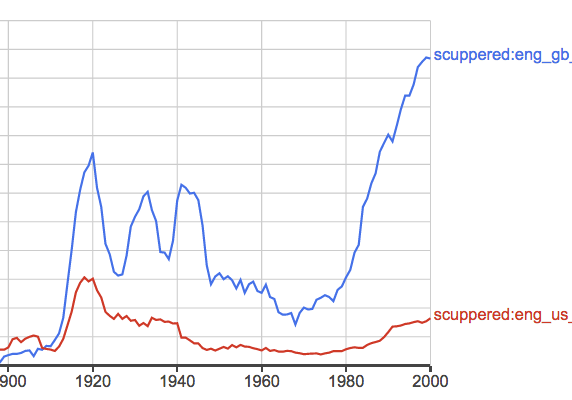
And it definitely is a Britishism, as seen in this Google Ngram Viewer chart:

screen-shot-2016-12-20-at-2-54-47-pm

I reckon that the recent popularity of “scuppered” is in part due to its aural resemblance to “scuttle”–originally a nautical term meaning to bore holes in the boat for the purpose of sinking it, and in figurative use by the 1888, after which it has been equally popular in the U.S. and U.K. according to Google Ngram Viewer. ( “The day..began with bad news. The Rent Subsidy Bill had been scuttled without opportunity to work on it.” Ladybird Johnson, White House Diaries, 1965.) “Scuppered” may (wrongly) make  journos and subeditors feel that they are using a fresher word than the tired old “scuttled.”

In any case, “scuppered” is gaining a foothold among U.S. writers, who may (wrongly) feel that using a Britishism makes them seem cool. It has appeared in the New York Times five times in 2016, first from the pen of columnist Maureen Dowd:

Of course, if [Hillary Clinton] had been a better listener on her health care initiative and the Iraq invasion, those two towering issues might not have scuppered her.

And most recently from the pen of former Harvard president Lawrence Summers, who wrote for the December 5 edition:

A trade deal between the European Union and hardly threatening Canada was almost scuppered by a recalcitrant Belgian province concerned about the effects of globalization on local workers.

“Ahnt”

I’ve written before about a trend I first noticed in my students, then observed in the wider world: eschewing the common or standard spelling, pronunciation, or version of a word in favor of one that is or seems more British. Examples include amongst (instead of the traditional among);  the British spelling grey (gray) and the faux-British spelling advisor; and pronouncing often as “off-ten” and either as “eye-ther.”

I’m far less certain about the causes for the trend than that it exists. Hypercorrection would seem an obvious explanation, though it’s puzzling why this would present itself especially among the young, or at a moment when formality is otherwise on the decline. Maybe, come to think of it, it’s a reaction to the casualness that’s rampant everywhere else.

In any case, I have a new specimen for the case: the pronunciation of the word for your mother’s sister. In the United States, there are two main alternatives. One is to sound like the insect, “ant” (“ænt” in the International Phonetic Alphabet). Centuries ago, it was pronounced that way throughout the British Isles, but then much of southern England switched to “ahnt” (“ɑnt” in IPA). And that’s the second U.S. pronunciation. In the nationwide dialect survey conducted by Bert Vaux of Harvard around the turn of the 21st century, 75 percent of the respondents reported saying “ant” (shown in blue on the map below) compared with 9.6 percent for “ahnt” (red).

Screen Shot 2016-11-30 at 10.10.56 AM

Clearly, the “ahnt” pronunciation — along with an additional 2.5 percent who reported rhyming the word with “caught” (“ɒnt” in IPA) — is concentrated in New England. (It’s how Rosalind Russell–born in Waterbury, Connecticut–says the word in the 1958 film Auntie Mame.) In addition, it is the “typical” pronunciation among African-Americans, according to Algeo and Butcher’s The Origins and Development of the English Language.

Vaux, now at Cambridge University, has continued his investigations under the project title Cambridge Online Survey of World Englishes. The results for aunt would seem to confirm my anecdotal observation and hunch that a change is afoot: A mere 60 percent of respondents now report saying “ant,” and 25 percent either “ahnt” or “awnt.” Hot spots for the latter include (besides New England) Virginia and the Upper Midwest.

I conducted my own semi-scientific test and listened to the 20 most recent times Americans have said the word on National Public Radio’s air. Eleven said “ant,” including Tom Hanks, Joe Biden, Gene Wilder’s nephew, and the hosts Rachel Martin and Terry Gross (the last was overdetermined, since Gross is a Brooklyn native in her 60s whom one would invite to a “cawfee tawk”). Of the nine who said “ahnt,” five were from the traditional African-American group. But there was also an 18-year-old New Yorker whose parents were born in Ecuador, a white drug counselor from Minneapolis, the reporter Hansi Lo Wang (a native of Philadelphia and a fairly recent Swarthmore graduate), and, in the biggest surprise, Weekend Edition host Scott Simon, a 64-year-old Chicagoan.

What’s missing is a generational study, testing the hypothesis that the growth in “ahnt” has been fueled by millennials. To paraphrase Matt Damon in The Martian, can someone please science that up for me?

“Give [someone] the pip”

After all these years, it’s rare for me to come across an American using a Britishism I was previously unaware of. But that’s what happened when I was reading the New York Times the other day. Theater critic Ben Brantley, reviewing a revival of the musical “Sweet Charity,” alliteratively noted, “Peppiness gives me the pip.”

Actually, “pip” is one of the first Britishisms I was ever aware of, upon reading the Conan Doyle story “The Five Orange Pips” when I was a kid. (The word I would use for the seeds in an orange is “seed.”) “Gives me the pip” was a new expression to me, one that definitely had a British sound to it. And Britishism it is. It derives from the poultry disease known as “the pip.” The Oxford English Dictionary and Green’s Dictionary of Slang reveal having or getting the pip was used to mean feeling depressed or out of sorts starting in the 1830s, and “giving [someone] the pip,” meaning to annoy or irritate, in 1896.

All of the many citations in Green’s are from British sources, including no fewer than five from the quintessential Englishman P.G. Wodehouse, ranging from 1910’s Psmith in the City (“That’s the sort of thing which gives me the pip”) to 1960’s Jeeves in the Offing (“It would be fatal to risk giving her the pip in any way”).