I started this blog in large part because its topic–British words and expressions becoming popular in America–runs counter to the far more popular narrative of Americanisms taking over British English. This supposed subjugation, which has been lamented for a couple of centuries, is the subject of a new book by Matthew Engel, That’s the Way It Crumbles: The American Conquest of English. In it he argues that so many Americanisms have taken hold in Britain — including “cookie” instead of the traditional “biscuit” — that within a century, quite possibly, American English will “absorb the British version completely.”
When he was researching the book, Engel decided to interview me, as the NOOBs phenomenon was obviously relevant to his thesis. In the book, he describes me as “an affable and hospitable man” but dismissed the blog as more or less inconsequential, with the subjects of many entries either “passing fads” or “so well camouflaged that their ancestry is largely forgotten.” (The latter would seem proof of the influence of British English in the U.S., but never mind.)
“When comparing the indignities with those heaped on British English,” Engel writes of me, “he can sound a bit like a White House spokesman threatening nuclear retaliation for an outrageous and provocative attack launched by the armed forces of Rutland.” (Rutland being a county in England.)
No comment on that analogy. I’ll just move on to observe that the reality is rather more complicated than Engel’s jeremiad suggests. As “Johnson” (Lane Greene) observed in The Economist:
It is true that America is influencing British usage. “Smart” is increasingly describing the intelligent as much as the well dressed. (Never mind that “smart” first was used this way in Britain in 1571.) Many Britons prefer “movies” to “films”. And “fries” and “cookies” are now appearing alongside “chips” and “biscuits”. But are they always replacing them?
No: “smart” is savvy, whereas “clever” is swotty. “Fries” are thin and crispy, and “cookies” are American styles like chocolate-chip, notes Lynne Murphy, an American linguist at Sussex University writing her own book about the relationship between British and American English. “Movies” tend to come from Hollywood; “film” is still preferred for the latest gritty cinema from Europe. In other words, these Americanisms are not an impoverishment of British English. They are additions to it.
Johnson concluded that British English is “in rude health.”
I’ll add that when I was in London recently, I found that a common menu item was “skinny fries,” emphasizing the distinction from the fatter, still thriving “chips,” as in fish and.
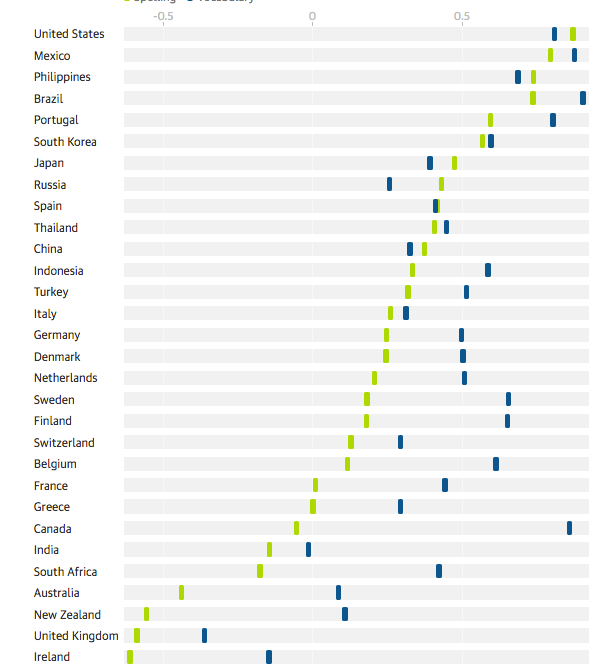
A new academic study that crunched 30 million tweets and 15 million digitized books published between 1800 and 2010 found that, in the worldwide use of English, spelling and vocabulary are indeed trending toward American versions. However, the trend is most pronounced in countries where English isn’t the primary language, and, in all the world, is seen least in Britain.
The Guardian did a nice graphic illustrating these findings, and suggesting that Americanisms are just slightly more prevalent in Britain than Britishisms are in America. The green bar indicates spelling and the blue bar vocabulary. A score of -1 means thoroughly British, and +1 thoroughly American.
That’s consistent with what I found in a book I just finished reading, Idiot Brain: A Neuroscientist Explains What Your Head Is Really Up To, by Dean Burnett, published in London in 2016. Burnett, a neuroscientist at Cardiff University, in Wales, is a sort of poster boy for the survival of British English. On page 1 alone, he does these distinctively British things:
- Spells the words “apologise” (American: “apologize”) and “behaviours” (“behavior”).
- Refers to a little boy “dribbling” (the more common American word word is “drooling”).
- Uses logical punctuation and single quotation marks (the American practice is double quotes) when he refers to ‘something people say’.
Page 1 is not an aberration. From beginning to end, the book is packed with Britishisms. Most apparent are the different spellings, including “sceptical” (U.S.: “skeptical”), “aeons” (“eons”), “”travelling” (“traveling”), “tyre,” “pyjamas,” “foetal” (“fetal”), “centre” (“center”) and “hippy” (“hippie,” as in the flower child of yore, not an adjective meaning wide around the middle. If you’re skeptical or sceptical on the British-American difference see this Google Ngram chart). Burnett probably somewhere wrote “programme,” but I didn’t catch it.
As far as vocabulary goes, in this 302-page book, I counted 44 distinctively British terms, including “dribbling.” Here are the others, in order, with American equivalents in parenthesis. For ease of reading, I’ve dispensed with quotation marks except where Burnett uses them. And the links are to Not One-Off Britishisms posts, indicating that term has had at least some penetration in the U.S.
Without any bother (without any trouble), petrol (gas), worrying (troubling), mum (mom), crisps (chips or potato chips), she used to live in the street next to us (on the street), well done (good job), “Not now, mate” (buddy), here’s the clever bit (smart part), massive (not exclusively British but used massively more often there than here), turning up drunk (showing up), at university (in college), row (argument), chap (guy), knock-on consequences (no real equivalent, hereafter abbreviated NRE), queue (line), maths (math), have a look (take a look), “you were crap” (NRE), boffin (NRE), sport (sports), daft (crazy), games consoles (game), trainers (sneakers), estate agent (real-estate agent), check your emails (email), goal-orientated (oriented), different to (from), a bit of fun (some fun), cut you up (cut you off, in the motoring sense), down to you (up to you), waiting staff (wait staff), I went to the shops (I went shopping), shop (store), forecourts (NRE), noughts and crosses (tic tac toe), heard it from some bloke down the pub (heard it from some guy at the bar), carry on (continue, go on), messes about (messes around), lift (elevator).
And how often does Burnett use American lingo? I’m at a bit of a disadvantage here, since presumably I wouldn’t necessarily recognize an Americanism as such; it might just seem normal to me. So bear that in mind when I say I counted only four terms that appear to be Yank imports: “up for grabs,” “fans” (in a sports context — the more common British word is “supporters”), “smart” (Burnett alternates it with “clever”), and the cowboy-movie “pronto.” (There were a few others that initially struck me as Americanisms but turned out not to be: “hubbub” came from Ireland, as early as 1555: “a big ask,” meaning a large or important request, is an Australianism, according to the OED; and the dictionary’s first cite for “the middle man,” meaning an intermediary, is from Edmund Burke in 1797.)
I would guess there’d be about the same number of Britishisms in a comparable American book, most likely coming from a relatively short list of the most popular NOOBs: “bits,” “clever,” “go missing,” “one-off,” “kerfuffle,” and a few more.
And that’s the way the biscuit crumbles.




 notoneoffbritishisms.com