“Smarmy,” II

In my previous post, I proudly asserted that I had antedated (from 1924 to 1905), the OED‘s first citation for “smarmy,” meaning “ingratiating, obsequious; smug, unctuous.” The use I found was in a poem featuring a rustic bloke speaking with a West Country accent. Moments after I proudly tweeted out my find, Jonathon Green, editor of Green’s Dictionary of Slang, responded with a bit of skepticism: “Looking at other bits of [the] poem allowed by Google Books I’m certain it is a positive sense and not the current one. All simple rustic good fellowship, none of implications of modern ‘smarmy.’”

On reflection, I took his point, although I couldn’t find such a good-fellowship meaning in any reference work or in any other text. The other recognized meaning of smarmy derives from the verb smarm (sometimes spelled smalm or smawm), defined by the OED as “smear, bedaub” and first cited by the dictionary in an 1847 work, A Dictionary of Archaic and Provincial Words. The OED has a secondary definition of smarmy as “smooth and sleek,” with the first citation from a 1909 source: “A tall, slight, smarmy-headed man.” As that suggests, the “smear” meaning became associated with the stuff one smears on one’s hair. A little quality time on Google Books gave me an antedate, from a 1903 play by Henry V. Esmond, When We Were Twenty-One:

Screen Shot 2018-10-10 at 9.21.20 AM

That one seemed to hold.

It makes sense that “unctuous”-smarmy, with its sense of behavioral greasiness, would have emerged from the hair sense of the word. And a short time after our initial Twitter exchange, Jonathon Green posted a true antedate, from a 1916 edition of an Australian newspaper, the Barrier Miner, in New South Wales: “I wonder what his game is […] He doesn’t look the sort she could make a friend of; too smarmy for my taste.”

I kept looking and eventually came upon an even earlier use of modern smarmy. Strangely enough, it was a joke. A London journal called The Academy ran “Literary Competitions” in each issue, much as New York magazine and The Washington Post have done in later years. Here are the rules for No. 14:

Screen Shot 2018-10-12 at 3.55.16 PM

Using Google Books, I found an article about the results of the competition, including this list of some of the best responses:

Screen Shot 2018-10-14 at 8.08.21 AM

After I sent that out over Twitter, language maven Ben Zimmer located the original article from the  January 14, 1899, issue of The Academy announcing the winner of the competition. It revealed that one B.R.L., of Brighton, had come up with the idea that a word for “saying treacly things which do not sound genuine” should be smarmy.

The Internet is full of articles about notable neologisms, such as witticism, coined by John Dryden, and serendipity, invented by Horace Walpole. But none of them includes smarmy, and the very fact that B.R.L.’s humorous definition in a literary contest should eventually have become widely adopted — even as screel, scrungle, and gluxy disappeared — I find amazing.

I hope that doesn’t sound smarmy.

“Smarmy,” I

A friend sent me an article published about a year ago on Business Insider called “88 very British phrases that will confuse anybody who didn’t grow up in the UK.” Not surprisingly, the title is patently untrue. While some of the words and phrases were indeed unknown to me — like “bagsy,” “pull a blinder,” budge up,” and “cack-handed” — others, such as “anorak” and “boot” (for the trunk of a car), are familiar to anyone who has watched much British television, read many British novels, or spent much time in Britain. And others have penetrated the U.S. to the extent that I’ve written posts about them for this blog: “bloody,” “bog standard,” “Bob’s your uncle,” “cheeky,” “chockablock,” and that’s only halfway through the “C”s!

What interested me most was a fourth category: words and expressions that have been common in America for as long as I can remember, and which I wouldn’t have necessarily thought of as British in origin. Eleven of these were listed: “the bee’s knees,” “(go on a) bender,” “dim” (as opposed to clever), “full of beans,” “gallivant,” “miffed,” “round (of drinks), “smarmy,” “waffle” (as in go back and forth on a decision), “wangle,” and “shambles.” [Update: As several commenters pointed out, what I have given is the American definition of “waffle.” The British one is indeed different. In the words of the Cambridge English Dictionary: “ to talk or write a lot without giving any useful information or any clear answers.”]

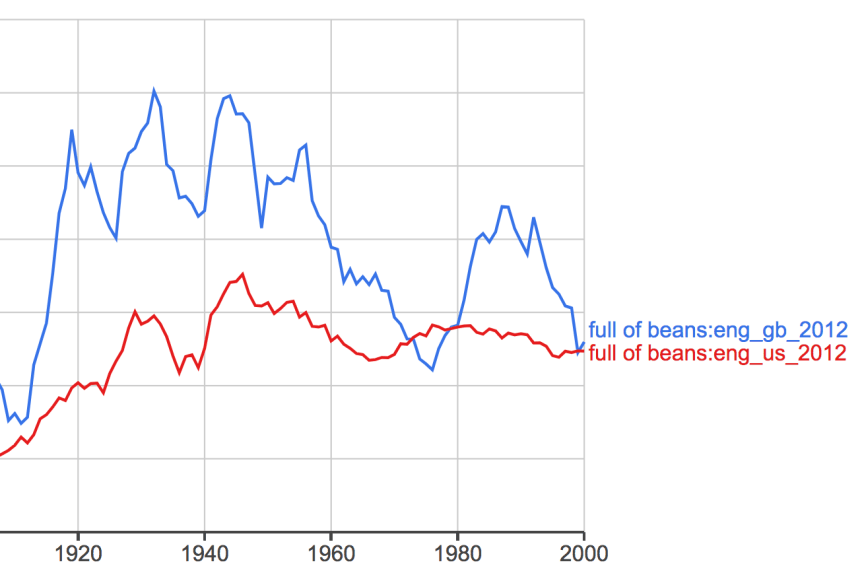
I tested them all–except “dim,” which was problematic because it has so many different meanings–with Google Books Ngram Viewer, which allows you, among other things, to chart the relative historical frequency of words of phrases in British and U.S. books. It turned out all of them have a long history of frequent use in America and most are currently at least as popular here as in Britain. (That’s including “shambles,” but not omnishambles.”) But three of them, in the early years of their use, were more common there than here, making them Historical NOOBs, and I’ll address all three, starting with “smarmy.”

The OED‘s principal definition of the word is “Ingratiating, obsequious; smug, unctuous,” and the first citation is from L. Brock, Deductions of Col. Gore, published in 1924: “Don’t you be taken in by that smarmy swine.” I found an earlier use in Google Books, in a poem called “The Widower” by Edward Sydney Tylee, published in The Living Age in 1905. Tylee is going for a dialect that I can’t identify:

Screen Shot 2018-10-09 at 5.20.51 PM

By the way, a secondary definition is “smooth and sleek,” with the first OED citation from a 1909 source: “A tall, slight, smarmy-headed man.” I believe I can antedate that as well, in a line from a 1903 play by Henry V. Esmond, When We Were Twenty-One:

Screen Shot 2018-10-10 at 9.21.20 AM

Back to the issue of British and American use of “smarmy,” here’s the Google Ngram chart:

Screen Shot 2018-10-10 at 9.23.58 AM

In other words, American use overtook British in the late 1970s, and by 2000 (the last year of reliable Google Ngram data) it was about 50 percent more popular in the U.S. I would imagine the margin is bigger today, what with all the smarmy people around who need to be described.

Any guesses as to the other two Historical Noobs on the Business Insider list?

“Browned off”

As I mentioned when discussing “cheesed off,” “browned off” is a similar term meaning fed up or annoyed. Both The Oxford English Dictionary and Green’s trace it to British sources, originating no later than 1938. That was the publication date of James Curtis’s novel They Drive By Night, this line from which both reference works quote: “What the hell had he got to be so browned off about? He ought to be feeling proper chirpy.”

But there is evidence of earlier use. The OED quotes Eric Partridge’s Dictionary of Slang (1961) as labeling the expression “Regular Army since ca. 1915; adopted by the RAF ca. 1929.” However, the dictionary sniffs, “pre-1938 printed evidence is lacking.” Green’s quotes a letter written in 1940 by Mrs. Jean Green in Hunsur, Mysore, in India, and published that year in American Speech:To brown off or to be browned off was first heard by me in Army circles at Aldershot [England] in 1932, and when I came out to India later in the year it was also used in Bangalore. Since then I have used it often, but gave it up a year or two ago, thinking it was overdone and dated.”

Much as one would like to, one cannot take Mrs. Green’s word for it that browned off was used in 1932. I can, however, provide the OED with a pre-1938 use in this line of dialogue from another James Curtis novel, There Ain’t No Justice, published in 1937: “All right, all right, all right, only fer Christ’s sake lay off of me. I’m feeling proper browned off. Be flying off the handle, any minute now.”

As for American adoption, “browned off” is not in wide use today on on either side of the Atlantic but appears to have been picked up by American soldiers in World War II–hence my categorizing it under “Historical NOOBs.” Green’s quotes a Norman Mailer letter from 1948 in which he lumped the expression in with a bunch of euphemisms he had disdain for: “Words liked [sic] browned-off, fouled-up, mother-loving, f—, spit for shit are the most counterfeit of currencies.” I can antedate that, too. On October 3, 1943, The New York Times published an article by Milton Bracker called “What to Write the Soldier Overseas.” Right at the get-go, Bracker takes up the topic of “Dear John” letters. He notes:

Screen Shot 2018-09-10 at 6.02.48 PM

I discussed the foregoing in a post for Lingua Franca, the Chronicle of Higher Education‘s blog about language and writing. Then I  proudly tweeted my James Curtis antedate.

Well, my moment of triumph lasted four hours and seven minutes. I had tweeted my find at 9:18 PM Eastern Daylight Time, and at 6:25 AM Greenwich Mean Time, Jonathon Green, editor of Green’s Dictionary, responded:

Screen Shot 2018-09-15 at 5.20.28 PM

As Jonathon suggests, the item is a bit difficult to decipher. Tommies is slang for common soldiers in World War I, and Kitchener’s men refers, Wikipedia says, to the so-called New Army, “an (initially) all-volunteer army of the British Army formed in the United Kingdom from 1914 onwards following the outbreak of hostilities in the First World War in late July 1914.” Bob down is trickier. Christopher Moore, in Roger, Sausage and Whippet: A Miscellany of Trench Lingo From the Great Warsays it means to take cover, on the approach of enemy aircraft. That’s consistent with a use in a 1915 British book called Soldiers’ Stories of the War: “The whole of the advance consisted of a series of what might be called ups and downs — a little rush, then a ‘bob down.’” After the war, it took on a broader use, according to Jonathon Green’s forebear, Eric Partridge, who writes in A Dictionary of Slang and Unconventional English that “Bob down — you’re spotted” was a catchphrase, dating from around 1920 , meaning “Your argument (excuse, etc.) is so very weak that you need not go on!”

As for “browned off,” it doesn’t seem in the newspaper item to have the later sense of angry or annoyed. Jonathan’s best guess was:  “‘brown off’ = for a veteran to defeat a rookie; the ‘old sweat’ would have served in India or elsewhere in Empire and thus be literally brown, i.e. sun-tanned. Probably WW I army use only.”

He followed his first tweet up with an image of a letter to the Portsmouth Evening News, December 10, 1935, that definitely used browned off in the annoyed sense, thus antedating my antedate. Oh well, it was nice while it lasted. It’s a response to a previous letter by a correspondent who called herself or himself “Browned Off,” indicating that the expression was already somewhat common. (The quotations marks around “six years inland in sweltering heat” indicates it was a well-known quote, too, but a Google search yields nothing.)

Dm-I3z-WwAE25qK

That leaves one mystery. Green’s entry for browned off lists as one of the few American citations a line from Chester Himes’s 1969 crime novel Blind Man With a Pistol: “By the time the sergeant got to the tenants in the last room he was well browned off.” I noted in my Lingua Franca post that it seemed odd that Himes — an African-American, born in Missouri in 1909 — would have used not only browned off but also the intensifier well, especially in reference to a New York City policeman. When well is placed in front of an adjective, I associate it strictly with British writers and speakers, a sense that’s confirmed by Brigham Young University’s Corpus of Global Web-Based English. I searched the GloWbE for the phrase well happy, meaning “very happy.” There were zero hits from American sources and 28 from British ones, including this line from a 1988 document, The Manual, that contains four Britishisms: “Nobody would dare ask to be paid for having a laugh [1], acting the lad [2] — buy them a pint [3] and they will be well happy [4].” (Americans do use a similar well in front of past participles: “That ball was well struck”; “It’s a well-written book.”)

So how did Himes come to use this well? The mystery was solved, to my satisfaction, by Lingua Franca commenter 99Luftballoons, who noted that Himes lived abroad — first in France, then in Spain — from 1953 till his death in 1984 and that his companion and eventually wife in his later years was Lesley Packard. Her 2010 obituary in The Guardian reports, “After he suffered a stroke, in 1959, she left her job to nurse him back to health and cared for him for the rest of his life, as his informal editor, proofreader and confidante.”

It almost goes without saying that Packard was British.

“Cheesed off”

The previous post on “Piss off!” mentioned the (originally American) expression “pissed off,” meaning annoyed, angry, etc.  There are two British equivalents, “browned off” and “cheesed off,” both of which date to World War II and both of which are NOOBs.

I’ll cover “cheesed off” today. All the citations in Green‘s Dictionary of Slang are from Britain or Commonwealth countries, for example this from a 1946 Philip Larkin letter — “I sympathise very much with your cheesed-off state.”

The earliest U.S. use I found was a 1983 New York Times quote from Congressman Les Aspin, referring to a heated debate about a nuclear freeze: ”Tempers are frayed — the boys are getting cheesed off.” (Interestingly, Aspin was from the American state of Wisconsin, which is known for cheese.) In 2008, in The New Yorker, Hendrik Hertzberg referred to “Hillary [Clinton]-supporting women who are still mightily cheesed off that Obama beat their candidate, despite his comparatively short resumé and so on.”

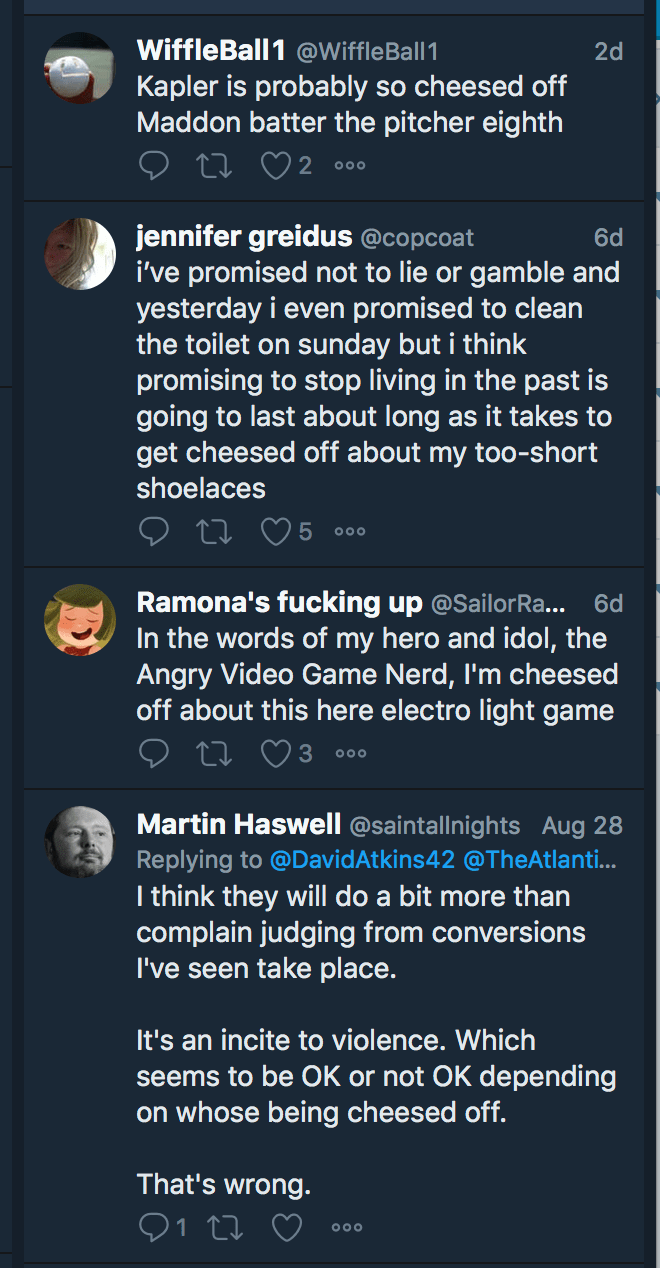
I got some more recent hits using my new favorite tool: the geo-tagging feature of TweetDeck that allows you to see tweets originating from a particular region. Here’s what came up when I set it for 200 kilometers from New York (Joe Maddon and Gabe Kapler, mentioned in the first tweet, are baseball managers):

Screen Shot 2018-09-05 at 10.52.04 AM

Next: “browned off.”


“Piss Off!”

A dependable American NOOBS informant, who wishes to remain anonymous, suggests an entry on “Piss off!” which she or he claims to be hearing more and more. This is distinct from “piss off” meaning to annoy, which started as U.S. service slang in World War II, and got picked up in Britain by 1989, according to Green’s Dictionary of Slang. And it’s also distinct from “pissed” meaning drunk, which is a Britishism dating from 1810 and has yet to be picked up in the U.S.–hence, a NOOB in waiting.

Green’s reveals that “piss off” originated in circa the 1920s as a verb meaning “to leave”; a 1959 Kingsley Amis letter notes, “She pissed off at about 9.” “Piss off” as a command is defined by Green’s as “an excl. of rejection, dismissal.” Citations–all from British or Commonwealth sources–date from 1934, with the most recent being from David Mitchell’s Black Swan Green, 2006: “The gypsy kid sat under the cedar sending out piss off waves.” The dictionary doesn’t say so, but it seems to me clearly a euphemism for the saltier “f— off.”

Has “Piss off!” penetrated to the United States? Not wanting to just take my informant’s word for it, I turned to Twitter, specifically the geo-tagging feature in TweetDeck. This allows me to create a column consisting of tweets containing the phrase “piss off” that originated within a 200-kilometer radius of New York City.

Bingo–we have a NOOB.

Screen Shot 2018-08-21 at 7.43.15 PM

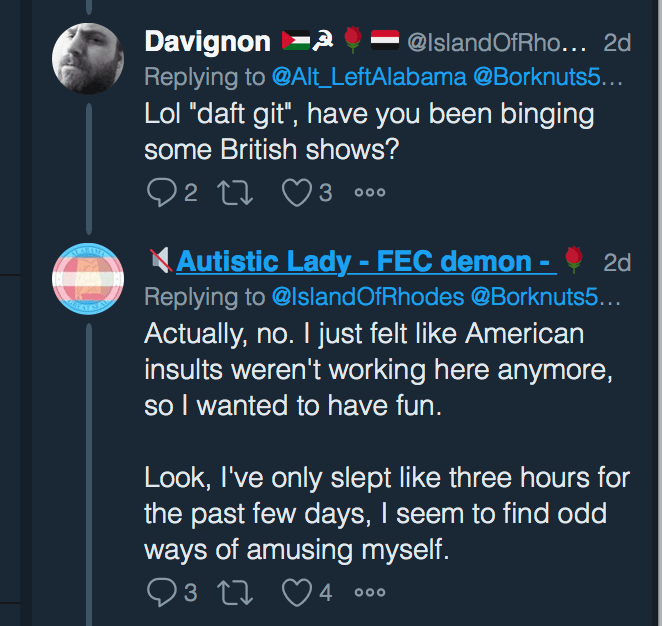
You’ll note that the tweet from “Autistic Lady – FEC demon -”  sure doesn’t sound like it originated from the New York vicinity, filled with Britishisms as it is. She subsequently explained:

Screen Shot 2018-08-21 at 7.44.05 PM

The “Bog Roll” Mystery

My friend Pat Raccio Hughes took a photo almost two years ago at her local Pennsylvania supermarket, Giant. She got around to sending it to me last week.

39760451_10212236333332251_1850624098435072_o

The reason she sent to to me, of course, was the term “bog roll”–what Americans would universally refer to as “toilet paper.” (“CHRM” refers to the brand, Charmin.) Pat reports that the product itself wasn’t labeled “bog roll,” just this sale-price card.

Giant is a chain that is based and exclusively operates in the northeast U.S., so there’s no British ownership or anything like that. So how did “bog roll” get there? I’m betting a British employee in the home office, but honestly, I have no idea.

Update: Commenters have let it be known that in Britain, “bog roll” is quite edgy and slang, and not the kind of thing you expect to read in the supermarket. Green’s Dictionary of Slang traces it to 1983:

Screen Shot 2018-08-23 at 10.10.23 AM

“Give a Toss”

From today’s New York Times, an article about the all-girl rock band the Go-Gos:

“Here were five women from my homeland, in angular haircuts and thrift-store miniskirts, tauntingly singing about their own public shaming — and not giving a toss.”

The author, Evelyn McDonnell, says that in 1981, when the band debuted, she was “a California-born punk-rock pirate marooned at a Midwestern public high school.”

Yet she uses the British expression “give a toss.” Green’s Dictionary of Slang‘s first citation for “toss” used this way is George Eliot’s 1876 novel Daniel Deronda. (“I don’t care a toss where you are.”) All subsequent citations are from British or Commonwealth sources until a 2012 American story called “Topless Vampire Bitches”: “A real horro nerd, Jimmy […] A shame that no one else gave a toss.”

It’s a nice NOOB. While it means the same as “give a hoot” or “give a fig,” it has a nice salty air to it–though there’s apparently no connection to the truly salty “tosser.”

“Wonky”

I read this in the New York Times a couple of weeks ago, in Alexis Soloski’s review of a production of Peter Pan, with music by Leonard Bernstein:

Peter (Peter Smith, an impish nonbinary comedian) intuits that growing up means mommy-daddy stuff, which is awfuller than all the awful things that ever were. Since the play’s vision of marriage is the wonky relationship between Mr. and Mrs. Darling, who’s to say he’s wrong?

The NOOB in there, of course, is “wonky.” I hasten to say that there are two separate, unrelated “wonky”s, one American in origin and the other (Soloski’s) British. As Green’s Encyclopedia of Slang, the essential resource on these matters, says, the former derives from the noun “wonk” defined as: “(orig. US campus, also wonky) anyone who works harder than the rest of the students see fit; latterly used to describe an expert, e.g. policy wonk.” The first citation is from the Harvard Crimson in 1955: “The articles vary from a serious appraisal of the Ivy League education to a less high-minded account of the social life of Harvard ‘wonkies’ and their Princeton and Yale counterparts, ‘tools’  and ‘weenies.’” In the form of “policy wonk,” it crossed over to Britain by 1999, when it was used in The Guardian.

The adjective form is seen in a March 2017 headline in the Times: “How a Wonky National-Security Blog Hit the Big Time.”

Green’s defines the second “wonky” as “of a person or object, unsteady, unstable, out of kilter.” Here are the first citations; the Union Jack indicates they are from British sources:

Screen Shot 2018-07-30 at 5.22.09 PM

The first appearance of the British “wonky” in the New York Times, as far as I can tell, appeared in a 1993 article about Ralph Lauren by Gerri Hirshey. She wrote

The Gap, Banana Republic and J. Crew, to name a few, have successfully marketed his look at a lower price. It’s a kind of piggyback populism, this rush to things basic and essentially conservative, worn, in Gap ad campaigns, by the unassailably edgy and hip. They are photographed in minimalist black and white: actors, painters, musicians. This is, in its way, a rebirth of the Whitmanesque longing that caused the jeaning of America in the late 60’s and went so wonky.

Nerd-“wonky” still is used more commonly than out-of-kilter “wonky” in the Times, but the latter has gained popularity, showing up at least seven times so far in 2018, including the Peter Pan review and this quote from the makeup artist Patrick Ta:

“I think eyebrows are super important. Eyebrows, in my opinion, are such a big part of the face, so if you have wonky, ugly eyebrows then people just like me are going to be judging you.”

“Lashings”

Lynne Murphy tells me that one of her readers at the Separated By a Common Language log alerted her to today’s New York Times, specifically a passage about a dish called “breakfast salad” at the Bushwick, Brooklyn, cafe Carthage Must Be Destroyed. Julia Moskin writes that it’s

a proper green salad, but supersized and unfurled on a warm pink plate…. It’s also enriched with a creamy-yolked boiled egg, lashings of golden olive oil, soft chunks of marinated feta and an avalanche of chives, cilantro and basil.

The notable term wasn’t “proper,” which is pretty familiar in the U.S. by now, but “lashings.” The OED says the word is originally Anglo-Irish and defines it as “‘Floods,’ abundance.” (I’m not sure why “floods”is put in quotation marks.) The first citation is from Sir Walter Scott’s journal in 1829, a reference to “whiskey in lashings.” All of the subsequent quotations are British and most are also in reference to alcoholic beverages (a 1927 Dorothy Sayers novel has the line, “Nice little dinner—lashings of champagne”). The first food-related lashings is from The Lancet in 1966: “The crusty wholemeal bread..eaten with lashings of butter.”

A nytimes.com search for “Moskin lashing” reveals that this writer is fond of the word and has used it since 2004, when she wrote that a dish at a New York Japanese restaurant is  served with “lashings of mayonnaise, an American import that has become ubiquitous in Japanese fast food.”

As for me, I have been missing Australian breakfasts since I left Melbourne in January. My daughter Maria lives in Bushwick, and next visit I want to go to Carthage Must Be Destroyed. I just hope they serve tall long blacks.