“Unbeknown(st)”

In a comment to the previous post, on “whilst,” David Collard posted a link to a Times Literary Supplement blog post he wrote about his aversion to the word. Mr. Collard (whose spelling, logical punctuation, and use of the term “car park” tag him as British) noted:

“Whilst” is a word that never fails to irritate me, not simply because it’s an unnecessary and unattractive alternative to “while”, but because it’s employed as part of the pervasive culture of “customer care”. Here are three examples gleaned on a quick stroll around my neighbourhood this morning:

“This car park is reserved for customers whilst using the bank.”

“We apologise for any inconvenience whilst work is in progress.”

“Please wait here whilst your order is being processed.”

And a very familiar recorded telephone message: “Please hold the line whilst we try to connect you”.

American readers will find “whilst” merely quaint, and possibly affected, but on this side of the pond there’s a terrible tendency to prefer “whilst” to “while”, especially in public notices. It’s not simply that “whilst” is outdated, it comes with a certain hidebound attitude – prim, supercilious, self-righteous.

He went on to say, “Compare the not-unrelated words: ‘amongst’, ‘betwixt’, ‘unbeknownst’. Especially ‘unbeknownst’. They all share – for me at least – a false Arthurian whiff, a saloon-bar, fake bonhomous resonance, something that implies thoughtful reflection and careful discrimination and eloquence but usually expresses the opposite.”

I agree on “amongst.” As for his other two examples, I’ve always associated “betwixt” exclusively with the expression “betwixt and between” (the way I never hear about crannies apart from nooks, or caboodles apart from kits). But when I looked into it, I discovered “betwixt” is indeed used on its own, and I’ll return to it in a future post.

As for “unbeknownst,” I think of it as normal, or “unmarked,” commonly used as it is in the first hit in a Google News search, a January 8 U.S. newspaper article about a daughter whose father beat her and instructed her to lie about it: “Unbeknownst to [the father], his daughter recorded the incident with her cellphone, authorities said.”

But it turns out “unbeknownst” is a word with a history, occasionally a contentious one, as in David Collard’s critique. Part of the trouble is there’s supposedly an older, more straightforward equivalent: “unknown.” That’s to some extent true. “Unknown” dates to the 14th century. But it has two distinct meanings. One is that a piece of information, or a person, is simply not known, as in this 1865 quote from a geology journal: “I have an anthozoan from the carstone of Hunstanton; its species unknown to me.”

The other, slightly different meaning is defined this way by the OED: “In parenthetic adverbial phrases or with adverbial force (chiefly with to, of, specifying the person or group to whom the fact or information is not known): without the knowledge of.” The dictionary cites this line from a 1672 medical text: “The Patient, unknown to me, pursued his intention.”

Perhaps you can see the problem in that sentence. On first read, it might seem that the patient is unknown to the writer. That’s obviously not true, so one figures out “unknown” here means “without the knowledge of.”

In order to address that ambiguity, I believe, two similar words sprang up in the early 18th century, both deriving from the Anglo-Saxon word for “know,” “be-knowen.” The first is “unbeknown.”  The OED has a 1637 citation for “unbeknowne,” but that’s an outlier as the next one isn’t until 199 years later, a line of dialogue in Dickens’s Sketches by Boz: “If my ‘usband had treated her with a drain..unbeknown to me, I’d tear her precious eyes out.”

As for “unbeknownst,” the first OED citation is a line from an 1848 letter by the English novelist Elizabeth Gaskell: “You don’t see me, but I often am sitting in the rocking-chair unbeknownst to you.” I can antedate that. It’s used in the “not known” sense in this passage from an 1832 book, Wacousta: or, The Prophecy. A Tale of the Canadas, by Major John Richardson, whom Wikipedia calls “the first Canadian-born novelist to achieve international recognition.”

screen shot 2019-01-10 at 11.12.08 am

The first example I’ve found of the “unbeknownst to” form is in a piece, credited to the presumably pseudonymous “Toby Allspy,” in an 1837 edition of Bentley’s Miscellany, which was edited at the time by Charles Dickens: “he ‘d paid for it with an old coat unbeknownst to his valet.”

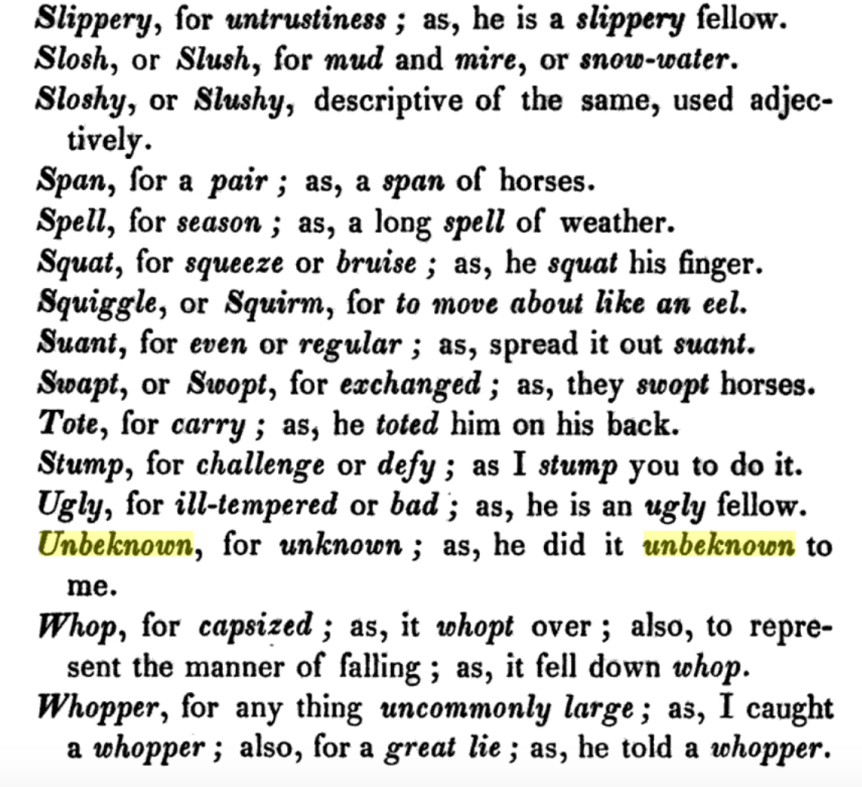
As for the national character of the two words, in 1842, six years after Gaskell’s use, “unbeknown” shows up in a grammar book published in Boston, in a list of “American Vulgarisms, Improprieties, &C.” Some of the vulgarisms  have stuck, some not, as you can see from this screen shot:

screen shot 2019-01-10 at 10.59.37 am

Five years after that, in another American grammar book, by Seth Hurd, “unbeknown” is listed as one of the “Common Errors of Speech.”

But wait: in 1875, “unbeknownst” turns up as an entry in a book about the language of Sussex, England.

screen shot 2019-01-11 at 8.41.59 am

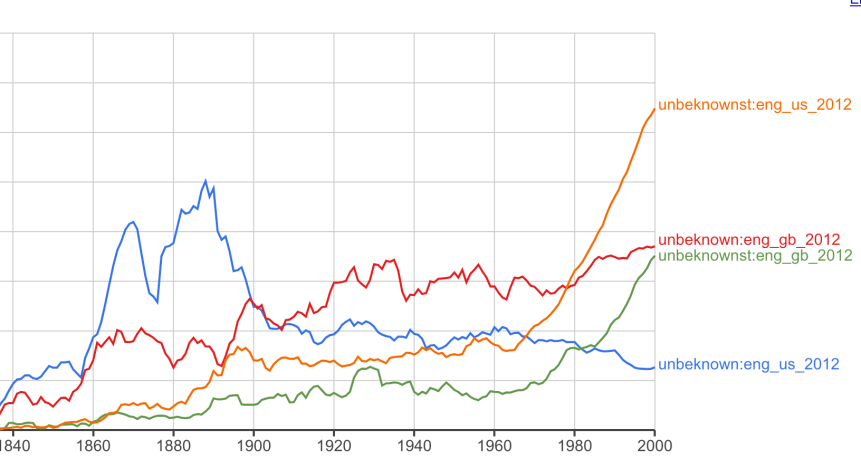
A Google Ngram Viewer graph tells the broader tale:

screen shot 2019-01-10 at 11.33.34 am

Let me try to parse it: in the late 1800s (as the books quoted above suggested), “unbeknown” was quite popular in the U.S. (blue line) and somewhat less so in Britain (red line). American “unbeknownst” (orange line) caught up to “unbeknown” in the 1940s and ’50s, caught up in the late 1960s, and took off from there. British “unbeknownst” was about to equal “unbeknown” in 2000 (the last year for which Google Ngram provides reliable data) and presumably has left it in the dust by now, much to David Collard’s displeasure.

Finally, do I agree with his critique? Not really. I still think “unbeknownst” a useful and inoffensive term, and definitely better than “unbeknown,” which sounds odd. But, of course, I’m an American.


“Whilst” Breaks Through

I always look forward to this time of year because, among other things, Lynne Murphy announces two Words of the Year at her Separated by a Common Language blog: U.S. to U.K. and U.K. to U.S. For 2018, the former is “Mainstream Media,” or MSM.

More to the interest of this blog, the U.K.-to-U.S. word is “whilst.” She graciously mentions that I wrote about the word (which is, of course, a substitute for the traditionally American “while”) in a NOOBs post back in 2011, shortly after I started the blog. But there have been significant developments since then. Lynne quotes an email from another friend of NOOBs, Nancy Friedman:

While standard dictionaries still mark it as “chiefly British,” it’s on the rise among Smart Young Things here in the U.S. who think it sounds “cool” or “refined.” Here’s an example from The Baffler (published in New York), April 6, 2018: “You see, while the violence of financial capitalism and the ever-widening chasm of economic inequality might have something to do with why poor folks get themselves into a tizzy and take to the streets, the true catalyst is that they don’t feel respected whilst being systematically eliminated by the police state, they don’t feel respected whilst performing wage slavery.” This humor piece in McSweeney’s (based in San Francisco), from April 2017, is egalitarian: it uses “while” and “whilst” twice each. And here’s the singer Lana Del Rey— born in Los Angeles, residing in Lake Placid, New York — writing on Instagram in May 2017: “I had complex feelings about spending the weekend dancing whilst watching tensions w North Korea mount.” (Quoted in Rolling Stone)

More “whilst”s from Americans:

Lisa Franklin, writer and comedian from New York: “people keep commenting on those comics whilst happily ignoring my jokes about The Flash.”

Halle Kiefer, “comedy writer out of Astoria, New York”: a surreally long, minutely detailed anecdote about a young Madonna auditioning with the Queen of Soul’s “(You Make Me Feel Like) A Natural Woman” whilst living in a crack den”

I’ll add that it’s not just the elite who are saying “whilst.” I used my new favorite TweetDeck tool, the location search, to find “whilst” users within 200 kilometers of a randomly selected U.S. city, St. Louis, and found plenty, who appear to be young things, though not necessarily notably smart (for British readers: clever).

screen shot 2019-01-07 at 3.26.05 pm

Interestingly, Lynne is interested in the pronunciation of the word. She writes:

Before I started hearing it in British English, I would have read it aloud as ‘willst’. (Dictionaries would have told me otherwise, but I don’t tend to look up pronunciations when I’m reading.) It is pronounced like while with a st on the end. In the US, it seems to mostly have a life in print (does anyone have any nice clips of audio clips of it in American mouths?), whereas in the UK, you hear it too.

I have the sense that I have heard it a fair amount here, always pronounced in the proper, long-“i” way. But I may be kidding myself. I searched the archives of National Public Radio for on-air utterances of the word, and found 246 of them. But they were all spoken by British people going back through 2015, at which point I gave up. Does anyone have evidence that an American has ever said “whilst,” and if so how she or he pronounced it?

Update: On the pronunciation issue, Ben Zimmer has directed me to a remarkable site called Youglish; it allows you to search YouTube videos for specific words or phrases, and narrow them down to U.S., U.K., or Australian speakers. He sent me a link for U.S. “whilst,” which has 364 videos. The categorizing isn’t perfect–the first clip is from a Canadian, and the second and third appear to be from an Australian and a Brit, respectively–but the speaker in the fourth video is from Minnesota, and I listened to enough true-blue Americans to establish that we do indeed say “whilst,” and that we pronounce it the same way the British do.

“Own goal”

The OED has two definitions for “own goal.” The first is, in reference to “sport,” is “A goal scored against the scorer’s own team, usually unintentionally.” The dictionary cites a use of the term in 1922 but the next one isn’t till the Sunday Pictorial‘s use in 1947, the quotation marks around the phrase suggesting it hadn’t yet entered public parlance: “An amazing ‘own goal’ by Wilf Mannion.” The OED has a 1998 quote from the Miami Herald in reference to hockey, and I would judge that in recent years the term is commonly used by Americans discussing that sport and what we still call “soccer.”

The second definition is: “fig[urative]. (orig. and chiefly Brit.). An act that unintentionally harms one’s own interests.” The first citation is from the The Economist in 1975: “The doyen of the Tribune group..scored an own goal on Wednesday night… His speech at a packed Tribune rally was a gross tactical miscalculation of [etc.].”

All the citations are British, but figurative “own goal” has definitely arrived in the United States. The term’s growth may have been spurred by a 2010 article in Harper’s that got a lot of attention: “Own Goal: How Homeless Soccer Explains the World.” In any case, it’s now very much out and about. In an article that will be published in the New York Times Magazine on December 23, but that has already been posted online, Jason Zengerle writes that Democratic Congressman Elijah Cummings

batted back Republicans’ most incendiary charges against Obama by pointing to the lack of any real evidence, and repeatedly provoked [Republican Congressman Darrell] Issa into own goals, like the time Issa received negative coverage for ordering Cummings’s microphone cut off when Cummings tried to make a statement at the end of a hearing.


“Quieten”

I was listening to the NPR radio show “Fresh Air” the other day; Terry Gross’s guest was Daniel Davis, a professor of immunology at the University of Manchester. I was struck by a word Davis used –“quieten.” In fact, a search of the episode’s transcript reveals he used it seven times, for example, “the exact evidence is really that when a person or an animal is stressed, the immune system does quieten down.”

The word felt unfamiliar; plus, I couldn’t tell the difference, if any, from “quiet.” Since Davis is British I suspected it is a Britishism, and I was right. The OED first lists a transitive sense of the verb: “To make quiet (in various senses); to calm, to pacify.” It’s listed in an 1828 book about York County dialect and apparently became popular enough so that someone wrote in the North British Review in 1844, “To ‘quieten’ the children..is not English.” Subsequent citations — all British — belie this assertion.

The definition for the intransitive sense — the one used by Dr. Davis — is “To become quiet (in various senses). Frequently with down.” The first citation, from 1890, and all subsequent ones are British, except this from Pissing in the Snow, and other Ozark Folktales (1976): “When things finally quietened down, the folks figured that the neighbor boys must have set off some fireworks under the bed.” The word also shows up in Whatever it was that was in the house, I quieten ’em down.” The word also shows up in The Frost Haint of ‘Possum Hollow and Other Ozark Tales (2008), by Alan Lance Andersen, so it does seem to be a thing in the Ozarks, a hilly region in the American South.

As for the difference between “quiet” and “quieten,” the OED definitions are pretty much the same. For the intransitive sense of “quiet,” it’s: “Now chiefly N. Amer. To become quiet; to quieten. Frequently with down.”

Outside of the Ozarks, “quieten” is pretty uncommon here, hence the “On the Radar” designation. It has been used eight times in the New York Times since 2010 but it turns out on seven of those occasions, the writer or the person being quoted isn’t from America. The eighth example is from an essay about the photographer Robert Adams by Teju Cole: “You are likely to feel your breath getting calmer and your senses quietened.” But even Cole, I discover, was born in Michigan to parents from Nigeria.

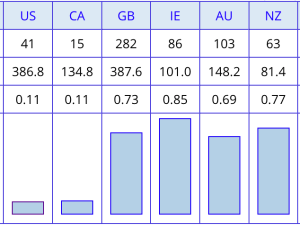
This chart from the Corpus of Global Web-Based English, showing use of “quieten” and its derivatives (“quietens,” “quietened,” etc.)  shows a bit more frequency in the U.S., but still lagging well behind Great Britain, Ireland, Australia, and New Zealand.

Screen Shot 2018-11-28 at 4.24.04 PM

One of the 41 American uses is this sentence from a comment to a 2011 Huffington Post article: “Even if the sun were to quieten down appreciably for the rest of this century, it would still be business as usual for global warming.”

Intransitive “quieten” strikes me as a potentially useful addition to American English.  “Quiets down” is fine, but saying that someone merely “quiets” sounds sort of naked; it could use an extra syllable. So I expect eventually to see more of “quieten” on these shores.


“On holiday” goes wide

I was talking to an employee of my local health club, a normal bearded guy in his thirties, and I mentioned I was going to be away from home for a few weeks.

“Are you going on holiday?” he asked.

This suggested to me that the expression for Americans’ traditional “on vacation” has established a beachhead here and probably won’t go away.

“Scrounge”

“Scrounge” is the virtual twin of the last word I wrote about, “wangle.” Both mean roughly the same thing, emerged in Britain as World War I slang, and after a few decades got adopted in America.

The OED definition for “wangle” is “To accomplish (something) in an irregular way by scheming or contrivance; to bring about or obtain by indirect or insidious means (something not obtainable openly).” “Scrounge” is more specifically about getting; the dictionary defines it as “To seek to obtain by irregular means, as by stealth or begging; to hunt about or rummage.”

The OED cites a 1909 book, Passing English of the Victorian Era:  Dictionary of Heterodox English, Slang, and Phrase, which defines “scrunging” as “(Country Boys’), stealing unripe apples and pears—probably from the noise made in masticating.” The word, with an added “o,” gained wide currency  and a more general sense during the war. George Goodchild’s 1918 book Behind the Barrage provides this explanation:

In the category of “odd jobs” came “scrounging.” “Scrounging” is eloquent armyese — it covers pilfering, commandeering, “pinching,” and many other familiar terms. You may scrounge for rations, kit, pay, or leave. Signallers are experts at it, and they usually scrounge for wire. Scrounging for wire is legitimized by the War Office, and called by the gentler name “salving.”

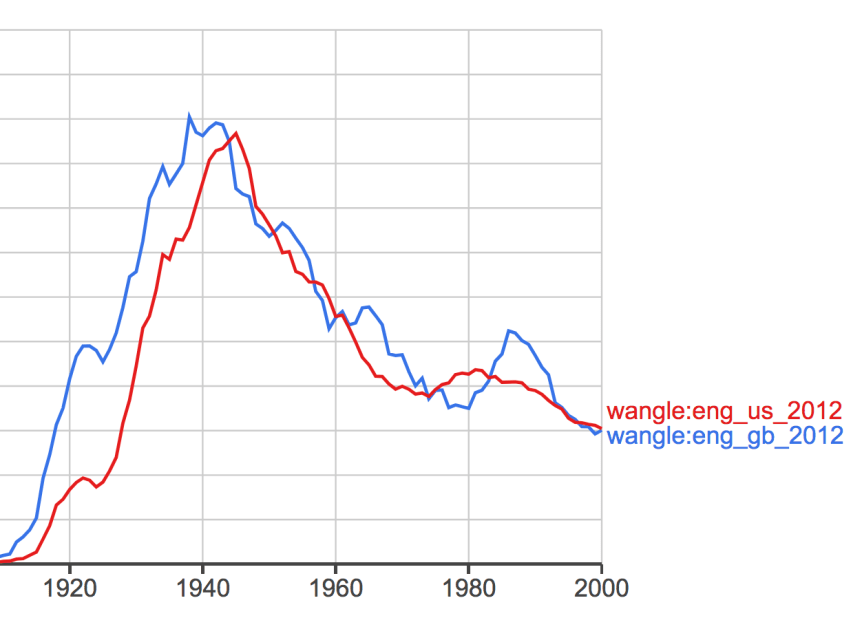
As for U.S. adoption, here’s the Google Ngram Viewer graph for “wangle”:

Screen Shot 2018-10-26 at 9.42.44 AMAnd here’s the one for “scrounge”:

Screen Shot 2018-11-13 at 8.47.51 AM

For whatever reason, “scrounge” reached parity later (in the 1960s as opposed to the 1940s), but ultimately became more (rather than equally) popular in the U.S. than in the U.K. Go figure!


“Wangle”

To recap: a couple of posts ago, I mentioned a listicle of supposed Britishisms that included eleven words or expressions I would not have though of as such: “the bee’s knees,” “(go on a) bender,” “dim” (as opposed to clever), “full of beans,” “gallivant,” “miffed,” “round (of drinks), “smarmy,” “waffle,” “wangle,” and “shambles.” I said that three of them turned out actually to be of British origin–although even they have been common in the U.S. for at least several decades. The three are “smarmy,” “full of beans,” and today’s entry, “wangle.” (A fourth is “waffle,” which I learned is used differently in the U.S. and U.K.)

The OED‘s definition for the transitive verb “wangle” is “To accomplish (something) in an irregular way by scheming or contrivance; to bring about or obtain by indirect or insidious means (something not obtainable openly).”

The dictionary suggests an intriguing origin for the term, in an 1888 British lexicon of printers’ terms: “Wangle, a slang term used by printers to express arranging or ‘faking’ matters to one’s own satisfaction or convenience.” But the first two proper citations are from 1917:  “No market is ever ‘free’: probe it deep enough, and..monopolies will..be found, in many cases deliberately ‘wangling’ prices and limiting production to sustain them.” And: “He had come in from the North Atlantic Cruiser Patrol, and when in home waters had ‘wangled’ a few days’ leave.” The first quote is from the Edinburgh Review and the second from the Stanford University Bulletin. Stanford is in California, but the reference to North Atlantic Cruiser Patrol suggests that it’s in reference to a Briton.

In any case, Google Books Ngram Viewer shows British use outpacing American till roughly the middle of World War II; ever since, it’s been roughly equivalent on both sides of the pond.

Screen Shot 2018-10-26 at 9.42.44 AM

Looking into the word, I found an antedate of the 1917 OED citation. In the January 23, 1915, issue of Notes and Queries, R.W.B reported that the word “has been used recently in a newspaper, as a verb, by a writer in describing his visit to a hospital for the wounded.” He encounters a patient who “has a liking for invalid food, and says to his visitor, ‘See me wangle a jelly.’ The word, therefore, is connected with the acquirement of something by a stratagem not devoid of humor.”


“Rubbish” (verb)

The ever-observant Jan Freeman sends along a quote from (Syracuse-born) Daniel Dezner in a Washington Post essay: “When [people associated with the Foundation for the Defense of Democracy] try to rubbish everyone else’s expertise, however, they only highlight their own intellectual inadequacies.”

This blog has covered the noun, which is the common British term for Americans’ “garbage” or “trash” — both metaphorical and literal — and noted that literal “rubbish” has pockets of popularity in Massachusetts and around Philadelphia. The OED defines the verb as “To disparage, criticize severely, pour scorn on” and notes it originated in Australia and New Zealand. The first citation is from a 1953 Australian novel, Riverslake: “If Verity was going to tramp [that is, dismiss from employment or sack] you for burning the tucker [that is, food] ..he would have rubbished you long before this.”

As the Google Books Ngram Viewer chart below shows, the verb started catching on in Britain in the 1980s, but is still very rare in the U.S., making rubbish the verb an outlier:

Screen Shot 2018-10-25 at 2.35.57 PM


“A patch on”

I’m not sure what this blog would do without Ben Brantley. The American-born New York Times theater critic is a veritable font of NOOBs, notably obscure ones, like “gives me the pip” and “twig.” He struck again yesterday in the first line of his review of Jez Butterworth’s play The Ferryman: “No matter what sort of spread you’ve planned for your Thanksgiving dinner, it won’t be a patch on the glorious feast that has been laid out at the Bernard B. Jacobs Theater.”

Since I didn’t recognize “won’t be a patch on,” and since it came from Brantley, I assumed it was a Britishism. I assumed right. The OED defines “not a patch on” as “in no way comparable to, not nearly as good as.” All the citations (starting in 1860) are from British sources, for example, the Daily Telegraph in 1994: “Set against native trees, Leyland green looks very synthetic, and is not a patch on yew.”

I’m going to label the phrase as an outlier, since when I searched Google Books for it, every single hit came from British or Commonwealth sources, including the title of the 2009 novel Not a Patch on Charlotte Cox.

patch

But in any case, cheers, Mr. Brantley.

“Full of Beans”

A couple of posts back, I mentioned a published list of Britishisms that included eleven “words and expressions that have been common in America for as long as I can remember, and which I wouldn’t have necessarily thought of as British in origin.” I commented that initial investigation suggested only three of them seemed to be proper Britishisms. The first was “smarmy.” And the second is “full of beans.”

The OED defines the expression, which seems to derive from horse racing, as meaning “to be full of energy, and in high spirits.” The first citation is from an 1843 novel: “‘Ounds, ‘osses, and men, are in a glorious state of excitement! Full o’ beans and benevolence!”

That and all subsequent citations are from British sources. In Green’s Dictionary of Slang, all cites are from Britain or the Commonwealth until this from the American writer Leo Rosten’s 1975 novel Dear Herm: “Now he is full of beans and vinegar and with a whole new outlook on Life.” (That seems like a euphemistic switch on the roughly equivalent U.S. phrase “full of piss and vinegar.”) One earlier U.S. use of “full of beans” is in a 1938 New York Times article: “Whenever Sage, a cowboy with whom I once punched cows on the San Simon Ranch in Eastern New Mexico, felt particularly full of beans of a cool early morning….”

In any case, Google Books Ngram Viewer shows British dominance for the phrase until roughly the late 1970s, when the U.S. caught up. That was followed by a British spurt, and equivalence again in 2000, the last year for which the database has reliable data. (Note there are some false positives, for example, for references to a pot that is literally full of beans.)

Screen Shot 2018-10-19 at 9.35.10 AM