The OED definition of larky, adj.: “Inclined or ready for a lark; frolicsome, sportive.” The verb form is commonly used in the gerund and followed by about. As Julie Andrews’ Mary Poppins famously instructed Dick Van Dyke’s Bert in the Disney film (words and music by Richard M. and Robert B. Sherman): “None of your larking about!”
It is a portrait of the larky upper-class sleuth of King’s College, Cambridge, and his thunderous middle-class quarry at the red-brick University of Newcastle. (Richard Eder, New York Times, August 13, 2000)/…Robert Wagner, who enjoyed his biggest success on Hart To Hart and It Takes A Thief, this larky series about an urbane jewel thief recruited to steal for the government when they’re not free to act. (Huffington Post, November 17, 2011)
The diction of mental instability is rich indeed. Already NOOBs has covered daft, nutter, and mad; now comes barmy. The etymology is interesting. From the mid-nineteenth century through the early twentieth, the adjective balmy was commonly used to mean (in the OED’s words), “weak-minded, idiotic.” In due time, this combined in the public mind with barmy, an obscure term derived from barm, that is, “the froth that forms on the top of fermenting malt liquors,” which had been metaphorically, but sparingly, used to mean “flighty” or “excited.”
By 1896, the confusion about the two words was such that a writer in the Westminster Gazette asked, “Should not ‘balmy’ be ‘barmy’? I have known a person of weak intellect called ‘Barmy Billy’.‥ The prisoner‥meant to simulate semi-idiocy, or ‘barminess’, not ‘balminess’.” As he suggested, barmy has since prevailed, no doubt in part to the felicitous barmy army, used to refer to political factions or supporters (a NOOB?) of particular teams.
The weak spot, whose center is off the coast of Brazil, is called the South Atlantic Anomaly, or S.A.A., and it has created a Bermuda triangle of space science. Under its influence, spacecraft can go barmy, losing data, having computer upsets and seeing ghostly images where none exist. (New York Times, June 5, 1990)/Our colleague Ron Charles checks in with Shakespeare scholars, who say Roland Emmerich’s “Anonymous” theory is half-snobby, half-barmy. (Washington Post, October 31, 2011)
Complain, kvetch, whine, moan. Most often used in gerund form, i.e., whingeing. Interestingly, in U.S., spelling is frequently given as whing and whinging, which, sensibly (as the first g is soft, as in fringe), have not been common in U.K. in recent decades.
… money alone won’t do it [produce happiness]. Listen to the poor rich lottery winners whingeing away. (The word whinge, as used in my poker game, is a whine from a winner.) (Walter Goodman, New York Times, April 15, 1996)/And as much as I adore Sheldon’s persnickety nature, watching him devolve into a whingeing man-child, bitching about his mother not making him fried chicken or pecan pie, kept what had the potential to be a top-flight episode from ever taking off. (Entertainment Weekly, “Big Bang Theory Recap,” October 20, 2011)
THE OED appropriates Samuel Johnson’s definition (“The buttocks, the part on which we sit”), notes that it is “Not in polite use,” and offers a first citation from 1387.
The Google Ngram below shows the relative use of his bum (blue), her bum (red) and my bum (green) in American English books published from 1800-2008.
The chart is interesting to me for two reasons. First, it shows a fairly common pattern of frequent use of a British expression (or spelling) around 1800, declining for a hundred years (give or take), then increasing, slowly at first, then more rapidly in the last twenty or thirty years, the age of NOOBs. More subtle and surprising, to me, is the relative frequency of the three expressions. At first her is the most common by far and my is barely (no pun intended) used. But now the three forms are all about equal. Surely someone can make of this a monograph on sexuality and identity!
Runway falls don’t get any more straightforward than this: blame the shoes — again. The beauty of this clip, however, is the drunken-looking wobbly-ness of her recovery. The model in question falls on her bum, but looks like she might have bumped her head and seen some little birdies. (Time.com, February 13, 2009)/Up first was Rob Kardashian with a jazz-influenced cha-cha to “Walk Like A Man” from “Jersey Boys.” In practice, he asks partner Cheryl Burke to teach him to shake his bum like pro Maksim Chmerkovskiy. (Baltimore Sun, “Dancing with the Stars” blog, October 24, 2011)
Bum is definitely a Britishism, but is bottom (a word with which, surprisingly, it has nothing in common etymologically)? The OED dates it to about 1800 and cites all British sources, including this from Carlyle’s 1837 The French Revolution: “Patriot women take their hazel wands, and fustigate … broad bottoms of priests.”
Bottom is certainly commonly used in the U.S. now, often (oddly) either fully or semi-lasciviously or in addressing children, but also more straightforwardly, as in this 2003 New Yorker review of a Martha Graham dance performance: “I saw that Gary Galbraith, when he played the Minotaur, was provided with a pair of shorts that covered his bottom.“
I would appreciate your thoughts on whether bottom is a Britishism, as well as a vote in the poll below.
“To smuggle in a West Virginia reference, [Jerry] West seems here like both the Hatfields and McCoys. He shoots himself repeatedly in the head, feet and private bits.” –Dwight Garner, New York Times, November 3, 2011
Keeping with the prepositions theme (a rich lode), British and American speakers use different ones when referring to the telephone. To be more precise, on both sides of the Atlantic we talk about calling on the phone, on a mobile, or on a particular day of the week; and we all say, “Call me at noon.” However, they say, “Call me on 555-555-5555,” while we say, “Call me at” a specific number. Or, we did do; the British on is creeping in.
I don’t have many published references, since this is very much a conversational deal. However, Stephen Hunter’s 2009 novel “Night of Thunder” contains this voice-mail message by a character: “Nick, Swagger. I have to run something by you and sooner would be so much better than later. Call me on this number please, bud.” And the internet is full of instructions such as this one, from performance-anxiety.org: “Call me on 1-888-512-2913 or use the contact form here to request a callback …”
Finally, the rapper known as C-Murder (who is currently serving life imprisonment following his conviction for a second degree murder committed in 2002) has the following lyric in his song “Betya”:
You can call me on 1-900-break bread Or 1-800-getting paid but don’t tell Or imma send Cut Boy to rang yo bell
There was some interesting back-and-forth on a recent post that offered as a NOOB the verb sit for, meaning to take a test or examination. A couple of British speakers replied, in essence, Nonsense; we don’t sit for exams, we sit them, minus the for. With no little satisfaction, I reprinted several Oxford English Dictionary examples of sit for=take. But my correspondent correctly pointed out that the most recent was written in 1955. I hadn’t noticed it the first time around, but the OED also has an entry for sit=take (an exam). The oldest citation was from 1957.
On reflection, it occurred to me that something similar has occurred with some other verbs, such as ring up, queue up, and sort out. In all these cases, common British usage has dropped the second word; the current idioms are ring, queue and sort. But–and this is the interesting bit–Americans have picked up the older, two-word form. I call this Phrasal Verb Lag Time, or PVLT for short.
I understand why the Brits would shorten the form, but not why Americans would adopt the long one. Any ideas? I’d be especially interested if Lynne Murphy, over at her excellent blog Separated by a Common Language, has any thoughts.
Americans traditionally “took” tests or exams. Now, increasingly, they are sitting. What’s next: standing for a by-election?
Certain readers of ”Herzog” complained the book was difficult. Much as they might have sympathized with the unhappy and comical history professor, they were occasionally put off by his long and erudite letters. Some felt that they were being asked to sit for a difficult exam in a survey course in intellectual history. (Saul Bellow, New York Times, March 8, 1987)/City School Superintendent Neel Durbin opened the meeting by celebrating the number of Dyersburg High School students enrolled in AP courses as well as the number that are passing the AP exams at the end of the course. …”Fifty-five percent of our students that sit for the exam pass it,” said Durbin… (Dyersburg [PA] State Gazette, October 18, 2011)
I fired up my e-mail this morning to find a note containing the following blurb for a collection of poems:
I was made silent and watchful by the continuing poetry here. I kept reading, sort of mesmerized by the consistent achievement, watching out for the occasional weakness. Surely the level couldn’t be maintained. But the weakness never showed.
One phrase jumped out at me. The phrase was sort of. A couple of years ago, my daughter Maria, then and now a college student (and a sharp observer of linguistic trends), commented to me that these two words were crack cocaine to her professors: irresistible and deadly. Note that she didn’t say “sort of crack cocaine”; she recognized that the qualifier would have sort of ruined her metaphor.
Ever since then, I had noticed my colleagues’ (and, truth to tell, my own) overuse-verging-on-abuse of the phrase in department meetings and lectures. The poetry blurb was a sign that it has migrated from speech to print.
Sort of is an adverbial phrase with two bloodlines, one distinctly British and the other American. The latter is a homespun qualifier; think of the bashful cowboy who is sorter (as it’s often rendered) sweet on the schoolmarm. The academic sort of follows the British tradition in suggesting an attitude of qualification and noncommittal diffidence that’s at once specific and universal. It is characteristically used either between noun and verb or in the construction a-sort of-noun or noun phrase. The Oxford English Dictionary cites a 1780 quote from The Mirror (“There is a sort of classic privilege in the very names of places in London”) and a line from Shaw’s 1903 “Man and Superman”: “I’ll sort of borrow the money from my dad until I get on my own feet.”
More recently, Tom Stoppard brilliantly nailed the Englishness of a character, Henry, in “The Real Thing” who is defensive about his love of popular music. Henry says: “I was taken once to Covent Garden to hear a woman called Callas in a sort of foreign musical with no dancing. … As though the place were a kind of Lourdes for the musically disadvantaged.” (Kind of is synonymous with sort of.) Graham Greene, meanwhile, invoked a cosmic sense of the phrase in entitling one of his memoirs A Sort of Life.
The academic sort of is in the British tradition and is neither brilliant nor cosmic. Sometimes it is a signal that a metaphor or figure of speech is coming up (an only marginally less smarmy as it were), and sometimes it merely signals a reluctance to stand fully behind what we have to say. It is uncannily like our students’ like: a crutch that has sort of turned into a tic.
Note: this above post originally appeared in the Chronicle of Higher Education’s Lingua Franca blog. I would like to update it with a sort of (sorry) crowdsourcing contest. This morning, the (British) Newsweek editor Tina Brown appeared on NPR’s Morning Edition for her weekly “Must Reads” segment. The seven-minute appearance was interlarded with so many sort ofs and kind ofs that the capacity of my fingers and toes to count them was quickly exceeded. I will send a free copy of my book The Sound on the Page: Style and Voice in Writing to the first reader to give me an accurate count of how many time Tina used each phrase.
When I first spent significant time in London, about fifteen years ago, one of the first words that struck me as unusual was book–used as an all-purpose verb to indicate, well, as the Oxford English Dictionary puts it: “To engage for oneself by payment (a seat or place in a travelling conveyance or in a theatre or other place of entertainment).” The OED cites a first use in Disraeli’s 1826 novel Vivian Grey –“I’ll give orders for them to book an inside place for the poodle”–and then an 1887 theatrical advert: “Seats can be booked one month in advance.”
In London a hundred-plus years later, people were always talking about booking theater, excuse me theatre, tickets, hotel rooms, tables at restaurants. (Granted, this came up a lot because I was in a tourism/study abroad situation.)
The usage was not unheard of in the U.S., but (the significantly less strong) reserve was much more common in reference to eating and sleeping. For theatre, I guess our best word has been get, which isn’t very good. Hence it’s not surprising that book has gotten traction here.
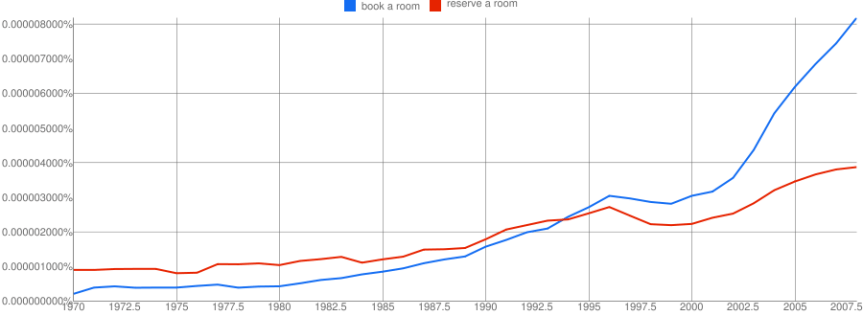
This Google Ngram shows the change in use of book a room (blue) and reserve a room (red) in American English, 1970-2008. Book surges ahead in 1993, which puts it in a sweet spot for NOOBs.
With the proper “Web browsing” software — available free on the Internet — the traveler can see photographs of a hotel’s lobby and of a typical room, check maps of its neighborhood, and even book a room and get a confirmation via the PC. (Peter H. Lewis, New York Times, December 11, 1994)/Combined with the iPhone’s rich location services, that allows for voice commands and questions like “Find the best vintage clothing store around here,” and “What was Apple’s net revenue in 2010,” or “Book a table for four at East End Kitchen for 7 tonight.” (Fast Company, October 5, 2011)




 When I first spent significant time in London, about fifteen years ago, one of the first words that struck me as unusual was book–used as an all-purpose verb to indicate, well, as the Oxford English Dictionary puts it: “To engage for oneself by payment (a seat or place in a travelling conveyance or in a theatre or other place of entertainment).” The OED cites a first use in Disraeli’s 1826 novel