
The 2013 Philadelphia Flower Show will be, apparently, brilliant.


The 2013 Philadelphia Flower Show will be, apparently, brilliant.

My NOOB ears perked up when I recently read in my local newspaper, The Swarthmorean, this line from an editorial supporting a local traffic project: “The proposed single-lane traffic-circle, or roundabout, with proper signs, would direct traffic to multiple destinations at slower rates of speed.”
What got my attention wasn’t a proper, which I’ve already covered, but roundabout, which struck me as a NOOB variant of the tried-and-true U.S. traffic circle or rotary. Sure enough, quite a few U.S. uses turned up, for example, this article posted today in the East Cobb (Georgia) Patch.com: “Dozens of East Cobb residents brought questions and concerns to Monday night’s information session about the roundabout being installed in their neighborhood this summer.”
Turning to the OED, the dictionary indeed says that roundabout, in a traffic sense, is “orig. and chiefly Brit.” The definition:
A junction of several roads consisting of a central (usually circular) island around which traffic moves in one direction. Vehicular roundabouts developed from large-scale circuses or rond-points in France and America … Typically smaller in size, British roundabouts are sometimes distinguished from similar junctions by the rule in which oncoming traffic must give way to traffic moving around the central island. Traffic circle and rotary are the more common terms in America …
The OED defines this noun as: “A person who has charge of or looks after a specified thing or operation, esp. in the course of employment. Without defining word esp.: = baby-minder.” There are many variants, in the realms of public relations, crime and sport, where it refers to a goalkeeper.
Indeed, one indication that minder has moved to NOOB status is this recent quote from a New York Times blog about (U.S.) college hockey: “Patterson had 44 saves on the weekend, Tigers’ net minder Josh Thorimbert had 73.”
There was also this from the Times capsule review of “Alvin and the Chipmunks: Chipwrecked”: “The furry guys and the Chipettes, the gal pals they acquired in an earlier installment of the franchise, find themselves shipwrecked along with their human minder, Dave (Jason Lee).”
In a similar human-on-animal way, there is a dog-walking company in Philadelphia called Monster Minders.
If further proof is needed, I offer the fact that minder recently figured in the popular TV series “Gossip Girl.” I confess I couldn’t udnerstand the references I found on the web, so I turned to my colleague Dawn Fallik, a “GG” aficionado, for explanation. She did not disappoint:
Blair was married to King Louis. She never really loved him, so she came back to New York while he headed to Monaco. But he send a royal minder to watch over her every move, so that he’d find out if Blair cheated on him, thereby annulling the marriage and costing Blair big money in dowry. Alas, it turns out the minder was secretly in love with the prince and did all she could to help Blair slut around. The minder is now back in Monaco.
It has been suggested to me that this all-but-inescapable online bro-phrase is a NOOB, and after some investigation, I believe it. On the British origin, I give you “Well played”, or, The major’s dilemma, a 1894 farce by Arthur Francis Knight. There is a 1921 book called Well Played! by Andrew Home (also the author of From Fag to Monitor: or, Fighting to the Front). Then there is this from Shane Leslie’s 1922 The Oppidan:
As each member of his team came through he cast him a faithful look or a winged word, ‘Well played! You deserved to win and you will win next time.’ He stood there seeing his boys through the bitterness of a defeat which had hit himself hardest. Spectators passed him sympathetically. Morleyites seeing the symbol of the vanquished nudged each other and began rubbing in the defeat. ‘Well played, Morley’s! Morley’s! Morley’s! a goal to a rouge.’ There was a curiosity to see the visible effect. But nothing was there revealed except the well known accent of Jenkinson saying to the dishevelled players, ‘Well played Mr Morley’s, very well played indeed!’
As for American use, it’s everywhere, not only in gaming message boards but, for example, in this Dave Itzkoff post for Arts Beat blog of the New York Times. (He’s describing Betty White talking to Jay Leno about her experience on “Saturday Night Live.”)
Ms. White says, “Somebody grabs your hand, and you’re out horizontal back here, and they take you into something, a room smaller than this desk, and somebody’s taking your clothes off and somebody’s putting them back on——”
“No,” Mr. Leno says, interrupting. “I didn’t ask you how you got the job.”
Well played, Mr. Leno. Well played.
A key figure in U.S. adoption of the phrase appears to be Seth Rogen, who said it first in the 2008 “The 40-Year-Old Virgin” and then in “Knocked Up” (the clip below), after being told that he was looks like “Babe Ruth’s gay brother … Gabe Ruth.”
Rogen’s signal contribution may have been ending with the word “sir.” JakeinSD posted an Urban Dictionary definition of “Well played my friend” in January 2008–that is before the release of “40 Year-Old Virgin”:
a statement of extreme agreement/praise for a particular activity that one of your friends has engaged in. can also be used sarcastically to point out a flaw in logic or action (example. when something is not well played, but you say it was in a sarcastic tone).
dude 1: did you get that girls number last night?
dude 2: not only did i get her number, i boned her and didn’t call her.
dude 1: well played my friend!
Clearly, more research is needed.

My intrepid spotter Ellen Magenheim wrote me a couple of weeks ago:
I noticed this morning in the Times that the headline above the story about Jeremy Lin’s latest performance was “Lin Tops Himself” and it briefly took my breath away since my mind went first to the British meaning (i.e., commit suicide) rather than the American meaning. As I thought about it, I wondered if the International Herald Tribune had a different headline–which it did–and then went back to the digital version of the NYT to find that it didn’t have the “Tops Himself” version either. Do you think none of this variation means anything or do you think maybe it dawned on someone about the unfortunate transatlantic ambiguity?
Sure enough, the article she was referring to–about a New York Knicks basketball player who for a time was a U.S. sporting sensation–had in the online N.Y. Times the headline “Lin Puts Knicks Back on Track.” At the very bottom of the article, in small gray print, are these words:
Often articles will have different headlines in print and online versions. But it’s amusing to think of some subeditor noting the unfortunate double meaning and stopping the presses to change it. I don’t suppose we’ll ever know. Unless, of course, the New York Times sports desk reads Not One-Off Britishisms and wouldn’t mind filling us in!
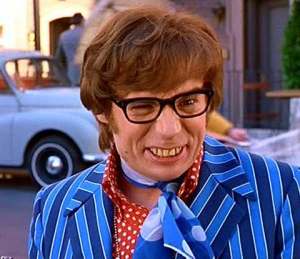
Whenever I read the word randy (quoth the OED: “orig. Sc. and Eng. regional. Lustful; eager for sexual gratification; sexually aroused. [Now the usual sense.]”), my mind’s eye and ear instantly visualize Austin Powers in full leer: “Feeling randy? Fancy a shag?” Then I start visualizing Brits “‘avin’ a laff” about all the Americans with names like Randy Newman, Randy Travis, and Randy Moss.
This has been happening more and more lately, most recently last night as I was reading a Jonah Lehrer article in the New Yorker in which he mused about the odd behavior of male Australian gray-crowned babblers: “Instead of acting like randy juveniles, seeking out mates and getting into territorial fights, they are content to remain at home.”
But it’s not just The New Yorker, as witness:
“In the Mood,” a new song and a strong indication of where New Edition is likely to go next, was a randy, simmering seduction anthem. (Newark Star Ledger, February 21, 2012)
Seth [the Justin Theroux character in the film “Wanderlust”] suggests a cross between Charles Manson and a randy hobbit. (Boston Herald, February 23, 2011)
The only conceivable response is:
“Yeah, baby.”
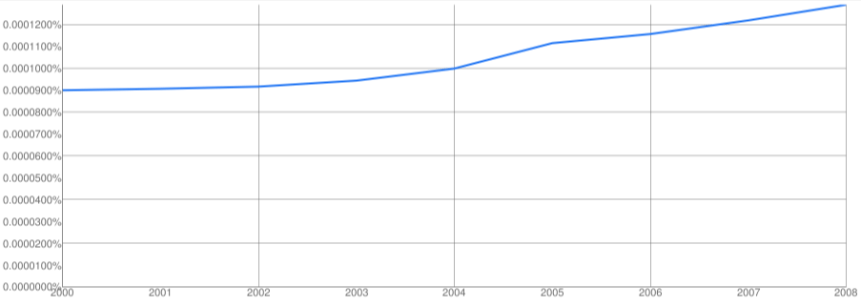
I first presented this “U”-phemism–first cited by the OED, appropriately, in a 1940 Nancy Mitford quote–as a Portland, Oregon, outlier, but I now believe it’s made the grade as a NOOB. The Google Ngram chart, below, shows a more than 50 percent increase in U.S. use between 200o and 2008:
Then there are these recent quotes:
I saw Another Happy Day, and thought you really brought it home playing the bitch ex stripper, coke-whore mom — nearly spitting nails with every word catapulted at your co-star, Ellen Barkin. That cat fight in the loo alone was worth the price of admission (“An Oscar-Themed Open Letter to Demi Moore,” Huffington Post, February 28, 2102)
SUSPECTED PEEPING TOM HITS CAMPUS LOO (Coast Report Online, Costa Mesa, Cal., February 21, 2012)
…it’s no longer the morning news that dad is reading on the loo, but rather a tablet computer. (Consumer Reports.org, February 17, 2012)
I can’t top that, so, like George Costanza and Mitt Romney, I will just say:
Gotta go!
No pun intended.
Daft, previously designated On the Radar, is edging perilously close to a proper NOOB. From a Richard Sandomir article about Magic Johnson and AIDS in today’s New York Times:
“Science caught up to the public optimism that made Johnson sound daft or in deep denial on the day of his announcement.”
Your thoughts?
I know Michael Sokolove. Michael Sokolove is a friend of mine. I have not served in the Senate with Michael Sokolove, but I have broken bread with him and played basketball with him and happen to know he hails from Lower Bucks County, Pennsylvania. And so I was surprised to read him say–in a Q and A at the New York Times website regarding his excellent recent article about Oscar Pistorius:
One of the great things about sport is that it is in some ways primitive, or we want to imagine it is.
The surprising thing was that he said sport, a Britishism, rather than the American sports. (We do, however, refer to baseball as a sport and to a person asa good sport.)I asked him about it and he blamed it on his English son-in-law.
But Sokolove is not alone. Times columnist David Brooks, theorizing on the Jeremy Lin phenomenon, recently wrote:
The moral ethos of sport is in tension with the moral ethos of faith, whether Jewish, Christian or Muslim. The moral universe of modern sport is oriented around victory and supremacy.
A headline in the Philadelphia Inquirer late last year read: “Money, not sport, the name of the game.” And a while back, Slate had this one: “Politics and sport: a dangerous mix.”
The next thing you know, we’ll be talking about maths.

@KenJennings of Jeopardy fame tweets:
What is going on where we are suddenly calling redheads “gingers”? People, we won the Revolutionary War, we don’t have to put up with this.
Hey, Ken, you may be the king of all trivia but you have to brush up your NOOBs: Ginger is the second most all-time most popular entry on this blog. (FYI, bits is first and wanker is third.) You and any other interested party can sort out what’s going on with ginger here.

