“Rump”

Joshua Keating’s recent Slate article had a brilliant conceit: how would the U.S. media report on the current U.S. political crisis if it were happening in another country? The piece started:

WASHINGTON, United States—The typical signs of state failure aren’t evident on the streets of this sleepy capital city. Beret-wearing colonels have not yet taken to the airwaves to declare martial law. Money-changers are not yet buying stacks of useless greenbacks on the street.

I recommend you read the whole thing, but the line that’s relevant to this blog is: “…the president’s efforts to govern domestically have been stymied in the legislature by an extremist rump faction of the main opposition party.”

The Oxford English Dictionary’s defines rump (in this context) as “A small, unimportant, or contemptible remnant or remainder of an (official) body of people, esp. a parliament,” and explains that it’s derived from rump Parliament, that is, “the remaining part of the Long Parliament, esp. in its second formation of 1659–60.” As befitting its origin, every citation for rump in the political sense is of British origin.

But it has occasionally been hauled out by Americans. One of the first to use it to refer to the Republican Tea Partyers who have been holding things up in the current mess was Senate Majority Leader Harry Reid (a Democrat). He was quoted as saying on Sept. 27, “The middle class, working men and women in this country, are the ones we were elected to serve. That’s who we should be thinking about. They’re the ones who are going to pay the price if these rump Republicans force a government shutdown.”

A few days later, Mother Jones magazine wrote, “Once again, a rump group of Republican radicals in the House are throwing the US government into chaos.” The day after that, a Baltimore Sun columnist opined, “fault for the current government shutdown lies with the rump, radicalized, tea party-beholden congressional Republicans who have no regard for the legislative process, the country’s credit rating, political traditions, or the U.S. Constitution they supposedly revere.”

Haven’t seen any beret-wearing colonels on the streets of Washington yet, but give it time.
TGIF

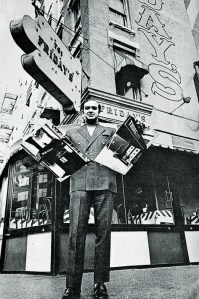
Founder Alan Stillman in front of the original TGI Friday's in New York City.
Founder Alan Stillman in front of the original TGI Friday’s in New York City.

Reader Rosalind Mitchell commented on the recent ta-ta post that the 1940s radio serial “ITMA” (or, “It’s that Man Again”) “also gave us TGIF (‘Thank Goodness It’s Friday’), and since this is now a US-based global restaurant chain this is surely also a NOOB.”

That intrigued me, as how could it not?

The initialism is best known, at least to me, from the restaurant chain mentioned by Ms. Mitchell, which is officially known as “TGI Friday’s” and sometimes called merely as “Friday’s.” Wikipedia reports that in 1965, a young New Yorker named Alan Stillman “purchased a bar he often visited, The Good Tavern at the corner of 63rd Street and First Avenue, and renamed it T.G.I. Friday’s after the expression “Thank God! It’s Friday!” from his years at Bucknell University.” (There are now about 920 restaurants in the chain, around the world.)

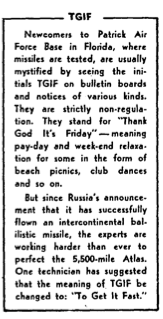
The first time TGIF appeared in the New York Times was in a 1959 article about the U.S. Air Force missile- and rocket-testing site in Cocoa Beach, Florida, which had this sidebar:

Screen Shot 2013-09-26 at 10.31.51 AM

Then came Stillman’s popular joint–one of the first of the “singles bars” on Manhattan’s Upper East Side. The next time the initials appeared in the Times was in a 1969 cartoon (and I’m still not sure how this happened, given that the newspaper is famous for not publishing cartoons). The spot, by Henry Martin, shows Robinson Crusoe spotting a native through some bushes. The inevitable caption: “TGIF!”

A Times reader wrote in to say he wasn’t familiar with the expression, and an editors’ note defined it and explained it was a favorite of–get this–the “Now Generation.” That occasioned a slew of other letters purporting to explain that “TGIF” was much older. One asserted that TGIF went back “at least 30 years–when I first started working in an office, and every stenographer and file clerk intoned those magic initials on Friday afternoons, while combing her hair in the ladies’ room.” Another claimed the initialism was invented by one Richard Amper during a “beer bout” near the University of Missouri in 1934.

It’s hard to verify those claims. But Jonathon Green’s authoritative Encyclopedia of Slang provides an authoritative 1941 quote, from the [Marion, Ohio] Star:

I thought I’d heard of everything in the way of booster clubs, alumni organization and the like, but this city, home of the Ohio State university Buckeyes […] has come up with one that tops them all. It’s the “Thank God It’s Friday” Club, composed entirely of undergraduates here at State. […] A typical meeting of the TGIF club foes something like this….

Now, “ITMA” ran from 1939 to 1949, and it’s possible that someone on the show uttered TGIF before the Ohio State club adopted it, but I’m dubious. For now, I’m going to label TGIF not only not a Not One-Off Britishism, but not a Britishism at all.

Lost in translation

Wes Davis sends along this from today’s New York Times real estate section. I believe the bathroom in question would not actually be considered a W.C., owing to its non-closet-like largeness and the presence of a shower, but some journos will do anything to avoid using the same word twice:

wes

“Gyno”

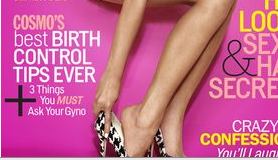
The ever-observant Nancy Friedman notes the viral popularity of a commercial in which a girl dispenses advice about menstruation to the other kids at her summer camp and is  dubbed the “Camp Gyno.” She also sends along the (American) Cosmopolitan cover headline below, and wonders, “is gyno [for “gynecologist”] the latest Britishism to cross the pond?”

Screen Shot 2013-08-29 at 10.39.59 AM

It would appear so, at least a little bit. The word doesn’t appear in the Oxford English Dictionary, and searching for it in Google and other databases is a bit chancey, since it is used in a variety of ways, in addition to the gynecologist abbreviation. That usage does appear to be of longer standing in the U.K. than the U.S., not surprising given the Brits’ fondness for such abbreviations as veg and cuppa.

But it has been gaining traction here for some time, or at least since 2007, the date of these citations:

From “Vibe Vixen” magazine: “At my gyno’s recommendation, I scheduled laser surgery to have the warts removed.”

From Don’t Sleep with a Bubba: Unless Your Eggs Are in Wheelchairs, by Susan Reinhardt: “Never wear C- or D-grade lingerie to the gyno because, chances are, when you wad up your clothes and place them on the chair, they’ll fall to the ground and the nurse will tell everyone in the office how hideous they were.”

Hard to argue with that.

Bum Steer

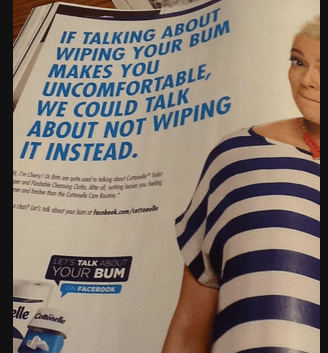
Lynne Murphy, a native American linguistics professor now living in the U.K. (and a good friend of this blog), has been visiting the U.S. and came across a startling magazine ad:

Screen Shot 2013-08-20 at 11.18.36 AM

Wait, what??

I’ve previously noted that bum has certainly made inroads on these shores, but this advert still was a bit surprising. It turns out that the manufacturers of Cottonelle, Kimberly Clark, put out a press release just two weeks ago:

Dallas, August 5, 2013-As bath tissue maker Cottonelle® looks to open the door on bathroom conversation, toilet talk is about to go mainstream. That’s right, Cottonelle wants to get North Americans talking about their bums and on the road to a better way to clean “down there” by using the Cottonelle Clean Routine — combining dry toilet paper and flushable wipes for a cleaner, fresher experience. With the help of London-based immersive journalist, Cherry Healey, Cottonelle is helping consumers to open up about their bathroom behaviors and “makeover” their old toileting routine. And with a sleek, newly designed dispenser for Cottonelle Flushable Cleansing Cloths, Healey is set to start the conversation now.

I had not heard of Cherry Healey, nor of “immersive journalism,” but I learn from Wikipedia that she has done a number of TV documentaries in the U.K,. including the one-offs “Drinking with the Girls, ” “Cherry Gets Pierced,” and “Cherry Goes Drinking,”” and this year had a six-part series: “The Year of Making Love.”

I imagine Kimberly Clark chose the word bum both as a nod to Healey’s nationality and a way of signaling that the ad is a little, well, edgy.

That’s all well and good, but it turns out that there are issues with the “Cottonelle Clean Routine,” specifically the bum-related use of “flushable” wipes. Nancy Friedman informs me that they are one of the prime causes of “fatbergs,” a serious environmental problem. Read her post on the subject … if you have the stomach for it.

“Boffin”

My friend Bruce Beans forwarded his “Word-of-the-Day” e-mail from Merriam-Webster. The word was  boffin, and M-W defined it as “a scientific expert; especially : one involved in technological research,” then provided this note:

“Boffin” is an informal word that is more common in the U.K. than in the U.S. It is a relative newcomer to the English language, only appearing toward the end of World War II. Despite its youth, however, the origins of “boffin” are a mystery to us. The term was probably first applied by British Royal Air Force members to the scientists and engineers working closely with radar technology. The term was soon being more broadly applied to scientists involved in technological research. British speakers also use “boffin” colloquially to refer to academics or intellectuals in general, often in a manner that is synonymous with “nerd” or “egghead.”

The OED is similarly circumspect on etymology. The editors sniff, “Numerous conjectures have been made about the origin of the word but all lack foundation”; apparently Dickens’ character Mr. Boffin in Our Mutual Friend is not considered worthy of mention. The dictionary does provides these illuminating early citations:

1945  Times 15 Sept. 5/4 A band of scientific men who performed their wartime wonders at Malvern and apparently called themselves ‘the boffins’.

1948 ‘N. Shute’ No Highway iii. 61 ‘What’s a boffin?’ ‘The man from Farnborough. Everybody calls them boffins. Didn’t you know?’.. ‘Why are they called that?’.. ‘Because they behave like boffins, I suppose.’

1948 Ld. Tedder in A. P. Rowe One Story of Radar p. vii, I was fortunate in having considerable dealings in 1938–40 with the ‘Boffins’ (as the Royal Air Force affectionately dubbed the scientists).

The word has been used once on this blog, by a commenter on the kit post:

‘KIT’, from my (UK) service days could be clothing/uniform – “sort your kit out!” – personal equipment – “don’t leave your kit around or it’ll go in the scan bag**” – and bigger things – “..it’s the latest all-singing-all-dancing swept-up bit of kit”. The latter was almost always ironic, usually said just before the wretched thing blew up on launch/crashed, to the merriment of all except attendant boffins.

Clearly, it’s a Britishism. But is it a not one-off Britishism? Well, yes, barely. The New York Times hasn’t used it since 2012, but that year it appeared three times in five months:

  • “Using its secret formula (note the sponsorship by Coca-Cola) that will next be assessed by the boffins who discovered the Higgs boson, Spain kept its spot at the top of the heap.” (Soccer story from  July 4, 2012)
  • “… the World Science Festival, the annual jamboree of science, culture and art that mixes boffins and boldface names.” (May 2012)
  • ” Alexander Hoffmann is no white-coated mad scientist, but a ‘quant,’ a computer boffin.” (Book review, March 2012)

And it shows up intermittently in the years before then.

So welcome to the fold, boffin. What you really need now is a proper etymology.

Marky Mark Talks British. Or Does He?

A few days ago, the American entertainer Mark Wahlberg gave an interview to The Sun in which he made some cutting remarks about singer Justin Bieber. Given that we are in a permanent silly season, it’s not surprising that his quote should have been picked up by new outlets all over the world, including my hometown Philadelphia Inquirer. Wahlberg–a former teen idol himself–supposedly apostrophized Bieber, telling him, in part: “Don’t be so naughty. Be a nice boy, pull up your trousers, make your mum proud.”

I say “supposedly” because the lingo is suspiciously British for a Bostonian like Marky-Mark. I’ve already covered trousers and mum on this site; naughty is certainly widely heard in U.S., but I believe it’s much more of a thing in the U.K., especially when applied to adults.

Presumably either Wahlberg tailored his diction to the Sun‘s readership, or the editors did the doctoring themselves. I suspect the latter. I couldn’t check the original quote because the Sun‘s archives are behind a paywall and I don’t subscribe. So all I learned at its site was “Gap Year Girls in Acid Attack” and “Towie Lucy Debuts Dodgy Afro.”