“Cheeky Nando’s”

Humility is always a good thing. I got a dose of it recently, courtesy of a BuzzFeed article posted to Facebook by a friend of mine, Siobhan Wagner, a journalist who was born in the U.S, but has been living in London for nine years. The article was called “Americans On Tumblr Are Trying To Find Out What A ‘Cheeky Nando’s’ Is And Are Struggling” and concerned a meme that had become popular in England. Here’s an example:

tumblr_no71pliLwO1rmrl0oo1_500

As the title suggests, the article detailed the exasperation expressed by Americans, in trying to cypher out the meaning not only of “cheeky Nando’s” but of the definitions for it put forward by Brits. Here’s one exchange:

Screen Shot 2015-05-25 at 2.54.42 PM

And another:

Screen Shot 2015-05-25 at 2.57.10 PM

I mentioned humility. The notion is relevant because premise of this blog is that the gap between the two brands of English — American and British —is diminishing and will one day recede to nothing.

The cheeky Nando’s discourse showed me how far away that day is. Both the above explanations could be in a foreign language, so full are they with slang that a Yank can barely comprehend, much less consider utilizing.  Take the second one. We get “mate,” to be sure;  “wif” is a rendition of Mockney th-fronting (as in calling Keith Richards “Keef”). “jd”: I have no clue. Same with “curry club” and “the ‘Spoons.” Urban Dictionary has this for “ledge”: “Shortened slang for ‘legendary’, or, more commonly, for ‘legend’.” Then there’s this whole “banter” thing, which seems to elevate joking around with the lads to a sacred pedestal. (I love the #barackobanter hashtag.) Turning again to Urban Dictionary,  I find the brev defined as “chav word for brother,” i.e, it’s a case of th-fronting abbreviation. And note that the person giving the definition calls him- or herself “chavvesty.” The OED, which doesn’t include ledge or brev, defines chav this way: “In the United Kingdom (originally the south of England): a young person of a type characterized by brash and loutish behaviour and the wearing of designer-style clothes (esp. sportswear); usually with connotations of a low social status.” (Sportswear??) I can figure out “Top. Let’s smash it” from context clues, but I couldn’t imagine using it.

That still doesn’t explain “cheeky Nando’s”! I have actually written about cheeky, which is something like a cross between sassy and impudent. And I know from my time in the U.K. that Nando’s is a chain of restaurants specializing in spicy grilled chicken, which has now expanded into the U.S.; I can figure out that in the meme, “Nando’s” signifies, basically, “food ordered and eaten in a Nando’s establishment.” (For a humorous take on the chain see this video.) But I still didn’t have a clue as to what the expression means. Taking on the established befuddled Yank role, I asked Siobhan if she could supply a definition/explanation, and she kindly did so:

Basically, the concept of a “cheeky Nandos” is similar to a “cheeky pint.” Maybe when you were in London, someone might have asked you ‘Fancy a cheeky pint after work?’ Effectively they’re saying: I know it’s only Tuesday and I really should be rushing home to make something for dinner or perhaps (more virtuously) going to the gym, but do you want to have a quick drink or two in the local pub before heading on the torture chamber known as the rush hour tube? A “cheeky Nandos” is, similarly, an unexpected suggestion. You’re probably already out with friends, maybe at the pub, actually maybe having that “cheeky pint” that was suggested, and then your stomach rumbles and you’re like: “Actually, how would you fancy a cheeky Nandos now?” Nandos following the consumption of 1.5-2 alcoholic beverages probably falls under the category of “cheeky.” Going to Nandos drunk isn’t cheeky, though. The idea is you are in the mid-point of your night out with friends when “banter” is really going. Everyone is laughing, probably “taking the piss” (making fun) of each other, and a relaxed sit-down restaurant where you pay up front (so you don’t have the messiness of figuring out how to split the bill later) is totally perfect.

I get it, kind of. But, keeping with the theme of humility, I’m still very ignorant on what might be called the rhetorical framing of the meme, including what it means that, in some representation, David Cameron (hardly a chav) is pictured. Can English readers help me out on the issue of exactly what group is being mocked, and what group is doing the mocking–and if there is any overlap between the two?

“Row”

“Row”–defined by the OED as “a noisy or violent argument”–is a useful word, being roughly in the middle between “fight,” on the one hand, and “quarrel” or “argument,” on the other.

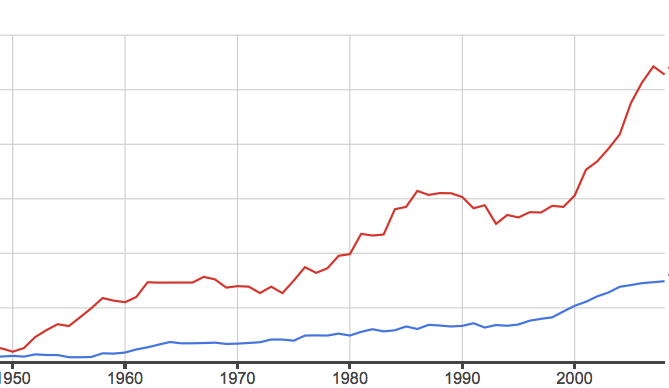
It is definitely a Britishism–or at least, has been one since about 1930, according to this Ngram viewer chart. (The OED‘s first citation is from 1746.) I searched for the phrase “had a row” to reduce other uses of the word.
Screen Shot 2015-05-22 at 10.18.30 AM

My sense is that in recent decades, “row” has generally been limited in the U.S., first, to pretentious people  and, second, to headline writers, based on another useful quality: its brevity. However, this sentence appeared recently in the text of a Wall Street Journal article, in reference to a Philadelphia woman: “Mrs. Stokes, 63, was arrested twice in 2008 and 2010 during rows with her now-estranged husband.”

I searched “had a row” on Google News and had to go back about 90 hits before I found one from an American source–a Chicago classical music website. But it turned out to be a quote from a British director. So for now, useful or not, “row” is still “on the radar.”

Red Nose Day

150428_2862418_Red_Nose_Day_Is_Coming
Nick Offerman with red nose

John Wall writes with the suggestion of new concept for this blog: the cultural Not One-Off Britishism. The import he has in mind is Red Nose Day, which I just learned was started in the U.K. in 1988 as a way to raise money for charitable causes through comedy performances on TV and, apparently, rampant photos of people wearing red noses, in the manner of clowns.

On May 21, Red Nose Day is coming to the U.S., through a variety of NBC broadcasts and other events.

It seems like a good cause, but with all due respect, the brand needs some work, since (in my humble opinion), there is little that’s unfunnier than a clown.

“Cuttings”

“Cuttings” is the BrE equivalent of the AmE “clippings”–that which one clips, or cuts, out of the newspaper and puts into a scrapbook or whatever. It turned up in a New York Times article the other day about Herbert Warren Wind, the late golf writer for the New Yorker, whose papers at Yale University, Karen Crouse wrote, “contain seven boxes brimming with the cuttings of a well-sown life.”

I had been a longtime reader and admirer of Wind (who died in 2005) and, because of his name and literary style, always had a sense that he was British–which would make the “cuttings” rather appropriate. But no–Crouse’s article reveals that he was a native of Brockton, Mass.

[Update: The comment by “popegrutch,” below, convinces me that I made a mistake and Crouse wasn’t perpetrating a Britishism at all: the “cuttings” she referred to was a botanical metaphor, not a journalistic reference.]

More on “Weds.”

I’ve just finished the new thriller “The Girl on the Train,” written by the Englishwoman Paula Hawkins. I read the American edition and I’m not sure to what extent (if any) British expressions in the original were translated into Americanese. But there were a few that cropped up repeatedly: “buggy” (Americans would say “stroller”), “come round for a visit” (“around”), and one I wasn’t aware of–the transitive verb “quieten,” as in “quieten a baby.” Americans say “quiet.”

When I was almost done with the book, I came upon this (I’m pretty sure there aren’t any spoilers):

IMG_1914

The thing that caught my eye was “Weds.” Longtime readers may recall my dislike of this abbreviation for “Wednesday” (my preference is “Wed.”), and my not notably successful attempt to determine if it’s a Britishism.

(If you want to know why it annoys me, here’s why: “Wed.” is a perfectly good, shorter, abbreviation; there is no tradition of skipping over letters in abbreviations [there is “Dr.” and “Mr.” but they go right to the last letter in the word]; and “Weds.”–unlike a decent abbreviation–doesn’t even represent how the first part of the word sounds–that would be “Wends” or “Wens.”)

“The Girl on the Train” would suggest, though it doesn’t prove, that a Britishism “Weds.” is.

“On the up and up”

Jan Freeman remarked on Twitter that she had been hearing the phrase “on the up and up” meaning “improving” instead of “honest.”

There are indeed two general meanings of the phrase. The one I’m familiar with is “honest” or “on the level,” and the OED identifies it as originally American, with citations going back to 1863.

The OED doesn’t specify any nationality for the “Steadily rising, improving, or increasing” meaning. The first citation is from The Baltimore Sun, 1930: “From now on, we are led to believe, law and order will be on the up and up, as the current phrase is.” But that strikes me as ambiguous–that is, it could mean that law and order is on the level, as opposed to on the rise. All the other citations are from British sources.

But in any case, as Jan suggests, it’s now being used in the U.S., as in this  from a March post in Forbes.com: “to say that Thrive [Capital] is on the up and up would be a massive understatement.”

Any Yanks out there who have a sense that  “on the up and up”=”on the rise” is a long-term thing over here?

Pronunciation of “-man”

This is (probably) off-topic, but I’d appreciate your help in something I’m looking into for another blog, Lingua Franca. I’m investigating how people pronounce the suffix “man” in such words as policeman, mailman, gunman, etc. (understanding, of course, that they are sexist and on the way out). The issue is whether the syllable is pronounced with a reduced stress and a “schwa” vowel, as in “woman,” or with equal stress, rhyming with “can” or “fan.”

Please take the survey at the link below, and do your part in helping the advancement of (pseudo-)science.

https://delaware.qualtrics.com/SE/?SID=SV_cMUN9GM9BbwcXXv

“Bog standard”

Keith Huss (@keithhuss) writes on Twitter: “Having British wife and friends, I’m familiar with the phrase “bog standard”. Recently read it twice on US tech blogger sites.”

New one on me!

The Oxford English Dictionary describes “bog standard” as: “slang (depreciative, chiefly Brit.). Ordinary, basic, standard without extra features or modification; unexceptional or uninspired.”

The citations (the earliest one is from 1962) all refer to cars or computers, with the exception of this 1995 quote from Empire magazine: “A bog-standard biography with a cheap ‘Psycho’ sales gimmick, you can’t help thinking [Anthony] Perkins deserved better.”

An Urban Dictionary definition from 2006 goes:

“Completely, utterly, absolutely ordinary in every way. British slang. ‘Dave drives a totally bog standard Escort. Not even aircon. Dave is a cheap bastard.'”

The etymology is uncertain but interesting. The OED suggests that it may have derived from “box-standard,” an obsolete noun denoting “a frame or standard hollow tubing forming the main framework of a machine, engine, etc.” “Box-standard” shows up as an adjective meaning the same thing as “bog-standard” in 1983. According to Google Ngram Viewer, the two phrases were roughly equally popular until the late 1990s, when “bog” took off and crushed the opposition.

Is “bog-standard” a NOOB? It’s out there, a little. Suzy Menkes wrote in the New York Times in 2012 that a fashion show has a “focus on outerwear, including cropped jackets rather than the bog-standard trench.” But most of the quotes I find are, as Keith Huss suggests, on tech sites, such as this from Ziff-Davis’s Extreme Tech: “The company’s plans for an ARM-based server business may be in their infancy, but AMD has built at least one bog-standard ARM core.”

Whatever that means.