“Flat”

IMG_2218

As I say, NOOB readers predicted “flat”–AmE equivalent, “apartment”–would catch on here, and so it seems to have, judging from the above and similar advertisements. The term is, in my experience, largely restricted to commercial attempts to fancy up a dwelling, rather than being a word an actual American person would use.

Except in San Francisco, Nancy Friedman reports: “One of the things that struck me when I moved to the Bay Area 40+ years ago [from Southern California] was that San Franciscans ALWAYS said ‘flat’ instead of ‘apartment.’ I’d never heard the term at all, and I grew up 370 miles away. It’s still true, and I still have no idea why.”

“Shag”

I see that back in 2012, I gave a poll asking readers for NOOB nominees. I promised to follow up and do posts on the winners, which were shagflat, and a tie for third between gap year and row.

Typically, I proceeded to totally forget about it, though I did ultimately write about row and gap year.

Bringing this to mind is a line in an article by an American college professor that just came out in the Chronicle of Higher Education. He’s writing about the depiction of professors in Woody Allen’s films, starting with “Manhattan” (1979) where

Michael Murphy plays an English professor dragging his feet on an F. Scott Fitzgerald book while still having enough money to wonder if he should trade in his spacious apartment on the Upper East Side for a house in Connecticut, with seemingly endless time and money to eat the overpriced food at Elaine’s (and being enough of a celebrity to get a table there) and have an affair with Diane Keaton, with whom he can have a spontaneous shag at a hotel somewhere between Bloomingdale’s and 68th Street.

So, “shag.” It’s of course a verb and noun (as above) referring to the act of copulation, made popular worldwide by the subtitle of one of Mike Myers’s Austin Powers movie: “The Spy Who Shagged Me.” Fascinatingly, the Oxford English Dictionary’s first citation for it came from none other than Thomas Jefferson in 177o: “He had shagged his mother and begotten himself on her body.” All the subsequent citations are from British and Commonwealth sources.

I’m not sure of its current state of play thereabouts, but in the U.S., post-Austin Powers, it seems to have settled in as a euphemism slightly more randy  than some of the others on offer but still respectable enough to meet the standards of such publications as the Chronicle.

Next: “flat.”

“The penny dropped”

The OED defines this useful phrase as meaning “a situation or statement has at last been understood; a person has reacted belatedly” and notes, “Originally used with allusion to the mechanism of a penny-in-the-slot machine.” The first citation is from The Daily Mirror in 1939; all the later cites are British as well.

As I say, it’s useful phrase. The closest American equivalent would be something like, “The lightbulb went on,” which, besides being clunky, lacks the apt imagined “click” of the penny equivalent.

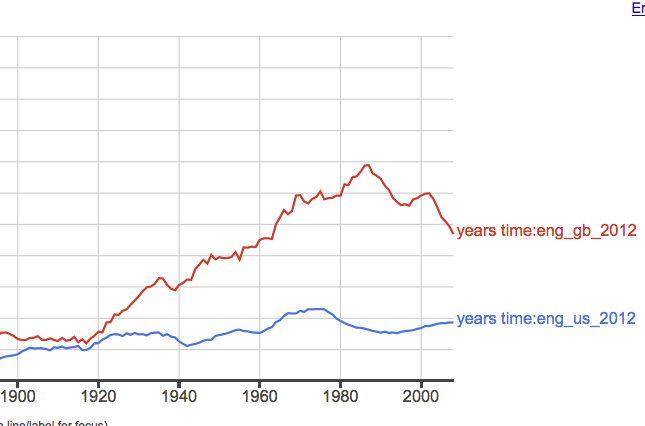
In addition to the OED cites, this Google Ngram Viewer chart suggests the phrase is indeed of British origin. The red line indicates British usage, the blue American.

Screen Shot 2015-08-10 at 5.12.36 PM

(There’s a fair amount of noise in the chart, emanating from references to actual pennies actually dropping.)

The chart indicates a steady rise in U.S. uses through 2008, and it appears to be continuing. In the New York Times, through 2006, the phrase almost always appeared as part of quote by a British or Canadian person. But there have been about fifteen uses of it by Times writers since then.  Quite a few of them came from the pen of one person, Deb Amlen, who writes the “Wordplay” crossword puzzle blog. Clearly, pennies have to drop or the puzzle doesn’t get solved.

The Queen’s Latin

I recently wondered why, in American movies and TV shows set in foreign or imagined lands, the characters almost invariably speak in British accents, and whether there’s a literary equivalent. I can now report some news on the topic.

First, there has been a lot of discussion about the general phenomenon. One commentator theorized that, on the fantasy end of things (on up through Game of Thrones, where poor Peter Dinklage is made to talk British), it’s the responsibility of J.R.R. Tolkien, author of the books that started the genre, The Hobbit and The Lord of the Rings: “even though Middle Earth is a fantasy world it’s clearly inspired by England. Thus it’s not unreasonable that the characters sound like they come from the country that has such a heavy influence on the settings in Middle Earth.”

The invaluable website TV Tropes came up with a name for the custom–“the Queen’s Latin”–and has this explanation for its use in historical dramas:

Britain’s long history causes British accents to seem somehow “older” — they are used to suggest a sense of antiquity. This is actually inaccurate from a linguistic perspective; the modern British accents actually represent a more evolved form of English. Older English accents were closer to modern Irish and American accents.

In any case, using the Queen’s Latin makes a series or film commercially viable in the U.S. It alleviates the need for subtitles, while maintaining the appearance of historical authenticity. It’s just foreign and exotic enough. (Many British actors already Play Great Ethnics.) It’s also no doubt inspired by productions of Shakespeare‘s plays set in Ancient Rome. Remember: Romeo might have been Italian, but he’s not realistic unless he talks like a proper British toff.

The other new thing is another example of literary Queen’s Latin, from the novel All the Light We Cannot See. The book is set in France and Germany during World War II, yet the author, Anthony Doerr — an American— frequently uses British terms: crisps instead of potato chips, lift instead of elevator, and biscuits. (The last is a reversal of the English rapper Lady Sovereign’s couplet “Some English MCs get it twisted/Start sayin’ ‘cookies’ instead of ‘biscuits.’”)

The lingo doesn’t make sense, but I suppose it adds to the feel of the book as taking place in a long-ago era.

Ain’t no stoppin’ “full stop”

Way back in 2011, I wrote about the expression “full stop” (BrE for AmE “period”), specifically to emphasize what the speaker has just said.

According to a Christian Science Monitor blog post, the trend has continued and, seemingly, intensified:

Before announcing his presidential bid, former Maryland Gov. Martin O’Malley made clear in December his disdain for the CIA’s highly controversial interrogation tactics. “I don’t believe the United States should torture,” he said. “Period. Full stop.’’

More recently, George Washington University political scientist John Sides was asked in May if early polls were relevant to who would take office: “They are not. Full stop.” A month later, Republican Rick Santorum, queried on Bruce Jenner’s decision to become Caitlyn Jenner, responded: “My job as a human being is to treat everybody with dignity or respect – period, stop, full stop, no qualification to that.” That same month, Iowa pollster J. Ann Selzer discussed Hillary Clinton’s supposed political invincibility in the Hawkeye State: “The reality is, this is a field where nobody has effectively stepped up to challenge Hillary Clinton, full stop.”
Just four days ago, in a speech in Kenya, Barack Obama said: “If somebody is a law-abiding citizen who is going about their business and working in a job and obeying the traffic signs and doing all the other things that all citizens are supposed to do, and not harming anybody, the idea that they are gonna be treated differently or abused because of who they love is wrong, full stop.”

“On holiday” isn’t going away

The British equivalent of Americans’ traditional “on vacation” seems to be getting more established over here, at least judging from the e-mail I got today:

Screen Shot 2015-07-03 at 10.45.10 AM

Or maybe she was using it in a distinctive way, to mean “out of the office on the day of a holiday.” Question to British readers: can “on holiday” refer to a period of time as short as a day?

In any case, happy July 4th to all of you as well, and no hard feelings to my friends across the Atlantic.

“Over the moon”

Earlier this month, Twitter CEO Dick Costolo said, “We have things rolling out this fall that I am over the moon about and can’t wait for people to see.” The week before, race car driver Scott Dixon said he was “over the moon” about winning the Firestone 600.

“Over the moon” is of course a metaphorical way of saying you’re happy and excited. The Oxford English Dictionary’s first citation is from 1936. It’s not unfamiliar to Americans, but it’s traditionally been more common in Britain, as this Google Ngram Viewer chart shows:

Screen Shot 2015-01-17 at 11.51.34 AM

In recent years, it’s mainly been the province of British and Australian celebrities talking about being pregnant or having a child, or athletes talking about winning a game. Such uses still yield the majority of Google News hits, such as Perth Now’s that an Australian businessman’s girlfriend has a baby bump: “’I’m over the moon. It’s the most wonderful thing that’s ever happened to me,’ the proud expectant dad told us exclusively.'”

But the Costolo and Dixon quotes suggest that “over the moon” will follow the lead of “at the end of the day” (which I see to my horror that I’ve never done an entry on) and become established in the U.S.

“Covers band”

Catching up on New Yorkers, I happened on a poem by John Koethe, which begins:

It’s a great poem, but, needless to say, what mainly interested me was Koethe’s use of covers band instead of cover band — to mean a musical combo whose repertoire consists of songs popularized by other performers. It was a new example, to me, of a phenomenon I’ve discussed before — the growing pluralization of attributive nouns, such as Yankees fan replacing Yankee fan. As with such phrases as jobs (instead of job) report, drinks (instead of drink) menu, and books (instead of book) editor, the covers band example is consistent with the trend of Americans (Koethe was born in San Diego) adopting British usage. Of course, plural forms have not been unheard of in the United States: for example, parks commissioner or Antiques Road Show. But more and more attributives have become plural; I actually have the sense that I had never before even confronted covers band.

This Google Ngram Viewer chart confirms that it has been rare in the United States, while (interestingly) roughly equally common as cover band in Britain.

In a sort of Woody Allen-Marshall McLuhan moment, I tweeted at The New Yorker copy editor Mary Norris, wondering about the use of covers in the Koethe poem. She responded:

Oldies station — a radio station that plays old songs — is indeed a longstanding formulation here. Maybe it’s a music thing?

That doesn’t appear to be the case. In a 2002 paper, the linguist Elisa Sneed refines the work of Maria Alegre and Peter Gordon in determining the circumstances in which plural attributives tend to be used. There seem to be two important factors. The first is “abstractness.” Sneed writes: “Something not easily imagable, such as a process (admissions), an action (assists), a thing (benefits), or something that is otherwise complex (dissertations) is abstract; something easily imagable and simple conceptually, such as pencils or flowers, is concrete” (italics added).

So dissertations index sounds okay; *flowers pot does not.

The second factor is heterogeneity in the head (final) noun of the phrase. Sneed gives the example of analyst as a head noun that promotes “diversity among the entities denoted by the internal noun” and pile as one that highlights homogeneity. So we might say weapons analyst but weapon pile, as well as cookie jar and sock drawer.

She provides this nifty predictive chart, explaining, “Compounds that most closely meet the requirements for abstractness and heterogeneity will be perfectly acceptable, like admissions department. However, as we move away from the ideal in either dimension, the compound becomes less acceptable. This is illustrated by the difference between antiques dealer and antiques collector in the iso-acceptability diagram, where the latter is farther from the ideal.”

Three other wrinkles. First, irregular plurals tend to be more acceptable than regular plurals as attributives. We might say mice droppings but never *rats droppings. Second, as noted by David Crystal, the plural is often used in cases when meaning might otherwise be ambiguous or misleading. Thus, in baseball, a batter who doesn’t have enough power to produce doubles, triples, or home runs is a singles hitter. To call him a single hitter might mean that he’s just one hitter, or that he’s unmarried. Finally, the plural is used in cases when a possessive apostrophe is understood, such as farmers market or the street in Philadelphia where you go to buy a wedding ring, Jewelers Row.

I haven’t found a source that discusses, much less explains, the British preference for plurals even when Sneed’s criteria are not met, or the recent American tendency to adopt these expressions. Going back to the original example, there definitely is a sense of heterogeneity — it wouldn’t do to play the same song over and over again.  But one has a concrete rather than abstract sense of the repertoire, be it “Proud Mary” or “Get Off of My Cloud.” Yet John Koethe chose and insisted on covers band. It is a puzzlement.

The one thing I’m fairly certain of is that the plural trend will continue, and that the tendency will be to call it the plurals trend.

“Hoover” avoidance

On a couple of occasions (most recently) I’ve written about “hoover” as a transitive verb meaning what Americans would traditionally describe as “vacuuming up.” The usage has gained traction here, to the point where when I saw this in today’s New York Times

Screen Shot 2015-06-01 at 3.15.26 PM

I couldn’t help thinking that the author of the article (or his editor) was trying really, really, really hard not to say “hoover.”